Second-Order Effects: So What? What If? What Else?
Read this page in: Français · Español · Português · Deutsch · Nederlands · Italiano · 日本語 · 한국어 · Bahasa Indonesia · Polski · Čeština · Svenska · Dansk · Norsk (bokmål) · Suomi · Ελληνικά · Türkçe · Eesti
Second-order effects are the consequences of consequences. A change happens, something follows directly from it, and then something follows from that. The first step is usually obvious to everyone. The second and third are where strategy is won or lost, because few people look that far and the effects arrive whether anyone looked or not.
At a glance
- What they are: the indirect results of a change. First-order effects follow from the change itself. Second- and third-order effects follow from the effects.
- Why they matter: the first-order effect is priced in by everyone. The later ones are where surprise, threat, and opportunity sit.
- How to find them: ask three questions of every important trend. So what? What if? What else?
- How far ahead to look: 5 to 20 years for strategic questions. Closer than that and the conversation turns tactical.
- Tools: the Futures Wheel for one change, cross-impact analysis for many, and STEEP as the filter.
An old idea with a long paper trail
The observation that actions have effects beyond the intended one is not new. In 1850 the French economist Frédéric Bastiat built an essay on the difference between the effect of a policy that is seen at once and the later effects that are not seen and have to be foreseen.
In 1936 the sociologist Robert K. Merton gave the problem its modern form in “The Unanticipated Consequences of Purposive Social Action.” He set out why people fail to foresee the results of their own deliberate acts: limits on what they know, errors of reasoning, an immediate interest so pressing that it crowds out the longer view, values that rule out certain considerations, and predictions that change the situation they describe.
Futurists turned the observation into a working method. In 1971 Jerome Glenn devised the Futures Wheel, which puts one change at the center of a page and draws its consequences outward in rings. In Future, Inc. (AMACOM, 2007) I described the underlying idea this way: “Because the world is superconnected, nothing changes just one aspect of life; the effects ripple out. Many people consider the first level of change but don’t look deeper.”
The three questions
Chapter 5 of Future, Inc. opens with three questions: “So what? What if? What else?” They are the whole discipline in six words.
- So what? You have a trend and the data to back it. What does it change for your customers, your costs, your competitors, or your legal position?
- What if? What if the trend accelerates, stalls, or combines with another one? What if a low-probability, high-impact event lands on top of it?
- What else? What else changes because of the first change? Then ask it again of the answer.
The third question is the one that produces second- and third-order effects. Each time you answer it, treat the answer as a new starting point and ask again.
The book adds five checks to run on any picture of the future:
- Does it suggest new competitors who may take business from us?
- Are the customers the same? Are there more of them or fewer?
- Does it suggest new regulation, or a public policy we should try to influence?
- How will it affect developing as well as industrialized countries?
- Are there new liabilities waiting for us?
Three “implications” that are not implications
Most presentations on “the future of” an industry never reach the second order, because they stop at conclusions that sound like insight and are not. In the book I listed three.
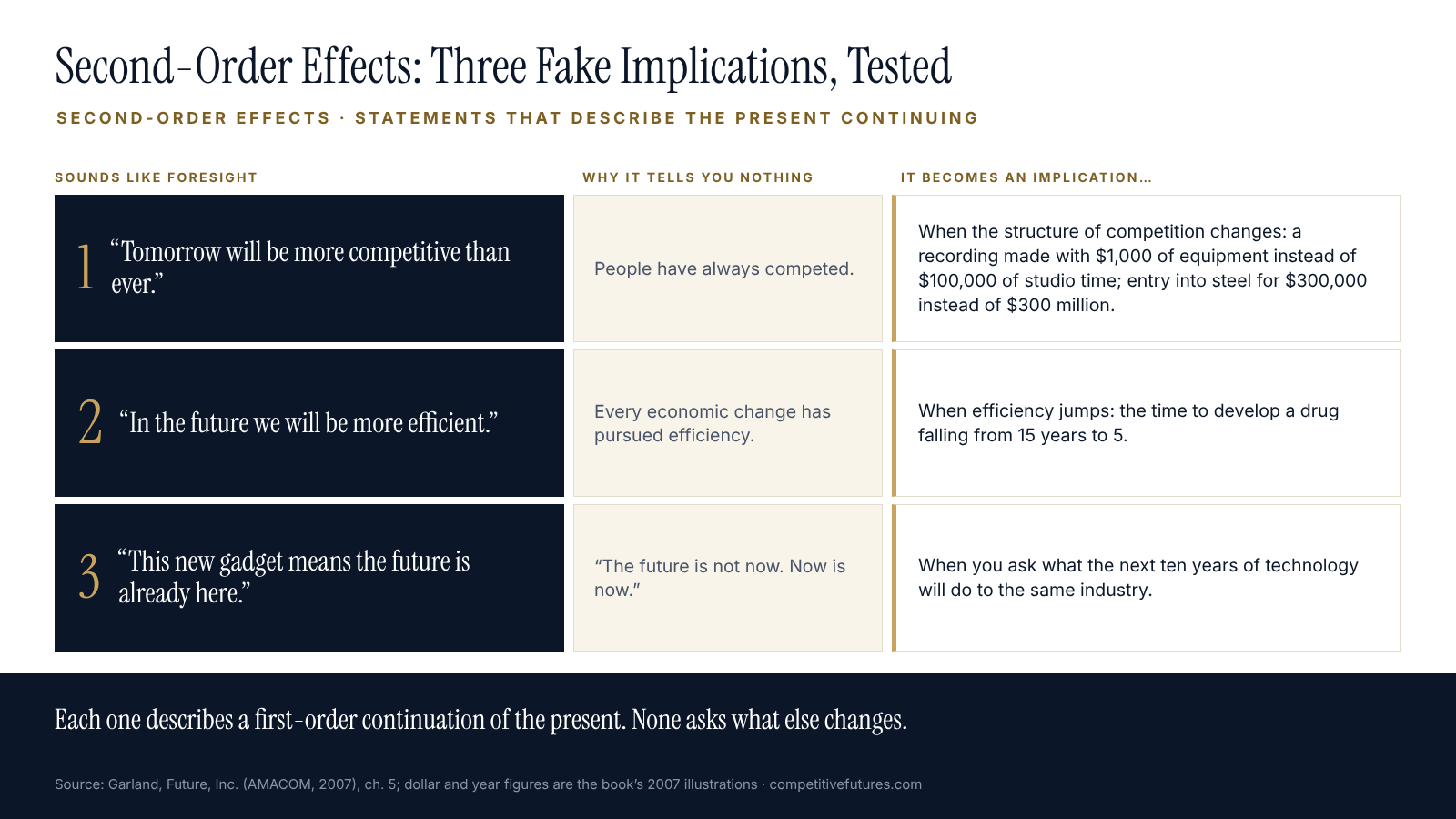
1. “Tomorrow will be more competitive than ever.” People have always competed. Saying it will continue tells a planner nothing. Competition becomes an implication when its structure changes. The book’s 2007 illustrations: when a professional recording can be made with $1,000 of equipment instead of $100,000 of studio time, or when entering the steel business takes $300,000 instead of $300 million, the number of competitors changes by orders of magnitude. The useful question is why it will be fiercer.
2. “In the future we will be more efficient.” Every economic change in history has pursued efficiency. A statement that tomorrow will be like today, only quicker, comes from what the book called “a mind that cannot grasp the future.” Efficiency becomes an implication when it jumps. If the time to develop a drug falls from 15 years to 5, strategists have something to work on.
3. “This new gadget means the future is already here.” In the book I put it bluntly: “The future is not now. Now is now.” A speaker who shows today’s product as “the future” has stopped imagining what the next ten years of technology will do to the same industry.
Each of these fails the same test. It describes a first-order continuation of the present. None asks what else changes.
How far ahead to look
Second-order effects take time to arrive, which is why the time frame matters. The book’s rule is that a study of the future should range from 5 to 20 years. Inside five years, the discussion gets pulled into tactics: this year’s budget, next year’s launch. That work is necessary, and it is not strategy. A strategic question deserves a horizon far enough out that today’s constraints loosen and the later-order effects have room to appear.
A worked example: compliance cost and de-risking
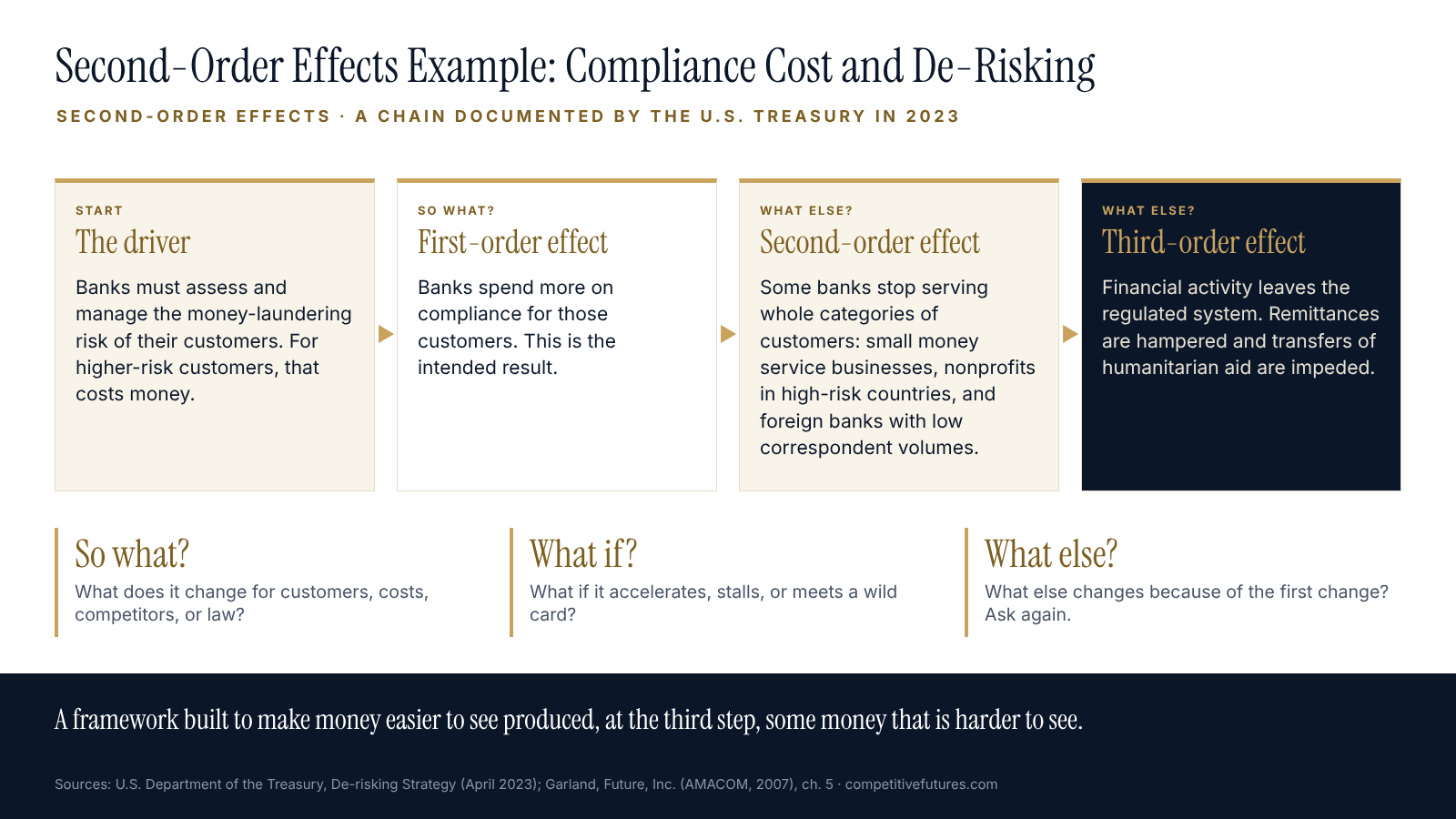
Here is a chain documented by the institution that sits at the start of it. In April 2023 the U.S. Department of the Treasury published its De-risking Strategy, a study Congress required in the Anti-Money Laundering Act of 2020.
- The driver. Banks must assess and manage the money-laundering and terrorist-financing risk of their customers. Doing that for higher-risk customers costs money.
- First-order effect. Banks spend more on compliance for those customers. This is the intended result.
- Second-order effect. Some banks stop serving entire categories of customers, because the relationships are no longer profitable once compliance cost is counted. Treasury calls this de-risking: “terminating or restricting business relationships indiscriminately” with broad categories of customers. It found profitability to be the primary factor. The customers most affected were small and medium-sized money service businesses, nonprofits working in high-risk countries, and foreign banks with low volumes of correspondent business.
- Third-order effect. Financial activity leaves the regulated system. Treasury’s finding is that de-risking drives activity out of regulated channels, hampers remittances, and impedes the transfer of humanitarian aid and disaster relief. It described that movement as a possible national security risk.
A framework built to make money easier to see produced, at the third step, some money that is harder to see. Nobody intended that. Treasury identified it by doing what this page describes: following its own rule outward and asking what else changes.
For a company, the same chain reads as a set of questions. If we bank, pay, or donate through any of those three categories, which of our relationships could be cut off? Who would pick up the business that regulated banks drop? What would a regulator do next?
How to trace second-order effects, step by step
- Pick one driver and state it precisely. A trend, a forecast, a new rule, or a wild-card event. Vague drivers produce vague chains.
- List the first-order effects. Ask “so what?” for customers, costs, competitors, and law. These are the effects your competitors will also see.
- Ask “what else?” of each first-order effect. Write the second-order effects. Expect the list to widen.
- Do it once more. Third-order effects are less certain and more valuable. Mark the ones that surprise the room.
- Run the results through STEEP. Check each ring for effects on society, technology, economics, ecology, and politics. Most teams find they wrote only technology and economics.
- Ask “what if?” Change one assumption or add a wild card and see which chains break.
- Sort what you found. The book’s rule: “The implications to worry about are the ones so big it will take time to affect the appropriate change in your company.” Those go to leadership. The rest go on a watch list.
Do this with other people. As I wrote in the book, “Implications are really a team sport.” A group of five to ten with different backgrounds will see chains that no one analyst would.
Common mistakes
- Stopping at the first order. The first-order effect is the one in the press release.
- Mistaking a platitude for an implication. See the three above.
- Following only the technology. New technologies change how people behave, and changed people seek new technologies. Leave out the social half and the chain goes wrong at the second step.
- Treating the chain as a prediction. A third-order effect is a possibility to watch, with a sentence of reasoning attached so it can be checked later.
- Looking for the effects that suit you. Threats and opportunities come out of the same exercise. If you found only one kind, look again.
What second-order effects teach about building an intelligence function
An intelligence report that stops at the first-order effect is a news summary. The reader could have gotten it from a newspaper. What a leadership team pays an intelligence function for is the next two steps: what this development will cause, and what that will cause.
Three habits build that capacity. Require an implications section in every product, written as “so what, what if, what else.” Record the chains, with the reasoning for each link, so the team can go back and see which links held. And staff the analysis with people from more than one discipline, because a lawyer, an engineer, and a sociologist will each extend the chain in a different direction.
Frequently asked questions
What is a second-order effect?
A consequence of a consequence. A change produces a direct, first-order effect, and that effect produces further results of its own. Those further results are second-order effects.
What is an example of a second-order effect?
Cheap transistors made the desktop computer possible. That is first-order. Executives began typing their own letters. That is second-order. Typing pools disappeared, which changed the roles open to women in offices. That is third-order. The example is from Future, Inc.
What is the difference between second-order effects and unintended consequences?
They overlap. A second-order effect is defined by its position in the chain. An unintended consequence is defined by whether anyone meant it to happen. Many second-order effects are unintended, and some are foreseen and planned for.
What is second-order thinking?
The habit of asking “and then what?” before acting. Investors, strategists, and military planners use the term for analysis that goes past the immediate result of a decision to the reactions it sets off.
How many orders of effect should I trace?
Three is the practical limit for most work. Past the third order the reasoning rests on too many assumptions to guide a decision, though it can still suggest things to watch.
Which tools help with second-order effects?
The Futures Wheel for a single change, cross-impact analysis for the interaction of many changes, and STEEP as a checklist so that social and political effects are not missed.
Work with Competitive Futures
Competitive Futures runs implications workshops and foresight projects in which leadership teams trace the later-order effects of the changes facing their own markets. To discuss a project, contact the company.
Related reading
- The Futures Wheel
- Cross-Impact Analysis
- STEEP Analysis
- Scenario Planning
- Enforcement Risk
- 25 Foresight Mistakes
References
- Garland, Eric. Future, Inc.: How Businesses Can Anticipate and Profit from What’s Next. New York: AMACOM, 2007. Chapter 5, “Strategic Implications.”
- Merton, Robert K. “The Unanticipated Consequences of Purposive Social Action.” American Sociological Review 1, no. 6 (1936): 894–904. https://doi.org/10.2307/2084615
- Bastiat, Frédéric. “Ce qu’on voit et ce qu’on ne voit pas” (“That Which Is Seen, and That Which Is Not Seen”). Paris, 1850.
- Glenn, Jerome C. “The Futures Wheel.” In Futures Research Methodology, Version 3.0, edited by Jerome C. Glenn and Theodore J. Gordon. Washington, DC: The Millennium Project, 2009.
- U.S. Department of the Treasury. The Department of the Treasury’s De-risking Strategy. April 2023. Announcement: https://home.treasury.gov/news/press-releases/jy1438. Fact sheet: https://home.treasury.gov/news/press-releases/jy1439
Part of the Strategic Foresight guide from Competitive Futures.