Analysis of Competing Hypotheses (ACH): How to Use It, and When It Fails

The Analysis of Competing Hypotheses (ACH) is a structured technique for judging which of several explanations best fits the evidence. Instead of picking a favorite answer and collecting support for it, ACH lays out every reasonable hypothesis and tests each piece of evidence against all of them at once. The answer that survives is the one the evidence fails to rule out, which is often not the one the room started with.
The CIA analyst Richards Heuer developed ACH and published it in Psychology of Intelligence Analysis (1999), which remains one of the most widely taught books in intelligence analysis. ACH has since spread from government intelligence into competitive intelligence, investigations, cybersecurity and corporate strategy.
I’ve used ACH for most of my career, in competitive intelligence for corporations and in our own published intelligence products. This page explains the method, walks through an example, and covers what the research says about when it helps and when it doesn’t.
At a glance
- ACH tests evidence against every hypothesis at once, not just the favorite.
- It looks for evidence that disproves, not evidence that supports. One solid inconsistency can eliminate a hypothesis; a pile of consistent evidence can’t prove one.
- Diagnostic evidence is what matters. Evidence that fits every hypothesis tells you almost nothing.
- The output is a ranking plus a watch list: which explanations survive, and what future signs would change the answer.
- It isn’t magic. Experiments show ACH can help organize thinking but doesn’t automatically remove bias. It works best inside a disciplined process.
Why ACH exists: the problem with intuitive analysis
The natural way to analyze a question is to form a view early and then gather evidence for it. That feels like rigor. It’s really advocacy, and it’s how smart people talk themselves into confident mistakes.
The problem is confirmation bias. Most evidence is consistent with more than one explanation, so a determined analyst can always find support for the answer they already like. Heuer’s insight was that the remedy has to be procedural. Knowing about bias doesn’t protect you from it; a structure that forces you to consider the alternatives does. See the cognitive bias field guide for the wider catalog.
The U.S. intelligence community has since built that idea into its formal standards. ICD 203, the directive that sets analytic standards across the community, requires analysts to incorporate analysis of alternatives (ODNI, ICD 203).
The eight steps of ACH
Heuer described ACH as an eight-step procedure (Heuer, ch. 8). In plain terms:
- List the hypotheses. Brainstorm every reasonable explanation, ideally with people who see the problem differently. Include the ones you dislike.
- List the evidence and arguments. Include facts, reporting, assumptions and logical arguments, and notice what’s missing as well as what’s present.
- Build the matrix. Hypotheses across the top, evidence down the side. For each cell, ask whether that item is consistent, inconsistent or irrelevant to that hypothesis.
- Refine the matrix. Reword or merge hypotheses, and drop evidence that doesn’t help tell the hypotheses apart.
- Draw tentative conclusions. Work down each hypothesis column looking for inconsistencies. The most likely hypothesis is usually the one with the least evidence against it, not the most evidence for it.
- Test the sensitivity. Ask which few items your conclusion really rests on, and what happens if any of them is wrong, misleading or deliberately planted.
- Report the conclusions, including the relative likelihood of every hypothesis, not just the winner.
- Set milestones. Name the future observations that would tell you events are taking a different course.
The key idea: diagnosticity
The most useful concept in ACH is diagnosticity. Evidence is diagnostic if it helps you tell the hypotheses apart. Evidence that’s consistent with every hypothesis can feel strongly supportive of your favorite, but it doesn’t help you choose.
This flips how most organizations read information. Executives tend to weigh evidence by how vivid, recent or authoritative it is. ACH asks a different question: does this item make any hypothesis less likely? If not, set it aside, however impressive it looks.
A worked example
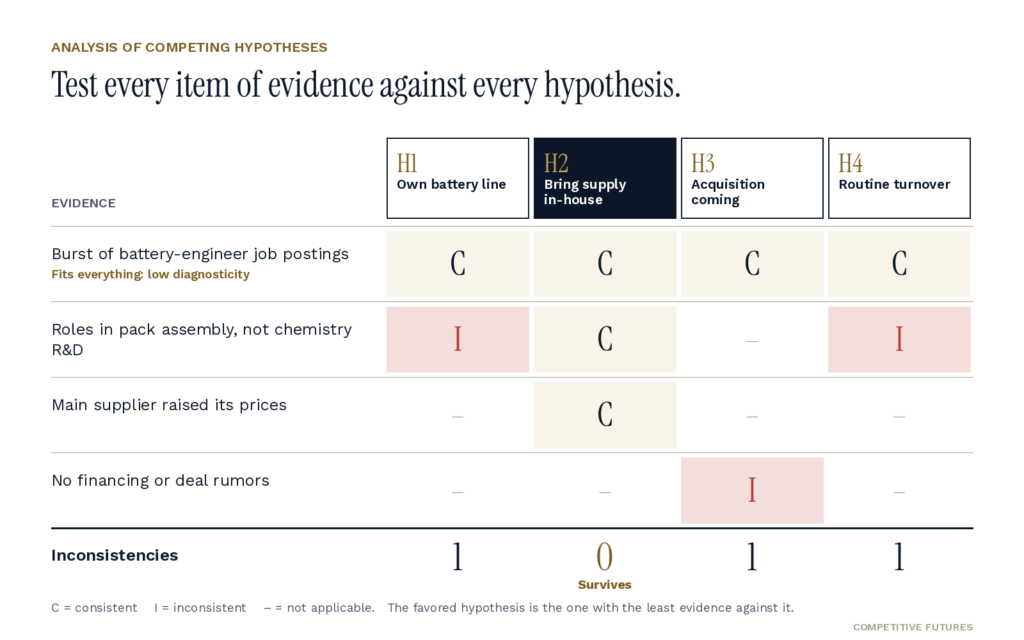
Suppose a competitor has posted a dozen job openings for battery engineers in the past two months. Leadership wants to know what it means. Four hypotheses:
- H1: The competitor is building its own battery product line.
- H2: It is bringing an outsourced component in-house to cut costs.
- H3: It is preparing to acquire a battery startup and staffing ahead of the deal.
- H4: It’s routine turnover, and the postings mean little.
Now the evidence:
- The job postings themselves fit all four hypotheses. They don’t discriminate at all.
- The roles are in pack assembly and supplier quality, not cell-chemistry research. That’s inconsistent with H1, since a new battery line would need chemists, and with H4, since a concentrated burst in one function isn’t routine turnover. It fits H2.
- The competitor’s main supplier recently raised its prices. Consistent with H2; it says nothing about the others.
- No financing activity or deal rumors appear in filings or the trade press. That’s inconsistent with H3.
The most vivid item, the burst of postings, turns out to be the least diagnostic. The quiet details, which jobs and what else happened, do the work. H2 survives with no inconsistencies. The milestones to watch: supplier contract changes, factory permits, and any new financing that would revive H3.
What the research says about ACH
ACH is widely taught, but the evidence that it improves judgment is mixed.
In a 2019 experiment, Mandeep Dhami, Ian Belton and David Mandel randomly assigned 50 intelligence analysts to use ACH or not on the same problem. They concluded that the intelligence community should consider the conditions under which ACH is useful and explore alternatives (Dhami, Belton & Mandel, Applied Cognitive Psychology, 2019). A review of the related experiments reports that analysts using ACH were sometimes less coherent in assigning probabilities than those who didn’t use it, and less likely to use base-rate information (Karvetski, Mandel & Irwin, Judgment and Decision Making, 2020).

That doesn’t make ACH useless. It means a matrix is not a substitute for judgment. In my experience, ACH earns its keep when four conditions hold:
- The hypotheses are genuinely distinct, so evidence can separate them.
- Base rates are considered first: how often does each explanation turn out to be true in situations like this?
- Someone outside the team challenges the hypothesis list, because the explanation nobody wrote down is the one that surprises you.
- The milestones are actually monitored, so the analysis stays alive after the meeting.
Used that way, ACH is less a calculator than a discipline: it makes the argument visible, so others can check it.
Where ACH fits
ACH is one of a family of structured analytic techniques. It works well alongside:
- Scenario planning, for questions about the future rather than explanations of the present.
- Evaluating a forecast, when you’re judging someone else’s claims.
- The premortem, which assumes a plan has already failed and asks why.
- A foresight culture, because no technique helps if the organization won’t act on an unwelcome answer.
Frequently asked questions
What is the Analysis of Competing Hypotheses?
ACH is a structured analytic technique developed by CIA analyst Richards Heuer. It evaluates several possible explanations at once by testing each piece of evidence against every hypothesis, and favors the hypothesis with the least evidence against it.
Who created ACH?
Richards J. Heuer Jr., a longtime CIA analyst, developed ACH and described it in his 1999 book Psychology of Intelligence Analysis, published by the CIA’s Center for the Study of Intelligence.
What is diagnosticity in ACH?
Diagnosticity is how well a piece of evidence helps distinguish between hypotheses. Evidence consistent with every hypothesis has low diagnosticity, however strongly it seems to support one of them.
Does ACH eliminate confirmation bias?
Not by itself. Experiments with intelligence analysts have found mixed results. ACH helps most when the hypotheses are distinct, base rates are considered, and outsiders challenge the hypothesis list.
Can businesses use ACH?
Yes. ACH is used in competitive intelligence, investigations, cybersecurity and strategy, anywhere a team must choose between competing explanations of incomplete evidence.
Work with Competitive Futures
We use structured analysis, including ACH, in our competitive intelligence work and published intelligence products, and we teach it in executive education and our advanced strategic analysis course. If your team is making a decision that depends on reading incomplete evidence correctly, request a 20-minute conversation.
Related analysis from Competitive Futures
- Cognitive Bias: A Field Guide for Leaders Who Must Decide Under Uncertainty
- How to Build a Foresight Culture
- How to Evaluate a Forecast
- Scenario Planning
- How to Avoid Strategic Mindtraps
References
- Dhami, M. K., Belton, I. K., & Mandel, D. R. (2019). The “analysis of competing hypotheses” in intelligence analysis. Applied Cognitive Psychology, 33(6), 1080–1090. doi.org/10.1002/acp.3550
- Heuer, R. J., Jr. (1999). Psychology of Intelligence Analysis, ch. 8. Center for the Study of Intelligence, CIA. cia.gov
- Karvetski, C. W., Mandel, D. R., & Irwin, D. (2020). Coherence of probability judgments from uncertain evidence: Does ACH help? Judgment and Decision Making, 15(6), 939–958.
- Office of the Director of National Intelligence (2015, amended 2022). Intelligence Community Directive 203: Analytic Standards. odni.gov