Turkish Intelligence: History, Structure, and the Headlines

Turkey sits on the borders of Syria, Iraq, Iran, the Caucasus, the Black Sea, and the European Union. It is a NATO member, a host of American aircraft at Incirlik, a channel to Hamas, a negotiator with Moscow, and, since 2024, the most influential foreign power in Damascus. Much of that work runs through one organization: the National Intelligence Organization of the Republic of Türkiye, known by its Turkish initials, MİT. Over the past fifteen years it has become the president’s service, a foreign-policy instrument, and a recurring defendant in the court of international opinion.
This page is a working overview of Turkish intelligence: where it came from, how it is organized today, and the cases that have put it in the news. It relies on Turkish laws and official chronologies, U.S. and UN records, court-reported facts, and named reporting. Where a claim comes from a government with a stake in the outcome, from state-run media, or from opponents of the Turkish government, the text says so.
Turkish intelligence at a glance
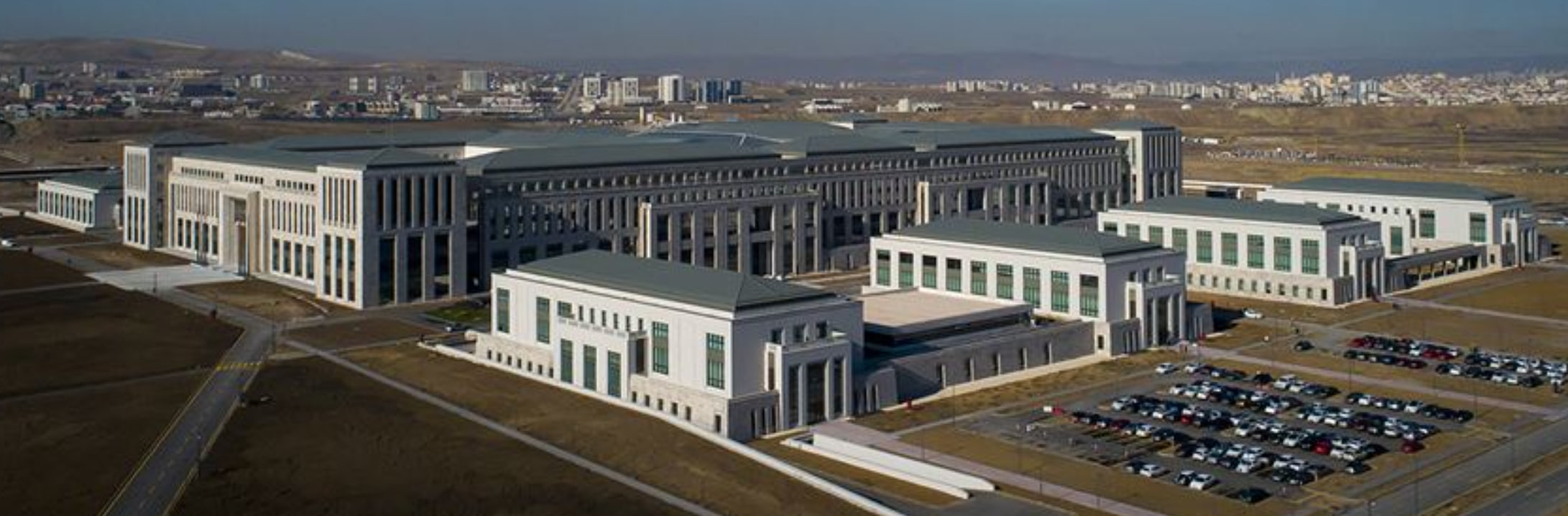
- Main intelligence service: the National Intelligence Organization (Millî İstihbarat Teşkilatı, MİT), established by Law No. 644, which took effect on July 22, 1965 (MİT chronology). Its governing law today is Law No. 2937 of November 1, 1983 (Law No. 2937, consolidated text).
- Head: İbrahim Kalın, President Recep Tayyip Erdoğan’s longtime spokesman and chief adviser, appointed director of MİT on June 5, 2023 (Hürriyet Daily News). He was still leading the agency in mid-2026 (Daily Sabah).
- Previous head: Hakan Fidan, who ran MİT from 2010 and became foreign minister in June 2023 (Reuters via The Star).
- Reporting line: MİT is attached directly to the president, who also chairs the National Intelligence Coordination Board (Millî İstihbarat Koordinasyon Kurulu, MİKK), for which MİT provides the secretariat (Law No. 2937, Articles 3 and 5).
- Budget: MİT’s 2025 activity report put actual spending at about 36.3 billion lira, up from an initial allocation of about 28.9 billion (Yetkin Report).
- Relationship with the United States: allied but often strained. Turkey has been a NATO member since 1952 (NATO), and the State Department calls it a valued ally whose bases, including Incirlik, have supported the campaign against ISIS (U.S. Department of State). The two governments have long disagreed over the Gülen movement and over Syria.
Before the republic: six centuries of Ottoman intelligence
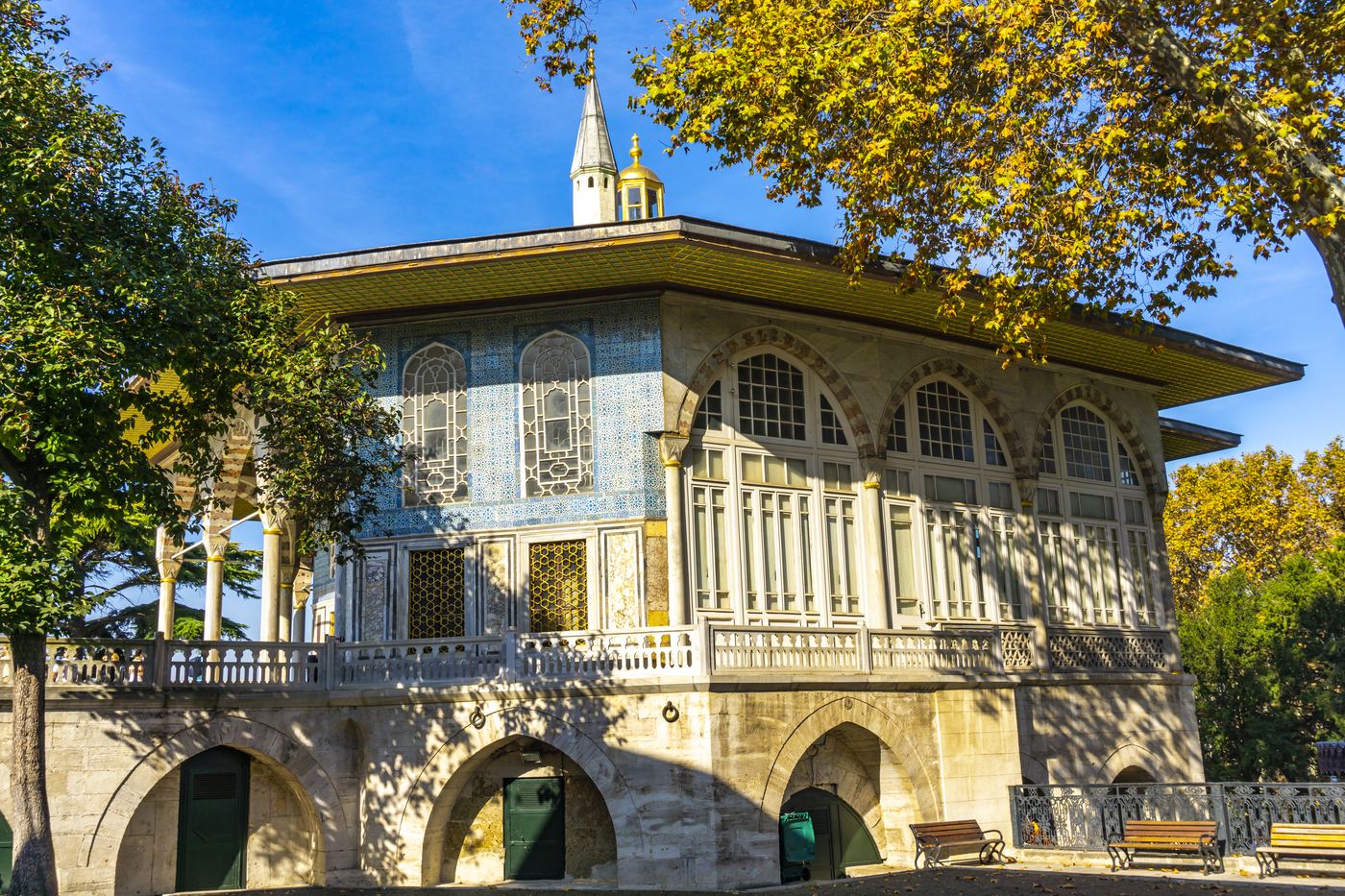
Turkish intelligence did not begin with the republic. As the Ottoman state expanded into the Balkans in the 1300s and 1400s, its frontier raiders, the akıncı light cavalry, served as its eyes: their raids scouted enemy forces and brought back prisoners for interrogation. Reports were gathered and weighed locally by provincial governors, and only the most important went on to the capital. Mehmed II, who took Constantinople in 1453, employed foreign agents, among them a German-born engineer known as Jörg of Nuremberg, and the merchant republic of Ragusa (Dubrovnik) became one of the empire’s most important sources of information, according to a 2021 survey of Ottoman intelligence by Ádám Majorosi in Hungary’s National Security Review (Nemzetbiztonsági Szemle).
In the 1500s, the rivalry with Habsburg Spain made the Mediterranean a theater of espionage. The historian Emrah Safa Gürkan, working from archives in Turkey, Spain, Italy, Austria, and Croatia, shows how the sultans relied on merchants, corsairs, soldiers, and travelers to report from far and wide, and how Ottoman operatives used disinformation, bribery, and sabotage against their enemies (Georgetown University Press). His research also found that the system was more personal than institutional: pashas and court favorites ran their own intelligence networks, often in their own interest, and information moved through Mediterranean go-betweens who brokered it to both empires (Medievalists.net, summarizing Gürkan’s Georgetown dissertation).
The first centralized service came in the late nineteenth century. According to the Ottoman legal historian Ekrem Buğra Ekinci, Sultan Abdülhamid II set up a palace intelligence service at Yıldız around 1880, whose informants, known as hafiye, filed sealed reports that the sultan read himself (Ekrem Buğra Ekinci).
The empire’s last and most controversial service was the Special Organization, the Teşkilat-ı Mahsusa. The historian Odile Moreau describes it as “a secret paramilitary intelligence organization under the control of the CUP’s inner circle and attached to the Ministry of War,” formally founded on November 30, 1913; during the First World War it ran guerrilla bands, propaganda, and covert missions from the Caucasus to North Africa, with German support (1914-1918-online, International Encyclopedia of the First World War). MİT’s own history dates the first intelligence organization to August 5, 1914, under Enver Pasha (MİT history, via the Federation of American Scientists). The organization’s role in the Armenian massacres of 1915–1916 remains contested. As Moreau summarizes, “Scholars continue to disagree about the role of the TM/OEA in the Armenian massacres of 1915-1916”: historians such as Taner Akçam hold that it was a key instrument of the killings, Hilmar Kaiser’s research challenges the chain of command, and other scholars deny it played a significant role.

After the 1918 armistice, intelligence work passed to resistance networks such as the Karakol society and the Felah group, which supported the nationalist forces in the War of Independence, according to MİT’s official history (MİT history, via the Federation of American Scientists). The republic’s own service grew out of that tradition.
History: from a secret service to the president’s agency
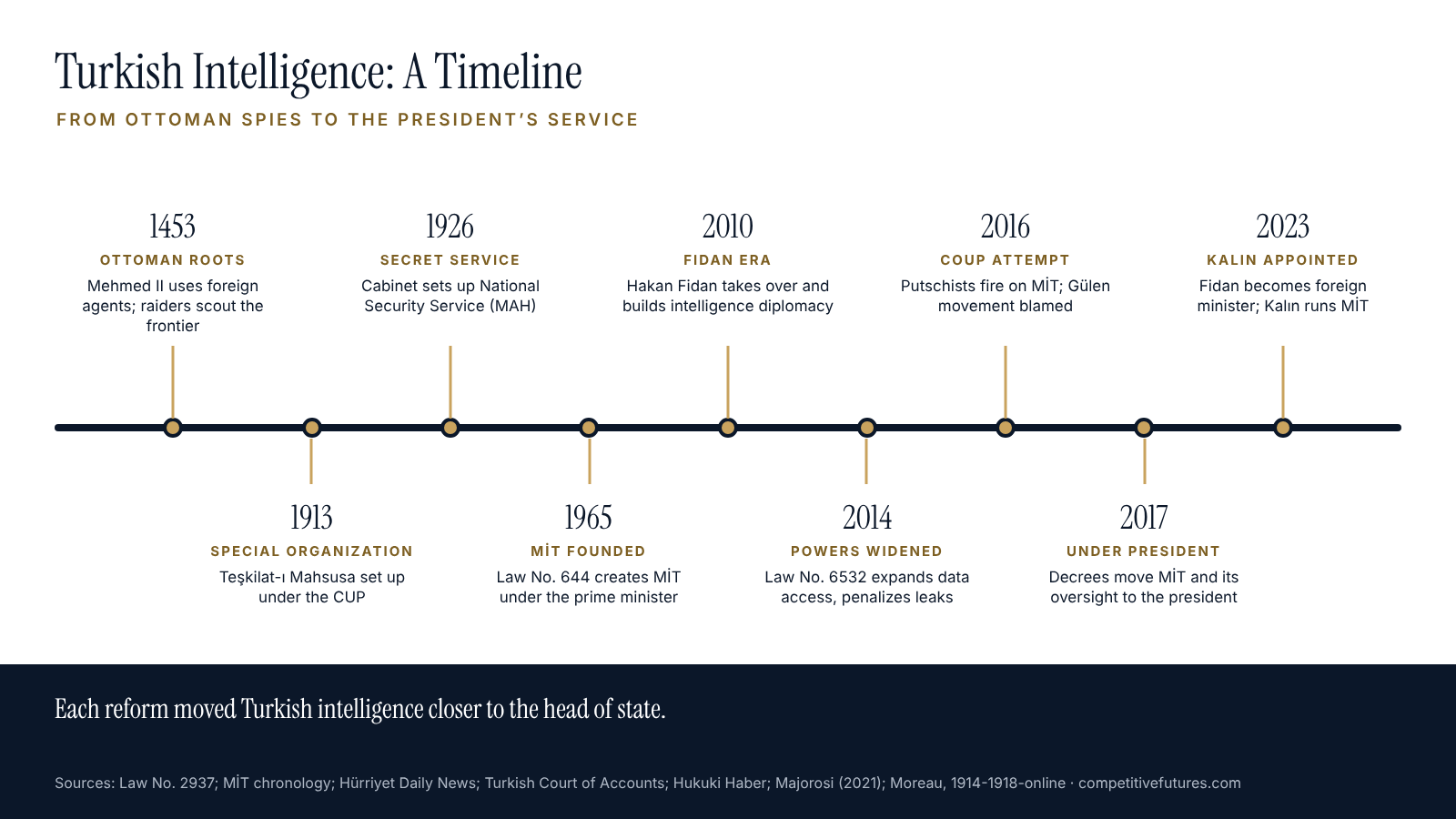
Modern Turkish intelligence dates to December 19, 1926, when the cabinet of the young republic agreed to establish a secret National Security Service, known by the abbreviations M.E.H. and MAH, attached to the Office of the Prime Minister (MİT chronology). Its first director, Şükrü Âli Ögel, ran it until 1941 (MİT, list of leaders).
After long debate, parliament passed a law creating MİT on July 6, 1965, and the new organization was set up under the prime minister’s office (MİT chronology). Following the 1980 military coup, Law No. 644 was replaced by Law No. 2937, which took effect on January 1, 1984; it placed MİT directly under the prime minister and folded the old MAH directorate into new internal and external intelligence directorates (MİT chronology). Through the Cold War and the long conflict with the Kurdistan Workers’ Party (PKK), MİT operated inside a security state in which the military was the senior partner.
That changed under Hakan Fidan. Appointed in 2010, Fidan turned MİT into Erdoğan’s instrument for the most sensitive files, including talks with the PKK. In February 2012, prosecutors in an investigation of the PKK’s urban network tried to summon Fidan and four other officials for questioning; Erdoğan said he was the real target, and parliament quickly passed a law shielding top intelligence officials from such probes (Hürriyet Daily News).
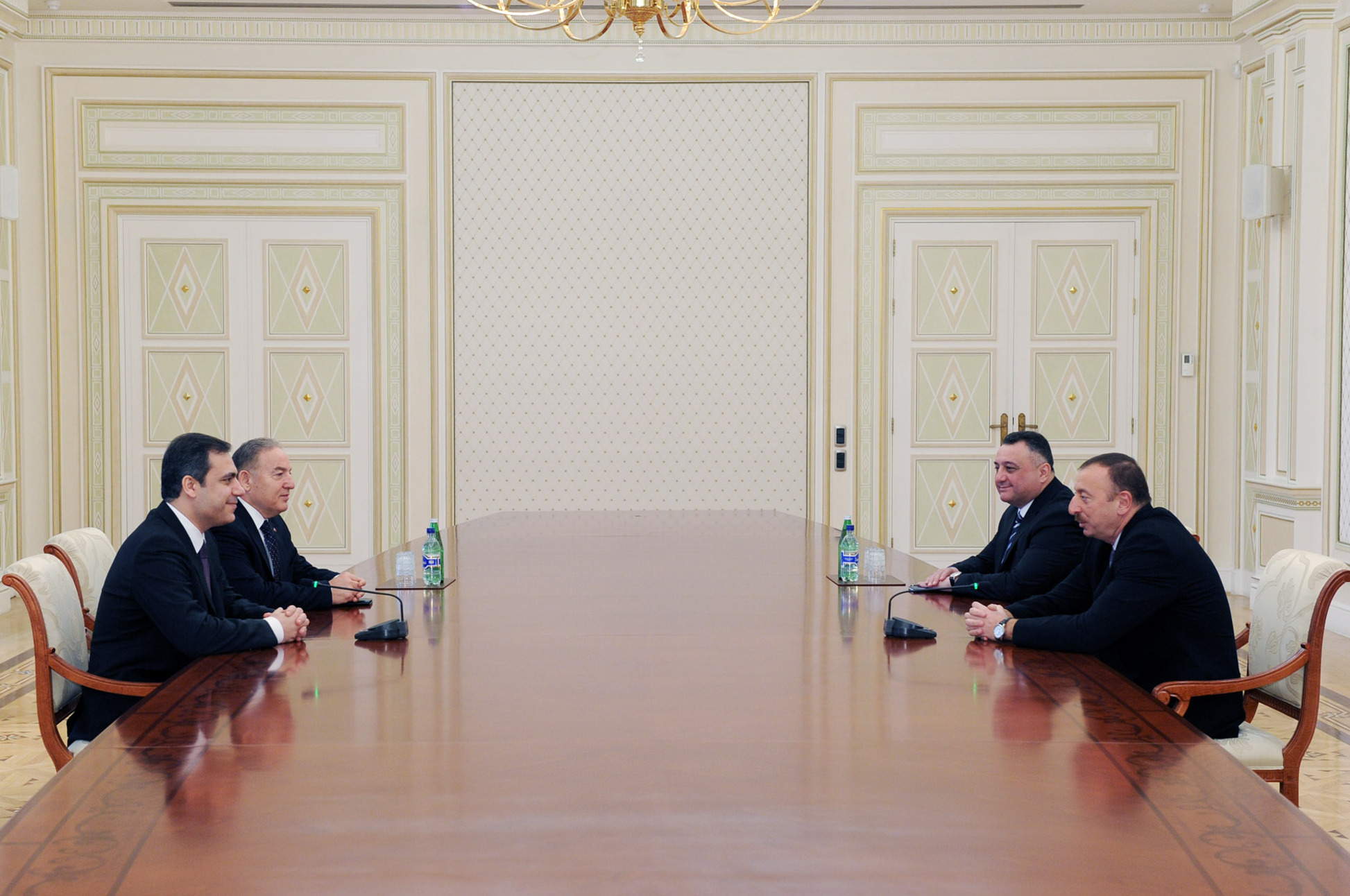
In April 2014, a broader law, No. 6532, followed. According to Human Rights Watch, it allowed MİT to collect personal data from public bodies, banks, and companies without a court order, made it harder to investigate MİT personnel, and set prison terms of three to nine years for journalists who publish leaked intelligence material. “The new MİT law gives the agency carte blanche while punishing those who seek to expose its wrongdoing,” said HRW’s Emma Sinclair-Webb (Human Rights Watch). Opposition parties warned the bill would create “an intelligence state”; the law also gave the president the final say on whether the MİT chief could be prosecuted and, in Hürriyet’s description, provided the legal ground for talks with the PKK through MİT (Hürriyet Daily News).
The coup attempt of July 15, 2016, completed the shift. In August 2017, emergency decrees moved MİT from the prime minister to the president, required presidential approval before any investigation of its chief, restored MİT’s authority to gather intelligence on the armed forces, and placed the coordination board under the presidency (Hürriyet Daily News). When Turkey moved to a presidential system on July 9, 2018, MİT’s undersecretariat was renamed a directorate (MİT chronology).
How Turkish intelligence is organized today
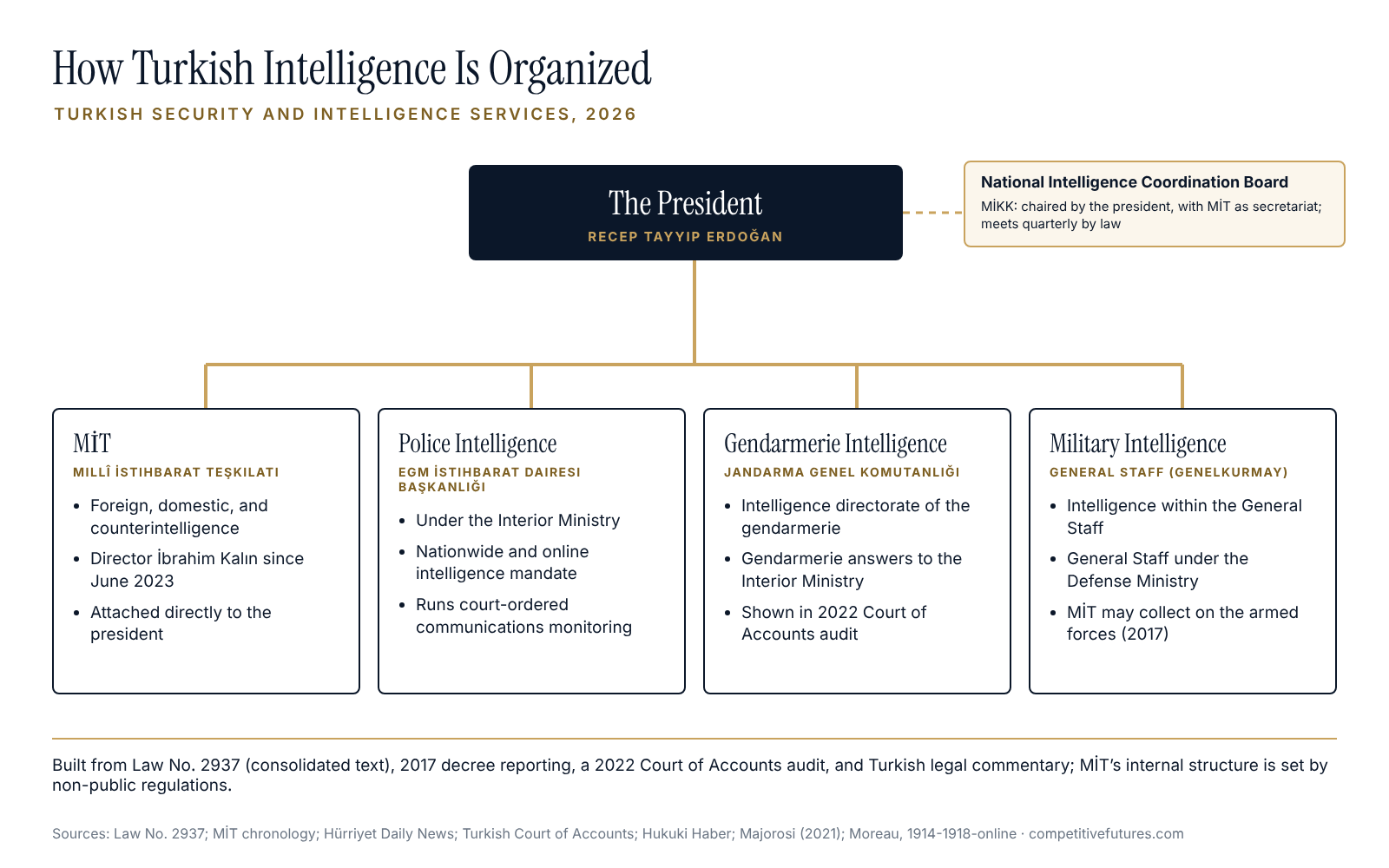
Turkey publishes its intelligence laws, but the internal structure of MİT is set by regulations that are not public. The legal texts and official audits show a system built around one dominant agency and several smaller ones, all ultimately answering to the president.
- MİT is the national foreign and domestic intelligence and counterintelligence service. Law No. 2937 allows it to use covert methods, create legal entities and cover identities, obtain records from public and private bodies, and intercept communications with a judge’s order, or in urgent cases on the written order of its head or deputy, subject to judicial approval within 24 hours (Law No. 2937, Article 6).
- Police intelligence, the Intelligence Department of the General Directorate of Security (Emniyet Genel Müdürlüğü İstihbarat Dairesi Başkanlığı), works under the Interior Ministry, with a legal mandate for nationwide and online intelligence under the police powers law (Hukuki Haber).
- Gendarmerie intelligence, the intelligence directorate (İstihbarat Başkanlığı) of the Gendarmerie General Command, which is attached to the Interior Ministry (Turkish Court of Accounts audit, 2022).
- Military intelligence sits within the General Staff, which a presidential decree places under the Ministry of National Defense (Hukuki Haber).
Two features stand out. First, the reforms of 2014 to 2018 removed most of the buffers between MİT and the head of state: the president appoints its leadership, approves any investigation of its chief, and chairs the board that coordinates every other service. Second, the balance with the military has reversed: before 2016, MİT worked in the army’s shadow; since 2017 it has had the authority to gather intelligence on the army itself.
Intelligence as foreign policy
MİT’s own chronology describes a growth in “intelligence diplomacy” from 2010, including roles in the Astana talks on Syria and the Sochi summit (MİT chronology). In practice, this means that the people who run Turkish intelligence also carry Ankara’s most delicate messages. The clearest sign came in June 2023, when Erdoğan made his spy chief, Fidan, foreign minister and his spokesman, Kalın, spy chief (Reuters via The Star). Kalın, an academic by training, had been presidential spokesman since 2014 and a founder of the SETA think tank (Hürriyet Daily News).
Under Kalın, MİT has been a front-line negotiator. Arab News described him as playing a central role in the behind-the-scenes talks in Doha that pressed Hamas to respond positively to the U.S.-backed Gaza ceasefire proposal in October 2025; Turkey was one of four countries, with the United States, Egypt, and Qatar, to sign the joint statement on the deal at Sharm el-Sheikh (Arab News). In MİT’s 2025 activity report, Kalın wrote that the agency conducted “intensive intelligence diplomacy with all relevant actors” and played a “bridge role between all parties” (Turkish Minute). He was still meeting Hamas’s chief negotiator, Khalil al-Hayya, in Ankara in March 2026 (Daily Sabah). At home, he has framed MİT’s work as a shift toward a “preventive intelligence paradigm” combining human, technical, and AI-assisted analysis (Yeni Şafak).
Turkish intelligence in the news
Most public knowledge of MİT comes from seven episodes. In several, the core facts are contested between the Turkish government and its critics, and Turkish courts have treated reporting on MİT itself as a crime. The account below gives each side and the legal outcome where there is one.
The MİT trucks (2014–2024)
In January 2014, gendarmerie and police in Adana and Hatay, acting on tip-offs that they carried weapons to Syria, stopped and searched trucks belonging to MİT. The government said the searches were ordered by followers of the cleric Fethullah Gülen and that the trucks carried only humanitarian aid for Turkmens in Syria (Duvar English). In 2015, the opposition daily Cumhuriyet published footage of the searches. Erdoğan said, “The person who wrote this story will pay a heavy price for it; I won’t let him go unpunished.” The editor, Can Dündar, and the Ankara bureau chief, Erdem Gül, were arrested in November 2015 (CPJ). In February 2016, the Constitutional Court ruled that their 92-day detention violated their rights; Erdoğan responded that “it was wrong that the constitutional court has put itself in the position of a primary court” (Hürriyet Daily News).
The legal aftermath ran for a decade. In June 2019, an Ankara court sentenced former Adana prosecutors and gendarmerie commanders who had stopped the trucks to prison terms of roughly 17 to 26 years for obtaining and disclosing confidential state documents (Hürriyet Daily News, from Anadolu). In December 2020, an Istanbul court sentenced Dündar, who lives in Germany, in absentia to 27 years and six months for espionage and aiding a terrorist organization; his lawyers boycotted what they called a political verdict (CPJ). Gül was acquitted of espionage in 2018 but, at a retrial in February 2024, was sentenced to five years for aiding the Gülen organization; he said he did not accept the charges “because journalism is not a crime,” and the sentence was subject to appeal (Hürriyet Daily News).
The coup attempt (2016)
On the night of July 15, 2016, a faction of the armed forces tried to seize power. The attempt killed 251 people and wounded about 2,200 (AP via PBS NewsHour). Hours earlier, a major from an army helicopter unit had gone to MİT headquarters to warn that plotters planned to seize Fidan, and during the night putschists fired on the intelligence headquarters (Daily Sabah). The military’s office said MİT alerted it at 4 p.m. that day, but MİT was criticized for not warning the political leadership: Erdoğan said he learned of the coup from his brother-in-law and said, “There was a weakness regarding intelligence, a failure” (AFP via SpaceDaily).
The government blamed Gülen, who lived in Pennsylvania, and his movement, which Turkey designates as a terrorist organization it calls FETÖ. Gülen adamantly denied involvement. Turkey demanded his extradition, but the United States said it needed more evidence, and he was never charged with a crime in the United States; he died in October 2024. In the purge that followed, tens of thousands were arrested and more than 130,000 suspected supporters were removed from civil service jobs (AP via PBS NewsHour). The hunt for the movement abroad became one of MİT’s main missions.
Renditions from abroad (2018–2024)
On March 29, 2018, six Turkish nationals were arrested in Kosovo over ties to schools linked to the Gülen movement and flown to Turkey the next day. Kosovo’s prime minister, Ramush Haradinaj, said the operation “was conducted without my knowledge and without my permission” and fired his interior minister and intelligence chief. Erdoğan said MİT had brought the six back “in coordination with Kosovo intelligence” and that they had recruited for the movement (RFE/RL). Turkey’s deputy prime minister, Bekir Bozdağ, then said MİT had captured 80 suspects in 18 countries: “The MİT has struck a major blow against FETÖ through its operation abroad. The incident in Kosovo was a great success” (Hürriyet Daily News).
UN human rights experts wrote to the Turkish government in May 2020 that more than 100 Turkish nationals had reportedly been forcibly transferred to Turkey, describing what they saw as a systematic practice of state-sponsored abductions abroad under bilateral agreements with countries including Azerbaijan, Albania, Cambodia, and Gabon (UN Special Procedures communication). Turkey treats such returns as lawful operations against a terrorist organization. In May 2021, the state-run Anadolu Agency reported that MİT had seized Gülen’s nephew, Selahaddin Gülen, abroad; he had been living in Kenya, where a court had barred his extradition weeks earlier (Al Jazeera). In October 2024, four Turkish refugees were seized in Nairobi and sent to Turkey. The UN refugee agency said it was “deeply concerned by the refoulement of four refugees from Kenya” (AFP via EWN). Kenya’s government said it had returned them “at the request of the Turkish government” and had assurances they would be “treated with dignity”; it did not address the abduction accounts (Citizen Digital). Ankara made no public statement on MİT’s role in that case in the sources reviewed here.
The Khashoggi recordings (2018–2022)
On October 2, 2018, the Saudi journalist Jamal Khashoggi was killed inside the Saudi consulate in Istanbul (AP via PBS NewsHour). Turkish authorities said they had audio recordings of the killing, and Ankara used them to drive the story. “We gave the tapes. We gave them to Saudi Arabia, to the United States, Germans, French and British, all of them,” Erdoğan said on November 10, 2018 (Al Jazeera). Saudi Arabia changed its account several times and denies that Crown Prince Mohammed bin Salman ordered the killing (Al Jazeera). In February 2021, the U.S. Office of the Director of National Intelligence released its assessment: “We assess that Saudi Arabia’s Crown Prince Muhammad bin Salman approved an operation in Istanbul, Turkey” to capture or kill Khashoggi (ODNI). A Saudi court convicted eight people in 2020. In April 2022, as Ankara repaired ties with Riyadh, an Istanbul court transferred the trial of 26 Saudi suspects to Saudi Arabia; Khashoggi’s fiancée, Hatice Cengiz, said “the crime is still the same crime” (AP via PBS NewsHour).
Mossad and Iran networks (2023–2026)
After Israel’s Shin Bet chief was recorded saying Israel would pursue Hamas members in Lebanon, Turkey, and Qatar, a Turkish intelligence official said in December 2023 that “it was expressed to Israel that (such an act) would have serious consequences” (Ynet). In January 2024, Turkish authorities detained 33 people described as Mossad personnel in eight provinces (Ynet), and in September 2024 a court convicted 37 people of espionage for Mossad and acquitted 19; no Israeli response to the verdicts was reported (The National). In February 2026, MİT detained two Turkish citizens it accused of working for Mossad through front companies since 2012; the details came from “security sources” and no charges had been reported (Hürriyet Daily News).
Iran has been the other target. In January 2026, MİT and police arrested six people, including an Iranian national, on suspicion of spying for Iran, including surveillance of the NATO air base at Incirlik; a judge ordered them held on espionage charges, and there was no immediate comment from Iran’s embassy (AP via WTOP). All of these suspects are presumed innocent until a court rules.
The Ankara prisoner swap (2024)
On August 1, 2024, 26 prisoners were exchanged on the tarmac of Ankara’s Esenboğa Airport in one of the largest East–West exchanges in decades. MİT said it “coordinated an extensive prisoner swap” among the United States, Russia, and other countries: ten prisoners went to Russia, 13 to Germany, and three to the United States, aboard seven aircraft from the United States, Germany, Poland, Slovenia, Norway, and Russia (Hürriyet Daily News). The choice of Ankara reflected a rare asset: a NATO service that both Washington and Moscow would trust with the logistics.
Syria after Assad (2024–2026)
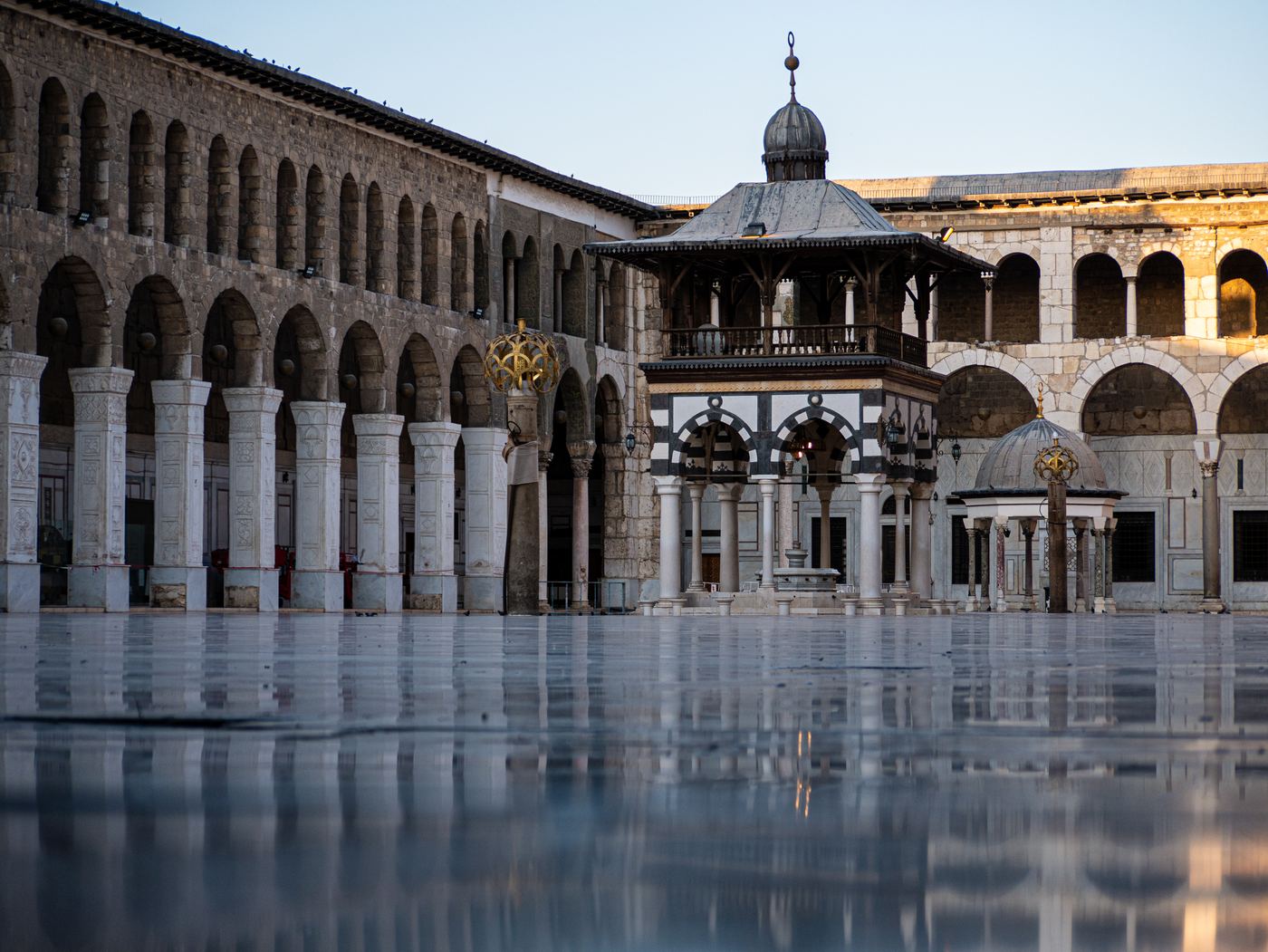
When Bashar al-Assad’s government fell in December 2024, Turkey moved faster than any other foreign power. On December 12, Kalın prayed at Damascus’s Umayyad Mosque and met Ahmed al-Sharaa, the rebel commander who would become Syria’s president, in what the Syrian outlet Enab Baladi described as the first visit by a Turkish official in 13 years (Enab Baladi). In 2026, Kalın said that Syria posed no direct threat to Turkey or NATO and that Turkish and Syrian intelligence were cooperating against remnants of ISIS (Daily Sabah).
How to read coverage of Turkish intelligence
Few intelligence services are covered by a more divided press. Anadolu Agency is state-run, and TRT is the state broadcaster; Daily Sabah and Yeni Şafak are pro-government, and much of what is known about MİT operations reaches the public through unnamed “security sources” quoted in those outlets, often naming suspects before any charge is filed. On the other side, many of the most detailed accounts of renditions and prosecutions come from outlets run by exiled Turkish journalists, whom Ankara regards as hostile. Israeli, Gulf, and Iranian outlets each have their own quarrels with Ankara. Laws that criminalize publishing intelligence information mean that Turkish reporters work under real legal risk, so silence in the domestic press is not evidence that nothing happened.
The discipline is the same one taught in our guides to trend analysis and evaluating forecasts: climb toward primary records. For Turkey, that means laws and decrees in the Official Gazette, MİT’s own chronology and annual reports, Constitutional Court rulings, UN special procedures communications, and the U.S. Justice Department’s database of foreign agents registered under the Foreign Agents Registration Act (FARA eFile), which lists the lobbyists and consultants working for Turkey, and for its rivals, in Washington. When a story rests on a single unnamed security source, treat it as a lead, not a finding.
Frequently asked questions
What is Turkey’s intelligence agency called?
Turkey’s main intelligence agency is the National Intelligence Organization (Millî İstihbarat Teşkilatı, MİT). It was created by law in 1965 from the National Security Service founded in 1926, and today it reports directly to the president.
Who is the head of Turkish intelligence?
İbrahim Kalın, formerly President Erdoğan’s spokesman and chief adviser, has headed MİT since June 2023. His predecessor, Hakan Fidan, who led the agency from 2010, became foreign minister.
Does Turkish intelligence work with the United States?
Yes, though the relationship is uneven. Turkey has been a NATO ally since 1952 and hosts U.S. forces at Incirlik, and MİT coordinated the 2024 U.S.–Russia prisoner exchange in Ankara. The two governments have disagreed sharply over the Gülen movement and over Syria.
Related reading
- Qatari Intelligence: History, Structure, and the Headlines
- Trend Analysis: How to Tell a Real Trend From Media Hype
- How to Evaluate a Forecast
- Cognitive Bias: A Field Guide for Leaders
Competitive Futures briefs companies and governments on intelligence services, foreign influence, and Turkey and its neighborhood; details are on the services page.