Brazilian Intelligence: History, Structure, and the Headlines

Brazil is the largest democracy in Latin America, and its intelligence service carries a heavier historical burden than most. The modern agency, ABIN, was built in 1999 to fill the space left by the National Information Service (SNI), the military regime’s political police, which catalogued hundreds of thousands of Brazilians. A quarter century later, ABIN is still trying to prove it serves the state rather than whoever holds power. Its former director has been convicted in a coup case, its phone tracking has been the subject of a Supreme Court inquiry, and it has been caught up in disputes with the United States, Russia, and Paraguay.
This page is a working overview of Brazil’s intelligence services: where they came from, how they are organized today, and the cases that have put them in the news. It relies on the texts of Brazilian laws and decrees, the agency’s own published material, Supreme Court and congressional records, and named reporting from across Brazil’s polarized press. It treats governments of the left and the right by the same standard, separates police allegations from court findings, and notes when a claim comes from a party with an interest in the outcome.
Brazilian intelligence at a glance
- Main intelligence service: the Brazilian Intelligence Agency (Agência Brasileira de Inteligência, ABIN), created by Law 9.883 of December 7, 1999, as the central body of the Brazilian Intelligence System (Sistema Brasileiro de Inteligência, SISBIN) (Law 9.883/1999).
- Head: Director-General Luiz Fernando Corrêa, a retired Federal Police delegate who led the Federal Police from 2007 to 2011, appointed on May 30, 2023, according to ABIN’s website (ABIN). By law, the president appoints the director-general only after the Senate approves the nominee (Law 9.883/1999).
- Reporting line: since Decree 11.426 of March 1, 2023, ABIN has sat in the Civil House (Casa Civil) of the Presidency, after years under the military-led Institutional Security Office (GSI) (Correio Braziliense).
- Oversight: Congress exercises external control through a joint committee that includes the majority and minority leaders of both chambers and the chairs of their foreign relations and defense committees (Law 9.883/1999).
- Other key body: the Federal Police’s Police Intelligence Directorate (DIP), which sits on the SISBIN advisory council and handles police intelligence and counterintelligence (Marco Cepik).
- Relationship with the United States: cooperative but scarred. The 2013 revelations of U.S. surveillance of Brazil’s president and Petrobras led Brasília to postpone a state visit, while later counterintelligence work against Russian “illegals” in Brazil began, according to The New York Times, with a U.S. tip in 2022 (NYT via NZ Herald).
History: from the SNI to ABIN
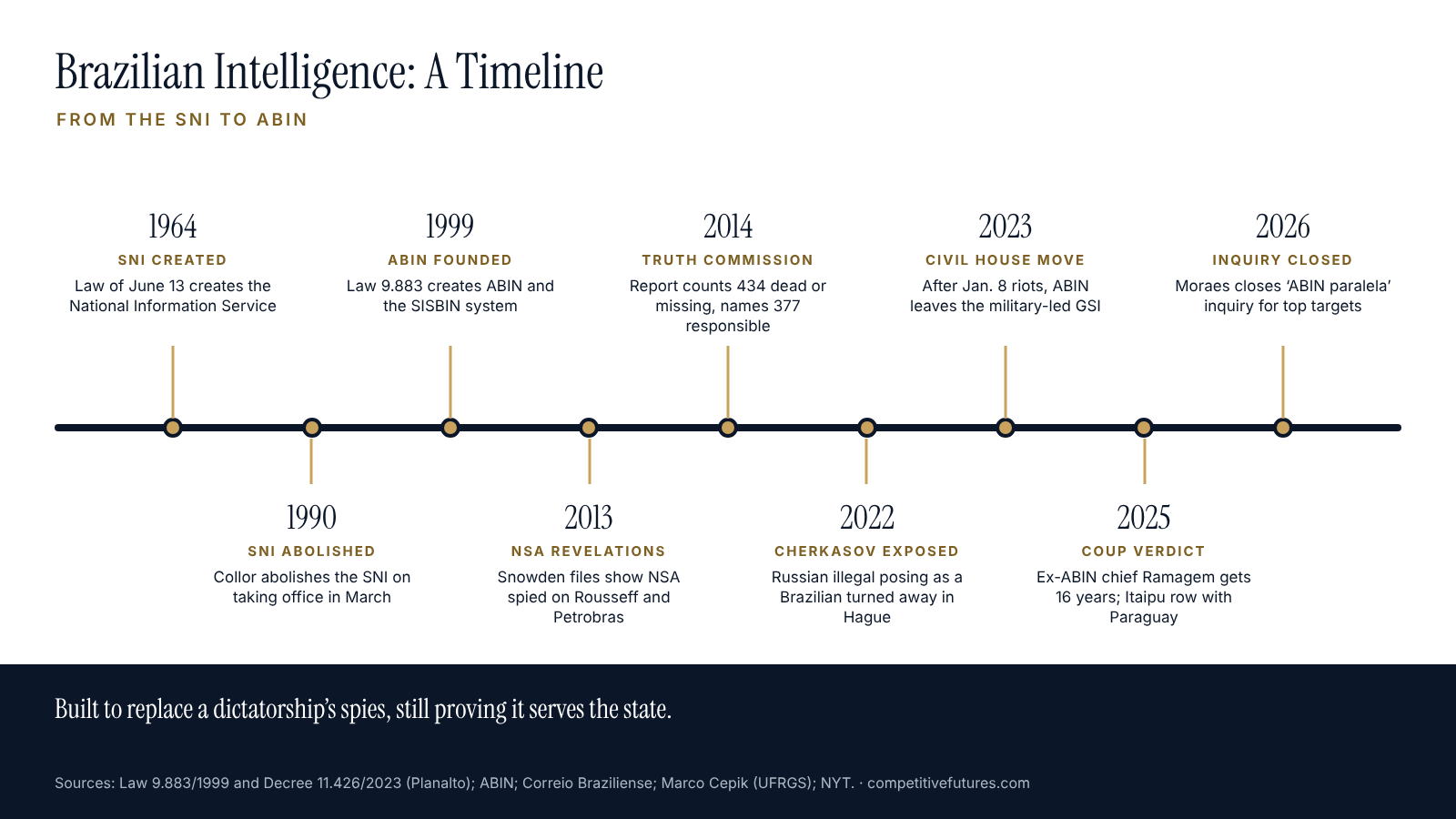
ABIN’s own history traces Brazilian intelligence to government councils from 1927 and then to the Federal Information and Counter-Information Service (SFICI), which operated from 1946 to 1964 (ABIN). A law of June 13, 1964, weeks after the coup, created the National Information Service (Serviço Nacional de Informações, SNI). Its architect and first chief, General Golbery do Couto e Silva, is quoted as later saying, “Criei um monstro” (“I created a monster”). The SNI built a network of regional agencies and security-information offices inside ministries, state companies, foundations, and universities, more than 100 units by the end of the regime by one historian’s count, and two of its chiefs, Emílio Garrastazu Médici and João Baptista Figueiredo, went on to become president (Correio Braziliense). A 2008 study by specialists at the National Archive found that more than 300,000 Brazilians had been catalogued by the SNI, and documents now held by the archive show it kept watching critics, journalists, and even members of the 1987–1988 Constituent Assembly after civilian rule returned in 1985 (Agência Pública).
President Fernando Collor abolished the SNI when he took office in March 1990 (Correio Braziliense). For most of the following decade, intelligence survived as a small unit attached to presidential secretariats, first as an Intelligence Department and later as an Intelligence Sub-secretariat (ABIN).
ABIN was created in 1999, in Fernando Henrique Cardoso’s second term. Law 9.883 set up SISBIN to support the president “nos assuntos de interesse nacional” (on matters of national interest) and made ABIN its central body, responsible for planning, executing, coordinating, supervising, and controlling the country’s intelligence activity (Law 9.883/1999). It was linked to the GSI for most of its life, apart from a period after 2015 when Dilma Rousseff’s government placed it in the Government Secretariat; Michel Temer returned it to the GSI (ABIN).
How Brazilian intelligence is organized today
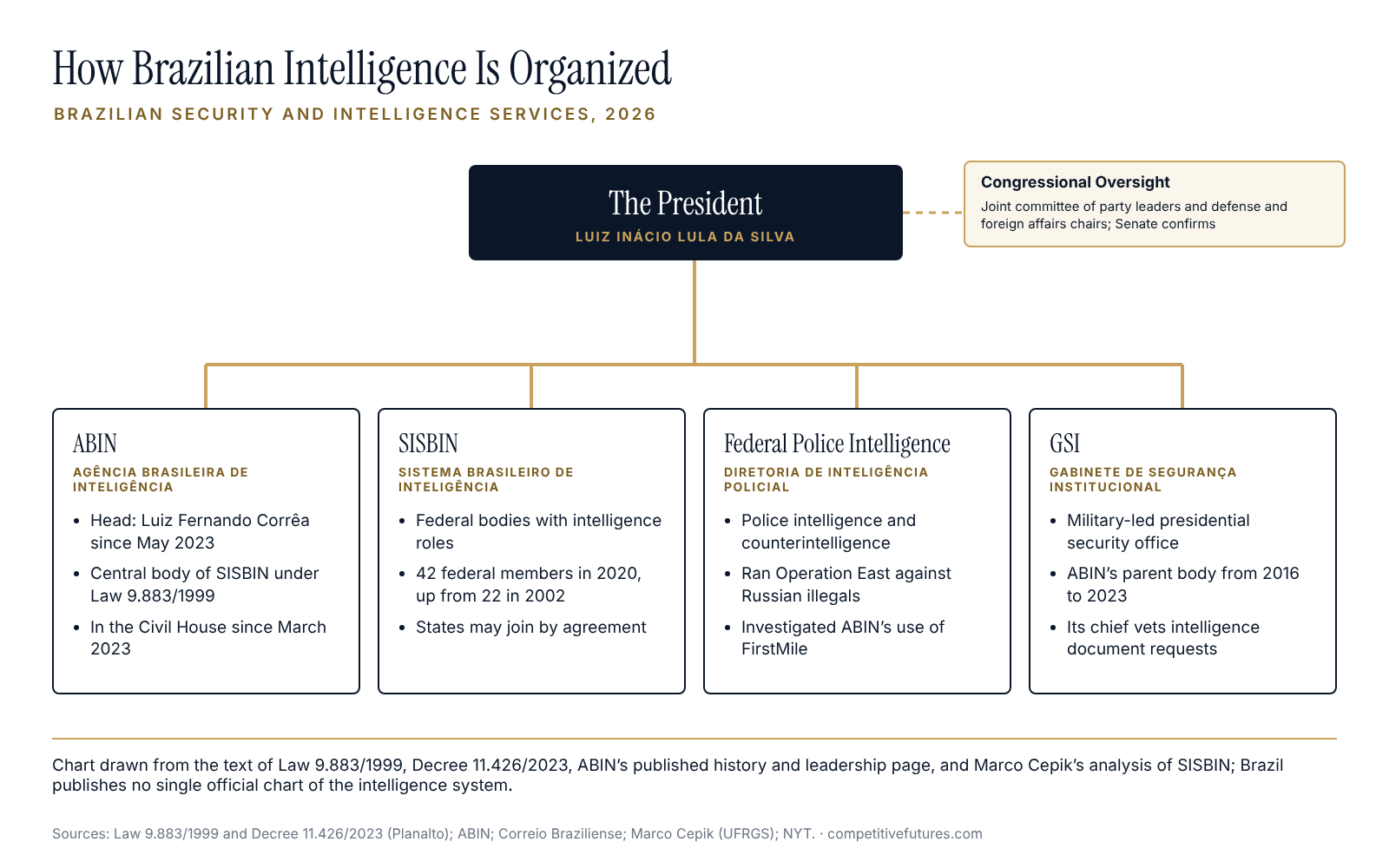
Brazil’s intelligence community is a system of many federal bodies coordinated, in theory, by one agency.
- ABIN is the central body of SISBIN. Its legal duties include intelligence operations, including covert ones, and assessing threats to the constitutional order (Law 9.883/1999). Decree 11.426 of 2023 places it in the Civil House (Decree 11.426/2023).
- SISBIN groups federal bodies that produce intelligence-relevant knowledge, especially those responsible for external defense, internal security, and foreign relations; states may join by agreement (Law 9.883/1999). Its federal membership grew from 22 bodies in 2002 to 42 in 2020, according to the political scientist Marco Cepik (Marco Cepik).
- The Federal Police, under the Justice Ministry, runs a Police Intelligence Directorate (DIP) and a General Coordination for Counterintelligence (CGCINT). The directorate has concentrated the main investigations into former president Jair Bolsonaro and his allies (Banda B), and its counterintelligence team ran the operation that exposed Russian illegals using Brazilian identities (NYT via NZ Herald).
- The GSI, the Presidency’s Institutional Security Office, is a military-led ministry that was ABIN’s parent from 2016 to 2023 (Correio Braziliense). The 1999 law still gives its chief a gatekeeping role over requests for intelligence documents (Law 9.883/1999).
- Defense and foreign-relations bodies, including military intelligence, are among the members the 1999 law singles out for SISBIN, alongside internal-security agencies (Law 9.883/1999).
The system’s weakness is coordination. Cepik argues that the 2016 National Intelligence Policy and 2017 National Intelligence Strategy do not specify each agency’s mission, and that overlapping federal, police, and state structures encourage a “uso tático e não estratégico” (tactical, not strategic, use) of intelligence (Marco Cepik). Since 2023, the rivalry between ABIN and the Federal Police has been open: the police have investigated ABIN’s leadership itself.
A democracy’s spy service
ABIN’s central problem is legitimacy. It was designed as a democratic successor to the SNI, but critics doubted from the start that the break was clean. In a 1996 hearing, the political scientist Thomaz Guedes da Costa warned that the planned agency was being designed to gather “informações para governar” (information for governing), which he saw as different from intelligence work in other democracies, and the historian Priscila Carlos Brandão has argued that its broad mandate invited abuse and that military culture carried over from the SNI (Correio Braziliense).
Scandals have recurred under governments of different parties. In 2008, Veja reported that ABIN had wiretapped officials, including Supreme Court Justice Gilmar Mendes; its director, Paulo Lacerda, was removed and denied that the agency took part in illegal wiretaps (Correio Braziliense). Under Bolsonaro, the Federal Police allege, it was turned against the president’s opponents; under Lula, Paraguay accused it of hacking. Congressional oversight has done little to settle these disputes: Cepik notes that the joint control committee created in 1999 operated poorly until it adopted rules in 2013 and that there is little evidence it is effective (Marco Cepik).
Each government reorganizes intelligence to keep it away from people it distrusts. Luiz Inácio Lula da Silva’s government moved ABIN to the Civil House in March 2023, after the January 8 riots, partly because his team believed the agency included military personnel loyal to Bolsonaro (Correio Braziliense). None of these moves has produced what ABIN most lacks: a settled public belief that it works for the state, not the government of the day.
Brazilian intelligence in the news
Most public knowledge of Brazilian intelligence comes from seven cases. Several remain open in Brazilian or foreign courts, so the line between allegation and finding matters.
The SNI and the National Truth Commission (1964–2014)
The National Truth Commission (CNV) released its final report on December 10, 2014, after more than two and a half years of work. It counted 434 people killed or disappeared, mostly under the 1964–1985 regime, and named 377 people as responsible, including the five military presidents and the SNI’s founder, Golbery. It recommended that the 1979 Amnesty Law not shield those responsible, arguing that the crimes were crimes against humanity, a position the Supreme Court had rejected in 2010 (Exame). The commission found that the abuses were “uma ação generalizada e sistemática” (a widespread and systematic action) and part of a state policy decided at the highest levels of government, and noted that the true toll may be higher because armed forces documents had been destroyed (Human Rights Watch).
The NSA revelations (2013–2014)
On September 1, 2013, TV Globo reported, based on documents leaked by Edward Snowden, that the U.S. National Security Agency had monitored President Rousseff’s communications with top aides; on September 8, it reported that the NSA had also spied on the state oil company Petrobras (MercoPress). On September 17, Rousseff postponed a state visit to Washington planned for October. Her office called the interceptions “a serious act which violates national sovereignty and is incompatible with democratic coexistence between friendly countries.” U.S. officials said the surveillance aimed to track suspected terrorist activity, and the White House said the visit could take place later (Al Jazeera).
Brazil answered with diplomacy and law. On September 24, Rousseff told the UN General Assembly that “meddling in such a manner in the lives and affairs of other countries is a breach of international law” (The World). Brazil and Germany tabled a resolution on the right to privacy in the digital age, which the General Assembly adopted by consensus on December 18, 2013 (German Foreign Office; SBS). On April 23, 2014, Rousseff signed the Marco Civil da Internet, Law 12.965, at the NETmundial conference in São Paulo; Brazilian legal press linked the law to the NSA scandal (Migalhas).
The “ABIN paralela” (2019–2026)
On October 20, 2023, the Federal Police launched Operation Última Milha (Last Mile), with orders from Supreme Court Justice Alexandre de Moraes, into the alleged use of FirstMile, a geolocation tool from the Israeli company Cognyte, without court authorization. ABIN had bought the tool without a tender at the end of 2018; the police said it could track up to 10,000 phones for up to 12 months using only a number, and that the alleged crimes ran until about mid-2021, when Alexandre Ramagem led ABIN (O Povo). ABIN said the tool stopped being used in May 2021, that its own review had led to an internal investigation in March 2023, and that it “colaborou com as autoridades competentes desde o início das apurações” (cooperated with the authorities from the start) (Agência Gov). Bolsonaro said of the scheme, “Quem fez e o porquê não tenho a menor ideia” (Who did it and why, I have not the slightest idea) (O Povo).
In June 2025, the police sent the Supreme Court a final report of more than 800 pages indicting more than 30 people. It named Ramagem as the main organizer of an illegal monitoring structure, accused the city councilor Carlos Bolsonaro, the former president’s son, of using its information to attack opponents online, and accused ABIN’s current director-general, Corrêa, and other current leaders of trying to obstruct the investigation (CNN Brasil). Carlos Bolsonaro responded, “Alguém tinha alguma dúvida que a PF do Lula faria isso comigo?” (Did anyone doubt that Lula’s Federal Police would do this to me?); Ramagem had earlier denied the existence of a parallel structure and illegal espionage (InfoMoney). ABIN said it was cooperating, and Lula kept Corrêa in post despite demands from the staff union for his removal (Estadão via Portal de Prefeitura).
A police indictment is not a charge. In June 2026, Prosecutor-General Paulo Gonet asked that the remaining facts go to a lower court, arguing that Bolsonaro’s conduct had already been addressed in the coup case (Congresso em Foco). On July 20, 2026, Moraes closed the inquiry into Bolsonaro and Ramagem on that basis and into Corrêa and three former ABIN officials for lack of concrete evidence, writing that the accusations were limited to “conclusões genéricas” (generic conclusions); Carlos Bolsonaro’s case went to a federal first-instance court, where prosecutors will decide whether to charge him (Sou Brasília). No one has been convicted in the ABIN monitoring case itself.
Russian illegals in Brazil (2022–2026)
In April 2022, Sergey Cherkasov, traveling as a Brazilian named Victor Muller Ferreira, tried to take up a job at the International Criminal Court in The Hague; Dutch officials turned him away. The U.S. Justice Department charged him in March 2023 with acting as an agent of a Russian intelligence service, visa fraud, bank fraud, and wire fraud (U.S. Attorney’s Office, D.C.). His lawyer said he was not a Russian spy, and Russia sought him on drug-trafficking charges; Brazil’s Supreme Court had conditionally approved the Russian request, and Brazil declined the U.S. one (Stars and Stripes). He is serving a sentence in Brasília for using a false identity. The government ordered his expulsion in July 2026, effective once he completes it, with a 30-year ban on return; in August, Justice Luiz Fux asked the government to explain the delay in extraditing him to Russia. Investigators found no evidence that he spied on Brazil itself (Portal de Prefeitura; AFP via Diario de Pernambuco).
Cherkasov’s birth certificate became the thread for something larger. In May 2025, The New York Times reported that a Federal Police counterintelligence team, in Operation East, had identified at least nine Russian intelligence officers living under Brazilian identities, by searching for “ghosts”: people with genuine birth certificates but no trace of a life in Brazil. They included Artem Shmyrev, who ran a 3D-printing business in Rio as Gerhard Daniel Campos Wittich until he left in December 2022, never to return. Because Interpol does not handle espionage cases, Brazil circulated blue notices on the officers as fraudulent-document cases (NYT via NZ Herald; bne IntelliNews). The reports cited no official Russian response.
The Itaipu operation against Paraguay (2022–2025)
On March 31, 2025, the UOL columnist Aguirre Talento reported that ABIN had hacked Paraguayan officials to obtain their positions in the negotiation of Annex C of the Itaipu treaty, which sets the price of the dam’s energy, citing an ABIN employee’s November 2024 testimony to the Federal Police (O Povo). The report said execution was authorized under Lula’s appointee; the Brazilian government “categorically” denied involvement, saying the operation was authorized by the previous administration in June 2022 and annulled by ABIN’s interim director on March 27, 2023. Paraguay summoned the Brazilian ambassador, recalled its own for consultations, and suspended the Annex C talks (Agência Brasil). After Foreign Minister Mauro Vieira gave Paraguay a confidential report, the two governments announced in November 2025 that the talks would resume, and Paraguay’s foreign minister called the matter closed; no outcome of Brazil’s promised accountability effort has been reported (Brazil Reports).

The January 8 riots (2023)
On January 8, 2023, a week after Lula’s inauguration, rioters invaded the seats of the three branches of government in Brasília. ABIN’s former deputy director Saulo Moura da Cunha told Congress’s inquiry commission that the agency produced 33 alerts between January 2 and 8, and that by about 1:30 p.m. on January 8 he warned GSI Minister Gonçalves Dias that the buildings would be invaded. He said Dias had asked to be removed as an official recipient of the alerts. Dias told the commission that aides had described the situation as calm and that he grasped its seriousness only after that call (Folha de Pernambuco). Dias resigned on April 19, 2023, after videos showed him inside the Planalto Palace during the invasion; he has denied any complicity with the rioters (Agência Câmara).
The coup trial (2025–2026)
On September 11, 2025, the Supreme Court’s First Panel voted 4 to 1 to convict Bolsonaro and six others of offenses including an attempted coup and armed criminal organization. Justice Luiz Fux voted to acquit on all counts; Bolsonaro has consistently denied the allegations, and his lawyer argued there was no evidence linking him to a coup plot (NPR via Michigan Public). Two defendants came from the intelligence chain: Ramagem, ABIN’s former director, sentenced to 16 years, one month, and 15 days, and General Augusto Heleno, Bolsonaro’s GSI minister, sentenced to 21 years; both, like the other defendants, appealed (O Povo). Ramagem’s lawyer told the court that prosecutors had misread the FirstMile evidence and asked that ABIN material be excluded (Jornal de Brasília). The panel rejected all defense appeals on November 7, 2025 (Agência Brasil).
Ramagem left Brazil despite a travel ban, lost his congressional seat in December 2025, when Brazil also requested his extradition, and was detained by U.S. immigration authorities in Orlando in April 2026 (Agência Brasil). He was released days later; allies said his immigration status was regular, and no decision on extradition has been reported (Observador).
How to read coverage of Brazilian intelligence
Almost every Brazilian intelligence story now arrives pre-sorted into the country’s political divide. Police reports, plea-deal testimony, and inquiry files leak in fragments, and outlets aligned with each camp tend to treat the same document as either proof or persecution. Officials are parties too: the Federal Police and ABIN are rivals, and each government has an interest in blaming its predecessor, as the Itaipu accounts show. Foreign governments add their own claims, as Russia’s account of Cherkasov shows.
The discipline is the one taught in our guides to trend analysis and evaluating forecasts: climb toward primary records. For Brazil, that means laws and decrees on the Presidency’s legislation portal, Supreme Court decisions and case dockets, congressional inquiry transcripts, the Federal Police’s own statements, and the SNI files held by the National Archive. For lobbying in Washington by or for Brazilian actors, the U.S. Justice Department’s public database of foreign agents (FARA eFile) is the place to start. A Brazilian police indictment is a recommendation to prosecutors, not a charge, and a charge is not a conviction.
Frequently asked questions
What is Brazil’s intelligence agency called?
Brazil’s main intelligence agency is the Brazilian Intelligence Agency (Agência Brasileira de Inteligência, ABIN), created by Law 9.883 in 1999 as the central body of the Brazilian Intelligence System (SISBIN), which also includes the Federal Police, the military intelligence services, and other federal bodies.
Who is the head of Brazilian intelligence?
Luiz Fernando Corrêa, a retired Federal Police delegate and former head of the Federal Police, has been ABIN’s director-general since May 30, 2023; he reports through the Civil House of the Presidency, and his appointment required Senate approval.
Is ABIN the same as the old SNI?
No: the SNI, created in 1964 under the military regime, was abolished in 1990, and ABIN was created by a separate law in 1999 under congressional oversight, though critics have argued since its founding that habits and personnel from the SNI era carried over.
Related reading
- Qatari Intelligence: History, Structure, and the Headlines
- Argentine Intelligence: History, Structure, and the Headlines
- Cognitive Bias: A Field Guide for Leaders
Competitive Futures briefs companies and governments on intelligence services, foreign influence, and Latin America; details are on the services page.