Iranian Intelligence: History, Structure, and the Headlines
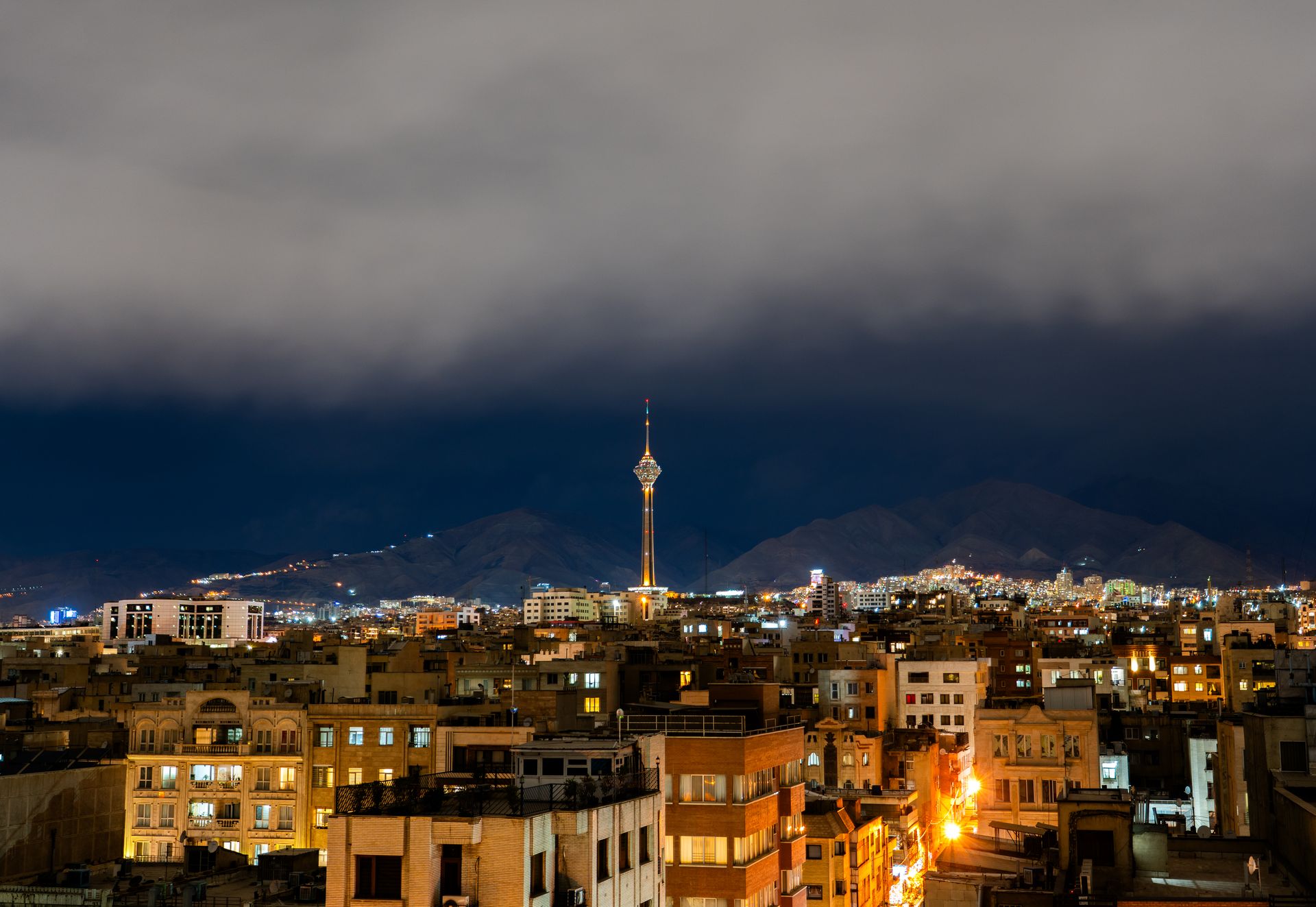
Few intelligence systems have been in the news as often, or as violently, as Iran’s. Its services have been accused in courts from Berlin to Antwerp to Manhattan of killing, kidnapping, and bombing plots against dissidents abroad. At home they police one of the world’s most closely watched societies. And since 2018 they have been on the losing end of a long contest with Israel that ended, in 2025 and 2026 and with the United States joining in 2026, with the deaths of two successive heads of Revolutionary Guards intelligence, the intelligence minister, and the Supreme Leader himself.
This page is a working overview of Iran’s intelligence and security services: where they came from, how they are organized, and the cases that have defined their reputation. It relies on Iran’s constitution, U.S. Treasury, Justice, and State Department records, European court verdicts and sanctions decisions, and named reporting. Allegations are attributed to the people making them, and Iran’s denials are given alongside them. Where Iran’s 2026 leadership losses leave current facts thin, we say so.
Iranian intelligence at a glance
- Main civilian service: the Ministry of Intelligence (Vezarat-e Ettela’at, often abbreviated VAJA, and in Western usage MOIS), created by a law passed in 1983 that is cited in Iranian reporting as the ministry’s founding statute (Radio Farda).
- Head: Minister Esmaeil Khatib was killed in an Israeli strike in March 2026 (Al Jazeera). On March 22, 2026, President Masoud Pezeshkian’s office said an acting minister had been appointed and that the name would be announced at an “appropriate time” (Iran International; Tasnim). We could not find a public announcement of a confirmed successor as of late October 2026.
- Military rival: the Intelligence Organization of the Islamic Revolutionary Guard Corps (IRGC), formed in 2009 (Al Jazeera). Its chief Mohammad Kazemi was killed by Israel in June 2025, and his successor, Majid Khademi, was killed in a U.S.-Israeli strike in April 2026 (The New Arab). In August 2026, reporting noted that several sensitive intelligence posts still had no publicly named permanent chiefs (Iran International).
- External operations: the IRGC’s Quds Force, which the U.S. Treasury called in 2007 “the Iranian regime’s primary instrument for providing lethal support to the Taliban” (U.S. Treasury).
- Reporting line: the Supreme Leader, who under Article 110 of the constitution holds “supreme command of the armed forces” and appoints and dismisses the IRGC’s chief commander (Constitute Project). Mojtaba Khamenei was named Supreme Leader by the Assembly of Experts on March 8, 2026, after his father’s death (Ahram Online).
- Relationship with the United States: hostile. Treasury designated the Ministry of Intelligence in 2012 for human rights abuses and support for terrorism (U.S. Treasury), and the State Department designated the entire IRGC, including the Quds Force, a Foreign Terrorist Organization in April 2019 (U.S. State Department).
History: from SAVAK to the Islamic Republic’s two services
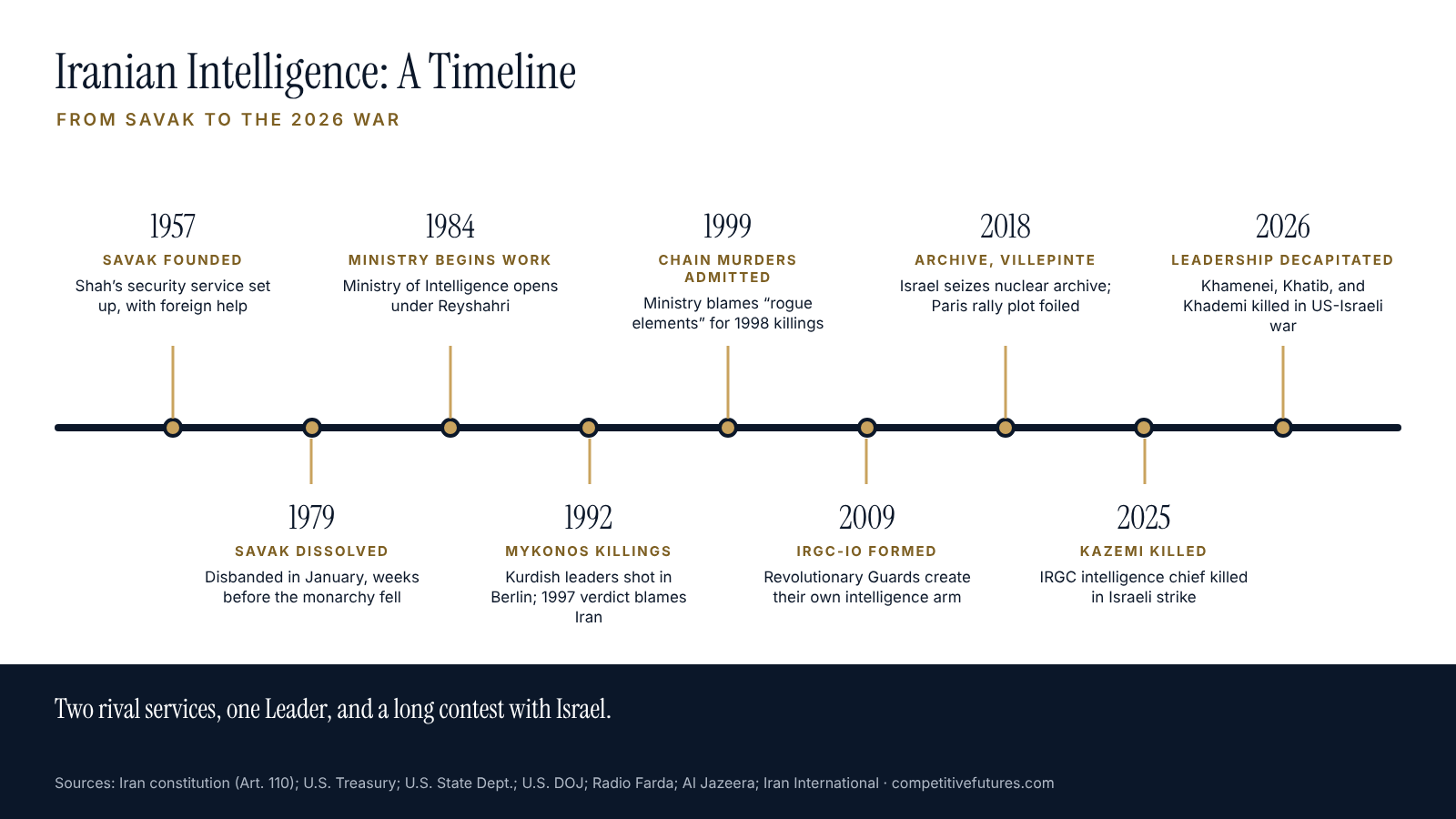
Modern Iranian intelligence begins with SAVAK, the Shah’s security and intelligence organization, set up in 1957. A 1991 research response by the Immigration and Refugee Board of Canada, summarizing the scholarly literature, cites the historian Mohsen Milani’s description of SAVAK as “created through the assistance of the Mossad and the CIA in 1957,” and notes that Ervand Abrahamian also names the FBI. SAVAK was formally attached to the prime minister’s office, suppressed opposition at home and abroad, and extended its reach into professional associations and the press. According to Milani, Shapour Bakhtiar, the Shah’s last prime minister, “dissolved SAVAK in January 1979,” weeks before the monarchy fell (Immigration and Refugee Board of Canada, via ecoi.net).
The revolution did not end secret policing; it replaced it. In the early 1980s, several revolutionary bodies competed for intelligence work, including the Revolutionary Guards. In 1983 the parliament passed the law establishing the Ministry of Intelligence (Radio Farda), which began operating in 1984 with the cleric Mohammad Mohammadi Reyshahri as the country’s first intelligence minister (Amwaj.media). The ministry is unusual in requiring clerical credentials at the top: a 2012 Library of Congress Federal Research Division profile states that “every minister of intelligence must hold a degree in ijtihad,” the qualification to issue rulings in Islamic law. The same report estimated the ministry’s staff at more than 30,000, a figure the Federation of American Scientists noted could not be independently corroborated (Federation of American Scientists).
The ministry’s first decades established the reputation that still follows it: assassinations of exiled opponents in Europe in the 1980s and 1990s, and, at home, the 1998 killings of dissident writers that the ministry itself later blamed on its own officers (both described below). Abroad, the Revolutionary Guards developed a parallel capability through the Quds Force.
The disputed 2009 presidential election and the protests that followed were a turning point. That year the Revolutionary Guards set up their own Intelligence Organization under Hossein Taeb, who had led the Basij militia; he ran it for 13 years (Al Jazeera). Since then, Iran has had two major intelligence services with overlapping domestic and foreign missions, and an expanding set of smaller ones. In 2014, the IRGC-affiliated Fars news agency reported that the number of intelligence and intelligence-protection bodies had grown from five in 1989 to 16 (Radio Farda, citing Fars).
How Iranian intelligence is organized today
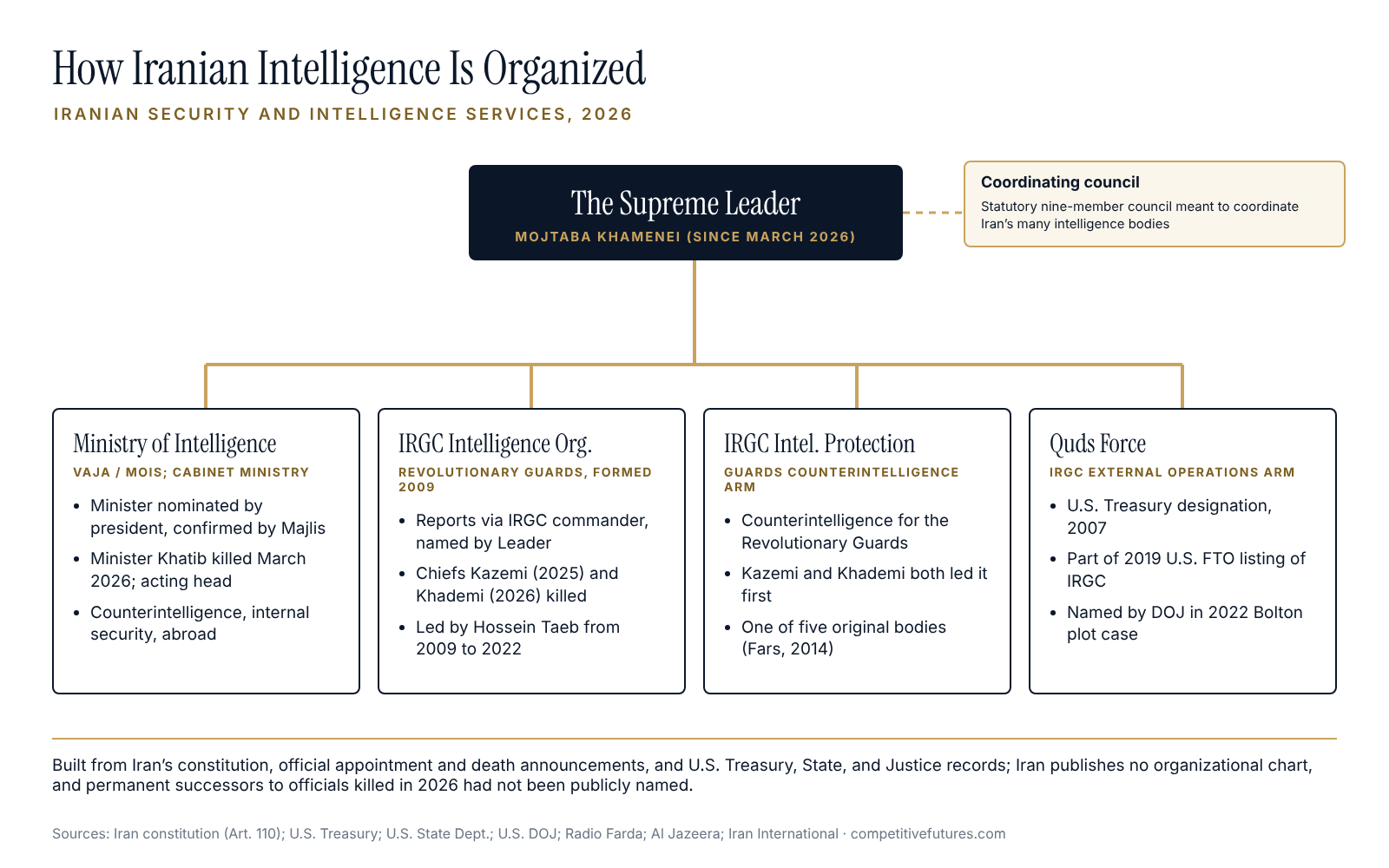
Iran publishes its founding laws and constitution, but not budgets, organizational charts, or the full roster of its intelligence chiefs. The public evidence comes from the constitution, official appointment announcements, and foreign sanctions and court records. It shows a crowded system answering, in the end, to one man.
- The Ministry of Intelligence is a cabinet ministry. Its minister is nominated by the president and confirmed by parliament: Khatib, who had served under President Ebrahim Raisi, was re-nominated by Pezeshkian and confirmed with 261 votes on August 21, 2024 (bne IntelliNews). It handles counterintelligence, internal security, and foreign intelligence. U.S. Treasury sanctioned the ministry again, with Khatib, in September 2022 over cyberattacks that “disrupted Albanian government computer systems” (U.S. Treasury); Albania’s prime minister said the attack was “orchestrated and sponsored” by Iran and cut diplomatic ties (The Record).
- The IRGC Intelligence Organization sits inside the Revolutionary Guards and reports through the IRGC commander, whom the Supreme Leader appoints. In January 2026 the U.S. Treasury sanctioned its then chief, Khademi, over the suppression of protests (The New Arab).
- The IRGC Intelligence Protection Organization is the Guards’ counterintelligence arm; both Kazemi and Khademi led it before running the Intelligence Organization (Al Jazeera; IranWire).
- The Quds Force runs the IRGC’s external military and paramilitary relationships; the U.S. Treasury has said it supplies the Taliban, Hezbollah, Hamas, and Palestinian Islamic Jihad.
- Smaller bodies include intelligence units of the regular army, the police, and the judiciary. The ministry’s statute provides for a nine-member coordinating council of intelligence bodies (Radio Farda).
The 2025 and 2026 wars hit this structure at the top. Israel’s June 2025 campaign killed Kazemi and his deputy (Euronews). The war that the United States and Israel launched on February 28, 2026 killed Supreme Leader Ali Khamenei on its first day, and in March, Israel’s defense minister said Israel had killed Khatib; President Pezeshkian confirmed the death and condemned the “cowardly assassination” of his colleagues (Al Jazeera). The IRGC confirmed Khademi’s death in April 2026 and praised his “great, lasting and instructive contributions in the fields of intelligence and security” (The New Arab). Who now runs each service, permanently, is one of the least transparent questions in Iranian politics.
Two services, one Leader
The defining feature of Iranian intelligence is that it has two centers of gravity. The Ministry of Intelligence belongs to the elected government; its minister sits in the cabinet and answers to parliament. The IRGC Intelligence Organization belongs to the Revolutionary Guards, whose commander is appointed by the Supreme Leader under Article 110 of the constitution (Constitute Project). The overlap is deliberate. A clerical minister and a Guards intelligence chief each report information that the other may not, and the Leader’s office sits above both.
Iranian and diaspora reporting has described the relationship as competitive. When Taeb was removed in June 2022, IranWire called the ministry the Guards unit’s “internal arch-rival” and noted that both services had faced mounting scrutiny over their failure to stop Israeli operations inside Iran, including the 2020 killing of nuclear scientist Mohsen Fakhrizadeh (IranWire). The IRGC gave no reason for his removal; it came days after Turkish authorities arrested members of an alleged Iranian-linked network said to be targeting Israelis in Istanbul, an allegation Israel’s foreign minister made publicly (Axios). Taeb was kept on as an adviser to the IRGC commander.
For anyone reading Iranian security behavior, the practical point is that “Iran” rarely acts through a single channel. U.S. charging documents and European verdicts have attributed some operations abroad to the ministry and others to the Guards, and in at least one case, described below, to both at different stages.
Iranian intelligence in the news
Most of what is publicly known about how Iran uses its intelligence services comes from the cases below. In each, the allegations come from courts, prosecutors, governments, or reporters; Iran has denied them, rejected the courts’ jurisdiction, or not commented.
The Mykonos killings in Berlin (1992–1997)

In 1992, gunmen killed Iranian Kurdish opposition leaders at the Mykonos restaurant in Berlin. After a trial of about three and a half years, a German court concluded in 1997 that the Iranian government was “directly involved.” Germany’s chief federal prosecutor had issued an arrest warrant for Intelligence Minister Ali Fallahian and said Supreme Leader Ali Khamenei and President Akbar Hashemi Rafsanjani “had knowledge of the crime.” European Union governments withdrew their ambassadors from Tehran (RFE/RL). Iran denied involvement. When one of the men convicted, Kazem Darabi, was later released and returned to Tehran, he said his release “proves I am innocent” and denied links to Iranian intelligence.
The chain murders (1998–1999)
In late 1998, several dissident writers and political figures were murdered in Iran, among them the veteran nationalist politician Dariush Forouhar and his wife, Parvaneh. On January 5, 1999, after a reformist newspaper had already reported that security forces were responsible, the Ministry of Intelligence made an extraordinary admission: “rogue elements” inside the security services had carried out the killings. The ministry called the murders “treason,” said the agents acted without orders, and claimed they served unspecified “foreign interests” (RFE/RL). Critics of the official account say the 1998 deaths were part of a longer series of killings of dissidents and intellectuals in the 1990s; Iran International, a London-based Persian-language broadcaster that Tehran regards as hostile, puts the toll at “at least 80 lives” (Iran International). Who ordered the killings has never been established in court.
The Villepinte bomb plot and the prisoner swap (2018–2023)

On June 30, 2018, European police foiled a plan to bomb a rally near Paris held by the National Council of Resistance of Iran, an exile opposition coalition. In January 2019 the EU added the Directorate for Internal Security of Iran’s intelligence ministry, the Vienna-based diplomat Assadollah Assadi, and a deputy minister to its terrorism sanctions list; Iran denied the allegations and promised to reciprocate (RFE/RL). In February 2021, a Belgian court sentenced Assadi to 20 years for attempted terrorism,; three co-defendants received 15 to 18 years. Iran called the case a “shallow fabrication” and said his prosecution violated the Vienna Convention on Diplomatic Relations (Al Jazeera).
On May 26, 2023, Belgium and Iran exchanged Assadi for Olivier Vandecasteele, a Belgian aid worker who had spent 455 days in an Iranian prison and had been sentenced to 40 years for espionage, a charge Belgium and his family rejected. Oman mediated. Belgian intelligence had described Assadi as an officer of Iran’s intelligence ministry working under diplomatic cover. Foreign Minister Hossein Amirabdollahian said Assadi had been “illegally detained,” while the opposition coalition called the release “a shameful ransom to terrorism and hostage-taking” (Al Jazeera).
Israeli penetration: from the nuclear archive to the 2026 war (2018–2026)
On April 30, 2018, Prime Minister Benjamin Netanyahu announced that Israel had taken about half a tonne of material from a Tehran warehouse, including “55,000 pages” and “55,000 files on 183 CDs,” and said it proved Iran had lied about past nuclear weapons work. Foreign Minister Javad Zarif replied that “the boy who can’t stop crying wolf is at it again,” and Iranian state television called the accusations “baseless” (Al Jazeera).
On July 31, 2024, Hamas political leader Ismail Haniyeh was killed in Tehran, where he had come for Pezeshkian’s inauguration. The Revolutionary Guards said a “short-range projectile” was fired from outside his lodging; Western press reports said a bomb had been planted in advance, and one, citing Iranian officials, said Guards members were paid to place it. Iran’s judiciary called reports of mass arrests “false” (Times of Israel). In December 2024, Israeli Defense Minister Israel Katz publicly acknowledged the killing (The New Arab).
The June 2025 war and the 2026 war turned penetration into decapitation, killing the IRGC intelligence chief, his successor, and the intelligence minister, as described above. In April 2026, the Israeli military also said it had killed Asghar Bagheri, whom it identified as a Quds Force special operations commander (Fox News). Iran’s response at home has been a wave of espionage prosecutions. In September 2025, Iran hanged Bahman Choobiasl, who was accused of meeting Mossad officers, its tenth known execution for spying since the June war; activists said another man executed that month, Babak Shahbazi, had been tortured into a false confession (Al Jazeera).
Ruhollah Zam (2019–2020)
Ruhollah Zam ran the Telegram channel Amadnews from exile in France, reaching up to two million followers during the 2017–2018 protests. In October 2019, he traveled to Iraq, apparently believing he would interview Grand Ayatollah Ali al-Sistani, and was seized there and taken to Iran (AFP via Times of Israel). The Revolutionary Guards said they had brought him back in a “complex security operation,” and Sistani’s office denied inviting him (IranWire). Convicted of “sowing corruption” and of spying for France and Israel, charges he and his supporters denied, Zam was hanged on December 12, 2020. The UN human rights chief, Michelle Bachelet, had warned that his capture “could amount to an abduction”; President Hassan Rouhani said the execution would not harm relations with Europe (AFP via Times of Israel).
The plots against Masih Alinejad (2020–2025)

In July 2021, federal prosecutors in Manhattan charged Alireza Shavaroghi Farahani, described as an Iranian intelligence official, and three alleged intelligence assets with plotting since at least June 2020 to kidnap a Brooklyn journalist and human rights activist and take her to Iran. Prosecutors alleged the network hired private investigators under false pretenses to watch her home, researched speedboat evacuation from New York and travel to Venezuela, and targeted people in Canada, the United Kingdom, and the United Arab Emirates (U.S. Attorney, SDNY). The target, Masih Alinejad, was identified by Reuters (Al Jazeera). Foreign Ministry spokesman Saeed Khatibzadeh said the claim was “so baseless and ridiculous that it is not really worth answering” (Reuters via The Star). The four Iranian defendants remain at large in Iran.
A second plot followed. According to the Justice Department, the IRGC offered $500,000 to Rafat Amirov, a leader of a Russian criminal organization, to have Alinejad killed, and a member of the group was arrested near her home in July 2022 with an AK-47-style rifle. Amirov and Polad Omarov were convicted in March 2025 and sentenced to 25 years each in October 2025 (U.S. Justice Department). The two cases illustrate the two-service pattern: the 2021 case named an intelligence official, the 2025 case the Revolutionary Guards.
The plot against John Bolton (2021–2022)
In August 2022, the Justice Department charged Shahram Poursafi, a 45-year-old Tehran resident it said was working on behalf of the IRGC’s Quds Force, with trying from October 2021 to pay individuals in the United States $300,000 to murder former National Security Advisor John Bolton, “likely in retaliation for the January 2020 death of Qasem Soleimani.” Poursafi remains at large abroad (U.S. Justice Department). Foreign Ministry spokesman Nasser Kanani said the department had made allegations “without providing valid evidence, creating a new work of fiction” (Dawn).
How to read coverage of Iranian intelligence
Iran is a difficult intelligence subject because almost every source is a combatant. Iran’s own outlets, such as Press TV, IRNA, Tasnim, and Fars, are state-run or close to the Revolutionary Guards and present arrests and executions as counterespionage successes. Persian-language outlets abroad include Radio Farda, funded by the U.S. government through RFE/RL, and Iran International, which Tehran treats as hostile. Israeli officials often announce or confirm operations for political as well as military reasons, and Iranian officials often deny or minimize them for the same reasons. Opposition groups are both targets of Iranian operations and sources of claims about them.
The discipline is the same one taught in our guides to trend analysis and cognitive bias: climb toward primary records. For Iran, the strongest evidence is in court verdicts and charging documents (Berlin, Antwerp, and the U.S. District Court for the Southern District of New York), U.S. Treasury and State Department designations, the EU’s Official Journal, and Iran’s own official announcements of appointments and deaths. For influence questions in Washington, the Justice Department’s public database of registered foreign agents (FARA eFile) shows who is registered on behalf of which governments and opposition groups. Remember that a U.S. indictment is an accusation, not a finding, and that confessions broadcast on Iranian state television are not evidence of anything except that the state wanted them broadcast.
Frequently asked questions
What is Iran’s intelligence agency called?
Iran has two main intelligence services: the Ministry of Intelligence (VAJA, often called MOIS in English), a cabinet ministry created by law in 1983 that began work in 1984, and the Intelligence Organization of the Islamic Revolutionary Guard Corps, formed in 2009. The IRGC’s Quds Force runs external paramilitary operations.
Who is the head of Iranian intelligence?
Intelligence Minister Esmaeil Khatib was killed in an Israeli strike in March 2026, and President Pezeshkian appointed an acting minister whose name was not announced at the time; the two most recent IRGC intelligence chiefs, Mohammad Kazemi and Majid Khademi, were killed in June 2025 and April 2026. Above them all is the Supreme Leader, Mojtaba Khamenei, named in March 2026.
Why does Iran have two intelligence services?
The Ministry of Intelligence belongs to the elected government, while the IRGC Intelligence Organization belongs to the Revolutionary Guards, whose commander is appointed by the Supreme Leader. The arrangement gives the Leader more than one source of information and more than one instrument, at the cost of rivalry and duplication between the two.
Related reading
- Qatari Intelligence: History, Structure, and the Headlines
- Trend Analysis: How to Tell a Real Trend From Media Hype
- Cognitive Bias: A Field Guide for Leaders
- Scenario Planning
Competitive Futures briefs companies and governments on intelligence services, foreign influence, and Iran and the Middle East; details are on the services page.