Mexican Intelligence: History, Structure, and the Headlines
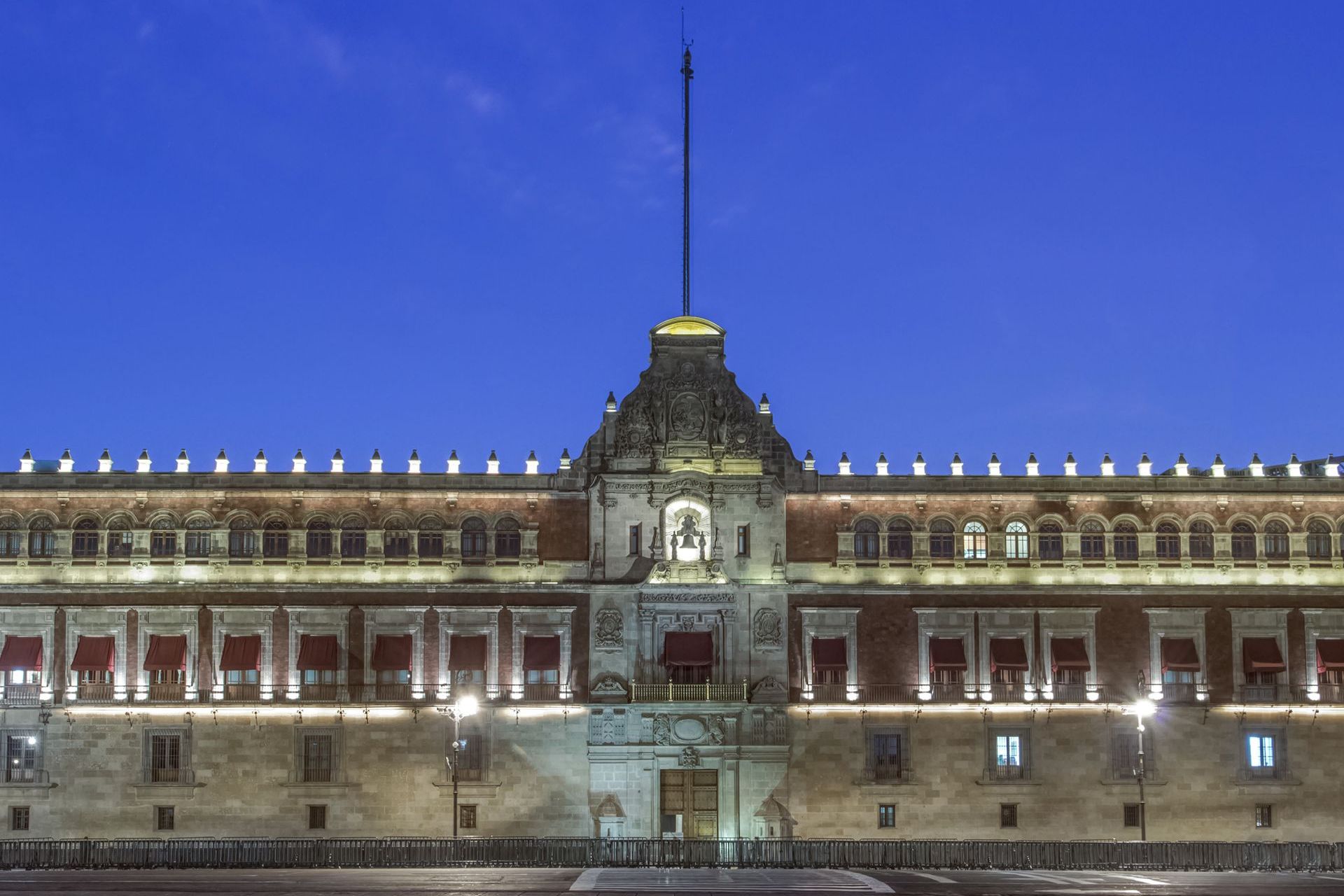
Mexico shares a 3,000-kilometer border with the United States, hosts some of the world’s most powerful criminal organizations, and has spent most of a century deciding whether its intelligence services exist to protect the state from its citizens, from foreign powers, or from the cartels. The name on the door has changed with the answer, from the Federal Security Directorate to CISEN to the National Intelligence Center. What has not changed is that Mexican intelligence sits at the center of the country’s relationship with Washington and its long war on organized crime.
This page is a working overview of Mexico’s intelligence services: where they came from, how they are organized today, and the cases that have put them in the news. It relies on Mexican laws as published in the Diario Oficial de la Federación, U.S. and Mexican court and prosecutorial records, forensic research, and named reporting, and it notes where a claim comes from a party with an interest in the outcome.
Mexican intelligence at a glance
- Main civilian intelligence service: the National Intelligence Center (Centro Nacional de Inteligencia, CNI), an administrative body under the Secretariat of Security and Citizen Protection (SSPC). It replaced CISEN after reforms to the federal public administration law published on November 30, 2018 (Government of Mexico).
- Head: Francisco Almazán Barocio, a career police investigator and former head of Mexico City’s investigative police, designated director general of the CNI in September 2024 as the incoming Sheinbaum government assembled its security team (SDP Noticias; ITAM CESIG).
- Reporting line: the CNI sits inside the SSPC, headed since September 30, 2024, by Omar García Harfuch, who reports to President Claudia Sheinbaum (Zeta Tijuana).
- Military intelligence: run separately by the Secretariat of National Defense (SEDENA), under Gen. Ricardo Trevilla Trejo, and the Secretariat of the Navy (SEMAR), under Adm. Raymundo Pedro Morales Ángeles, both in office since October 1, 2024 (Zeta Tijuana).
- Legal framework: the National Security Law of 2005 (Chamber of Deputies) and the Law of the National Investigation and Intelligence System in Public Security Matters, published July 16, 2025 (Chamber of Deputies).
- Relationship with the United States: deep but contested. The two governments share cartel intelligence, but a 2020 law restricts what foreign agents may do in Mexico, and disputes over unauthorized U.S. activity recur.
History: from political police to cartel intelligence
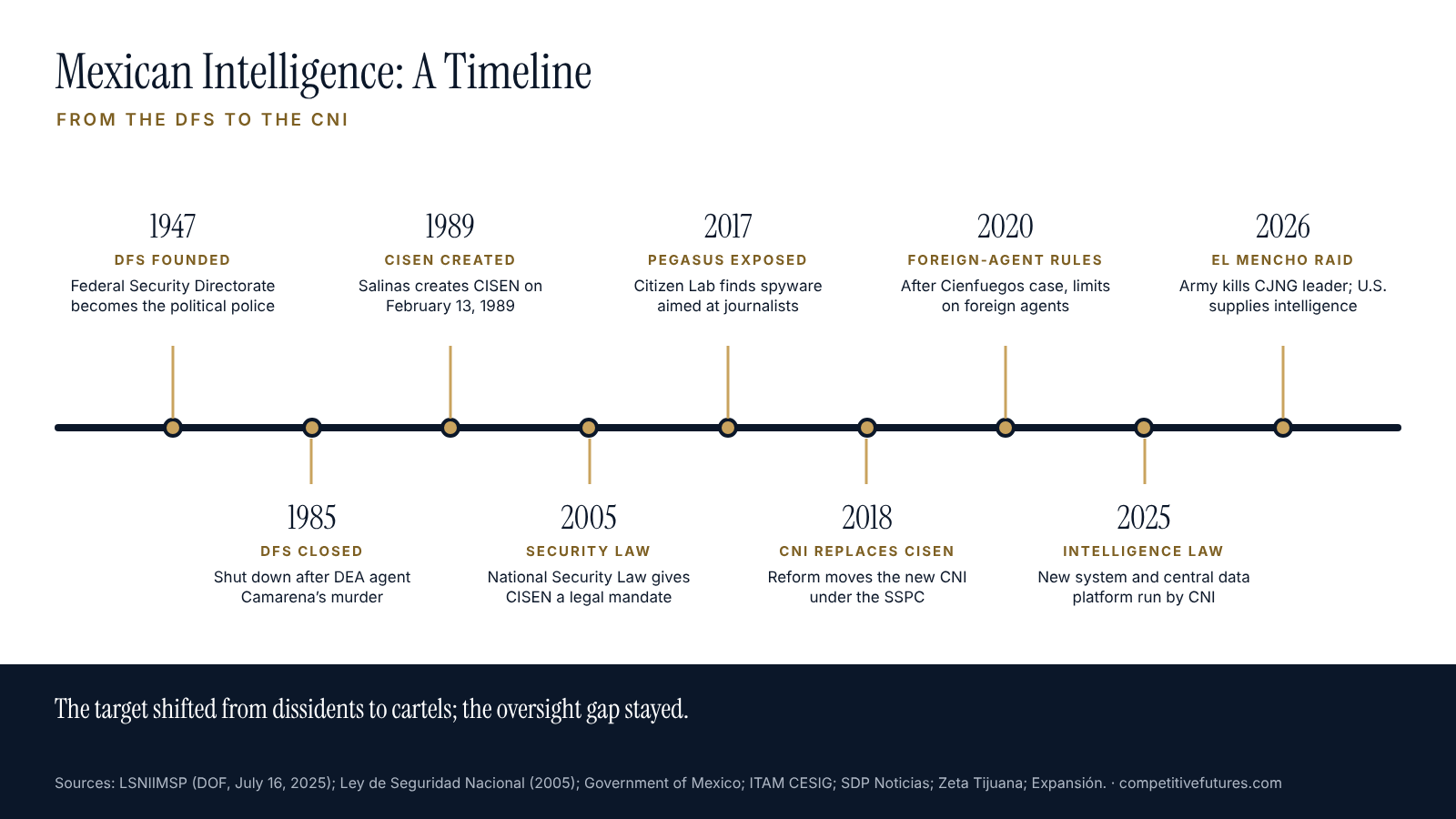
Modern Mexican intelligence begins with the Federal Security Directorate (Dirección Federal de Seguridad, DFS), created in 1947 with the stated aim to “preservar la estabilidad del país y combatir a grupos subversivos y terroristas,” to preserve the country’s stability and combat subversive and terrorist groups (Expansión). In practice, it became the political police of the long era of one-party rule.
Its darkest chapter was the “dirty war” against leftist guerrillas and student movements in the 1960s, 1970s, and 1980s. In 2006, the National Security Archive published a draft report by Mexico’s special prosecutor for past political crimes concluding that hundreds of people had been killed or “disappeared” by military and security forces between 1964 and 1982 (National Security Archive). In 2004, prosecutors arrested the former DFS director Miguel Nazar Haro over the 1975 disappearance of Jesús Piedra Ibarra, a leader of the Liga Comunista 23 de Septiembre; the case stalled on appeal, Nazar Haro was acquitted in a separate case in 2006, and he died in 2012 without being convicted (Expansión). In August 2024, a government truth mechanism presented its report, “Fue el Estado: 1965–1990,” documenting 8,594 victims of grave human rights violations; its commissioners said the army still protects key information (La Crónica).
The DFS did not survive the drug trade. In May 1984, the columnist Manuel Buendía was murdered in Mexico City; José Antonio Zorrilla Pérez, then head of the DFS, was later convicted of the killing and served years in prison, though he always denied it (El Financiero). In February 1985, the U.S. Drug Enforcement Administration agent Enrique “Kiki” Camarena was kidnapped and murdered in Guadalajara. Zorrilla was removed from the DFS that month, and before the end of 1985 President Miguel de la Madrid ordered the agency closed (Expansión).
A successor directorate briefly took its place until, on February 13, 1989, President Carlos Salinas de Gortari created the Center for Investigation and National Security (CISEN), with Gen. Jorge Carrillo Olea as its first head (El Universal). CISEN’s mandate was written into the National Security Law of January 31, 2005, which defined it as an autonomous administrative body of the Interior Secretariat (Chamber of Deputies).
Andrés Manuel López Obrador campaigned on abolishing CISEN, arguing that it spied on opponents rather than doing intelligence work (El Universal). After he took office, the 2018 reform moved the renamed CNI into the new SSPC, and in February 2019 his government ordered agencies to transfer historical records on political persecution and human rights violations to the National Archive (Expansión). Audomaro Martínez ran the CNI from 2018 to 2024 (ITAM CESIG).
How Mexican intelligence is organized today
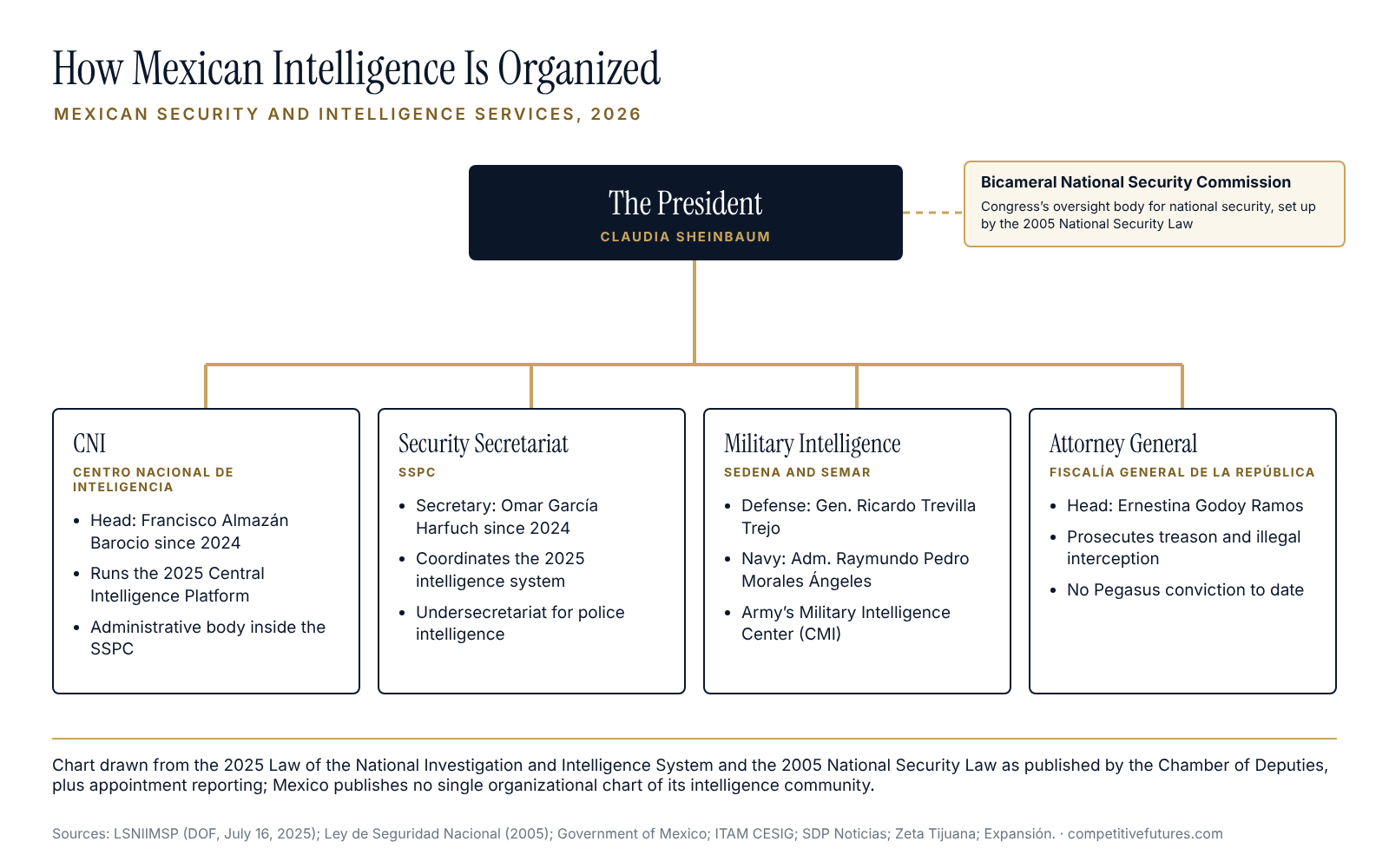
Mexico has no director of national intelligence. The CNI coordinates and collaborates with other agencies rather than commanding them (ITAM CESIG). The 2025 law changed that balance by giving the security secretariat a statutory hub.

- The National Intelligence Center (CNI) is the civilian service. Under the 2025 law, it is “responsable de la operación diaria del Sistema,” responsible for the daily operation of the national system, and for administering the new Central Intelligence Platform (Chamber of Deputies). Its budget rose from about 2.76 billion pesos in 2025 to about 3.86 billion pesos in 2026, and its mandate is domestic, with no foreign intelligence arm comparable to those of larger powers (La Crónica).
- The Security Secretariat (SSPC) coordinates the national system, and its Undersecretariat of Intelligence and Police Investigation carries out investigations and supports prosecutors (Chamber of Deputies).
- The Defense Secretariat (SEDENA) runs army and air force intelligence, including the Military Intelligence Center that civil-society investigators identified in 2023 as the unit behind military spyware use (LatAm Journalism Review). It also commands the National Guard, whose “plan de consolidación” Gen. Trevilla announced on taking office (Zeta Tijuana).
- The Navy (SEMAR) maintains its own naval intelligence apparatus, separate from the army’s.
- The Attorney General’s Office (FGR), headed by Ernestina Godoy Ramos, prosecutes espionage, illegal interception, and treason cases (Expansión).
The 2025 law is the most important structural change in a generation. It creates a National Investigation and Intelligence System and a platform that can connect to vehicle, biometric, telephone, property, financial, health, and telecommunications records, and it requires private companies holding such databases to share them (Chamber of Deputies). Critics among legislators, academics, and civil society warned that the breadth of access “podría derivar en una vigilancia intensiva sin precedentes,” could lead to unprecedented intensive surveillance, with no prior judicial review and the system’s information classified as reserved (IDC Online).
Intelligence against the cartels
Mexico’s intelligence priorities are now set by criminal organizations that run their own surveillance networks, bribe officials, and fight wars with each other. The best public window on that contest is the operation that killed Nemesio Oseguera Cervantes, “El Mencho,” leader of the Jalisco New Generation Cartel, near Tapalpa, Jalisco, on February 22, 2026. According to Defense Secretary Trevilla, military investigators identified a trusted associate of one of Oseguera’s partners, followed him as he escorted her to the cartel leader, and sent special forces in after she left; Trevilla said U.S. intelligence provided “very important additional information” confirming the location. More than 70 people died in the operation and the reprisals that followed, including 25 National Guard members (Fortune).
The U.S. contribution is described differently in each capital. Reuters reported that a new U.S. military-led body, the Joint Interagency Task Force–Counter Cartel, launched in January 2026, “played a role,” in the words of a U.S. defense official who stressed that the raid was a Mexican operation. Mexico’s defense ministry said only that U.S. authorities provided “complementary information,” and a Mexican government source said no U.S. military personnel were physically involved (Reuters via Arab News).
In February 2025, the New York Times reported that the CIA was flying drones over Mexico to locate fentanyl labs. The CIA declined to comment, and President Sheinbaum said the flights were made with her government’s collaboration, adding: “Every time it is at Mexico’s request for collaboration, for information” (AP via Stars and Stripes). In 2025, Mexico also sent dozens of cartel suspects to U.S. courts (Daily Maverick). A constitutional amendment published April 1, 2025, states that Mexico will not consent to foreign intervention in investigations without the authorization of the Mexican state (Publimetro).
Mexican intelligence in the news
Most public knowledge of how Mexico’s intelligence and security services operate comes from eight cases. In each, allegations come from prosecutors, investigators, researchers, or reporters, and the outcome in court often differs from the headline.
Genaro García Luna (2001–2024)
Genaro García Luna headed Mexico’s Federal Investigation Agency from 2001 to 2005 and was secretary of public security, in charge of the Federal Police, from 2006 to 2012. In February 2023, a federal jury in Brooklyn convicted him of taking millions of dollars in cash bribes from the Sinaloa Cartel in exchange for safe passage for its drug shipments and sensitive law enforcement information. On October 16, 2024, Judge Brian Cogan sentenced him to 460 months in prison and a $2 million fine (U.S. Immigration and Customs Enforcement). García Luna maintained his innocence, telling the court, “I have not committed any of these crimes,” and saying Mexico’s government and criminal groups had smeared him (Daily Maverick).
Ayotzinapa and the army’s intelligence files (2014–present)
On the night of September 26, 2014, 43 students from the Ayotzinapa teachers’ college disappeared in Iguala, Guerrero. The international expert group (GIEI) that investigated the case documented that the army had internal communications tracking the students during and after the attack, and in 2023 it accused the defense and navy ministries of withholding documents it knew existed. President López Obrador rejected the charge, saying, “no es cierto que Marina y Defensa no estén ayudando,” it is not true that the navy and defense ministries are not helping (Zeta Tijuana). By March 2026, a Mexico City court had ordered SEDENA to hand over records from the Regional Intelligence Fusion Center in Iguala, ruling that the information cannot be classified as confidential; the families say about 853 military folios were never provided (Grupo Animal). By the case’s twelfth anniversary, at least 20 soldiers had been named in judicial investigations, the government was reporting new arrests, and the students’ fate was still unresolved (Grupo Animal).
Pegasus and the journalists (2017–2024)
In June 2017, the University of Toronto’s Citizen Lab, working with the Mexican groups R3D, SocialTIC, and Article 19, reported that NSO Group’s Pegasus spyware had been used to target journalists including Carmen Aristegui and Carlos Loret de Mola, lawyers at the Centro PRODH human rights center, anti-corruption researchers, and Aristegui’s son, a minor. Citizen Lab wrote that “We have no conclusive evidence attributing these messages to specific government agencies in Mexico,” though NSO sells only to governments (Citizen Lab). President Enrique Peña Nieto denied that his government was responsible and said, “I hope that within the law something can be done about those who lodged false allegations,” before calling for an investigation (Times of Israel). The only person tried, Juan Carlos García Rivera, an employee of a private company that operated Pegasus, was acquitted in January 2024; the judge found that Aristegui had been spied on and asked prosecutors to keep investigating (Voice of America). No one has been convicted.
The Culiacán operation (2019–2023)
On October 17, 2019, soldiers in Culiacán, Sinaloa, detained Ovidio Guzmán López, a son of Joaquín “El Chapo” Guzmán, who was wanted in the United States. Cartel gunmen besieged the city, and the government let him go. In June 2020, López Obrador acknowledged, “yo ordené que se detuviera ese operativo y que se dejara en libertad a este presunto delincuente,” I ordered that operation stopped and this alleged criminal released, saying more than 200 civilians could otherwise have died. His security secretary had earlier conceded that there was no Mexican arrest warrant for Guzmán López at the time, only a U.S. extradition request (Expansión). He was recaptured in January 2023 and extradited to the United States that September (Mexico News Daily).
The Cienfuegos affair and the foreign-agents law (2020–2021)
On October 15, 2020, U.S. authorities arrested Gen. Salvador Cienfuegos, Mexico’s defense secretary from 2012 to 2018, in Los Angeles on drug trafficking charges. The arrest strained relations between the two governments. On November 17, 2020, the U.S. attorney general and Mexico’s attorney general announced that “the U.S. Department of Justice has made the decision to seek dismissal of the U.S. criminal charges against former Secretary Cienfuegos” so that Mexico could investigate him under its own law (U.S. Department of Justice via GlobalSecurity.org). On January 14, 2021, the FGR decided not to prosecute, saying the evidence did not show ties to organized crime; the U.S. government expressed deep disappointment and accused Mexico of breaching a treaty by disclosing evidence the United States had shared (Expansión). Cienfuegos was never tried in either country.
Mexico’s response was legislative. A decree published December 18, 2020, amended the National Security Law to require foreign agents to share the information they gather with Mexican authorities, to strip them of immunity if they commit crimes, and to require state and local officials to report any contact with a foreign agent to the foreign and security ministries within three days (Diario Oficial de la Federación).
Spyware in the army’s hands (2020–2026)
In October 2022, R3D, Article 19, and SocialTIC published “Ejército Espía,” alleging that the army’s Military Intelligence Center had used Pegasus after López Obrador took office, against the human rights defender Raymundo Ramos of Nuevo Laredo and two journalists; SEDENA gave oblique answers or denied the contracts (LatAm Journalism Review). In May 2023, the New York Times reported, with forensic confirmation by Citizen Lab, that Pegasus had repeatedly infected the phone of Alejandro Encinas, the deputy interior minister leading the Ayotzinapa truth commission, while he was investigating the armed forces (Expansión). López Obrador said Encinas had told him about it and that he had told Encinas “not to give it any importance,” adding that “we do not spy” (KJZZ).
The story took a different turn in April 2026, when the U.S. Treasury Department sanctioned Ramos, alleging that he worked for the Cartel del Noreste “bajo la fachada de defensor,” under cover of a rights defender, including by promoting complaints against the army (UnoTV). Ramos denied the allegation, telling AFP that he had spent 30 years as a human rights defender and that attempts to criminalize him had failed (AFP via CRHoy). The sanctions are an administrative designation, not a criminal conviction.
The capture of “El Mayo” Zambada (2024–2026)
On July 25, 2024, Ismael “El Mayo” Zambada, co-founder of the Sinaloa Cartel, landed at a small airstrip in New Mexico with Joaquín Guzmán López, another son of El Chapo, and was arrested. In a letter released by his lawyer, Zambada said he had been kidnapped in Mexico and taken across the border against his will; the U.S. ambassador said he had been brought to U.S. territory against his will by Guzmán López, and the U.S. Embassy said no U.S. resources were used in the transfer. Mexico’s FGR opened a treason investigation under the federal penal code provision that punishes anyone who unlawfully deprives a person of liberty in Mexico to hand them to another country’s authorities (ADN40). The FGR later withdrew its arrest-warrant request against Guzmán López after a judge questioned the evidence; the FGR said its evidence was sufficient and it would go to another court (UnoTV). Zambada pleaded guilty in Brooklyn in August 2025 (Daily Maverick) and was sentenced to life in prison on July 20, 2026; Guzmán López has also pleaded guilty (Al Jazeera).
The Chihuahua operation and the treason case (2026–present)
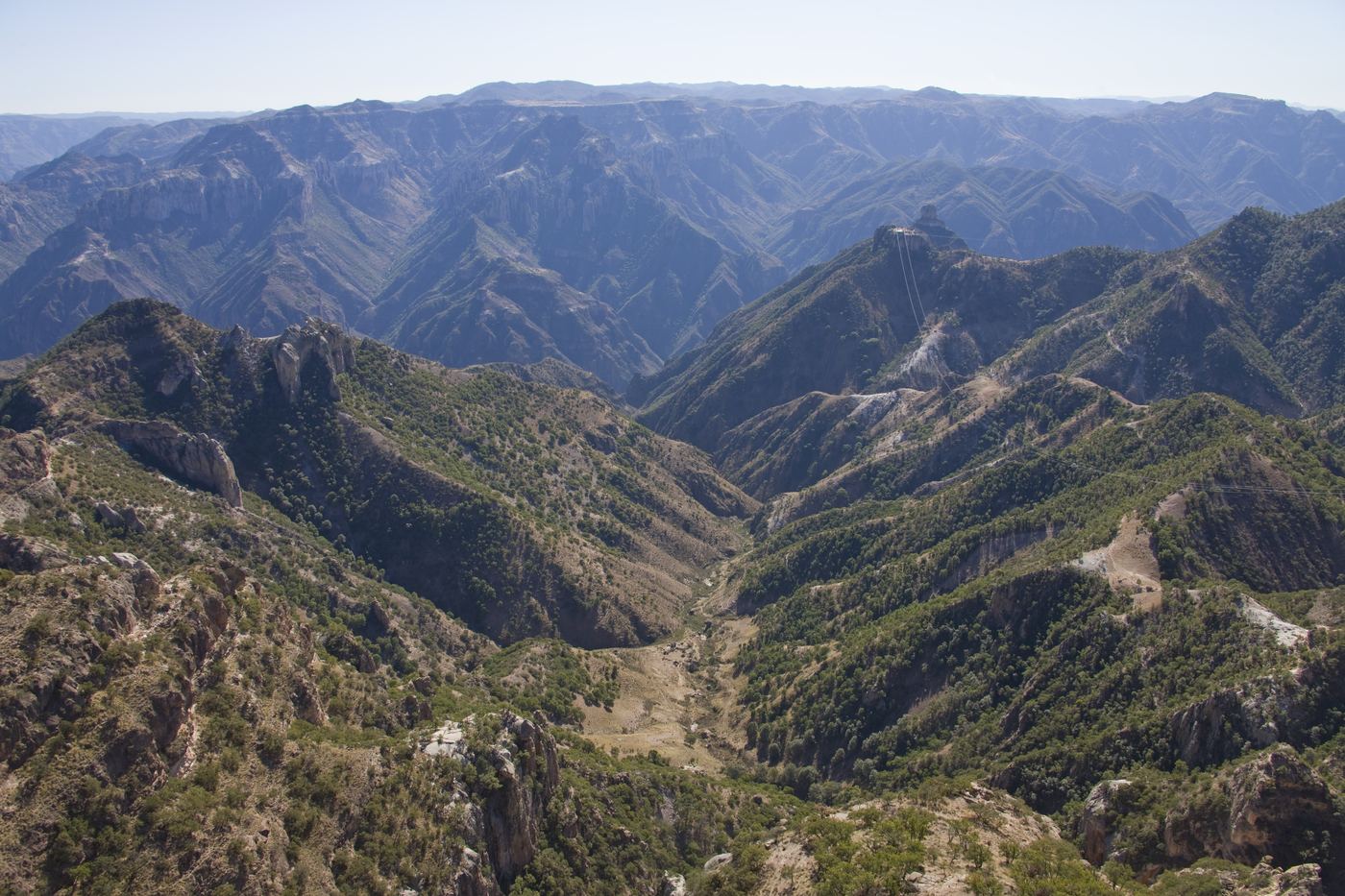
In April 2026, two U.S. officials and two Chihuahua state investigators were killed in a vehicle crash returning from the destruction of a clandestine drug lab in the Sierra Tarahumara. A U.S. official and two others told the AP that the Americans worked for the CIA; the U.S. Embassy said only that they were supporting Chihuahua state authorities against cartel operations, and the CIA declined to comment. President Sheinbaum said she had known nothing of a joint operation (AP via PBS NewsHour). On October 17–18, 2026, the former Chihuahua state prosecutor César Jáuregui Moreno was taken into federal custody, and the FGR charged him with treason for allegedly authorizing U.S. agents to take part without federal approval. Attorney General Godoy said, “Esto atenta contra la soberanía y la integridad de la Nación,” this violates the sovereignty and integrity of the nation. On October 24, a federal judge ordered him to stand trial and kept him in pretrial detention; his lawyer has contested the case (Expansión). Sheinbaum called the operation “muy irresponsable” and said “no se permiten los operativos en tierra de las agencias extranjeras,” ground operations by foreign agencies are not allowed (Zeta Tijuana). Jáuregui has not been convicted.
How to read coverage of Mexican intelligence
Mexican intelligence is hard to research because many of the most important facts surface first in another country. U.S. indictments, sanctions designations, and leaks to American newspapers often set the story, and they reflect U.S. priorities, cooperating witnesses seeking leniency, and evidence Mexican courts may never see. Mexican officials speak mainly through the president’s daily press conference, a political platform as much as a record. Spyware findings come from civil-society researchers with advocacy positions, though their forensic work has held up repeatedly.
The discipline is the same one taught in our guides to trend analysis and evaluating forecasts: climb toward primary records. For Mexico, that means the Diario Oficial de la Federación and the Chamber of Deputies’ consolidated law texts, Mexican court rulings, U.S. federal court dockets and Justice Department releases, Treasury sanctions notices, and the U.S. Justice Department’s public database of registered foreign agents (FARA eFile), which lists the lobbyists and consultants representing Mexican government bodies and private interests in Washington. When a story rests on a single cooperating witness or a single anonymous official, treat it as a lead, not a finding.
Frequently asked questions
What is Mexico’s intelligence agency called?
Mexico’s main civilian intelligence agency is the National Intelligence Center (Centro Nacional de Inteligencia, CNI), part of the Secretariat of Security and Citizen Protection. It replaced the Center for Investigation and National Security (CISEN), which operated from 1989 to 2018, and before that the Federal Security Directorate (DFS), which operated from 1947 to 1985.
Who is the head of Mexican intelligence?
Francisco Almazán Barocio has directed the CNI since the Sheinbaum government took office in 2024; he reports through Security Secretary Omar García Harfuch to President Claudia Sheinbaum. Military intelligence answers separately to the defense and navy secretaries.
Can U.S. agents operate in Mexico?
U.S. agencies have accredited personnel in Mexico for liaison, information exchange, and training, but since a December 2020 amendment to the National Security Law they must share the information they gather with Mexican authorities, have no immunity if they commit crimes, and may not conduct arrests or ground operations, and Mexican officials must report their contacts with them within three days.
Related reading
- Qatari Intelligence: History, Structure, and the Headlines
- Argentine Intelligence: History, Structure, and the Headlines
- How to Evaluate a Forecast
Competitive Futures briefs companies and governments on intelligence services, foreign influence, and Latin America; details are on the services page.