Czech Intelligence: History, Structure, and the Headlines

The Czech Republic is a mid-sized NATO and EU member of about eleven million people, but its intelligence services have produced some of the most consequential public findings in Europe about Russian and Chinese activity. Czech officials publicly tied a Russian military intelligence unit to a deadly sabotage operation on NATO soil, Czech counterintelligence exposed a Moscow-financed media network that reportedly paid politicians across the EU, and the Czech government publicly named a Chinese state-linked hacking group inside its own Foreign Ministry. All of this happened in a country whose communist-era secret police, the StB, is still a live subject in its politics, including in disputes about the current prime minister’s past.
This page is a working overview of Czech intelligence: where it came from, how it is organized under the law today, how leadership has changed since the October 2025 election, and the cases that have put it in the news. It relies on Czech statutes, official releases, EU legal acts, court-reported facts, and named reporting, and it flags claims from interested parties or anonymous sources.
Czech intelligence at a glance
- Legal basis: Act No. 153/1994 Coll. on the intelligence services names three services: the Security Information Service, the Office for Foreign Relations and Information, and Military Intelligence. The government is responsible for their activities and coordinates them (Act 153/1994, zakonyprolidi.cz).
- Security Information Service (Bezpečnostní informační služba, BIS): the domestic counterintelligence and security service. Director: Michal Koudelka, who has led it since August 2016 (E15) and was reappointed from February 15, 2022 (Radio Prague International). His mandate expires in February 2027 (Echo24).
- Office for Foreign Relations and Information (Úřad pro zahraniční styky a informace, ÚZSI): the civilian foreign intelligence service, attached to the Interior Ministry. Director: Miroslav Toman, from October 1, 2026, succeeding Vladimír Posolda (Ministry of the Interior).
- Military Intelligence (Vojenské zpravodajství, VZ): part of the Defense Ministry and the only Czech service that combines foreign intelligence and counterintelligence. Director: Lt. Gen. Petr Bartovský, since July 1, 2024 (Ministry of Defense).
- Oversight: the government, the Chamber of Deputies, and a five-member Independent Oversight Body elected by the Chamber; that body was created in law in 2017 but was not staffed until July 2024 (ČT24).
- Relationship with the United States: allied. The Czech Republic joined NATO on March 12, 1999, among the first former Warsaw Pact members to do so (NATO), and its services work with U.S., NATO, and EU partners; its 2025 attribution of a cyberattack to China drew statements of support from the EU and the North Atlantic Council (The Record).
History: from the StB to a law-based system
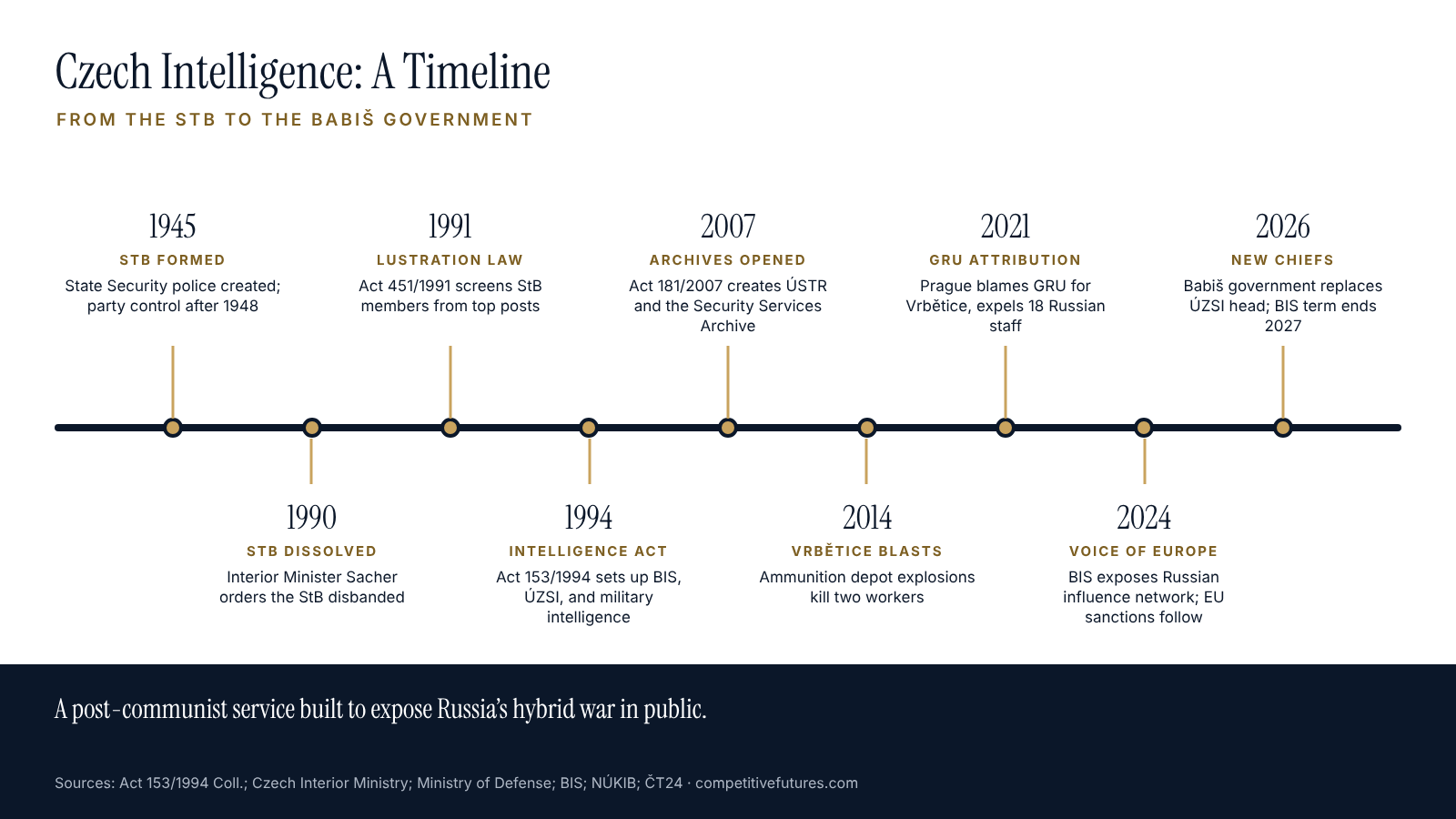
Czechoslovakia’s communist-era secret police, the Státní bezpečnost (StB), was formed in 1945, came under Communist Party control, and grew rapidly after the party’s February 1948 seizure of power (Radio Prague International). For four decades it watched, recruited, and harassed citizens at home. Radio Prague, the public international broadcaster, has called the StB era “one of the ugliest chapters in Czechoslovak history.”
The Velvet Revolution of November 1989 ended that system quickly. On January 31, 1990, Interior Minister Richard Sacher ordered the StB dissolved, and within 15 days some 13,000 StB officers had handed in their weapons and badges (Radio Prague International). Act No. 451/1991 Coll., the lustration law, requires a certificate for many elected and appointed posts stating whether the person was a member of the StB or recorded in its files as a collaborator between February 25, 1948, and November 17, 1989. The Interior Ministry still issues those certificates; the law does not apply to people born after December 1, 1971 (Ministry of the Interior).
Opening the files took longer. Victims gained access to StB records in December 1996, and a law passed in March 2003 let the wider public consult the lists, after which the Interior Ministry opened documentation on 75,000 StB informants (Radio Prague International). In 2007, Parliament created the Institute for the Study of Totalitarian Regimes (ÚSTR) and the Security Services Archive (ABS), which holds the communist-era security files. The law’s preamble says the state should make the secret activities of the totalitarian security services accessible “v maximální míře,” to the greatest possible extent (Act 181/2007; Security Services Archive; ÚSTR).
The new democratic services were built in the early 1990s and put on a single legal footing by Act No. 153/1994 Coll., which defines intelligence services as state bodies for gathering and evaluating information important for the constitutional order, economic interests, security, and defense of the Czech Republic (Act 153/1994). Military intelligence took its present form in 2005, when the military counterintelligence service and the military foreign intelligence service were merged into a single Military Intelligence (Military Intelligence).
How Czech intelligence is organized today
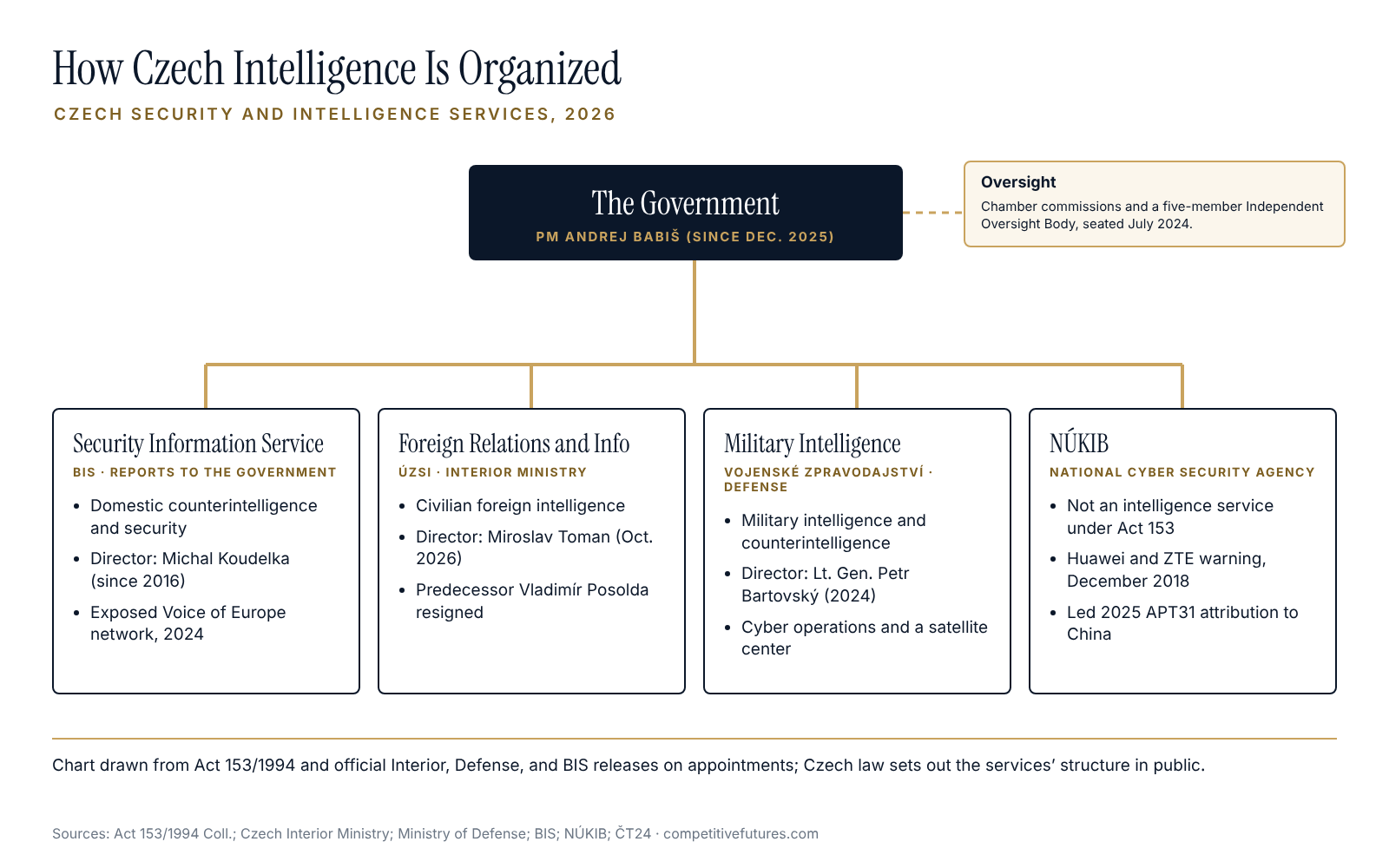
The Czech intelligence architecture is set out in public statute. The services report annually to the President and the government, and urgent findings go directly to the President, the Prime Minister, and the relevant ministers (Act 153/1994).
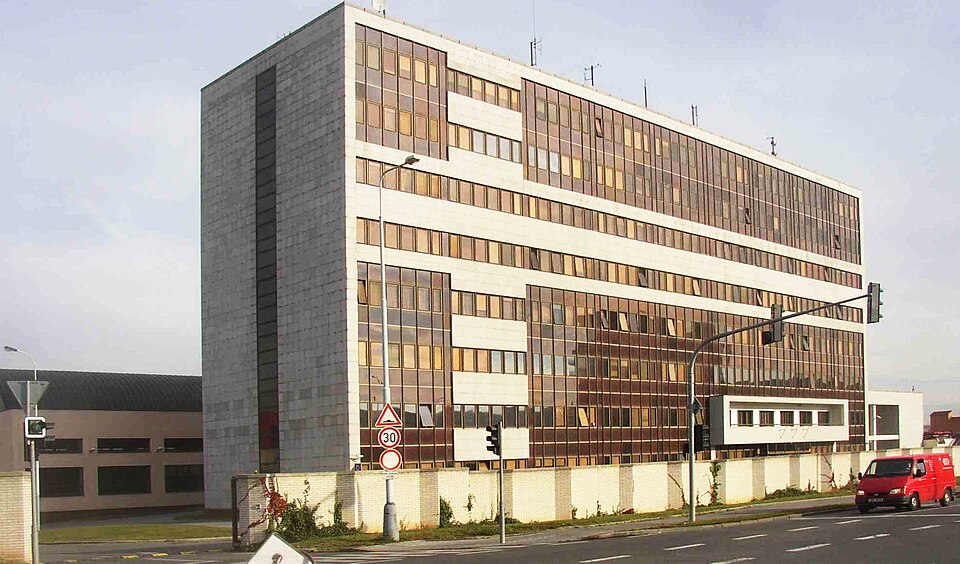
- The Security Information Service (BIS) is the domestic counterintelligence and security service. Its director has listed its priorities as espionage, terrorism, disinformation campaigns, and threats in cyberspace, and its director is appointed by the government after review by the Chamber’s security committee (BIS). BIS publishes an unclassified annual report; the report for 2025 was released on August 27, 2026 (BIS).
- The Office for Foreign Relations and Information (ÚZSI) is the civilian foreign intelligence service. Its director is appointed through the Interior Minister, with the government’s consent (Ministry of the Interior).
- Military Intelligence (VZ) is part of the Defense Ministry and handles both foreign military intelligence and military counterintelligence. It has helped run Czech cyber defense since 2015, is building a National Cyber Operations Center, and runs a satellite center that serves NATO and the Czech armed forces. Its director is appointed by the Defense Minister after review by a Chamber committee and with government consent (Military Intelligence).
- The National Cyber and Information Security Agency (NÚKIB) is not an intelligence service under Act 153/1994, but it issues binding cyber-security warnings and coordinates technical attribution with the three services, as it did in the 2025 Foreign Ministry case (NÚKIB).
Oversight comes in layers. Committees and commissions of the Chamber of Deputies review the services, and Act 153/1994 creates a special parliamentary body of at least seven deputies for ÚZSI. A 2017 amendment added an Independent Oversight Body of five members, elected by the Chamber on the government’s proposal for five-year terms, who must be at least 40 and hold a top-level security clearance; the body can request information from the services and must report suspected crimes by their members to the Supreme State Prosecutor (Act 153/1994). It sat empty for six years amid disputes over candidates (ČT24) and its members finally took office on July 2, 2024 (ČT24). The system is fragmented by design: three services under three masters, which limits concentration of power but makes each director’s appointment a political event.
On the front line of Russian hybrid warfare
Czech counterintelligence treats Russia as the country’s main security threat, and the record of public cases shows why. In April 2021, the Czech government attributed a deadly 2014 explosion at a munitions depot to Russian military intelligence. In 2024, BIS exposed a Prague-registered media outlet that it said was financed from Moscow to influence European elections. In what was likely his last public appearance as BIS director, in October 2026, Michal Koudelka said Russia is the greatest security threat to the Czech Republic and will remain so for a long time, and warned that Moscow could move to riskier actions within months (HlídacíPes.org).
The Czech response has relied less on secret retaliation than on public attribution: naming the unit, publishing the evidence that can be released, expelling officers under diplomatic cover, and using national and EU sanctions lists. The diplomatic cost has been real. After the 2021 Vrbětice attribution, Moscow’s retaliatory expulsions left the Czech embassy in Moscow with five diplomats and 19 technical staff, and Prague moved to shrink Russia’s embassy in Prague to the same size (AFP via Inquirer).
The services have also worked under domestic political pressure. President Miloš Zeman, who held office from 2013 to 2023, was a long-time critic of Koudelka and repeatedly declined to promote him to general; in 2018 a senior source at Prague Castle linked the refusal to Zeman’s dissatisfaction with BIS’s work, though Zeman’s spokesman declined to explain it (E15; EuroZprávy). In 2021, Andrej Babiš’s first government left Koudelka in an acting role when his term expired and left the permanent decision to its successor (Radio Prague International). China is the second axis: Czech agencies have warned about Chinese telecommunications equipment and, in 2025, named a Chinese state-linked group in the Foreign Ministry’s network.
Czech intelligence in the news
Most public knowledge of how Czech intelligence works comes from six cases. In each, the claims come from Czech officials, investigators, courts, or reporters, and we note the response of the people and governments involved.
The prime minister’s StB file (2012–2024)
The lustration system has reached the top of Czech politics. Slovakia’s Nation’s Memory Institute, which holds the Slovak share of the old Czechoslovak security files, lists Andrej Babiš, the Slovak-born founder of the ANO movement, as an StB agent under the code name “Bureš.” Babiš has always denied knowingly collaborating and sued in Slovakia in 2012. A Bratislava regional court rejected his suit in 2018, and Slovakia’s Constitutional Court later ruled that the institute could not be sued and that the Interior Ministry was the proper defendant. In 2024 the Slovak Interior Ministry settled, agreeing that he did not knowingly collaborate and that claims he was an agent were unjustified. “I had no doubt that I’d win the dispute,” Babiš said (AP via ABC News). Petr Fiala, then the Czech prime minister and Babiš’s political rival, called the settlement a political deal rather than a court finding, and the institute’s records still list Babiš as an agent (Radio Prague International). No court has found that he knowingly collaborated.
Vrbětice and GRU Unit 29155 (2014–2024)
On October 16, 2014, explosions tore through a military ammunition depot at Vrbětice in the east of the country, killing two employees of a private company that rented the site (Al Jazeera). On April 17, 2021, Prime Minister Babiš said there was “well-grounded suspicion” that officers of Russia’s GRU military intelligence, linked to its Unit 29155, were involved, and Interior and Foreign Minister Jan Hamáček announced that “Eighteen employees of the Russian embassy must leave our republic within 48 hours” (Al Jazeera). Czech police said they were looking for two men who had traveled on Russian passports in the names “Aleksandr Petrov” and “Ruslan Boshirov,” the same names used by the suspects in the 2018 Salisbury poisoning of Sergei Skripal; the investigative group Bellingcat has identified them as Aleksandr Mishkin and Anatoly Chepiga (RFE/RL via GlobalSecurity.org).
Russia denied involvement. Foreign Ministry spokeswoman Maria Zakharova said “Prague is well aware of what comes after such hocus-pocus” (RFE/RL via GlobalSecurity.org), and Moscow expelled 20 Czech diplomats, calling the Czech move part of “a series of anti-Russian actions” (Al Jazeera). Prague answered by moving to cut Russia’s embassy staff to the size of its own mission in Moscow (AFP via Inquirer). On April 29, 2024, after a three-year investigation, Czech police announced that “the explosions of both ammunition depots were carried out by members of the Russian military intelligence agency,” but filed no charges because the suspects are under Russia’s protection (Kyiv Independent). In May 2024, Czech authorities put GRU Major General Andrey Averyanov on their wanted list in connection with the case (Kyiv Independent). No one has been tried.
The Huawei and ZTE warning (2018–2019)
On December 17, 2018, NÚKIB issued a formal warning that the use of Huawei and ZTE hardware and software in critical systems posed a security threat. NÚKIB’s director, Dušan Navrátil, said the main problem was “the legal and political environment” of the People’s Republic of China, including laws requiring companies to cooperate with Chinese intelligence, and the agency also cited BIS reporting that China conducts espionage in the Czech Republic (Lupa.cz). Huawei denied that its products contain back doors and said it wanted to resolve the matter in a “friendly and open way.” Prime Minister Babiš criticized the warning’s lack of clarity but said the government must follow it, and a NÚKIB official later told Reuters that the decision had taken the United States by surprise (Reuters via Business Insurance).
APT31 and the Foreign Ministry (2022–2025)
On May 28, 2025, the Czech government publicly attributed a long-running cyber-espionage campaign against one of the Foreign Ministry’s unclassified networks to APT31, a group it linked to China’s Ministry of State Security. The government said the activity dated back to at least 2022 and that the analysis was carried out by NÚKIB together with BIS, ÚZSI, and Military Intelligence (NÚKIB). The Chinese embassy in Prague denied the allegations; the EU’s foreign-policy chief and NATO’s North Atlantic Council issued statements of solidarity with Prague (The Record). This is a government finding, not a court verdict; no individuals were charged.
Voice of Europe (2023–2026)
On March 27, 2024, the Czech government announced that BIS had uncovered a Russian influence network run through Voice of Europe, a Prague-registered news website. Prime Minister Petr Fiala said the network was also focused on the European Parliament and that “The whole thing only points to long-term efforts on the part of the Russian Federation.” Reports on BIS’s findings said politicians in six EU states had received money through the network and that no Czech politicians were suspected (Radio Prague International). Prague placed the outlet; Viktor Medvedchuk, a pro-Russian former Ukrainian legislator who reportedly financed it; and Artem Marchevskyi, who reportedly ran it, on its national sanctions list. On May 27, 2024, at Czechia’s proposal, the EU listed all three, stating that Medvedchuk “uses Voice of Europe media platform to run a Russian influence operation” (Czech Ministry of Foreign Affairs; Council Decision (CFSP) 2024/1508). The reports we cite carried no response from Medvedchuk, Marchevskyi, or the Kremlin.
The case’s best-known spillover is in Germany. Reports said Czech intelligence collected evidence of alleged payments to Petr Bystron, a politician of the Alternative for Germany (AfD), now a member of the European Parliament. Bystron denies the accusations and calls them a “defamation campaign” (OCCRP). The European Parliament has lifted his immunity so that Munich prosecutors can pursue their inquiries; as of the latest reporting we found, the bribery investigation was continuing, he had not been charged in it, and he called the proceedings “politically motivated” (AFP via Yahoo News).
New government, new chiefs (2025–present)
Andrej Babiš’s ANO won the October 2025 parliamentary election, and Babiš was sworn in as prime minister on December 9, 2025, at the head of a coalition with Freedom and Direct Democracy (SPD) and the Motorists (Euronews). Lubomír Metnar became interior minister and Jaromír Zůna defense minister (Government of the Czech Republic). The coalition has not announced a restructuring of the services, but it is replacing leaders. In August 2026 the government approved the resignation of ÚZSI director Vladimír Posolda and Metnar named Miroslav Toman, a career intelligence officer and diplomat who joined BIS in 1991, to succeed him from October 1 (Ministry of the Interior). No official reason was given for Posolda’s departure; iROZHLAS, citing security sources, reported he had been considering leaving for about two years. Deputy Prime Minister Karel Havlíček said the government wants ÚZSI to deliver fast information that cannot be obtained elsewhere, rather than material the public already knows (Echo24).
At BIS, Koudelka’s term ends in February 2027. The investigative site Neovlivni.cz, citing an unnamed collaborator of the prime minister, reported in July 2026 that Babiš had told Koudelka he would not be reappointed and opposed his preferred successor; the government has not confirmed that account (Neovlivni.cz). Whether the changes amount to routine turnover after a decade or to political pressure on a counterintelligence service that has clashed with Prague Castle before is a question the choice of Koudelka’s successor, which goes through the Chamber’s security committee, will help answer.
How to read coverage of Czech intelligence
Czech intelligence is unusually well documented, but coverage still needs care. Russian state media and officials have rejected every major Czech attribution and promoted alternative explanations of Vrbětice; the EU’s own counter-disinformation unit, EUvsDisinfo, which is part of the European External Action Service and therefore not neutral, catalogs those claims. Some of the reporting cited here comes from Radio Free Europe/Radio Liberty, which is funded by the U.S. government. On the domestic side, Czech media run across the full political range, and leadership changes at BIS are routinely reported as partisan contests; several important stories, including the July 2026 report on Koudelka’s future, rest on anonymous sources close to the people involved.
The discipline is the one taught in our guides to trend analysis and evaluating forecasts: climb toward primary records. For the Czech Republic, that means the statutes, ministry releases on appointments, BIS annual reports, police statements, EU sanctions decisions, and the Security Services Archive, remembering that StB files were written by the secret police and are not self-proving. For lobbying by foreign governments or their proxies in Washington, the U.S. Justice Department’s database of registrations under the Foreign Agents Registration Act (FARA eFile) is the place to check. When a story rests on a single anonymous source, treat it as a lead, not a finding.
Frequently asked questions
What is the Czech Republic’s intelligence agency called?
The Czech Republic has three intelligence services under Act No. 153/1994 Coll.: the Security Information Service (BIS), which handles domestic counterintelligence; the Office for Foreign Relations and Information (ÚZSI), the civilian foreign intelligence service; and Military Intelligence (VZ), part of the Defense Ministry. BIS is the one most often in the news.
Who heads Czech intelligence?
Michal Koudelka has directed BIS since 2016, with his current term ending in February 2027. Miroslav Toman has led ÚZSI since October 1, 2026, and Lt. Gen. Petr Bartovský has led Military Intelligence since July 2024. The government as a whole is legally responsible for the services and coordinates them.
Has the Babiš government changed Czech intelligence?
Not in structure: the services still operate under the 1994 law, with the Independent Oversight Body in place since 2024. The government has changed leadership at ÚZSI and, according to press reports it has not confirmed, does not plan to reappoint BIS director Koudelka when his term ends in February 2027.
Related reading
- Qatari Intelligence: History, Structure, and the Headlines
- Hungarian Intelligence: History, Structure, and the Headlines
- Trend Analysis: How to Tell a Real Trend From Media Hype
- How to Evaluate a Forecast
Competitive Futures briefs companies and governments on intelligence services, foreign influence, and Central Europe; details are on the services page.