Cuban Intelligence: History, Structure, and the Headlines
Cuba is a small island under heavy U.S. sanctions, and by most measures it has punched far above its weight in one field: espionage against the United States. U.S. courts have convicted a senior Defense Intelligence Agency analyst, a former State Department official, and a former U.S. ambassador of working for Havana, and members of a Cuban network in Miami were convicted of acting as unregistered agents. According to Reuters, Cuban officers also helped rebuild Venezuela’s military intelligence service. To understand Cuba’s government, its survival, and its quarrel with Washington, you have to understand the services inside its Interior Ministry and armed forces.
This page is a working overview of Cuba’s intelligence and security services: where they came from, how they are organized today, and the cases that have put them in the news. It relies on U.S. court records and Justice Department statements, Treasury and State Department sanctions documents, United Nations records, Cuban government statements, archival records from former Eastern Bloc services, and named reporting. Each allegation is paired with Cuba’s response, and the page notes when a source is Cuban state media, a U.S. government outlet, or an exile publication.
Cuban intelligence at a glance
- Main foreign intelligence service: the Intelligence Directorate (Dirección de Inteligencia, DI) of the Ministry of the Interior (MININT), long known abroad as the General Directorate of Intelligence (DGI). U.S. prosecutors still used the DGI name in the 2023 complaint against Víctor Manuel Rocha (AOL, summarizing the complaint). Its current head is not publicly named.
- Counterintelligence: the Directorate of Counterintelligence (Dirección de Contrainteligencia), under a separate MININT vice ministry (GlobalSecurity.org).
- Interior minister: Army Corps General Lázaro Alberto Álvarez Casas, promoted from vice minister to minister on November 25, 2020, according to the U.S. Treasury, which designated him and MININT under its Global Magnitsky human rights program in January 2021 (U.S. Treasury). An exile outlet reports that his career was spent in military counterintelligence and MININT and that he sits on the Communist Party’s Political Bureau (CiberCuba).
- Military intelligence and counterintelligence: separate directorates under the Ministry of the Revolutionary Armed Forces (MINFAR), which Czechoslovak archives show signing its own cooperation agreements with Eastern Bloc services (Czech Institute for the Study of Totalitarian Regimes).
- Oversight and reporting line: the 2019 Constitution names the Communist Party “the superior driving force of the society and the State” (Art. 5) and makes the president commander in chief and head of the National Defense Council (Art. 128) (Constitute Project). Miguel Díaz-Canel has been president since 2018 and party first secretary since 2021; Raúl Castro held the top party post until then.
- Relationship with the United States: adversarial, with narrow channels. Cuba is on the U.S. list of state sponsors of terrorism, and on May 14, 2026, the CIA director met Interior Minister Álvarez Casas and the head of Cuba’s intelligence services in Havana (AP via OPB).
History: from the guerrilla G-2 to the Interior Ministry
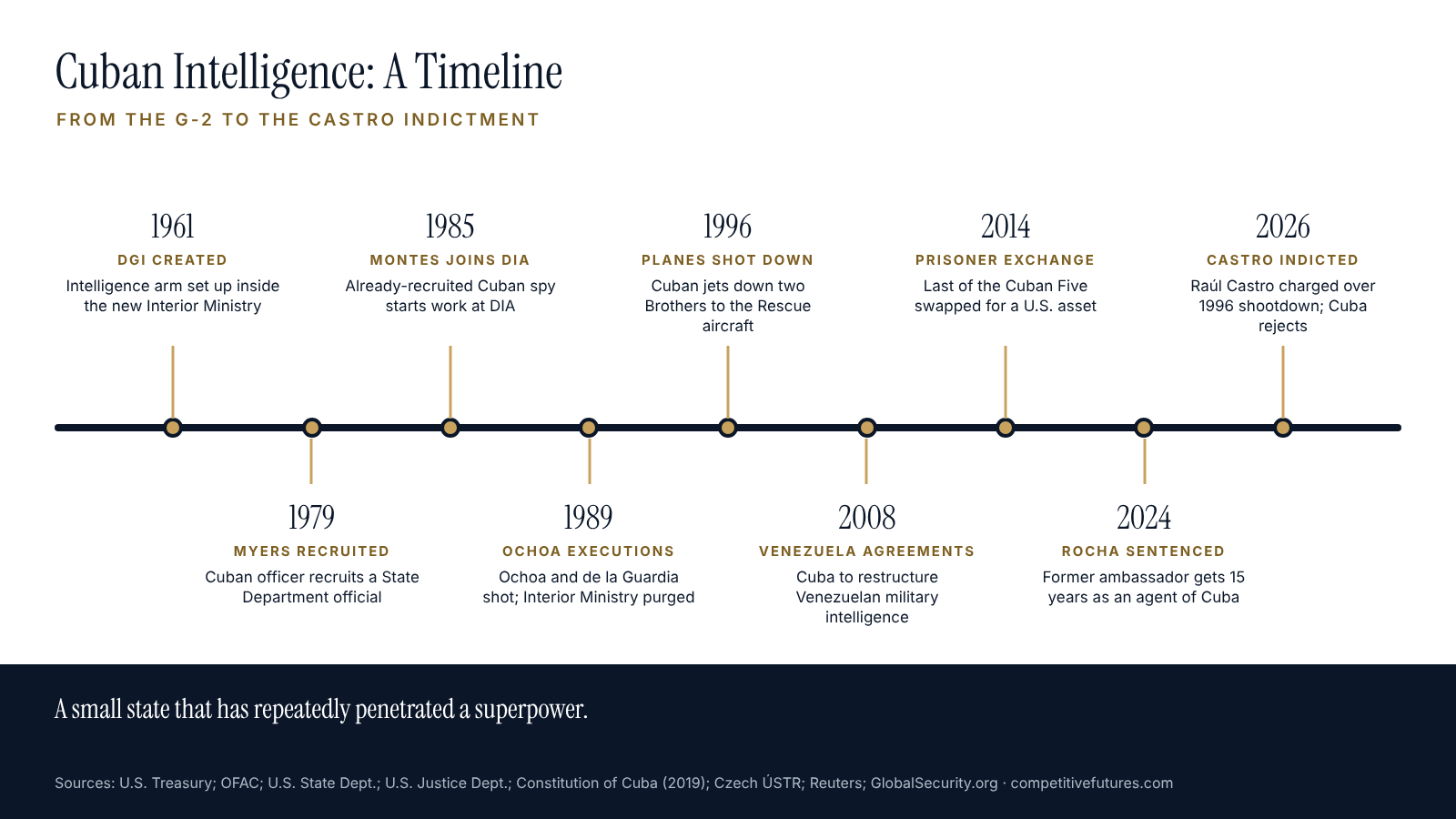
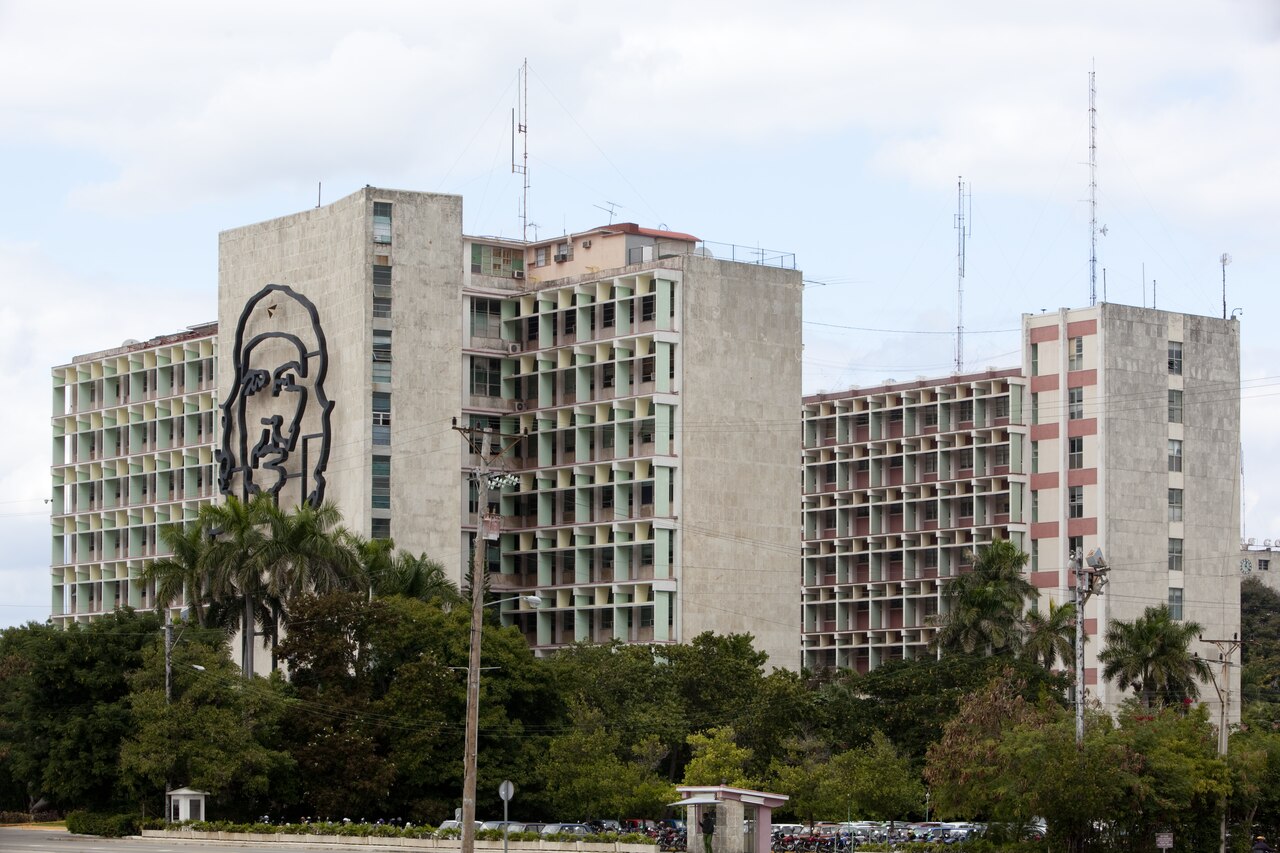
Cuba’s revolutionary intelligence apparatus was built almost from scratch after Fidel Castro took power in January 1959. Its first home was G-2, a security department that later became the Department of State Security. The Ministry of the Interior was created in June 1961 to take charge of internal security (GlobalSecurity.org). According to an account by a former DGI officer, reproduced in an online archive of Cuban espionage documents, the DGI “was created as a separate entity within the Interior Ministry” in late 1961, with a section of State Security as its nucleus. The same account says it was headed by Major Manuel Piñeiro Losada, a former guerrilla officer under Raúl Castro nicknamed “Barba Roja” for his red beard, and that the system was built “with guidance and assistance from the Soviet Union” (Latin American Studies archive).
The Soviet bloc tie was institutional, not just ideological. The Czech Institute for the Study of Totalitarian Regimes lists a 1976 cooperation agreement between the Czechoslovak and Cuban interior ministries, a 1980 agreement between Cuban military counterintelligence and a Czechoslovak counterintelligence directorate, and further plans and protocols through 1992 covering counterintelligence and technical directorates (ÚSTR). Through the Cold War, Cuba’s services worked alongside Soviet and East European partners while running their own operations in Latin America, Africa, and the United States.
The defining internal crisis came in 1989. That summer, a military tribunal convicted General Arnaldo Ochoa, a Hero of the Revolution who had commanded Cuban forces in Angola, along with Interior Ministry Colonel Antonio de la Guardia and others, of drug trafficking and treason. Ochoa, de la Guardia, and two other officers were executed by firing squad on July 13, 1989 (Deseret News). De la Guardia had run the MC department, a secret Interior Ministry unit set up to evade the U.S. embargo and earn hard currency. The government charged that his group moved about six tons of cocaine through Cuba. Interior Minister José Abrantes was fired, arrested, and sentenced to twenty years for dereliction of duty and corruption, although no evidence publicly linked him directly to the drug activity. He was replaced by Abelardo Colomé Ibarra, a career army officer, and Fidel Castro said the ministry would have to be “made all over again” (Julia Preston, The New York Review of Books). The ministry’s top layers were purged and refilled with officers from the armed forces, and Colomé was a close associate of Raúl Castro, then defense minister (GlobalSecurity.org).
The Soviet collapse two years later ended Cuba’s subsidies but not its intelligence focus on the United States. Several of the most damaging penetrations of the U.S. government described below were active through the 1990s and 2000s, and from 2000 Cuba’s alliance with Venezuela gave its services a new client.
How Cuban intelligence is organized today
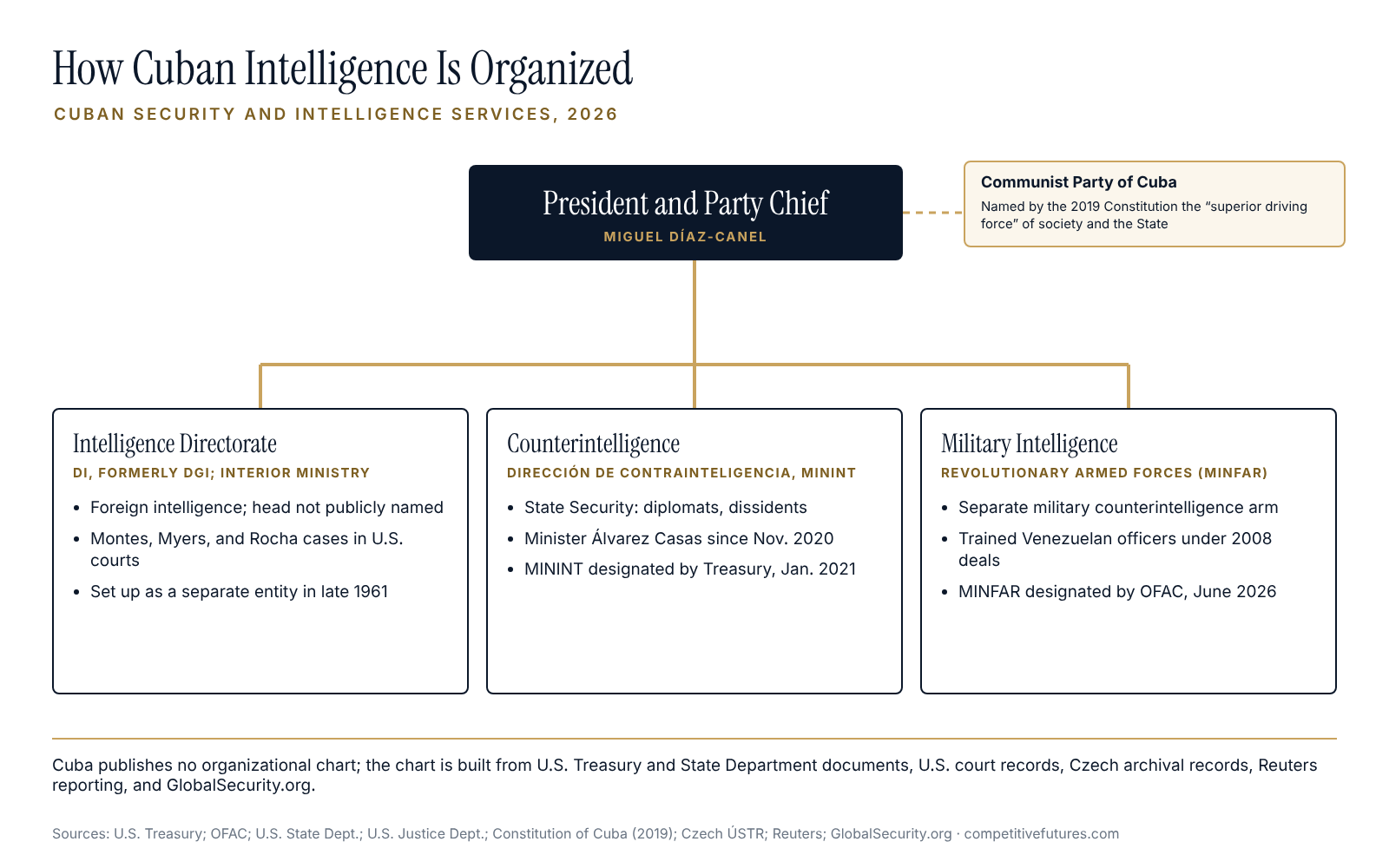
Cuba publishes no organizational chart or budget for its intelligence services, and its Interior Ministry law is not readily available in English. The outline below is drawn from U.S. government documents, court records, and specialist reference sources.
- The Intelligence Directorate (DI) is MININT’s foreign intelligence arm, under a vice ministry for intelligence (GlobalSecurity.org). U.S. court records describe its methods in detail: recruitment of sympathetic Americans, shortwave radio broadcasts of encrypted instructions, and in-person meetings abroad.
- The Directorate of Counterintelligence, the core of what Cubans call State Security, watches foreign diplomats, dissidents, and the population at large. The U.S. Treasury describes MININT as responsible for Cuba’s “internal security, to include controlling Cuba’s police” (U.S. Treasury).
- Military intelligence and counterintelligence sit under MINFAR, which the United States designated for sanctions in June 2026.
- Mass organizations extend the system’s reach. The State Department says the Committees for the Defense of the Revolution are under the direction of the Interior Ministry, and that the Cuban Institute of Friendship with the Peoples (ICAP), founded in 1960, “supports Cuban intelligence and counterintelligence activities” (U.S. State Department).
Two features stand out. First, since 1989 the security services have been bound tightly to the military and to the Castro family; the State Department describes Raúl Castro’s son Alejandro Castro Espín as “the former head of the Cuban intelligence services” (U.S. State Department). Second, the services have long treated the Cuban diaspora and American sympathizers as their richest recruiting ground, which explains why so many of the cases below were tried in Miami and Washington.
Exporting intelligence
Cuba’s security services have also been an export. The clearest documented case is Venezuela. In 2019, Reuters reported on two agreements signed in Caracas on May 26, 2008, by Venezuela’s defense minister and a Cuban vice minister of defense. According to the documents Reuters reviewed, Cuba’s defense ministry would oversee a restructuring of Venezuela’s military intelligence service, help create new units, and train up to 40 Venezuelan officers at a time in Havana. Reuters reported that the service, renamed the DGCIM in 2011, shifted its focus from foreign rivals to surveilling Venezuela’s own officers. Cuban officials did not respond to Reuters, but Cuba’s foreign minister had earlier written, “I strongly reject repeated and false accusations” about Cuba’s role in Venezuela (Reuters via The Peninsula).
The extent of that presence became public in January 2026. After the U.S. military operation that captured Nicolás Maduro in Caracas on January 3, 2026, the Cuban government said 32 members of its armed forces and Interior Ministry had been killed. Officials said they were in Venezuela “as part of agreements between the two countries” and did not describe their missions (AP via Stars and Stripes). Four months later, the CIA director was in Havana meeting Cuba’s interior minister and intelligence chief.
Cuban intelligence in the news
Most public knowledge of Cuban intelligence comes from U.S. prosecutions and U.S. government statements. In most of the cases below, the facts were established in U.S. courts through guilty pleas or jury verdicts; in others, they remain allegations. Cuba has generally either celebrated its agents as heroes or not commented.
The Brothers to the Rescue shootdown (1996–2026)
On February 24, 1996, Cuban Air Force fighters shot down two unarmed Cessnas flown by Brothers to the Rescue, a Miami exile group that searched for rafters in the Florida Straits, killing four men. An investigation by the International Civil Aviation Organization found that the aircraft were shot down about 10 nautical miles outside Cuban territorial airspace and that Cuba had not tried other means, such as radio contact. On July 26, 1996, the UN Security Council endorsed the ICAO report in Resolution 1067, by a vote of 13 to 0 with China and Russia abstaining. Cuba’s National Assembly president, Ricardo Alarcón, told the Council that the United States “had attempted from the beginning to manipulate information and falsify data” (UN press release).
Three decades later, the case reached Cuba’s former leader. On May 20, 2026, the Justice Department unsealed a superseding indictment, returned by a Miami grand jury on April 23, charging Raúl Castro, then the defense minister, and five others with conspiracy to kill U.S. nationals, destruction of aircraft, and four counts of murder. Prosecutors allege that “Cuban intelligence agents infiltrated the organization” and passed details of its flights to Havana, and that the jets fired “under the chain of command overseen by Raul Castro.” The department noted that “an indictment is merely an allegation” and that all defendants are presumed innocent (U.S. Justice Department). The pilots had been indicted earlier. President Díaz-Canel called the indictment a political act, said Cuba acted in “legitimate self-defense,” and called Brothers to the Rescue a “narco-terrorist” group. An arrest warrant has been issued; Castro, in his nineties, remains in Cuba (NPR via WLRN).
The Wasp Network and the “Cuban Five” (1998–2014)
In 1998, the FBI arrested members of a Cuban intelligence network in South Florida. In 2001, a Miami jury convicted five of them of acting as unregistered foreign agents and related charges; prosecutors said they had spied on exile groups and tried to infiltrate military facilities. Their leader, Gerardo Hernández, was also convicted of conspiracy to commit murder over the 1996 shootdown and received a double life sentence. The five said they were monitoring exile groups that planned attacks on Cuba, and in Cuba they were “lionized” as anti-terrorist heroes (Baltimore Sun). Two had already been released, in 2011 and early 2014. The remaining three, including Hernández, were sent home on December 17, 2014, in exchange for a U.S. intelligence asset imprisoned in Cuba. The Director of National Intelligence said that person had helped identify Ana Montes and had aided the cases against Walter Kendall Myers, his wife, and the Wasp Network. Cuba released the American contractor Alan Gross the same day (NPR).
Ana Montes (2001–2023)
Ten days after the September 11 attacks, the FBI arrested Ana Belén Montes, a senior analyst at the Defense Intelligence Agency. According to the FBI, she had been recruited by Cuban intelligence in 1984 while working in a clerical job at the Justice Department and joined DIA in 1985 as “a fully recruited spy.” She memorized material at work, typed it up at home, received instructions in code by shortwave radio, and passed encrypted disks to her handlers. She pleaded guilty in 2002 and was sentenced to 25 years (FBI). She revealed the identities of U.S. intelligence officers, and a former U.S. counterintelligence chief told Congress she had compromised virtually everything the United States knew about Cuba. She was released in January 2023 and moved to Puerto Rico. CBS News reported that she was motivated by ideology, including opposition to U.S. policy in Nicaragua (CBS News). No Cuban government reaction to her release was reported.
Walter Kendall Myers (2009–2010)
In June 2009, the FBI arrested Walter Kendall Myers, a former State Department official, and his wife, Gwendolyn. According to the Justice Department, a Cuban intelligence officer who had lectured at the State Department’s Foreign Service Institute invited Myers to Cuba in December 1978 and recruited the couple during a 1979 visit to South Dakota. For about 30 years they passed information through encrypted shortwave messages, dead drops, hand-to-hand passes, and at least one swap of shopping carts in a grocery store. Myers pleaded guilty in November 2009 and on July 16, 2010, was sentenced to life without parole; Gwendolyn Myers received 81 months (U.S. Justice Department). Cuba did not publicly acknowledge the couple.
The “Havana syndrome” incidents (2016–2026)
Beginning in late 2016, U.S. diplomats in Havana reported unexplained symptoms, in what U.S. agencies later called anomalous health incidents. Cuba denied any role from the start. In 2021, a panel of 16 experts convened by the Cuban government and linked to the Cuban Academy of Sciences, whose report was published on the state news site Cubadebate, concluded, “There is no novel syndrome” (AFP via Raw Story). In 2023, the U.S. intelligence community said it could not link any case to a foreign adversary, and Cuba responded that Washington had taken too long to accept the evidence (Reuters via The Star). An updated assessment released in January 2025 found that five of seven agencies judged foreign involvement “very unlikely,” one judged it unlikely, and one abstained, while two agencies had changed their views of foreign capability; it did not name Cuba (Office of the Director of National Intelligence). In June 2026, the Office of the Director of National Intelligence rescinded both assessments; according to CNN, an ODNI memo said they had “selectively excluded relevant intelligence” and “suppressed alternative analysis.” No replacement assessment had been published (CNN via KEYT).
Sanctions on the security leadership (2021–2026)
In January 2021, the U.S. Treasury designated MININT and Interior Minister Álvarez Casas under its Global Magnitsky program, citing serious human rights abuse and the treatment of the dissident José Daniel Ferrer in a MININT-controlled prison (U.S. Treasury). In May 2026, the Office of Foreign Assets Control (OFAC) brought the conglomerate GAESA (Grupo de Administración Empresarial S.A.) under a new Cuba sanctions program and added a GAESA-linked executive to its list of Specially Designated Nationals (OFAC). On June 4, 2026, OFAC designated President Díaz-Canel, his wife Lis Cuesta Peraza, his stepson Manuel Anido Cuesta, Alejandro Castro Espín, and Castro Espín’s son Raúl Alejandro Castro Calis, along with MINFAR, ICAP, and the Committees for the Defense of the Revolution (OFAC). Díaz-Canel condemned the U.S. “aggressiveness and perversity,” and Foreign Minister Bruno Rodríguez said, “Every US action aimed at creating a scenario of conflict between the two countries is doomed to failure” (Anadolu Agency, Turkey’s state news agency).
Víctor Manuel Rocha (2023–2024)
In December 2023, the FBI arrested Víctor Manuel Rocha, a former U.S. ambassador to Bolivia who had served on the National Security Council and at the U.S. Interests Section in Havana. The complaint alleged he had worked for Cuba’s DGI for decades (AOL). Investigators said he was recruited in Chile in 1973. In recorded conversations cited by prosecutors, he called the United States “the enemy” and described his work as “more than a grand slam.” He was not charged with espionage but with acting as an agent of a foreign government; on April 12, 2024, he pleaded guilty and was sentenced to 15 years in prison (CBS News). No response from the Cuban government was reported.
How to read coverage of Cuban intelligence
Almost every source on Cuba has a stake. Granma, Cubadebate, Prensa Latina, and the Foreign Ministry’s CubaMINREX site are Cuban state media and speak for the government. Radio and TV Martí are funded by the U.S. government. Miami and other exile and diaspora outlets, such as CiberCuba and CubaNet, are openly opposed to the Cuban government and often break stories first, sometimes on thin sourcing. Defectors’ memoirs are valuable but self-interested. Even official U.S. assessments have been revised, as the “Havana syndrome” record shows.
The discipline is the one taught in our guides to trend analysis and cognitive bias: climb toward primary records. For Cuba, that means federal court filings and Justice Department releases from Miami and Washington, OFAC’s sanctions list and State Department fact sheets, UN and ICAO records, Cuba’s own official gazette and statements, and the Justice Department’s public database of registered foreign agents (FARA eFile), which shows who represents Cuban and anti-Castro interests in Washington. Archives of former Eastern Bloc services, such as the Czech ÚSTR, add documented detail on the Cold War years.
Frequently asked questions
What is Cuba’s intelligence agency called?
Cuba’s main foreign intelligence service is the Intelligence Directorate (Dirección de Inteligencia, DI) of the Ministry of the Interior, still widely called by its older name, the General Directorate of Intelligence (DGI). The ministry also runs a Directorate of Counterintelligence, and the Revolutionary Armed Forces have their own intelligence and counterintelligence directorates.
Who is the head of Cuban intelligence?
Cuba does not publicly name the head of the Intelligence Directorate. The service sits under Interior Minister Lázaro Alberto Álvarez Casas, who has held the post since November 2020 and who met the CIA director in Havana in May 2026 alongside Cuba’s intelligence chief. Ultimate authority rests with President and party First Secretary Miguel Díaz-Canel.
Has Cuba spied successfully on the United States?
Yes, according to U.S. courts. Ana Montes of the Defense Intelligence Agency, former State Department official Walter Kendall Myers, former ambassador Víctor Manuel Rocha, and members of the Wasp Network in Miami were all convicted of working for Cuban intelligence, in most cases after guilty pleas. Cuba has hailed some of its agents as heroes and has not commented on others.
Related reading
- Intelligence Services Around the World: Structure, History, and the Headlines
- Qatari Intelligence: History, Structure, and the Headlines
- Mexican Intelligence: History, Structure, and the Headlines
- How to Evaluate a Forecast
Competitive Futures briefs companies and governments on intelligence services, foreign influence, and Cuba and the Caribbean; details are on the services page.