Pakistani Intelligence: History, Structure, and the Headlines
Pakistan is a nuclear-armed country that sits between Afghanistan, India, Iran, and China. Its main intelligence service, the Inter-Services Intelligence directorate, or ISI, ran the pipeline for the U.S.-backed war against the Soviet army in Afghanistan, has been accused for decades of backing militant groups it denies supporting, has been one of Washington’s most important and most difficult counterterrorism partners, and is a constant presence in Pakistan’s own politics. In 2025 its director general also became the country’s national security adviser. Few intelligence services are so central to the fortunes of the state that runs them.
This page is a working overview of Pakistan’s intelligence and security services: where they came from, how they are organized today, and the cases that have put them in the news. It relies on Pakistani court judgments and official notifications, U.S. government records and court testimony, declassified documents, and named reporting. Each allegation is paired with Pakistan’s response, and the page distinguishes findings by courts and commissions from claims by governments, litigants, or journalists.
Pakistani intelligence at a glance
- Main intelligence service: the Inter-Services Intelligence directorate (ISI), founded in 1948 to coordinate intelligence for the army, navy, and air force, and led by a serving army general.
- Head: Lieutenant General Muhammad Asim Malik, who took charge as director general of the ISI on September 30, 2024, succeeding Lieutenant General Nadeem Anjum (Dawn). On April 29, 2025, a Cabinet Division notification gave him the additional charge of national security adviser (Arab News). In September 2026, Pakistani outlets reported, citing unnamed security sources, that he had been given a further one-year term in both posts; no official notification had been published (Minute Mirror; Daily Pakistan).
- Other services: the Intelligence Bureau (IB), a civilian agency that answers to the prime minister; Military Intelligence (MI), the army’s own service; and the Federal Investigation Agency (FIA), a civilian investigative agency.
- Reporting line: the ISI formally reports to the prime minister, who appoints its director general. Neither the constitution nor the Army Act sets out the procedure; by tradition, the army chief proposes three names and the prime minister chooses (Dawn). In practice, the ISI’s leadership comes from the army, whose chief, Field Marshal Asim Munir, was notified in December 2025 as the country’s first chief of defence forces (Dawn).
- Relationship with the United States: long, close, and often strained. Pakistan was the conduit for U.S. covert aid to the Afghan resistance in the 1980s and a counterterrorism partner after 2001, and in March 2025 it handed over to the United States a man charged in the 2021 Kabul airport bombing (Dawn).
History: from a British-built directorate to the Afghan wars
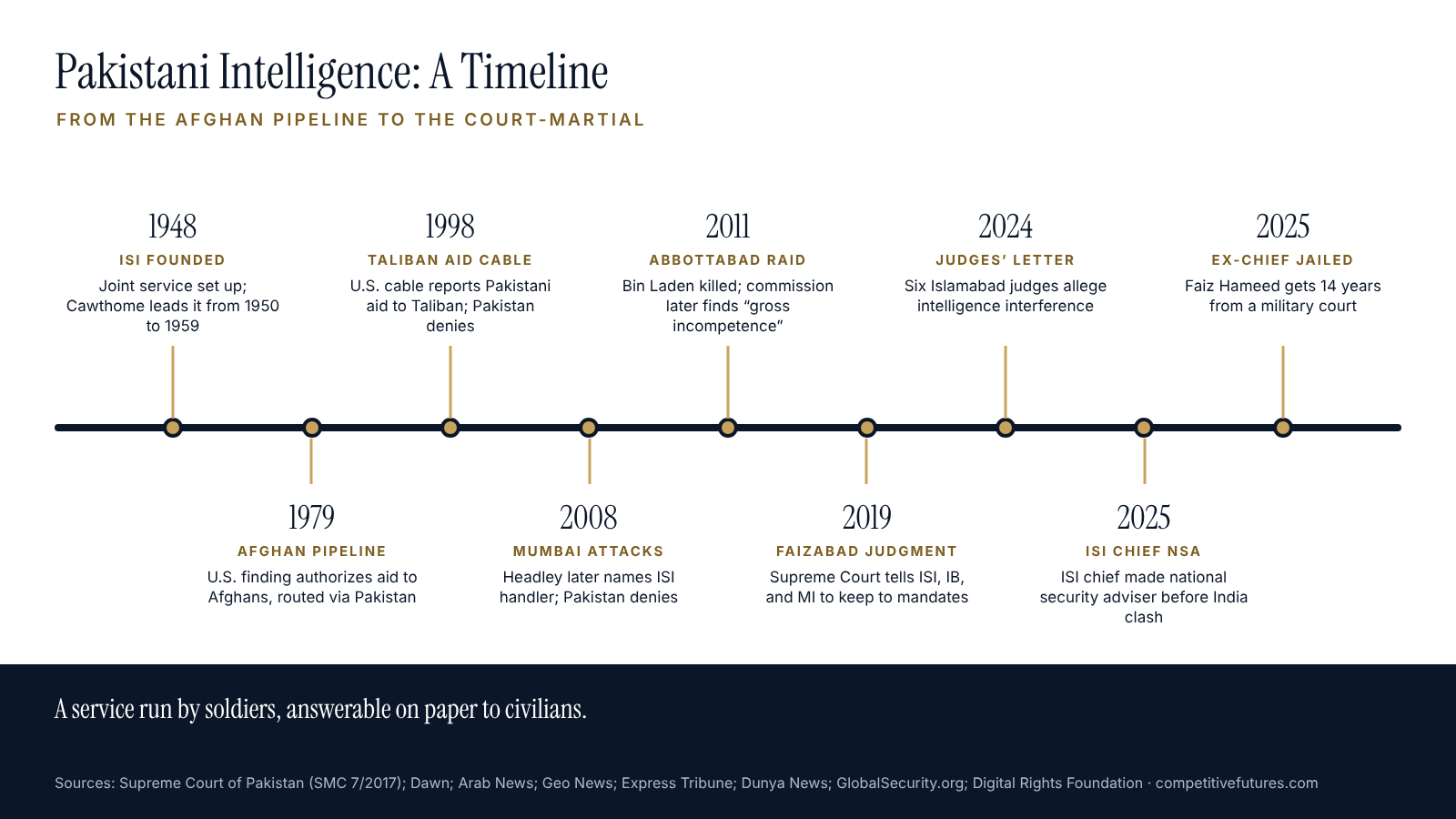
Pakistan inherited its first intelligence structures from British India at partition in 1947. The ISI was set up in 1948 to coordinate intelligence among the three armed services. Its early shape owed much to Major General Robert Cawthome (also spelled Cawthorne), an Australian-born former British Army officer who stayed on in the Pakistan Army and directed the ISI from 1950 to 1959, the longest tenure of any of its chiefs (The News). Pakistan keeps no public intelligence archive, so even the early leadership record is disputed, as a 2025 review of Julian Richards’s history of the ISI notes (The Friday Times).
The service’s defining era began with the Soviet invasion of Afghanistan in December 1979. Declassified records released by the National Security Archive include a presidential finding attached to a summary of a December 28, 1979, White House meeting that authorized “lethal military” aid to the Afghan opponents of the Soviet intervention; the program ran through Pakistan (The News). Bruce Riedel, a former CIA analyst who wrote a history of the program for the Brookings Institution, has described the ISI as the headquarters of the Afghan resistance: in his account, Pakistan’s military ruler, General Zia ul-Haq, decided which groups got which weapons, ISI teams advised and led fighters in the field, the CIA acted as quartermaster without sending its own officers into Afghanistan, and Saudi Arabia matched U.S. government funding dollar for dollar (Brookings transcript; Brookings). The Soviet withdrawal in 1989 left the ISI with deep ties to Afghan factions and a reputation, at home and abroad, as the most powerful institution in the state.
In the 1990s those ties extended to the Taliban. A National Security Archive collection of declassified U.S. cables and intelligence reports from the period describes Pakistani intelligence supplying the Taliban with munitions, fuel, and food; a July 1998 cable reports Pakistani approval of $6 million in additional aid, and a September 2000 State Department cable calls Pakistan’s support “unprecedented.” The same records show that Islamabad publicly denied being the Taliban’s patron, and a 1995 cable judged that Pakistan had influence on the Taliban but fell “short of being able to call the shots” (National Security Archive).
After September 11, 2001, Pakistan joined the U.S.-led campaign against al-Qaeda, while American officials increasingly accused parts of the security establishment of keeping ties to Afghan insurgents. On September 22, 2011, Admiral Mike Mullen, then chairman of the U.S. Joint Chiefs of Staff, told the Senate Armed Services Committee that the Haqqani network “acts as a veritable arm” of the ISI. Pakistan’s foreign minister, Hina Rabbani Khar, called the claim “unsubstantiated,” and the army chief, General Ashfaq Parvez Kayani, said it was “not based on facts” (Al Jazeera). Since the Taliban returned to power in Kabul in 2021, the relationship has inverted: Islamabad now accuses Kabul of sheltering the Pakistani Taliban (TTP) and Baloch militants, which Kabul denies. After deadly border clashes in October 2025, the ISI chief joined Pakistan’s delegation to talks in Doha, opposite Afghanistan’s defense minister and intelligence chief, and the two sides agreed to an immediate ceasefire mediated by Qatar and Türkiye (Dawn; Arab News).
How Pakistani intelligence is organized today
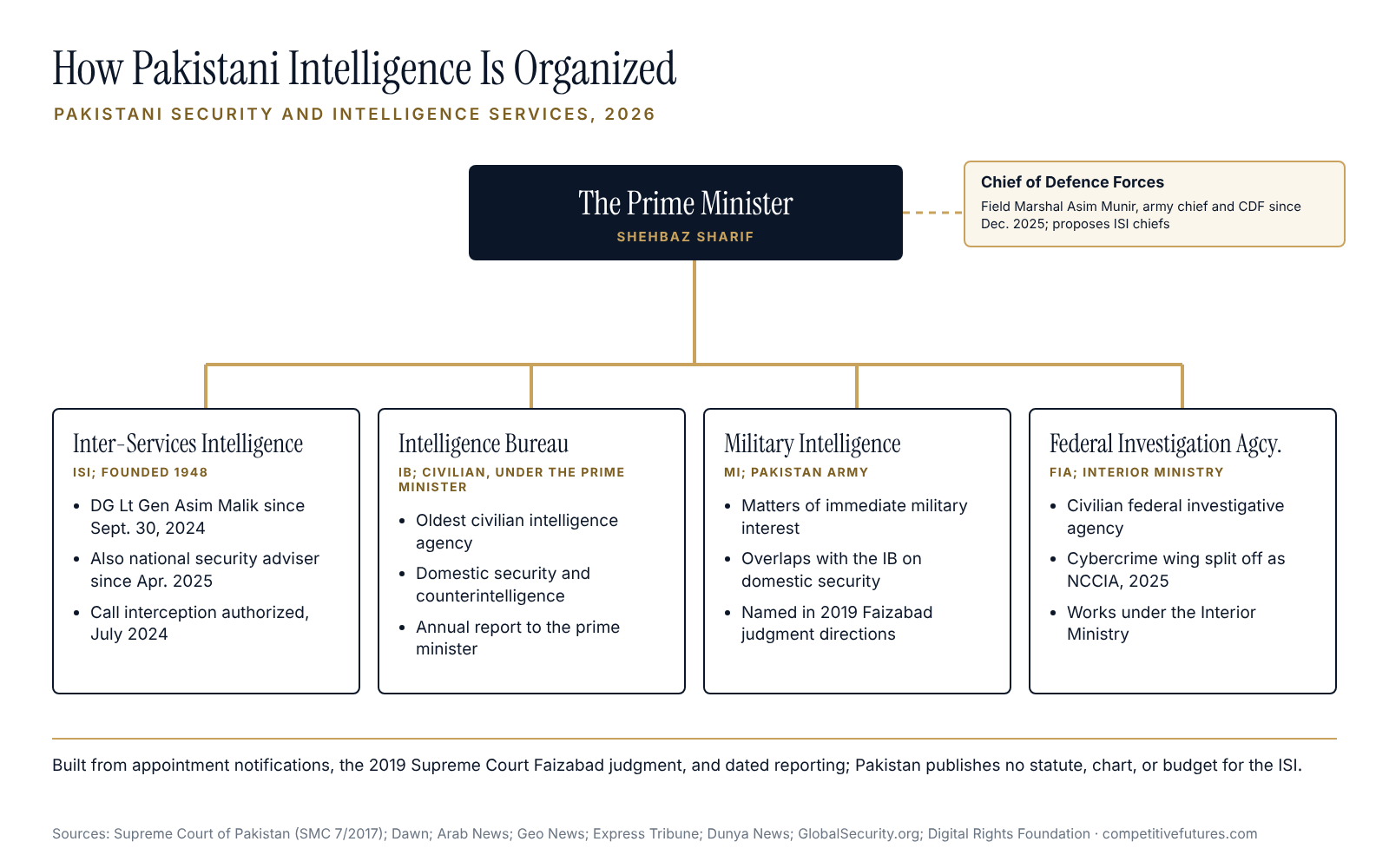
Pakistan has no published statute setting out the ISI’s mandate. When the Supreme Court asked in 2018 what law governed the service, the Ministry of Defence said only that it was governed by the “laws of the country,” and the mandate was later handed to the court in a sealed document (Supreme Court judgment, Suo Motu Case No. 7 of 2017). The public picture therefore comes from appointments, notifications, and court records.
- The ISI is the principal foreign and domestic intelligence service, led by a serving three-star general. Since April 2025 its director general has also served as national security adviser, the first time a serving ISI chief has held both jobs at once (Minute Mirror). In July 2024, the federal government authorized ISI officers of grade 18 and above, nominated by the ISI, to intercept calls and messages and trace calls “in the interest of national security,” under Section 54 of the Telecommunication (Re-organization) Act 1996 (Geo News).
- The Intelligence Bureau is the oldest civilian intelligence agency and reports to the prime minister; it presents an annual performance report to the head of government (Dunya News). It concentrates on domestic security, counterintelligence, and political monitoring (GlobalSecurity.org).
- Military Intelligence serves the army on matters of immediate military interest, and its work often overlaps with the IB’s at home (GlobalSecurity.org).
- The Federal Investigation Agency is a civilian investigative body that works under the Interior Ministry (Dawn). In April 2025, its cybercrime wing was turned into a separate National Cyber Crime Investigation Agency (Digital Rights Foundation).
- The army chief sits above the system in practice. On May 20, 2025, the federal cabinet promoted General Asim Munir to field marshal after the conflict with India (Express Tribune). The 27th constitutional amendment, signed in November 2025, created the post of chief of defence forces, commanding all three services (Arab News), and Munir was notified in that post, alongside army chief, for five years on December 5, 2025 (Dawn).
Two features stand out. First, the formal chain of command runs to the elected prime minister, while the people who run the ISI are serving officers whose careers depend on the army chief. Second, the line between intelligence and policy has narrowed further since 2025, with one officer serving as both the country’s spy chief and the prime minister’s principal adviser on national security.
The “state within the state” debate
Pakistani politicians, judges, and journalists have long argued over how far the ISI and the army shape domestic politics. The most authoritative findings come from the Supreme Court. In its February 2019 judgment on the 2017 Faizabad sit-in, the court said that the perception the ISI “may be involved in or interferes with matters” beyond its remit, including politics, “was not put to rest.” It recalled its 2012 decision in the Asghar Khan case, which had called for strict action over the involvement of members of secret agencies “in unlawful activities,” and it held that armed forces personnel, including the ISI, “must never be perceived to support a particular political party, faction or politician” (Supreme Court judgment).
Judges have also made allegations of their own. In 2018, Justice Shaukat Aziz Siddiqui of the Islamabad High Court publicly accused senior ISI and military officials of manipulating judicial decisions and was removed on the recommendation of the Supreme Judicial Council; in March 2024, the Supreme Court ruled that removal illegal. Days later, on March 25, 2024, six Islamabad High Court judges wrote to the Supreme Judicial Council alleging that intelligence operatives had tried “to intimidate judges, under threat of coercion or blackmail, to engineer judicial outcomes in politically consequential matters,” citing hidden cameras in a judge’s home and the abduction of another judge’s relative. The military and the law ministry did not respond to Al Jazeera’s questions at the time (Al Jazeera).
The military’s own position is that its mandate excludes politics. The ISI mandate disclosed to the Supreme Court in the Faizabad case did not include “either politics or the media” (Supreme Court judgment). In his farewell address on November 23, 2022, the then army chief, General Qamar Javed Bajwa, acknowledged that a major reason for criticism of the army was “the army’s interference in politics for the last 70 years which is unconstitutional,” and said the institution had “decided that it would never interfere in any political matter” (Dawn). The December 2025 conviction of a former ISI chief, described below, included a charge of political activity. Supporters of the military cite that case as proof of accountability; critics see a pattern older than any one officer.
Pakistani intelligence in the news
Most public knowledge of how Pakistan’s services operate comes from six episodes. In each, the claims come from courts, commissions, foreign governments, or litigants, and Pakistan’s response is noted alongside them.
The Mumbai attacks and the Headley testimony (2008–2025)
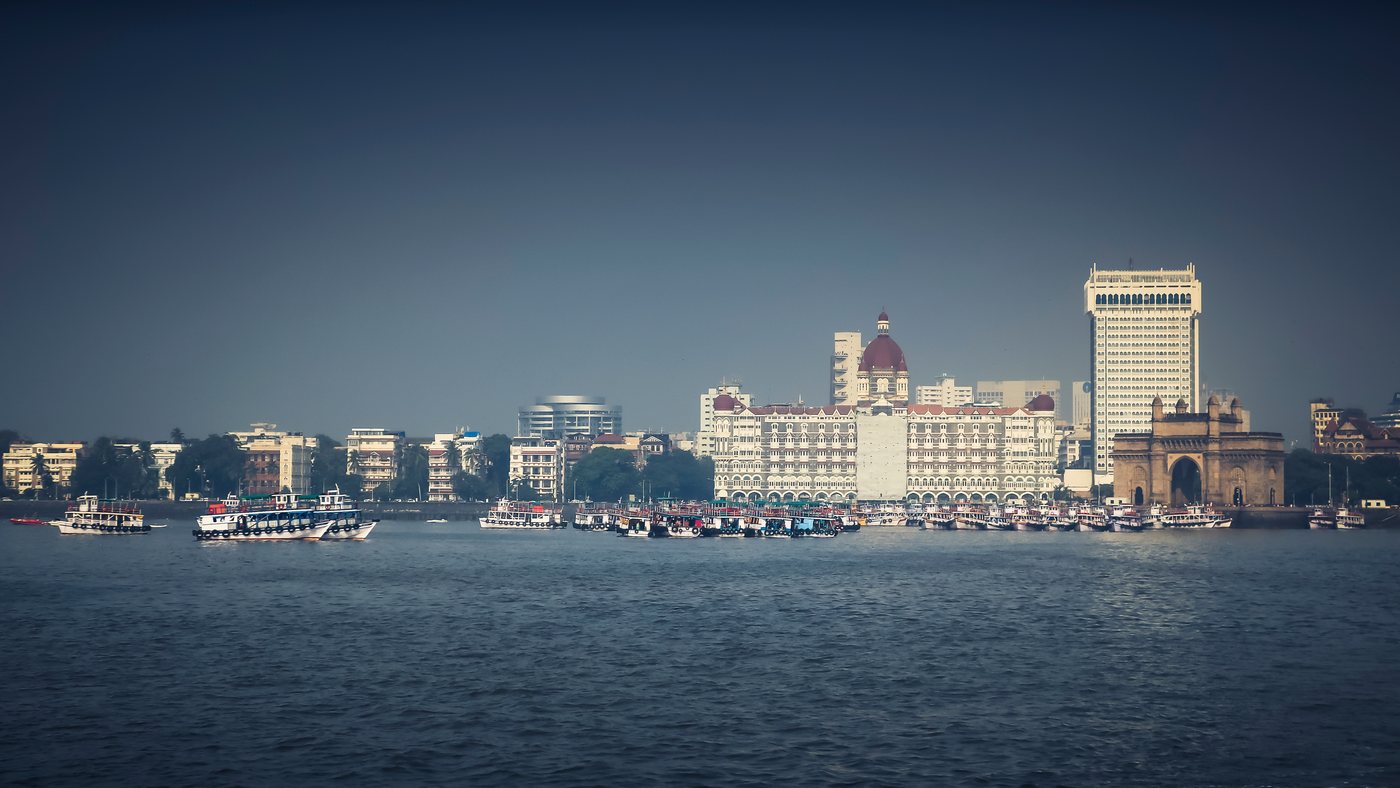
In November 2008, gunmen from the Pakistan-based group Lashkar-e-Taiba attacked targets across Mumbai over several days. In May 2011, David Coleman Headley, an American who had pleaded guilty to scouting the targets, testified in a Chicago federal court that ISI officers had funded, supported, and directed the attacks with Lashkar, and that his handler was an ISI officer known to him only as “Major Iqbal.” Headley said he believed the ISI’s top leadership was unaware of the plot. The defendant in that trial, Tahawwur Rana, was acquitted of supporting the Mumbai plot but convicted on two other counts, and a U.S. federal indictment charged Headley’s handler in the deaths of six Americans; he has not been arrested (ProPublica). Pakistan’s embassy in Washington challenged Headley’s credibility and said that “Major Iqbal” did not exist (WBEZ). Headley was sentenced in 2013 to 35 years in prison, and in April 2025 the United States extradited Rana to India to stand trial there (Dawn).
Raymond Davis (2011–2017)
On January 27, 2011, Raymond Davis, a CIA contractor, shot dead two Pakistani men, Muhammad Fahim and Faizan Haider, in Lahore. The Lahore High Court rejected the U.S. claim that he had diplomatic immunity, and on March 16, 2011, a court acquitted him after the victims’ families accepted blood money under Islamic law. The U.S. government denied paying the compensation (Christian Science Monitor). In a 2017 memoir, Davis wrote that the ISI, under its then director general, Lieutenant General Ahmed Shuja Pasha, had arranged the settlement and pressed the families to accept it. In court, all 18 relatives said they had not been coerced, and Dawn’s report on the book carried no response from Pasha or the ISI (Dawn). The case marked a low point in CIA–ISI relations.
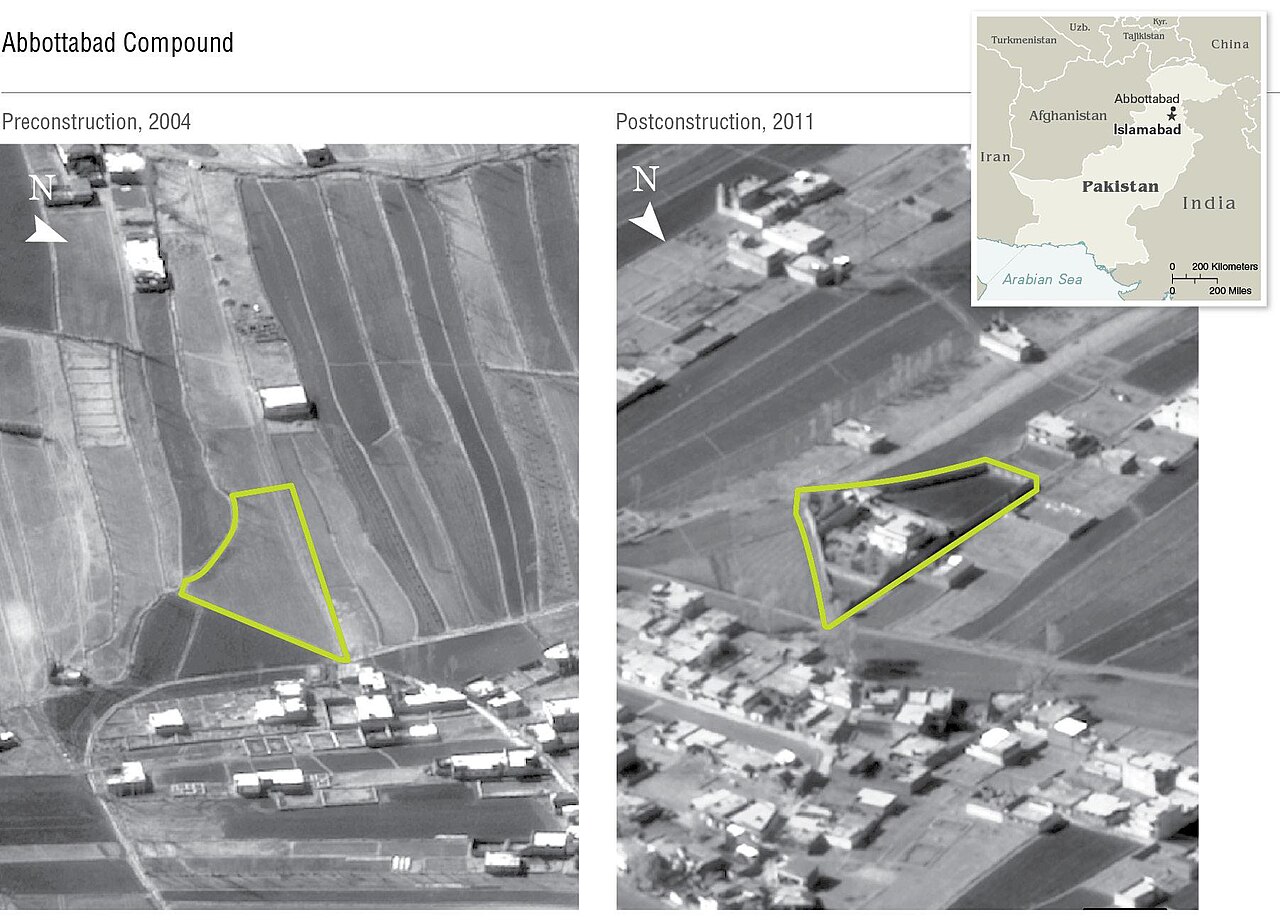
Abbottabad and the bin Laden commission (2011–2013)
On May 2, 2011, U.S. special forces killed Osama bin Laden at a compound in Abbottabad, a garrison town north of Islamabad. Pakistan set up a judicial commission to investigate, and in July 2013 Al Jazeera published the commission’s report, which the government had not released. It held the government and the military responsible for “gross incompetence” and “collective failures” that let bin Laden live undetected, called the lapses “a collective and sustained dereliction of duty,” and also found that the raid violated Pakistan’s sovereignty. A page of the ISI chief’s testimony was missing from every copy Al Jazeera obtained (Al Jazeera). The commission could not determine whether bin Laden’s presence reflected incompetence or “connivance” by rogue officials, and it criticized the ISI for, among other things, not properly following up phone numbers supplied by the CIA (War on the Rocks).
The Faizabad sit-in judgment (2017–2023)
In November 2017, the Tehreek-e-Labbaik Pakistan party staged a sit-in at the Faizabad interchange on the edge of Islamabad. In its judgment of February 6, 2019, written by Justice Qazi Faez Isa, the Supreme Court said that cash handouts by men in uniform to protesters made the involvement of intelligence agencies seem plausible (Dawn). It directed that “all intelligence agencies (including ISI, IB and MI) and the ISPR must not exceed their respective mandates,” said it would be appropriate to enact laws stating those mandates, and ordered the defense ministry and the service chiefs to act against personnel who had violated their oath by engaging in politics (Supreme Court judgment). The Ministry of Defence, the IB, and several political parties filed review petitions; most had been withdrawn by November 2023, when the government set up a new commission to examine the sit-in, including the role of anyone working with intelligence agencies (Dawn). No law setting out the ISI’s mandate has been enacted.
The court-martial of Faiz Hameed (2024–2025)
Lieutenant General Faiz Hameed, who led the ISI until 2021, was taken into military custody in August 2024, when the army announced field general court-martial proceedings under the Pakistan Army Act. On December 11, 2025, the military’s media wing, ISPR, announced that he had been found guilty of all four charges, engaging in political activities, violating the Official Secrets Act, misusing authority and government resources, and causing wrongful loss to persons, and sentenced to 14 years’ rigorous imprisonment. ISPR said he had been given all legal rights, including a defense team of his choice, and that he could appeal; under the Army Act, an appeal lies to a court headed by the army chief or officers he designates. ISPR said his alleged role in political agitation was being dealt with separately. Dawn’s report carried no statement from Hameed or his lawyers (Dawn).
The India–Pakistan conflict (2025–2026)
On April 22, 2025, gunmen killed 26 people, most of them tourists, near Pahalgam in Indian-administered Kashmir. India blamed Pakistan; Pakistan denied any involvement and called for a neutral investigation. India suspended the Indus Waters Treaty, and Pakistan answered with its own measures (Dawn). A week later, Pakistan made its ISI chief national security adviser as well (Arab News). On May 7, 2025, India announced strikes, which it called Operation Sindoor, on nine sites it described as terrorist infrastructure, saying that “no Pakistani military facilities have been targeted” and that its actions were “focused, measured and non-escalatory” (High Commission of India, Colombo). Pakistan rejected India’s account and launched its own operation, Bunyan-um-Marsoos (Express Tribune). On May 10, India’s foreign secretary announced that the two sides had agreed to stop all firing and military action on land, air, and sea after a call initiated by Pakistan’s director general of military operations (All India Radio). On the first anniversary of the attack, in April 2026, Pakistan’s Foreign Office again rejected what it called India’s “baseless allegations and propaganda” (Dawn). No court or international body has ruled on who was responsible for the Pahalgam attack.
How to read coverage of Pakistani intelligence
Few intelligence services are covered by so many interested parties. Indian media and officials, whose country has fought several wars with Pakistan, have strong reasons to emphasize ISI wrongdoing, and Indian outlets sometimes present allegations as settled fact. ISPR, the Pakistani military’s media wing, issues the official line and is often the only source for military court proceedings. Pakistani newspapers such as Dawn and The Express Tribune do serious work under pressure, but their reports of appointments often rest on unnamed “security sources.” Pakistani politicians tend to accuse or defend the ISI according to which side of power they are on.
The discipline is the same one taught in our guides to trend analysis and evaluating forecasts: climb toward primary records. For Pakistan, that means Supreme Court judgments, Cabinet Division and Ministry of Defence notifications, the Abbottabad Commission report, U.S. court records such as the Chicago trial transcript, and declassified U.S. cables. For lobbying in Washington, the Justice Department’s public database of registered foreign agents (FARA eFile) lists the firms paid to represent Pakistan, and those paid by its rivals. Weigh a court judgment or commission finding above a government statement, and a government statement above an anonymous leak.
Frequently asked questions
What is Pakistan’s intelligence agency called?
Pakistan’s main intelligence agency is the Inter-Services Intelligence directorate, usually called the ISI. It was founded in 1948 and is led by a serving army general. Pakistan also has a civilian Intelligence Bureau (IB), which reports to the prime minister, and the army’s own Military Intelligence (MI).
Who is the head of Pakistani intelligence?
Lieutenant General Muhammad Asim Malik has been director general of the ISI since September 30, 2024, and since April 2025 he has also been Pakistan’s national security adviser. Pakistani outlets reported in September 2026 that his term had been extended for another year, though no official notification had been published. The ISI’s chiefs come from the army, which is led by Field Marshal Asim Munir, chief of army staff and, since December 2025, chief of defence forces.
Does the ISI work with the CIA?
Yes, though the relationship has been uneven. The two services ran the covert supply of the Afghan resistance in the 1980s and cooperated against al-Qaeda after 2001, but relations suffered over the Raymond Davis case, the 2011 bin Laden raid, and U.S. accusations about the Haqqani network, which Pakistan rejected. In March 2025, Pakistan handed over to the United States a man accused in the 2021 Kabul airport bombing, who was charged in a U.S. court with supporting ISIS-K (U.S. Department of Justice); he is presumed innocent unless proven guilty.
Related reading
- Intelligence Services Around the World: Structure, History, and the Headlines
- Qatari Intelligence: History, Structure, and the Headlines
- Iranian Intelligence: History, Structure, and the Headlines
- Cognitive Bias: A Field Guide for Leaders
Competitive Futures briefs companies and governments on intelligence services, foreign influence, and Pakistan and South Asia; details are on the services page.