Chinese Intelligence: History, Structure, and the Headlines

China’s intelligence services are among the largest in the world and among the least transparent. They are also, more than most, woven into a political party rather than a state: the Ministry of State Security, the police, military intelligence, and the Communist Party’s own influence apparatus all answer upward to the same leadership. Courts and governments in the United States, Britain, Germany, and elsewhere have described Chinese intelligence activity in espionage trials, cyber advisories, and foreign-agent cases; Beijing rejects nearly all of it as smears. For anyone who deals with China, understanding these services, and the evidence about them, is basic due diligence.
This page is a working overview of China’s intelligence and security services: where they came from, how they are organized today, and the cases that have put them in the news. It relies on Chinese law and official Chinese statements, U.S. and European court records and government advisories, scholarly work, and named reporting. Each allegation is paired with the response of China or the accused, and the page distinguishes court findings from charges and from claims by governments or journalists.
Chinese intelligence at a glance
- Ministry of State Security (MSS): Guojia Anquanbu, China’s main civilian intelligence and counterintelligence service, created in 1983 (Federation of American Scientists). Minister: Chen Yixin, whose appointment was announced by the National People’s Congress in October 2022, when he replaced Chen Wenqing (The Standard). In December 2025 he set out the ministry’s priorities for 2026–2030 in the Party journal Study Times, naming Taiwan as the core priority (StratNews Global).
- Ministry of Public Security (MPS): Gong’anbu, the national police ministry, which the U.S. Justice Department describes as China’s “primary domestic law enforcement and intelligence agency” (U.S. Department of Justice). Minister: Wang Xiaohong, appointed by China’s top legislative body in 2022 to replace Zhao Kezhi (South China Morning Post).
- Military intelligence: run under the Central Military Commission. The U.S.-China Economic and Security Review Commission names the Joint Staff Department’s Intelligence Bureau as part of China’s human-intelligence community (USCC, 2019). In April 2024, the People’s Liberation Army (PLA) set up an Information Support Force, directly led by the Central Military Commission, and abolished the Strategic Support Force (gov.cn).
- United Front Work Department (UFWD): the Party department that manages relationships with non-Party groups at home and overseas Chinese communities abroad (USCC, 2018). Head: Li Ganjie, who swapped posts with Shi Taifeng in April 2025 (Reuters via ThePrint).
- Legal basis: the National Intelligence Law of 2017, amended in 2018, which names the intelligence bodies of the state security and public security organs and the military as “national intelligence work institutions” (China Law Translate), and the Counter-Espionage Law, revised in April 2023 with effect from July 1, 2023 (China Daily).
- Oversight and reporting line: Party control rather than legislative oversight. The USCC describes the MSS as answerable to both the State Council and the Politburo Standing Committee, and PLA intelligence as subordinate to the Central Military Commission (USCC, 2019).
- Relationship with the United States: adversarial, with occasional bargaining. In November 2024 the two governments carried out a prisoner exchange in which three Americans came home and China confirmed repatriating at least three of its nationals convicted in the United States (Voice of America).
History: from Yan’an to the Ministry of State Security
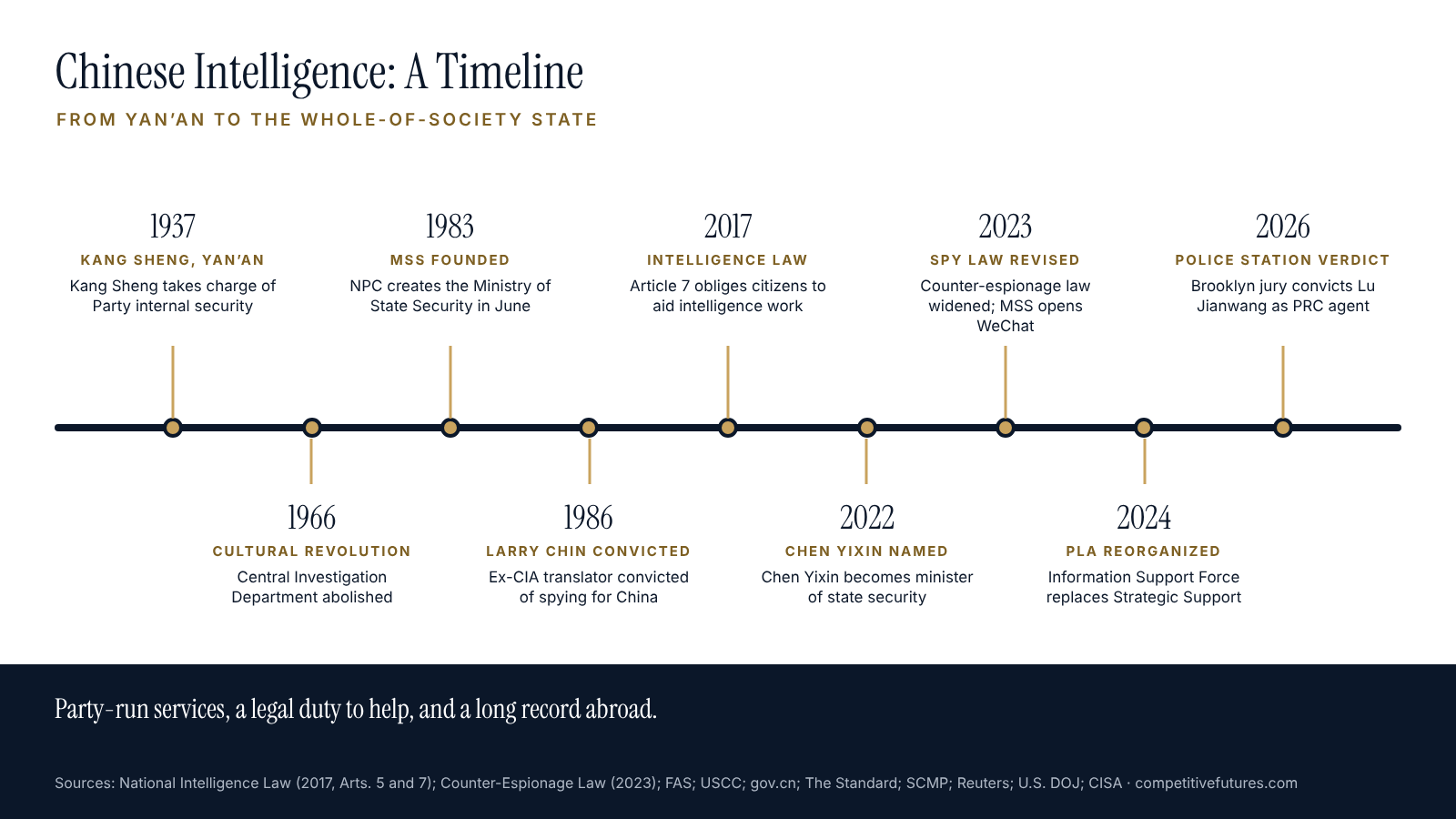
The Chinese Communist Party ran intelligence operations long before it ran a country. Kang Sheng, the figure most associated with its security apparatus, joined the Party in 1925, became director of its intelligence bureau, spent seven years with the Comintern in the Soviet Union from 1933, and in 1937 took charge of internal security at the Communist base at Yan’an (Britannica). The Party’s central intelligence body, the Central Department of Social Affairs, supplied intelligence that helped win battles in the 1946–1949 civil war (FAS).
After 1949 that work passed to the Party’s Central Investigation Department, while the PLA General Staff’s Second Department handled military intelligence. In the Cultural Revolution the Central Investigation Department was abolished, its senior leaders were sent to the countryside, and its assets went to the military; according to the Federation of American Scientists, some of its cadres, acting on Kang Sheng’s orders, helped remove leaders such as Deng Xiaoping from power. The department was re-established in the early 1970s (FAS). Kang himself was “one of the three or four most powerful individuals in the government during the Cultural Revolution”; he died in 1975, and in 1980 the Party posthumously expelled him over his close relationship with the Gang of Four (Britannica).
The modern system dates from Deng Xiaoping’s reforms. In 1983, the Central Investigation Department was merged with the counterintelligence department of the Ministry of Public Security, and in June 1983 the National People’s Congress established the Ministry of State Security under the State Council (FAS; Sheena Chestnut Greitens, China Leadership Monitor). A Counter-Espionage Law followed in 2014. Reforms in 2016–17 put the state security bureaucracy under “vertical leadership,” which the scholar Edward Schwarck, as cited by Greitens, calls “the most important development in China’s civilian intelligence system” since 1983 (Greitens).
Military intelligence went through its own overhaul. In 2015–16, Xi Jinping replaced the PLA’s four general departments with new bodies under the Central Military Commission, including a Joint Staff Department, and created a Strategic Support Force to take on some intelligence collection (USCC, 2019). At a ceremony on April 19, 2024, Xi described the new Information Support Force as “a new, strategic branch of the military,” and the Strategic Support Force was dissolved (gov.cn). Analysts at the Jamestown Foundation note that “some intelligence elements from the GSD 2nd Department (2PLA) were grouped under the Network Systems Department,” which now carries the name Cyberspace Force (J. Michael Dahm, Jamestown Foundation).
How Chinese intelligence is organized today
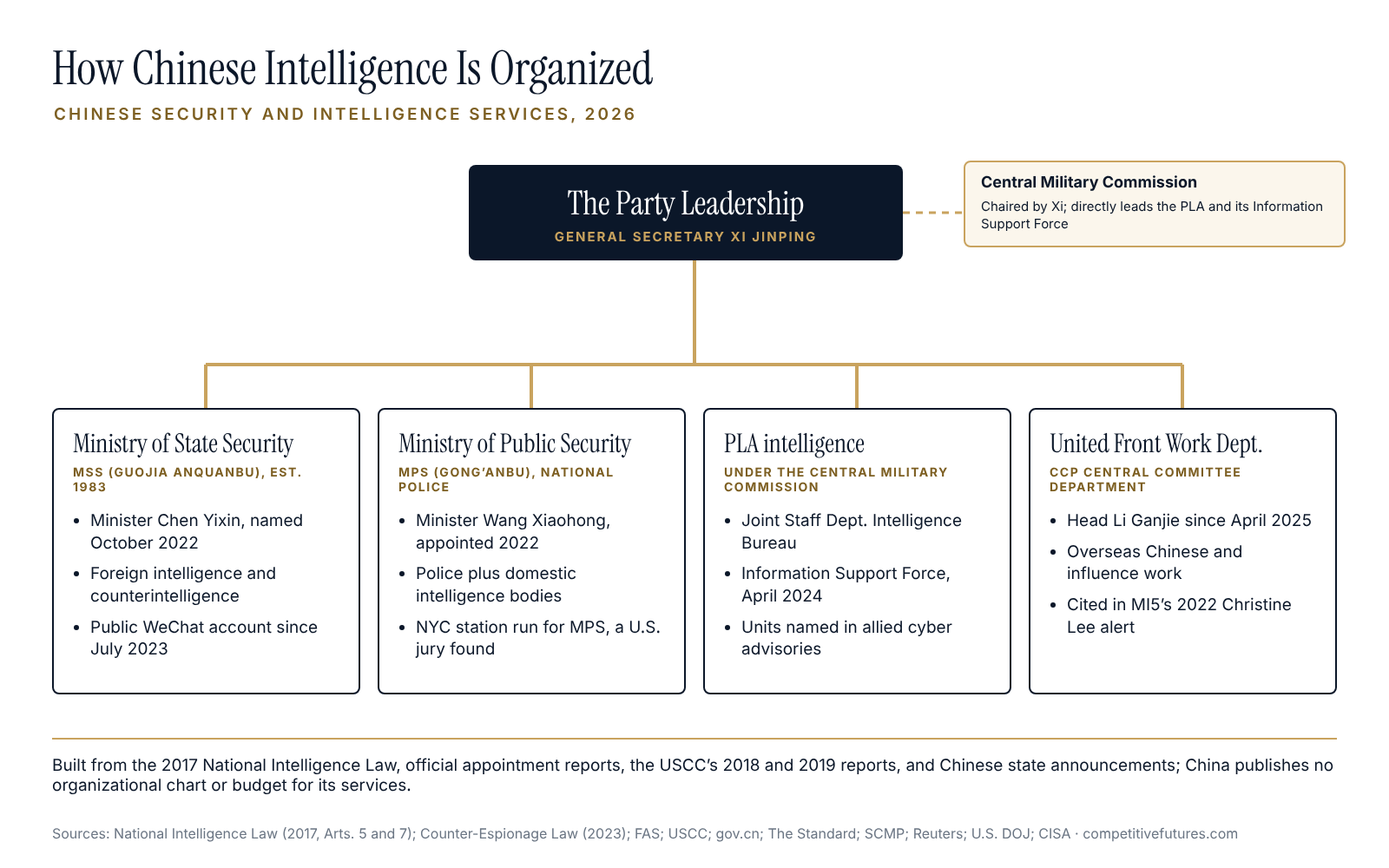
China publishes its intelligence laws but not budgets or organizational charts, so the public picture comes from statute, appointments, scholarship, and foreign court records.
- The MSS handles foreign intelligence, counterintelligence, and political security, including human intelligence and cyber operations (USCC, 2019).
- The MPS runs the national police and its own intelligence bodies, which the 2017 law counts among the national intelligence institutions. In the New York “police station” case below, a U.S. jury found that the station operated for the MPS.
- PLA intelligence includes the Joint Staff Department’s Intelligence Bureau and the technical and cyber units reorganized in 2024 under the Information Support Force and the Cyberspace Force.
- The United Front Work Department is not a spy agency in the Western sense, but the USCC says it builds and manages relationships with actors overseas to advance the Party’s agenda and has helped build intelligence collection networks, particularly in Taiwan (USCC, 2019).
Two features stand out. First, the services have become more public under Xi Jinping. The MSS now runs a social media account, and it promotes an annual National Security Education Day every April 15 (Greitens). Second, the line between intelligence, policing, influence work, and civic life is drawn differently than in Western systems, by law and by design.
The whole-of-society model
China’s legal framework asks more of ordinary people than most. Article 7 of the National Intelligence Law states: “All organizations and citizens shall support, assist, and cooperate with national intelligence efforts in accordance with law,” and requires them to keep confidential any intelligence work secrets they learn (China Law Translate). Foreign governments have cited the article in debates over Chinese technology suppliers; Beijing’s position is that it has the right to “safeguard its national security through legislation” and will “uphold the rule of law” (AFP via Hong Kong Free Press).
The 2023 revision of the Counter-Espionage Law pushed in the same direction. According to Chinese state media, it brings cyberattacks on state organs and critical information infrastructure within the definition of espionage and protects “all documents, data, materials and articles concerning national security and interests” (China Daily). Critics called the language vague, and Craig Allen of the US-China Business Council wrote that the changes “have raised legitimate concerns about conducting certain routine business activities.” The revision followed raids on the consultancies Mintz Group and Bain and Company (AFP via Hong Kong Free Press).
Weeks later, on July 31, 2023, the MSS opened its first public account on WeChat (Greitens). Its first post declared, “The entire society must mobilise against espionage!” (AP via The Star). The state-run Global Times summarized the message as “counter-espionage work requires the mobilization of all parts of society” (Global Times).
Abroad, the model has two other strands. United Front work seeks to co-opt potential opposition and, through “overseas Chinese work,” ethnic Chinese communities living outside China (USCC, 2018). And China runs what the FBI says are “hundreds of talent plans” to recruit researchers and bring foreign knowledge and technology to China. The FBI itself stresses that “participating in talent plans is not inherently illegal”; prosecutions have turned on undisclosed affiliations, trade secret theft, or fraud (FBI).
Chinese intelligence in the news
Most public knowledge of Chinese intelligence activity abroad comes from cases like the eight below. The allegations come from prosecutors, security services, or governments; the outcomes range from convictions to a collapsed prosecution; and China has denied them or not commented.
Larry Wu-tai Chin, the CIA translator (1952–1986)
Larry Wu-tai Chin joined the CIA in 1952 and worked for its Foreign Broadcast Information Service until he retired in 1981. He was arrested in November 1985, reportedly after a defecting Chinese intelligence officer identified him, and accused of spying for China for 33 years. According to a U.S. Defense Department summary, he passed photographs of classified reports to Chinese couriers and may have received up to $1 million. At trial he admitted giving information to China but said he did so to promote reconciliation between the two countries. A federal jury convicted him on all counts on February 8, 1986, and he died by suicide in his cell on February 21, before sentencing (Defense Personnel and Security Research Center). No Chinese government response appears in that record.
Chi Mak and the naval secrets (2005–2008)
Chi Mak, an engineer for the defense contractor Power Paragon in California, was convicted in May 2007 of conspiracy, export-control violations, acting as an unregistered foreign agent, and false statements. Prosecutors said he worked from “tasking lists” sent from China and copied U.S. Navy warship research, including on nuclear-powered submarines, onto CD-ROMs; his brother was arrested in October 2005 boarding a flight to China with one hidden in his luggage. In March 2008 Chi Mak was sentenced to 293 months in prison. The judge said, “We will never know the full extent of the damage that Mr. Mak has done to our national security” (U.S. Department of Justice). His defense argued the material was not classified and was often discussed at public conferences, and Mak told the court, “I never intend to hurt my country” (Al Jazeera).
Xu Yanjun and GE Aviation (2018–2024)
In April 2018, Xu Yanjun, a deputy division director in the Ministry of State Security, traveled to Belgium carrying cash and photos of a GE Aviation employee who was cooperating with the FBI. He was arrested at the meeting and became, in the Justice Department’s words, “The first Chinese government intelligence officer ever to be extradited to the United States to stand trial.” A federal jury in Cincinnati convicted him in November 2021 of conspiracy and attempted economic espionage over GE’s composite engine fan technology, and he was sentenced to 20 years in November 2022 (U.S. Department of Justice). In November 2024, media reports named Xu among the Chinese nationals returned in the prisoner exchange, and federal prison records listed him as no longer in custody. China’s foreign ministry spokeswoman, Mao Ning, did not name those returned or confirm a swap (Voice of America, a U.S.-government-funded broadcaster).
Christine Lee and the MI5 alert (2022–2024)
In January 2022, Britain’s security service, MI5, issued an interference alert to lawmakers saying that the London solicitor Christine Lee was involved in “political interference activities” in coordination with the United Front Work Department. The Speaker of the House of Commons said she had facilitated donations to parties and legislators on behalf of foreign nationals. Lee was never charged with a crime. She sued MI5, arguing that the alert was politically motivated and breached her human rights, but in December 2024 the Investigatory Powers Tribunal unanimously found that MI5 had issued it for “legitimate reasons.” The Chinese embassy accused British lawmakers of “smearing” China and told Britain to “stop anti-China political manipulations” (Euronews).
The New York “police station” (2022–2026)
In 2022, the Spain-based group Safeguard Defenders reported that Chinese police ran more than 100 offices abroad used to monitor and pressure critics (AP via PBS NewsHour). The FBI searched one, in Manhattan’s Chinatown, in October 2022. Prosecutors said Lu Jianwang and Chen Jinping set up “the first known overseas police station in the United States on behalf of the MPS” and that Lu was tasked with helping locate a pro-democracy advocate who had fled China. Chen pleaded guilty in December 2024 to conspiring to act as an agent of the Chinese government. On May 13, 2026, a jury in Brooklyn convicted Lu of acting as an illegal agent of the Chinese government and of obstruction, after agents found that “WeChat messages between the defendants and their MPS handler had been deleted” (U.S. Department of Justice). Lu’s lawyer called it a paperwork case and planned an appeal; both men awaited sentencing at last report (Documented). Beijing has said there is “no such thing as an overseas police station,” saying the offices help Chinese citizens with routine paperwork such as renewing driver’s licenses, and has accused the United States of “smears and political manipulation” (AP via PBS NewsHour).
Volt Typhoon and Salt Typhoon (2023–2025)
In February 2024, the U.S. Cybersecurity and Infrastructure Security Agency, the NSA, and the FBI, with four allied agencies, assessed that Chinese state-sponsored hackers known as Volt Typhoon “are seeking to pre-position themselves on IT networks for disruptive or destructive cyberattacks” against U.S. critical infrastructure in the event of a major crisis or conflict (CISA). In August 2025, a 13-country advisory on the group known as Salt Typhoon, which compromised telecommunications networks, named three Chinese companies, Sichuan Juxinhe Network Technology, Beijing Huanyu Tianqiong Information Technology, and Sichuan Zhixin Ruijie Network Technology, as providing “cyber-related products and services to China’s intelligence services,” including PLA and MSS units (Reuters via Insurance Journal). These are government assessments, not court findings. China rejects them: in July 2024 its National Computer Virus Emergency Response Center issued a report claiming that U.S. agencies had fabricated and hyped the Volt Typhoon threat to win funding from Congress (China Daily).
Spy cases in Britain and Germany (2023–2025)
In April 2024, British prosecutors charged Christopher Cash, a former parliamentary researcher, and Christopher Berry, an academic, under the Official Secrets Act with passing information to a suspected Chinese intelligence agent between late 2021 and February 2023. Both denied wrongdoing, and the Chinese embassy called the allegations “malicious slander.” In September 2025, shortly before the trial was due to start, the Crown Prosecution Service dropped the case, saying “the evidential standard for the offence indicted is no longer met” (AP via WTOP). The Director of Public Prosecutions later said government witness statements did not state that China represented a threat to national security at the time of the alleged offences; the prime minister said the evidence had to reflect the government’s position at that time (Irish Times).
Germany produced a conviction. On September 30, 2025, a court in Dresden sentenced Jian Guo, a former aide to an Alternative for Germany member of the European Parliament, to four years and nine months for acting as an agent of a Chinese intelligence service. A co-defendant at a Leipzig airport logistics firm received a suspended sentence for passing him cargo and flight information (The Local). Guo denied wrongdoing in court, and Euronews reported that he had also gathered information on Chinese dissidents in Germany. China’s foreign ministry had earlier dismissed European spying reports as “hyping up with an aim to smear and suppress China” (Euronews).
Linda Sun and the New York governor’s office (2024–present)
Linda Sun, a former senior aide to two New York governors, was charged in 2024 with acting as an undisclosed agent of the Chinese government and with bribery, money laundering, and visa fraud; her husband, Chris Hu, was charged alongside her. In December 2025 a judge in Brooklyn declared a mistrial after jurors reported “fundamental differences on the evidence and interpretation of the law.” Her lawyer said, “Throughout this trial, Linda Sun has steadfastly maintained her innocence — and that does not change now” (Washington Times). Prosecutors said they would retry the case, and in January 2026 the court set a tentative retrial date of January 18, 2027 (amNY). No Chinese government response was reported in coverage of the mistrial. Both deny wrongdoing.
How to read coverage of Chinese intelligence
China is a hard subject to research honestly because the sources are so unevenly matched. Chinese state media, including Xinhua, China Daily, the Global Times, and CGTN, carry the official line, and the MSS’s WeChat account announces cases without evidence outsiders can test. On the other side, outlets linked to the Falun Gong movement, such as The Epoch Times and NTD, and U.S.-government-funded broadcasters such as Radio Free Asia and Voice of America, report on Chinese security services from openly critical positions. Advocacy groups such as Safeguard Defenders, and Taiwanese officials, have their own interests too. None of that makes any of them wrong; it makes each of them a party.
The discipline is the same one taught in our guides to trend analysis and evaluating forecasts: climb toward primary records. For China, that means Chinese law texts, U.S. court records on PACER and Justice Department sites, European court rulings, and joint cyber advisories. For influence work in Washington, the Justice Department’s public database of registered foreign agents (FARA eFile) shows who is paid to represent Chinese interests, and who is paid to oppose them. Mind the gap between arrest and verdict: the cases above include a hung jury and a collapsed prosecution. Weigh a court finding above a government assessment, and a government assessment above an anonymous leak.
Frequently asked questions
What is China’s intelligence agency called?
China’s main civilian intelligence service is the Ministry of State Security (MSS), Guojia Anquanbu, created in 1983. The Ministry of Public Security also has intelligence functions, military intelligence is run under the Central Military Commission, including the Joint Staff Department’s Intelligence Bureau, and the Party’s United Front Work Department handles influence work with overseas Chinese communities and other groups.
Who is the head of Chinese intelligence?
Chen Yixin has been minister of state security since October 2022. Wang Xiaohong heads the Ministry of Public Security, Li Ganjie has led the United Front Work Department since April 2025, and all of these bodies ultimately answer to the Communist Party leadership under Xi Jinping, who also chairs the Central Military Commission that directs military intelligence.
Does Chinese law require companies to help the intelligence services?
Article 7 of China’s 2017 National Intelligence Law says that all organizations and citizens “shall support, assist, and cooperate with national intelligence efforts in accordance with law” and keep intelligence work secrets confidential. Foreign governments have cited it in decisions about Chinese technology suppliers. Beijing says its security laws are a lawful exercise of its right to protect national security, and how Article 7 is applied to any particular company is not made public.
Related reading
- Intelligence Services Around the World: Structure, History, and the Headlines
- Qatari Intelligence: History, Structure, and the Headlines
- Japanese Intelligence: History, Structure, and the Headlines
- Trend Analysis: How to Tell a Real Trend From Media Hype
Competitive Futures briefs companies and governments on intelligence services, foreign influence, and China and the Indo-Pacific; details are on the services page.