Israeli Intelligence: History, Structure, and the Headlines

Israel’s intelligence services are discussed and argued over far beyond its borders. Its foreign service captured Adolf Eichmann in 1960, its military intelligence failed to give adequate warning of the 1973 war, and its domestic and military services both acknowledged in 2025 that they had failed to prevent the Hamas-led attack of October 7, 2023. Since then, Israeli leaders and officials have publicly described intelligence operations in Lebanon and inside Iran. Anyone whose work touches the Middle East needs to know how these agencies are organized, who runs them, and how the public record about them was built.
This page is a working overview of Israel’s intelligence and security services: where they came from, how they are organized today, and the cases that have put them in the news. It relies on official Israeli statements and archives, Israeli court rulings, U.S. government records, statements by other governments, and named reporting. Each allegation is attributed, paired with the accused party’s response, and labeled by its legal status, and findings by courts and commissions are kept apart from claims by governments, officials, or journalists.
Israeli intelligence at a glance
- Mossad: HaMossad LeModi’in U’LeTafkidim Meyuchadim, the Institute for Intelligence and Special Operations, responsible for covert collection and operations abroad; it reports to the prime minister (Jewish Virtual Library). Director: Maj. Gen. Roman Gofman, whose appointment the government approved on April 12, 2026, and who took up the post on June 2, 2026, when David Barnea completed a five-year term (AFP via Arab News; JNS).
- Shin Bet: the Israel Security Agency (ISA, also called Shabak), responsible for counterterrorism, counterintelligence, and protective security; its director answers directly to the prime minister (Jewish Virtual Library). Director: Maj. Gen. (res.) David Zini, approved by the government on September 30, 2025 (Ynet), who took office on October 5, 2025 (JNS). How the post changed hands is described below.
- Military Intelligence Directorate (Aman): the Israel Defense Forces’ intelligence branch, which produces national intelligence estimates for the prime minister and cabinet (Federation of American Scientists) and includes the signals intelligence Unit 8200. Head: Maj. Gen. Shlomi Binder, who took over on August 21, 2024, from Maj. Gen. Aharon Haliva, who resigned over the October 7 failures (Ynet).
- National Security Council: the coordinating staff in the Prime Minister’s Office. Its head’s post was filled only on an acting basis after the prime minister dismissed Tzachi Hanegbi in October 2025 (Jewish Insider); in June 2026, the government unanimously approved Shmuel Ben Ezra, who had led development of the Arrow 3 interceptor, as head (JNS).
- Oversight and reporting line: Mossad and Shin Bet answer to the prime minister, and Aman to the military chief of staff. Shin Bet’s powers rest on the ISA Law passed by the Knesset in February 2002 (Jewish Virtual Library), and the Knesset has an intelligence and security services subcommittee (Government of Israel statement, 1998).
- Relationship with the United States: close, with one lasting exception. After the June 2025 war with Iran, the Mossad’s director publicly thanked the CIA, which he called “our key partner,” for “the joint action” (AFP via Free Malaysia Today). The exception is the Pollard case, described below.
- Political context: Israelis voted in a general election on October 27, 2026; official results were expected on November 4, and no new government had been formed when this page was last updated (Israel Hayom).
History: from the Haganah to three services
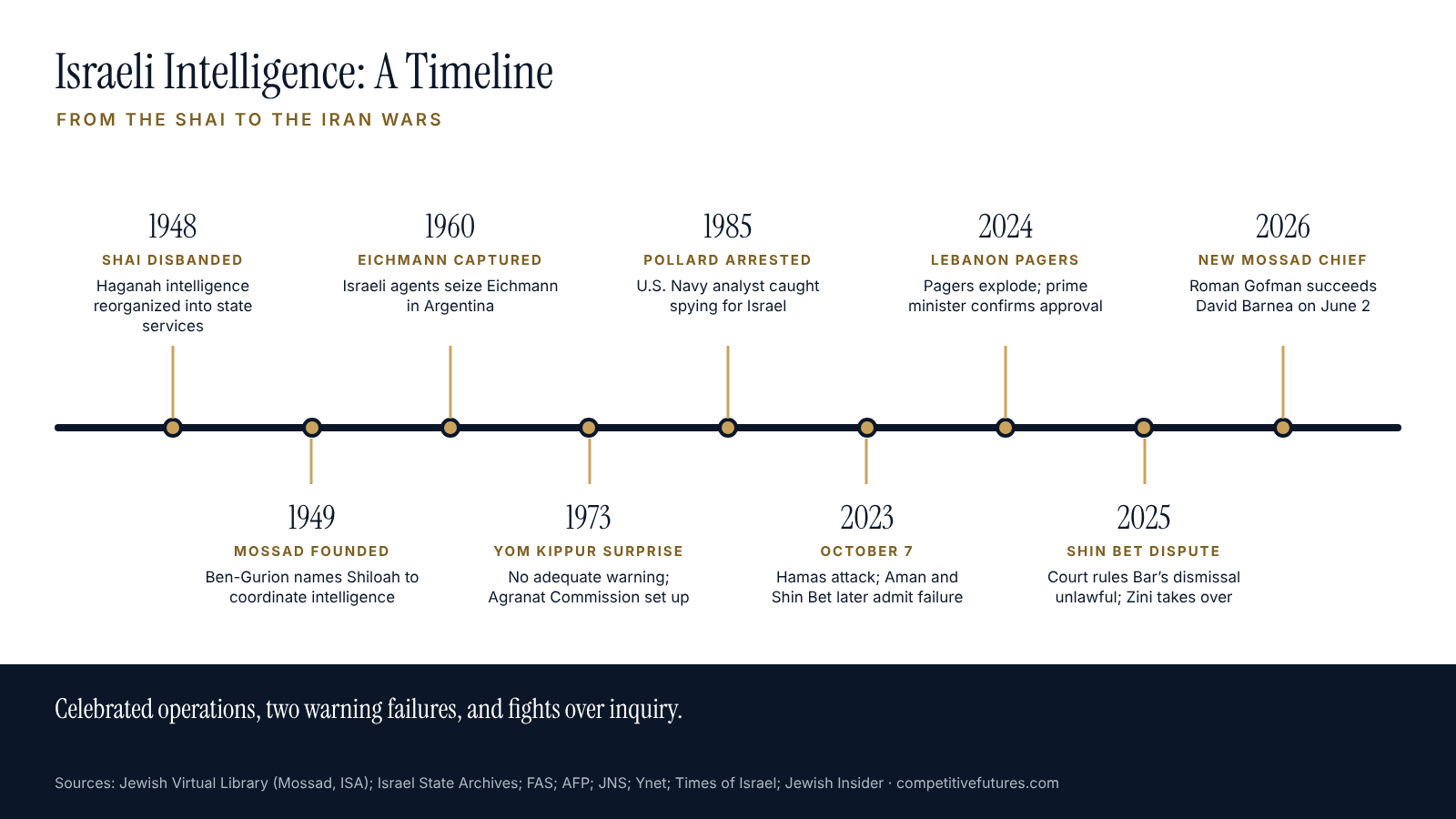
Before statehood, the Jewish community in British Mandate Palestine relied on the Shai, the intelligence arm of the Haganah militia, which operated from the 1930s. Israel declared independence on May 14, 1948, the Israel Defense Forces were created on May 26, and the Shai was disbanded on June 30, 1948, its people and functions reorganized into state structures. The military component, first called the Intelligence Service, became the Military Intelligence Directorate, Aman, an independent branch under the General Staff, by 1950 (GlobalSecurity.org).
The internal service that became Shin Bet also dates its founding to June 30, 1948, under Isser Harel. Its existence was anchored in law on February 18, 1949, but not revealed to the public until 1957 (Jewish Virtual Library). On December 13, 1949, Prime Minister David Ben-Gurion appointed Reuven Shiloah, a Foreign Ministry adviser, to establish and head an institute to coordinate intelligence, the date the Mossad treats as its founding. Ben-Gurion’s directive said, “Reuven Shiloah will report to me.” In March 1951 Ben-Gurion ordered Shiloah to create a directorate to run all intelligence operations abroad, and in 1952 Harel moved from the internal service to replace Shiloah (Jewish Virtual Library).
The operation that made the Mossad famous came in May 1960, when Israeli agents captured the Nazi war criminal Adolf Eichmann in Argentina and Mossad agents handed him to the Israel Police on arrival in Israel. Ben-Gurion announced the capture to the Knesset on May 23, 1960, without naming the country. Eichmann was tried by the Jerusalem District Court, sentenced to death on December 15, 1961, and executed on the night of May 31 to June 1, 1962. Argentina protested to the UN Security Council, which condemned Israel and directed it to pay “appropriate compensation”; the two governments later ended the crisis with a joint statement that included an Israeli apology (Israel State Archives).
The formative failure came in October 1973, when Egypt and Syria attacked on Yom Kippur. Aman was held responsible for the failure to obtain adequate warning, and faulty assessments at higher levels allowed major Arab gains before the army could mobilize (Federation of American Scientists). Unit 8200, Aman’s signals intelligence arm, which had intercepted communications between Egypt’s Gamal Abdel Nasser and Jordan’s King Hussein in 1967, grew into a major technical intelligence organization after 1973 (GlobalSecurity.org).
How Israeli intelligence is organized today
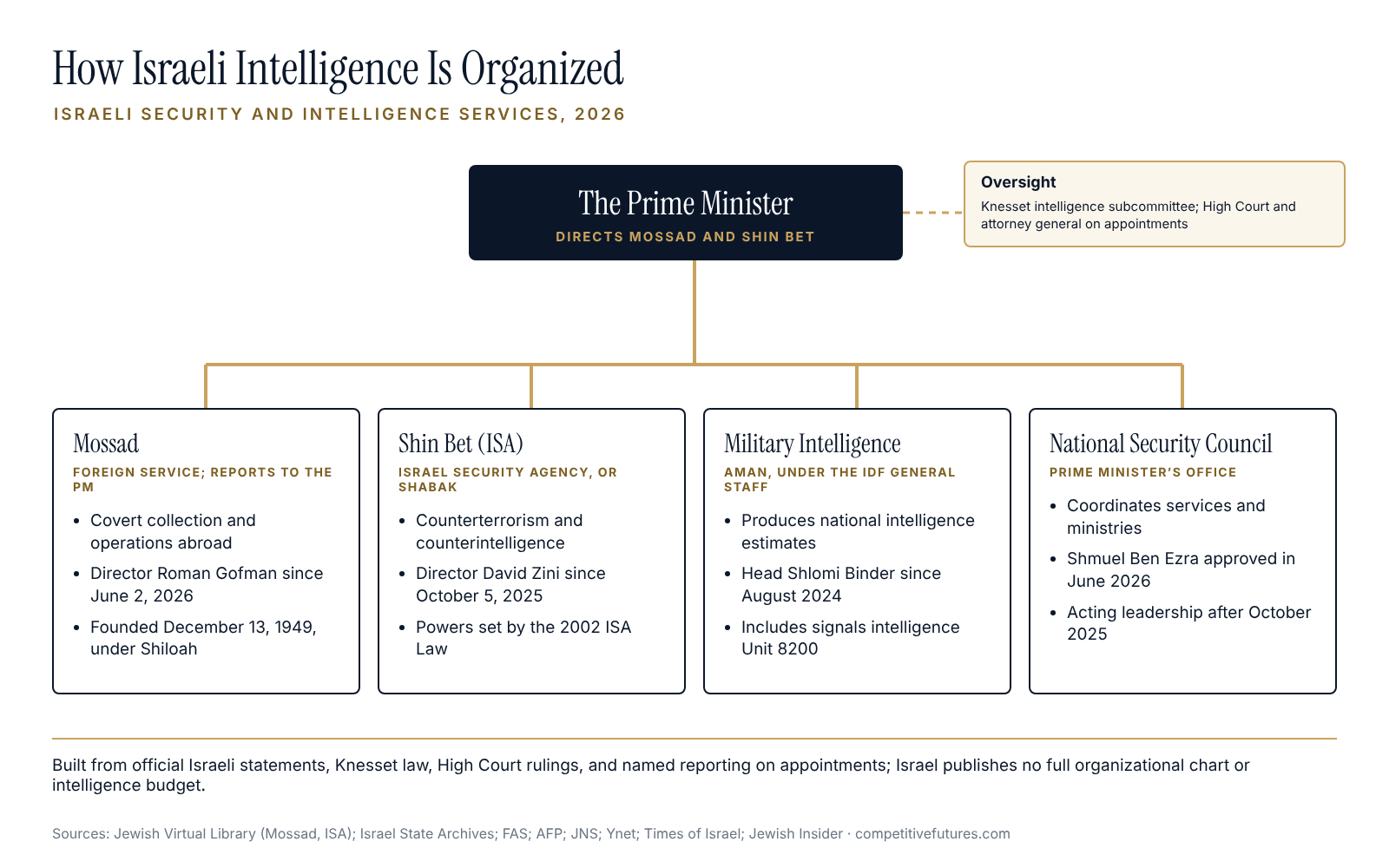
Israel does not publish intelligence budgets or full organizational charts, but law and official decisions set out the main roles.
- The Mossad handles human intelligence collection and covert action abroad, as well as efforts to prevent hostile states from acquiring unconventional weapons and to prevent attacks on Israeli targets abroad (Jewish Virtual Library). Its director is appointed by the prime minister and reviewed by a committee on senior appointments (AFP via Al-Monitor).
- Shin Bet is responsible for counterterrorism, counterespionage, protection of senior officials and sensitive sites, and the prevention of political subversion, under the 2002 ISA Law. It is not part of the Defense Ministry (Jewish Virtual Library).
- Aman is the senior producer of national intelligence assessments, and Unit 8200 sits within it.
- The National Security Council in the Prime Minister’s Office coordinates policy among the services and ministries.
The most consequential recent change was a legal fight over Shin Bet’s leadership. In March 2025, the cabinet voted to dismiss Shin Bet’s director, Ronen Bar, after the prime minister said he had lost confidence in him; Bar later announced he would leave on June 15, and the government annulled the dismissal. On May 21, 2025, the High Court of Justice ruled that the dismissal had been unlawful, finding that the prime minister had a conflict of interest because of criminal investigations involving his aides, including the inquiry known as Qatargate, and that the required advisory committee had not been consulted. The prime minister called the ruling “disgraceful” and said, “The government of Israel, under my leadership, will appoint the head of the Shin Bet” (Times of Israel). On May 22, he named Zini, then head of the army’s Training Command; Attorney General Gali Baharav-Miara said he had acted “in contravention of legal instructions” (Times of Israel). In July 2025 the High Court approved a compromise between the government and the attorney general that routed the choice through the senior appointments committee and required a conflict-of-interest arrangement for the new director regarding the investigations of the prime minister’s aides (Times of Israel). The committee unanimously endorsed Zini, and the attorney general found no legal grounds to block him (Ynet). On December 28, 2025, the High Court rejected petitions against the appointment by a 2–1 majority, with Chief Justice Yitzhak Amit dissenting (Ynet).
Intelligence failure and inquiry
Israel has a well-developed tradition of investigating its own intelligence failures, and an equally developed tradition of arguing over who should conduct the investigation. The model is the Agranat Commission, set up on November 21, 1973, and headed by Shimon Agranat, the chief justice of the Supreme Court (Israel State Archives). Its first report, published on April 1, 1974, dealt with the conduct of the government and the intelligence community and made personal recommendations about senior officers (IDF and Defense Establishment Archives). That report forced the resignation of the chief of staff, David Elazar; several senior officers were demoted or forced to resign, among them the head of military intelligence, Eli Zeira; and it precipitated the resignation of Prime Minister Golda Meir’s cabinet (JTA).
After October 7, 2023, the services investigated themselves first. The military released 77 separate investigations in late February 2025, finding flaws in its intelligence assessments of Hamas’s capabilities and intentions; the outgoing chief of staff, Lt. Gen. Herzi Halevi, said he took full responsibility (AFP via Arab News). Shin Bet published its own findings on March 4, 2025, described below. Aman’s chief, Haliva, had announced his resignation in April 2024 and said at his August handover that “the ultimate responsibility for the failure of the Intelligence Division rests on my shoulders” (Ynet).
What has not happened is a state commission of inquiry of the Agranat type, whose members are appointed by the president of the Supreme Court. The prime minister has said he supports an “objective” commission but not one whose conclusions are “already written in advance” (NPR via Connecticut Public), and he argues that a judiciary-selected panel would be biased against him. In late May 2026, the High Court gave the government until July 1 to devise a suitable framework for an investigation, without ordering a state commission (Times of Israel). On July 6, 2026, a coalition bill for a six-member commission, with members appointed by a two-thirds Knesset majority or, failing that, three each by the coalition and the opposition, passed its first reading 59 to 0 as the opposition boycotted the vote. The bill’s sponsor said only an “egalitarian” panel would uncover the truth; opposition leader Yair Lapid called it “a sham.” Final readings were then expected before the Knesset dissolved, and polls suggest that most Israelis support a state commission (AFP via Arab News).
Israeli intelligence in the news
Most public knowledge of how Israel uses intelligence comes from six cases. Israel’s long-standing practice is not to confirm or deny covert operations abroad, so in several of these cases the attribution rests on other governments, on later statements by Israeli leaders, or on unnamed Israeli officials, and the text says which.
Jonathan Pollard (1985–2020)
Jonathan Pollard, a civilian intelligence analyst for the U.S. Navy, sold military secrets to Israel in the 1980s. He was arrested in 1985 after unsuccessfully seeking asylum at the Israeli Embassy in Washington, pleaded guilty, and received a life sentence (AP via ABC 33/40). For years Israel did not acknowledge him. In May 1998, the government stated publicly for the first time that Pollard “served as an Israeli agent handled by senior members of the Scientific Liaison Bureau,” known as Lakam (Government of Israel statement). U.S. defense and intelligence officials consistently argued against his release. He was paroled on November 20, 2015, and in November 2020 the Justice Department announced that his parole had ended after the U.S. Parole Commission found “no evidence to conclude that he is likely to violate the law” (AFP via Gulf News). He arrived in Israel on December 30, 2020.
The killing of Mahmoud al-Mabhouh in Dubai (2010)
On January 20, 2010, Mahmoud al-Mabhouh, a Hamas official, was killed in a Dubai hotel room. Dubai police identified at least 26 suspects, some traveling on forged European and Australian passports, among them British, Irish, French, and Australian documents, and Dubai’s police chief said he was almost certain Israeli agents were involved; Interpol published a wanted list of 27 people. In March 2010, Britain expelled an Israeli diplomat over the misuse of British passports, with the foreign secretary calling Israel’s actions “completely unacceptable.” Israel neither confirmed nor denied a role. Its Foreign Ministry said it regretted the British decision and that “Minister Lieberman has not received any proof of Israeli involvement in this affair” (Al Jazeera, which is funded by the Qatari state). No public trial in the killing was identified in the sources reviewed for this page.
October 7: the warnings and the agencies’ own reports (2023–2025)
Shin Bet’s March 2025 summary said the agency had “a deep understanding of the threat” but that Hamas’s attack plan, known in 2018 and 2022, was not treated as an actionable threat, and that “the massacre could have been prevented” had it acted differently. It concluded that “the Shin Bet failed to provide a warning regarding the scope of the attack.” Director Ronen Bar said he would carry “this heavy burden” for the rest of his life (AFP via Arab News). On the night itself, according to the report, Shin Bet alerted other bodies at 3:03 a.m. that Hamas units were activating SIM cards, but the signal was discounted because a similar activation had happened a year earlier. The report also cited a “policy of quiet” that allowed Hamas to build up, including Qatari funds that it said reached Hamas. The prime minister’s office responded that “the Shin Bet chief did not see fit to wake the Prime Minister,” and Qatar called the funding claims “false accusations” (NPR via Connecticut Public). These reports are internal reviews, not findings of an independent commission.
Iranian recruitment of Israelis (2023–2026)
Since the Gaza war began, Shin Bet and the Israel Police have announced a steady series of arrests of Israelis accused of carrying out tasks for Iranian handlers. By January 2026, Ynet counted 35 indictments involving 54 alleged Iranian agents. Police said handlers cast a wide net online, often on Telegram, and paid through money changers or cryptocurrency; according to the indictments, tasks ranged from graffiti and photographing sensitive sites to agreeing to assassinations that were not carried out. A police investigator said, “In 99 percent of cases, suspects know they are dealing with an Iranian entity.” Convictions have lagged arrests: at that point one defendant, Moti Maman of Ashkelon, had been sentenced, to 10 years under a plea deal, after traveling to Iran to meet operatives, and another had been convicted and awaited sentencing. (Ynet). Most defendants have not been tried, and the allegations against them remain unproven. Iran’s government did not respond to the specific cases in the reporting cited here.
The pager and walkie-talkie explosions in Lebanon (2024)
On September 17, 2024, pagers carried by Hezbollah members exploded across Lebanon and parts of Syria, and walkie-talkies exploded the next day. Lebanese health authorities said the blasts killed 37 people and injured almost 3,000. Hezbollah blamed Israel, and Lebanon filed a complaint against Israel with the International Labour Organization, alleging that workers were among those killed (Euronews). Israel did not claim responsibility at the time. On November 10, 2024, the prime minister’s spokesman said Netanyahu had confirmed that he “greenlighted the pager operation in Lebanon,” Israel’s first acknowledgment of involvement (AFP via Dawn). In April 2026, Mossad Director Barnea said the agency had worked “shoulder-to-shoulder with the IDF” against Hezbollah and Iran and had “proved new, groundbreaking operational capabilities in target countries” (AFP via Arab News). No court has ruled on the operation.

The wars with Iran (2025–2026)
Israel began attacking Iran on June 13, 2025, striking missile and nuclear facilities, military commanders, and nuclear scientists, in a 12-day war; the United States later struck Iranian nuclear sites, and a ceasefire took effect on June 24 (AFP via Free Malaysia Today). On the first day, an Israeli security official told Ynet that Mossad commando units had earlier placed precision-guided weapons near Iranian surface-to-air missile batteries and had set up a drone base near Tehran, from which “explosive-laden drones were launched overnight” at missile launchers (Ynet). These details come from an unnamed official and have not been independently confirmed. After the ceasefire, Barnea said in a video that “we will continue to keep our eyes wide open on all of Iran’s undertakings” (AFP via Free Malaysia Today). Iran responded with arrests and executions: by late September 2025, according to its judiciary’s news outlet Mizan, it had executed 10 people for spying for Israel since the war, including a telecommunications worker it accused of meeting Mossad officers; activists disputed at least one other confession as coerced (Al Jazeera). On February 28, 2026, Israel and the United States launched a wider war on Iran. On March 18, Israel’s defense minister said Israel had killed Iran’s intelligence minister, Esmail Khatib, which Iran’s president confirmed, condemning the “cowardly assassination” (Al Jazeera).
How to read coverage of Israeli intelligence
Israeli intelligence is unusually well covered and unusually hard to verify. Israeli outlets often attribute operational details to unnamed security officials, which can mean an authorized briefing as much as a leak, and Israel’s practice of neither confirming nor denying operations abroad leaves room for both exaggeration and denial. On the other side, Iranian judicial outlets announce spy convictions that rights groups say rest on coerced confessions, Hezbollah and its allies have every reason to frame events their way, and Al Jazeera, a major source on the region, is funded by the Qatari state. Casualty figures from Lebanon come from local authorities and should be cited as theirs.
The discipline is the same one taught in our guides to trend analysis and cognitive bias: climb toward primary records. For Israel, that means High Court of Justice rulings, the published findings of the military and Shin Bet inquiries, the Agranat reports and other material in the Israel State Archives, Knesset legislation, and U.S. court and Justice Department records in the Pollard case. For influence work in Washington, the Justice Department’s public database of registered foreign agents (FARA eFile) shows who is paid to represent Israeli interests and who is paid to represent their rivals. Weigh a court ruling or commission finding above a government statement, and a government statement above an anonymous official.
Frequently asked questions
What is Israel’s intelligence agency called?
Israel has three main services. The Mossad, formally the Institute for Intelligence and Special Operations, works abroad; Shin Bet, also called the Israel Security Agency or Shabak, handles domestic security and counterintelligence; and the Military Intelligence Directorate, known as Aman, produces national intelligence assessments and includes the signals intelligence Unit 8200.
Who is the head of Israeli intelligence?
Maj. Gen. Roman Gofman has directed the Mossad since June 2, 2026, succeeding David Barnea. Maj. Gen. (res.) David Zini has headed Shin Bet since October 5, 2025, after a legal dispute over the dismissal of his predecessor, Ronen Bar. Maj. Gen. Shlomi Binder has headed military intelligence since August 2024, and Shmuel Ben Ezra was approved as head of the National Security Council in June 2026.
What is Unit 8200?
Unit 8200 is the signals intelligence unit of the Military Intelligence Directorate. It intercepted communications between Egypt’s Gamal Abdel Nasser and Jordan’s King Hussein during the 1967 war and grew into a major technical intelligence organization after the 1973 war.
Related reading
- Intelligence Services Around the World: Structure, History, and the Headlines
- Qatari Intelligence: History, Structure, and the Headlines
- Iranian Intelligence: History, Structure, and the Headlines
- Cognitive Bias: A Field Guide for Leaders
Competitive Futures briefs companies and governments on intelligence services, foreign influence, and Israel and the Middle East; details are on the services page.