Canadian Intelligence: History, Structure, and the Headlines

Canada is a founding member of the Five Eyes, shares the world’s longest land border with the United States, and sits on top of the Arctic approaches that Russia, China, and the United States all watch closely. It is also, by its own public inquiry’s account, a target of sustained foreign interference, and since 2023 it has been at the center of an international dispute over the killing of a Sikh activist on Canadian soil. Yet Canada runs its intelligence business in an unusual way: unlike Britain, the United States, or Australia, it has no dedicated foreign human-intelligence service.
This page is a working overview of Canadian intelligence: where it came from, how it is organized and overseen today, and the cases that have put it in the news. It relies on federal statutes, government releases, royal commission and parliamentary committee reports, court-reported facts, and named reporting, and it notes where a claim comes from a party with an interest in the outcome.
Canadian intelligence at a glance
- Security intelligence: the Canadian Security Intelligence Service (CSIS; in French, Service canadien du renseignement de sécurité), headed by Director Daniel Rogers, who took office on October 28, 2024. He had been deputy national security and intelligence adviser to the prime minister and before that spent a decade at the Communications Security Establishment (CBC News).
- Signals intelligence and cyber security: the Communications Security Establishment (CSE; Centre de la sécurité des télécommunications). In September 2026, Prime Minister Mark Carney named Scott Jones, president of Shared Services Canada and a former head of CSE’s Canadian Centre for Cyber Security, to replace the retiring chief, Caroline Xavier (Canadian Press via CP24).
- Police: the Royal Canadian Mounted Police (RCMP), whose Integrated National Security Enforcement Teams investigate national security crimes and lay charges (Global News).
- Military intelligence: Canadian Forces Intelligence Command (CFINTCOM), commanded by Major-General Dave Abboud. “The Commander of CFINTCOM is also the Chief of Defence Intelligence” (National Defence).
- Coordination: the National Security and Intelligence Advisor to the Prime Minister. In March 2026, Nathalie Drouin left the post to become ambassador to France, and the Privy Council Office said David Morrison, named the prime minister’s senior diplomatic and international affairs adviser, would also take on the national security adviser role (Canadian Press via National Newswatch).
- Oversight: the National Security and Intelligence Committee of Parliamentarians (NSICOP), established in 2017; the National Security and Intelligence Review Agency (NSIRA), in force since July 2019; and the Intelligence Commissioner, a retired superior court judge who reviews certain ministerial authorizations (NSICOP; CSIS).
- Relationship with the United States: foundational. CSE says Canada has had close intelligence relationships with the United States, the United Kingdom, Australia, and New Zealand for more than seventy years, the partnership known as the Five Eyes (CSE).

History: from the Gouzenko affair to a civilian service
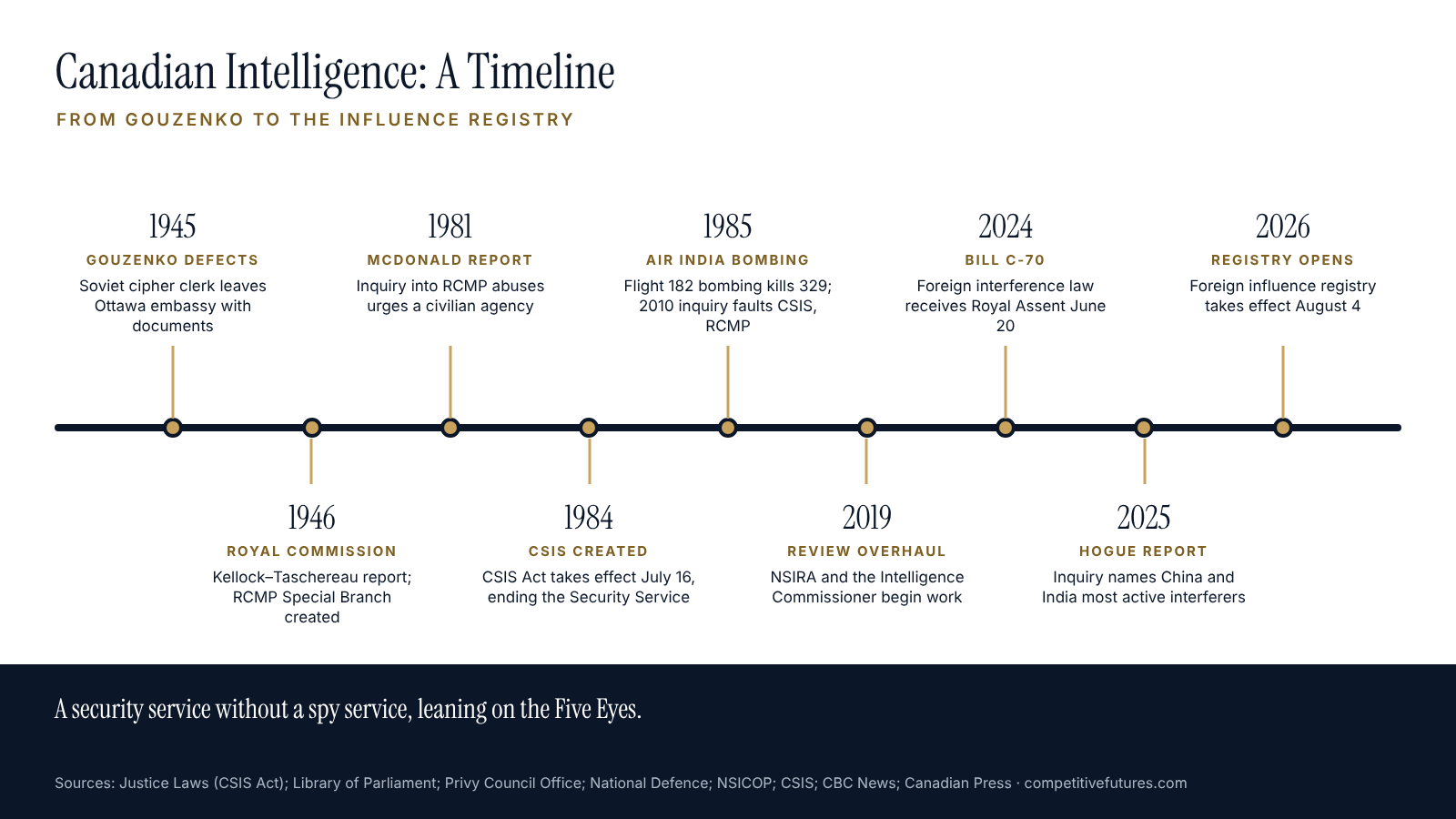
Canada’s modern intelligence history begins with a defection. According to the 1946 report of the royal commission that investigated it, “On the night of September 5th, 1945, Gouzenko left the Embassy with a certain number of documents from his own office.” Igor Gouzenko, a cipher clerk at the Soviet embassy in Ottawa, carried telegrams to and from Moscow that exposed what the commissioners, Justices Robert Taschereau and R. L. Kellock, called “a conspiratorial organization operating in Canada and other countries,” with parallel networks run by Soviet military intelligence and the NKVD (Report of the Royal Commission, 1946).
The institutional response came quickly. The RCMP created a Special Branch in 1946, after the Gouzenko case heightened awareness of the need for counter-espionage capabilities; it was renamed the Security Service in 1970 and placed under a civilian director general, but it still had no statute of its own (Library of Parliament). The same year, 1946, Canada created its first peacetime codebreaking agency, the Communications Branch of the National Research Council, under Edward Drake; it became the Communications Security Establishment in 1975 (CSE).
The Security Service’s downfall came from its own conduct. In the 1970s, investigations of Quebec separatism and the left included unauthorized break-ins, mail openings, the theft of a Parti Québécois membership list, and the burning of a barn in Quebec (The Canadian Encyclopedia). The federal government set up the McDonald Commission in 1977. Its final report, made public on August 25, 1981, found that some activities were “not authorized or provided for by law,” that the service lacked a precise mandate, effective political control, and adequate review, and that police work and security intelligence were incompatible. It recommended a separate civilian agency (Library of Parliament).
Parliament acted in 1984. Bill C-9 passed the House of Commons on June 21, 1984, and most of the Canadian Security Intelligence Service Act came into force on July 16, 1984. The Act defined “threats to the security of Canada,” required Federal Court warrants for intrusive techniques, and created the Security Intelligence Review Committee to review CSIS (Library of Parliament). The RCMP kept national security policing, setting up the CSIS–RCMP divide that the Air India case would expose.
The review system was rebuilt three decades on. NSICOP, a committee of lawmakers from both houses of Parliament, was established on June 22, 2017 (NSICOP). The National Security Act, 2017, passed into law on June 21, 2019, created NSIRA, which replaced both the Security Intelligence Review Committee and the CSE Commissioner, and created the Intelligence Commissioner. CSIS calls the accompanying amendments “the most significant changes to the CSIS Act since 1984” (CSIS). NSIRA came into force on July 12, 2019, with a mandate covering the national security work of every federal department, including the RCMP (Security Intelligence Review Committee release).
How Canadian intelligence is organized today
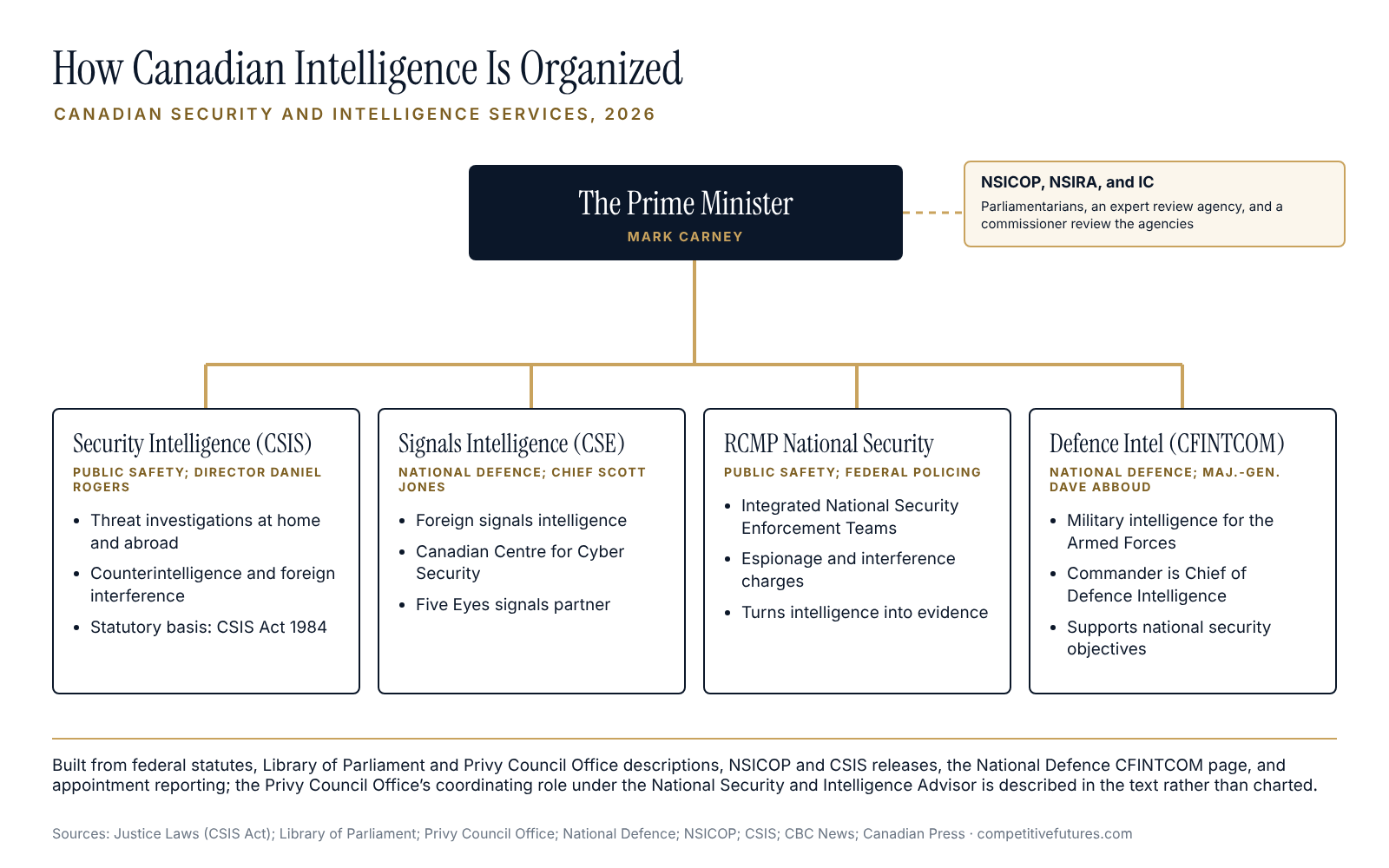
Canada’s community is small, legally constrained, and split across several ministers.

- CSIS collects and analyzes intelligence on threats to the security of Canada and advises the government. Under section 12 of the CSIS Act it “may perform its duties and functions under subsection (1) within or outside Canada,” and it can take measures “within or outside Canada, to reduce the threat” (CSIS Act, Justice Laws). It answers to the Minister of Public Safety.
- CSE collects foreign signals intelligence, protects federal systems, and runs the Canadian Centre for Cyber Security. It falls under the Minister of National Defence.
- The RCMP turns national security intelligence into criminal cases, from espionage to foreign interference to terrorism.
- CFINTCOM provides defence intelligence to the Canadian Armed Forces and the government (National Defence).
- The Privy Council Office coordinates. Its National Security Council Secretariat “provides leadership for Canada’s intelligence assessment community,” and its Assistant Secretary serves as Canada’s Head of Assessment; a Deputy Secretary to the Cabinet for national security and intelligence develops the government’s intelligence priorities for Cabinet (Privy Council Office).
The striking gap is foreign human intelligence. Canada has no equivalent of MI6, the CIA, or Australia’s ASIS; CSIS works abroad only in pursuit of threats to Canada. Collection of foreign intelligence for its own sake is covered by section 16 of the CSIS Act, which lets CSIS “assist the Minister of National Defence or the Minister of Foreign Affairs, within Canada,” in collecting information on the capabilities, intentions, or activities of foreign states and foreigners, and which bars that assistance from being “directed at” Canadian citizens, permanent residents, or Canadian corporations (CSIS Act, Justice Laws). In practice, Canada relies on CSE’s signals collection, diplomatic reporting, and its Five Eyes partners, which is why the alliance matters so much to Ottawa.
Foreign interference and the Hogue Commission
No issue has defined Canadian intelligence in this decade as much as foreign interference. In June 2024, NSICOP published a special report stating that some unnamed parliamentarians were “semi-witting or witting participants” in the efforts of foreign states to interfere in Canadian politics. It named China and Russia as primary perpetrators and listed India, Pakistan, and Iran among states that had engaged in interference (JURIST).
A public inquiry led by Commissioner Marie-Josée Hogue had already found, in its May 2024 initial report, that foreign meddling “didn’t affect which political party formed government” in the 2019 and 2021 elections. Its final report, released on January 28, 2025, made 51 recommendations. Hogue wrote, “I did not see evidence of ‘traitors’ in Parliament,” and named China and India as “the two most active perpetrators of foreign electoral interference in Canada” (CBC News). The 860-page report also concluded that “information manipulation (whether foreign or not) poses the single biggest risk to our democracy,” adding, “It is an existential threat” (Global News).
The responses split predictably. The federal government said it would “carefully review” the findings; the Conservatives said the report “leaves Canadians with concerns that the government failed to inform” them; and the NDP said it would implement the recommendations (CBC News). India’s Ministry of External Affairs said, “We reject the report’s insinuations on India,” and added, “It is in fact Canada which has been consistently interfering in India’s internal affairs” (PTI via Business Standard). The sources reviewed for this page did not include a Chinese government response to the final report.
Parliament had already legislated. Bill C-70, the Countering Foreign Interference Act, received Royal Assent on June 20, 2024. It made what Public Safety Canada called “the most significant update” to the CSIS Act since 1984, modernized foreign interference offences and the sabotage offence, and set out the framework for a Foreign Influence Transparency Registry (Public Safety Canada). The registry took two more years. The Foreign Influence Transparency and Accountability Act came into force on August 4, 2026, under a first Foreign Influence Transparency Commissioner, Anton Boegman, formerly British Columbia’s chief electoral officer. Arrangements with a foreign principal must be registered within 14 days, and penalties run up to $1 million in administrative fines or, on prosecution, up to five years in prison (Borden Ladner Gervais). The public registry is now online.
Canadian intelligence in the news
Most public knowledge of Canadian intelligence comes from a handful of cases. Several are allegations still before the courts; where that is so, it is noted, along with the response of the government or person accused.
Air India Flight 182 (1985–2010)
In June 1985, a bomb destroyed Air India Flight 182, killing all 329 people aboard, most of them Canadians. Two men tried on murder and conspiracy charges, Ripudaman Singh Malik and Ajaib Singh Bagri, were acquitted of all charges in 2005. A commission of inquiry led by John Major, a former Supreme Court of Canada justice, released its final report in June 2010. Major condemned CSIS and the RCMP for failing to use information available to them before the bombing and for failing to cooperate with each other during the investigation. “A lack of awareness of the threat of Sikh terrorism at the agency level led to inadequate procedures and practices,” he said. “This reflected a culture of complacency” (JURIST). The CSIS–RCMP friction it exposed is still cited whenever intelligence must become evidence.
Jeffrey Delisle and the GRU (2013)
Sub-Lieutenant Jeffrey Delisle, a naval intelligence officer at HMCS Trinity, an intelligence facility in Halifax, approached the Russian embassy in Ottawa and asked to meet someone from the GRU, Russia’s military intelligence agency. For four years he passed classified material, including NATO information, to Russia, receiving more than $111,000. He pleaded guilty to breach of trust and two counts of passing information to a foreign entity, and on February 8, 2013, he became the first person sentenced under the Security of Information Act, receiving 20 years. “Society is justifiably outraged at the betrayal,” Judge Patrick Curran said (CBC News).
The Chinese “police stations” (2022–2025)
In the fall of 2022, the Spain-based human rights group Safeguard Defenders reported that China was running overseas “police stations,” including three sites in the Toronto area, that pressured people to return to China. China’s embassy in Ottawa said the offices were staffed by “local volunteers, and not Chinese police officers” and helped with services such as driver’s licence renewals (AFP via Hong Kong Free Press). In March 2023, the RCMP said it was investigating two Montreal-area community organizations and was “carrying out police actions aimed at detecting and disrupting these foreign state-backed criminal activities.” China’s foreign ministry said China was “strictly abiding by international law and respecting all countries’ judicial sovereignty” (CBC News). The two organizations denied wrongdoing and sued the RCMP for $4.9 million. In September 2025, the RCMP confirmed it had closed the Quebec investigation and said, “At this stage, the RCMP is not recommending that charges be laid” (National Post, via Unpublished). No charges in connection with the alleged stations appear in the reporting reviewed for this page.
The killing of Hardeep Singh Nijjar (2023–present)
On June 18, 2023, Hardeep Singh Nijjar, a Sikh activist and supporter of an independent Sikh homeland, was shot dead in Surrey, British Columbia, as he left his temple’s parking lot (Canadian Press via paNOW). In September 2023, Prime Minister Justin Trudeau told the House of Commons there were credible allegations linking agents of India’s government to the killing; he later said he had intelligence but no “hard evidentiary proof” at the time. India’s Ministry of External Affairs has called Canada’s allegations “absurd and baseless” (Scroll). In May 2024, four Indian nationals were charged with first-degree murder and conspiracy to commit murder (CTV News), and in November 2024 prosecutors used a rarely used direct indictment to send the case straight to trial. In February 2026, Canada’s Attorney General sought a Federal Court order under the Canada Evidence Act to keep some information from disclosure on national security and international relations grounds (Canadian Press via paNOW); the trial was expected to begin later in 2026 (PTC News). The accused are presumed innocent, and no court has made any finding about Indian state involvement.
Cameron Ortis (2023–2026)
Cameron Ortis, who had led an RCMP intelligence unit, was convicted by a jury in November 2023 of three counts under the Security of Information Act, one count of attempting to violate it, breach of trust, and fraudulent use of a computer system. He pleaded not guilty, testifying that he gave secret material to targets to get them to use an encryption service that an allied intelligence agency had set up to spy on adversaries. The judge said he had held a position of “extreme trust.” He was sentenced in early 2024 to 14 years. Ortis is appealing his conviction and sentence, and the Crown is appealing the sentence as too short. The Parole Board of Canada granted him day parole in February 2026 and extended it in August 2026 (Canadian Press via CP24).
William Majcher and the China case (2023–2026)
In 2023, William Majcher, a former RCMP officer who had moved to Hong Kong to work in banking and private security, was arrested at Vancouver’s airport. The RCMP alleged that he helped China “to obtain intelligence or services to benefit the People’s Republic of China” in a 2017 effort to pressure a Vancouver resident whom China accused of fleeing with “tens of millions of dollars.” By the time of trial in April 2026, the case had narrowed to a single count under the Security of Information Act. On May 13, 2026, a B.C. Supreme Court judge acquitted him, calling the Crown’s evidence “entirely circumstantial” and a finding of guilt “simply too far a leap.” Majcher said, “The verdict confirmed what I have maintained from the beginning: I committed no offence – full stop!” In June 2026, the Public Prosecution Service of Canada appealed and asked for a new trial (Global News). The reporting reviewed did not include a Chinese government response. Majcher stands acquitted unless the appeal succeeds.
Iran, Russia, and the spy chief’s warning (2024–2025)
On June 19, 2024, Canada listed Iran’s Islamic Revolutionary Guard Corps as a terrorist entity under the Criminal Code, which requires Canadian institutions to freeze its property (Public Safety Canada). When the House of Commons had urged that step in a May 2024 motion, Iran’s foreign ministry spokesman called it “unwise” and said, “This irresponsible step is in line with the mistaken path,” according to Iran’s state broadcaster Press TV (Press TV via GlobalSecurity.org). In his first public speech as CSIS director, on November 13, 2025, Rogers said CSIS had shifted resources to counter “Iranian intelligence services and their proxies” and that “in more than one case” it had detected and disrupted “potentially lethal threats against individuals in Canada.” He said “Illicit Russian procurement networks seek to illegally acquire Canadian goods and technologies,” and he named India’s government among those engaged in transnational repression (Global News). These are the service’s assessments, not court findings, and the Global News report did not include responses from the governments named.
How to read coverage of Canadian intelligence
Canadian intelligence coverage is unusually shaped by leaks and by foreign media. Much of the foreign interference debate was driven by reporting based on unnamed security sources, and the official reports that followed did not always bear them out in full. Coverage of the Nijjar case in Indian outlets, of the police stations in Chinese state media, and of the IRGC in Iranian state media reflects each government’s position.
The discipline is the same one taught in our guides to cognitive bias and trend analysis: climb toward primary records. For Canada, that means the statutes on Justice Laws, the final reports of the Hogue and Major commissions, NSICOP and NSIRA reports, B.C. Supreme Court and Federal Court records, Public Safety and CSIS releases, the new Canadian foreign influence registry, and the U.S. Justice Department’s public database of foreign agents registered under the Foreign Agents Registration Act (FARA eFile), which lists the lobbyists and consultants working for foreign governments, including Canada and its rivals, in Washington. When a story rests on a single anonymous intelligence source, treat it as a lead, not a finding.
Frequently asked questions
What is Canada’s intelligence agency called?
Canada’s main intelligence agency is the Canadian Security Intelligence Service (CSIS), created in 1984 to replace the RCMP Security Service. Signals intelligence and cyber security belong to the Communications Security Establishment (CSE), military intelligence to Canadian Forces Intelligence Command, and national security policing to the RCMP.
Who heads Canadian intelligence?
No single person does. Daniel Rogers has been Director of CSIS since October 2024; Scott Jones was named in September 2026 to succeed Caroline Xavier as Chief of CSE; and the National Security and Intelligence Advisor to the Prime Minister, a role David Morrison took on in 2026, coordinates the community from the Privy Council Office.
Does Canada have a foreign intelligence service like MI6 or the CIA?
No. Canada has no dedicated foreign human-intelligence service. CSIS may operate abroad to investigate threats to Canada, and under section 16 of the CSIS Act it may help the foreign and defence ministers collect foreign intelligence within Canada, but not against Canadians. Canada relies on CSE’s signals intelligence and its Five Eyes partners for much of its foreign intelligence.
Related reading
- Intelligence Services Around the World: Structure, History, and the Headlines
- Qatari Intelligence: History, Structure, and the Headlines
- British Intelligence: History, Structure, and the Headlines
- Cognitive Bias: A Field Guide for Leaders
Competitive Futures briefs companies and governments on intelligence services, foreign influence, and Canada and the Five Eyes; details are on the services page.