Venezuelan Intelligence: History, Structure, and the Headlines
For a quarter century, Venezuela’s intelligence services have been known more for what they did at home than for what they collected abroad. United Nations investigators concluded that the Bolivarian National Intelligence Service (SEBIN) and the military counterintelligence directorate (DGCIM) were central to a state plan to repress government opponents. U.S. prosecutors charged a former head of military intelligence as a leader of a drug-trafficking network. Cuban advisers helped rebuild the military service from the inside. Then, on January 3, 2026, a U.S. military operation captured President Nicolás Maduro in Caracas, and the services that had protected him had to find their place in a new order.
This page is a working overview of Venezuela’s intelligence and security services: where they came from, how they are organized today, and the cases that have put them in the news. It relies on Venezuela’s official gazette as reported, U.S. court records and sanctions actions, United Nations and Inter-American Court findings, and named reporting. Allegations are paired with the response of the people or government concerned, and the page notes when a source is a state outlet, a U.S. government outlet, or an exile publication.
Venezuelan intelligence at a glance
- Main civilian service: the Bolivarian National Intelligence Service (Servicio Bolivariano de Inteligencia Nacional, SEBIN), successor to the DISIP, which was founded in 1969. Hugo Chávez announced the change of name on December 4, 2009 (GlobalSecurity.org). Since 2021 it has been attached to the Interior Ministry under Decree 4.601, published in Official Gazette No. 41.116 (Diario de Los Andes).
- SEBIN head: the last publicly reported appointment was Major General Alexis Rodríguez Cabello, named in October 2024 (Voice of America). The U.S. Treasury sanctioned him in November 2024 (Diario Las Américas). We could not confirm whether he still holds the post.
- Military counterintelligence: the General Directorate of Military Counterintelligence (Dirección General de Contrainteligencia Militar, DGCIM), the former Military Intelligence Directorate (DIM), renamed in 2011 (Reuters via The Peninsula). Its director since March 18, 2026, is Navy Captain Germán Gómez Lárez (El Diario).
- Defense minister: General Gustavo González López, a former SEBIN chief, who replaced Vladimir Padrino López on March 18, 2026, after briefly running the DGCIM. The United States sanctioned him over the crackdown on 2014 protests (AP via WTOP).
- Reporting line: Acting President Delcy Rodríguez, who took over after Maduro’s capture and told the UN General Assembly in September 2026 that “Elections will be held in Venezuela,” without setting a date (AP via KAXE).
- Relationship with the United States: hostile for two decades, now a close working relationship. The United States lifted sanctions on Rodríguez in April 2026 (AP via KAXE), and Cuban security advisers have been eased out of the DGCIM (Reuters via The Star).
History: from the DISIP to the Bolivarian services
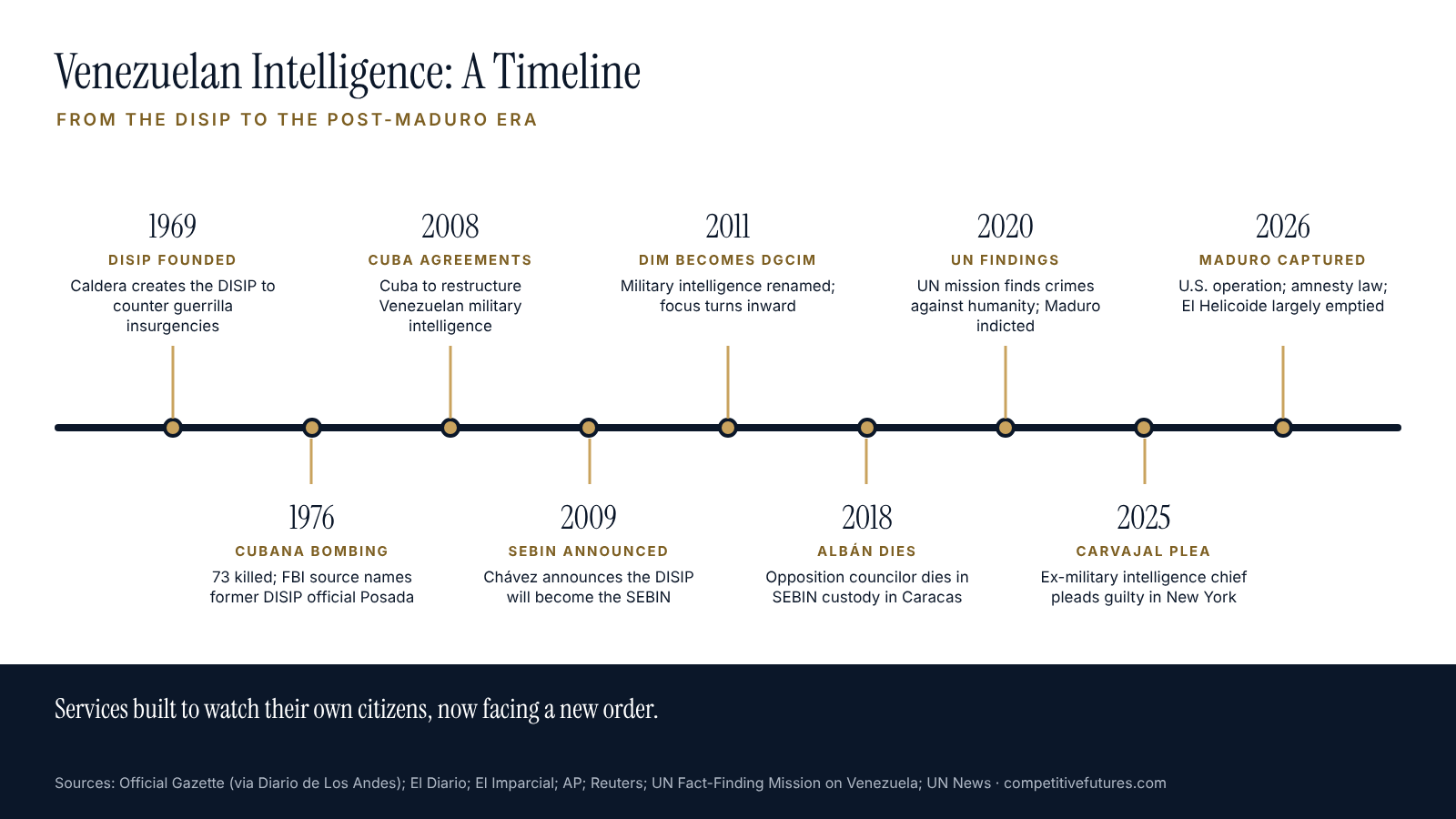
Venezuela’s modern civilian intelligence service was born in the Cold War. President Rafael Caldera created the National Directorate of Intelligence and Prevention Services (DISIP) in March 1969 to replace an earlier political police, the DIGEPOL, and to fight what one specialist reference describes as “Cuban-supported guerrilla insurgencies” (GlobalSecurity.org). Early on, the DISIP combined counterintelligence, criminal investigation, and work against the armed left, and at least one anti-Castro Cuban exile with CIA paramilitary training rose to a senior post, the center of the most notorious case in its history (described below).
The service changed character under Hugo Chávez, who took office in 1999. After the failed coup against him in April 2002, Chávez restructured the security services and removed officers he considered politically unreliable, and, according to the same reference, Cuban advisers took positions inside the DISIP and taught interrogation, surveillance, and counterintelligence (GlobalSecurity.org). That source is openly critical of Chávez and cites few sources, so it is best checked against the documented record below.
The legal framework has been built largely by decree. In May 2008, Chávez issued a decree law that would have replaced the country’s two main intelligence services with new agencies and required citizens to provide information to them, with prison terms of two to six years for refusing. After protests and criticism from human rights groups, he annulled it on June 10, 2008 (Voice of America). The same year, Venezuela and Cuba signed agreements to restructure Venezuelan military intelligence (Reuters via The Peninsula), and in December 2009 Chávez announced that the DISIP would become the SEBIN (GlobalSecurity.org).
Under Nicolás Maduro, who succeeded Chávez in 2013, the services moved closer to the presidency. SEBIN was placed under the executive vice presidency in 2014 and returned to the Interior Ministry by Decree 4.601, signed by then Vice President Delcy Rodríguez in 2021 (Diario de Los Andes). When SEBIN’s director, Manuel Cristopher Figuera, broke with the government during the April 30, 2019, uprising and fled to the United States, Maduro brought back Gustavo González López, who ran SEBIN from 2014 to 2018 and again from 2019 to 2024 (El Imparcial).
How Venezuelan intelligence is organized today
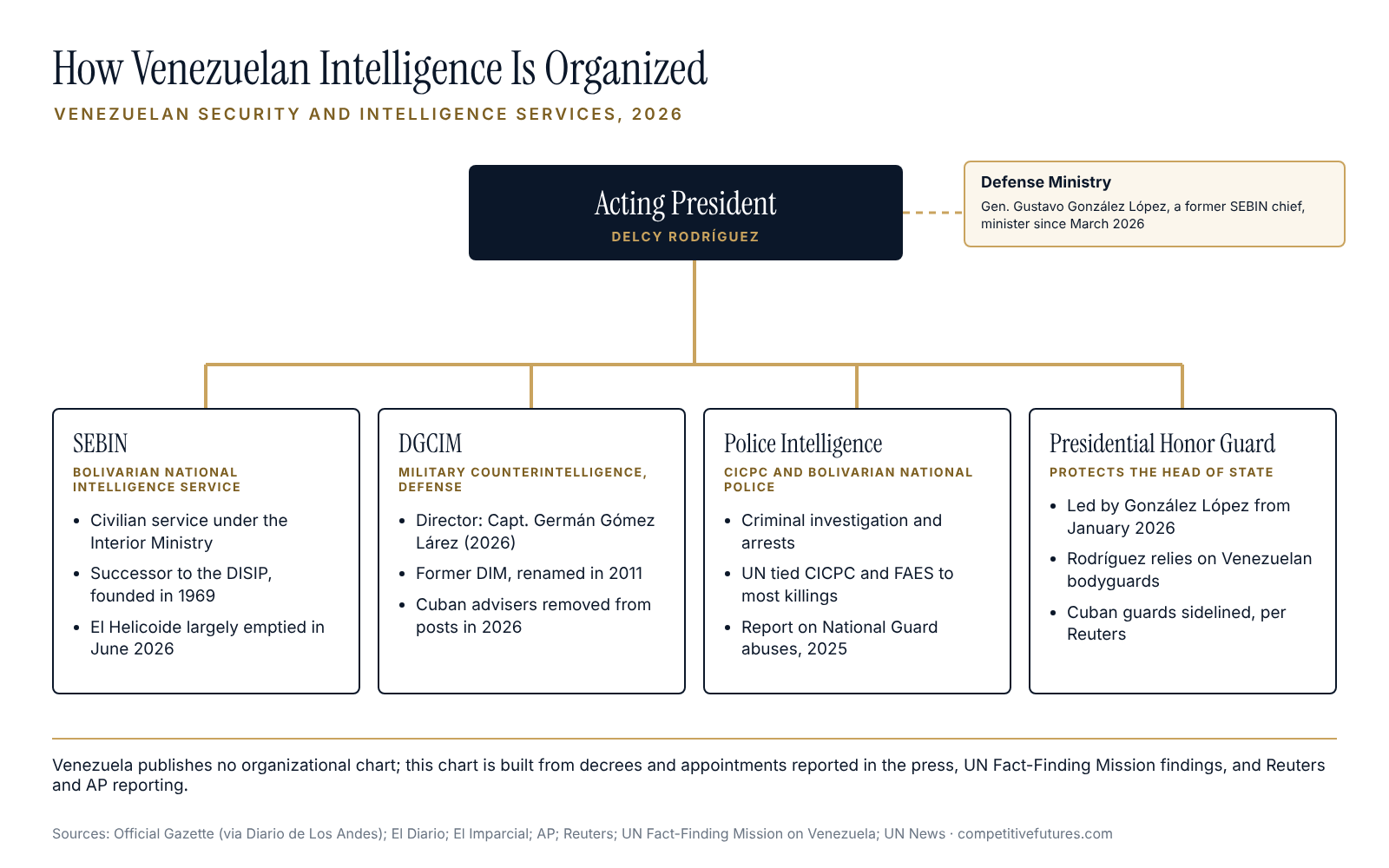
Venezuela publishes no organizational chart or budget for its intelligence services. The outline below comes from decrees as reported in the press, UN findings, and U.S. records.
- SEBIN is the civilian intelligence and counterintelligence service, attached to the Ministry of Interior, Justice, and Peace as a deconcentrated body (Diario de Los Andes). Its best-known detention site, El Helicoide in Caracas, was largely emptied in June 2026.
- The DGCIM is the military counterintelligence directorate, under the Defense Ministry. UN investigators identified its Boleíta headquarters in Caracas, alongside El Helicoide, as a site of serious violations (UN Fact-Finding Mission via ReliefWeb).
- Police intelligence and investigation rests mainly with the Scientific, Penal, and Criminal Investigations Corps (CICPC) and the Bolivarian National Police (PNB). The UN mission found in 2020 that the CICPC and the PNB’s Special Action Forces (FAES) “were responsible for 59 per cent of all killings by security forces in the period under review” (UN News).
- The Presidential Honor Guard protects the head of state; in January 2026 Rodríguez put González López in charge of it and the DGCIM (El Imparcial).
Two features define the system. First, a small circle of officers rotates among intelligence, the presidential guard, and the cabinet, so personnel moves are the best public signal of who holds power. Second, both services have been oriented toward internal threats: opposition politicians, protesters, and above all disloyal officers. The new DGCIM director previously ran the service’s special detentions unit, and a retired officer once held by the DGCIM named him in a 2023 complaint to international bodies as among those allegedly responsible for torture; he has not been charged or convicted (El Diario).
Political police
The most detailed public record of SEBIN and the DGCIM comes from the Independent International Fact-Finding Mission on Venezuela, created by the UN Human Rights Council in 2019. Its first report, in September 2020, concluded that abuses since 2014, including unlawful executions, enforced disappearances, arbitrary detentions, and torture, amounted to crimes against humanity. One of its members, Francisco Cox, said, “We have reasonable grounds to believe that the President Maduro did give orders to the director of SEBIN,” and the report found that senior officials “gave orders, coordinated activities and supplied resources” (UN News). The mission’s database named 20 SEBIN officers and 25 DGCIM officers, and it cited the case of Navy Captain Rafael Acosta, believed to have died of torture in DGCIM custody. Venezuela’s Foreign Ministry called the report “plagued with falsehoods, prepared remotely, without any methodological rigor” (Al Jazeera).
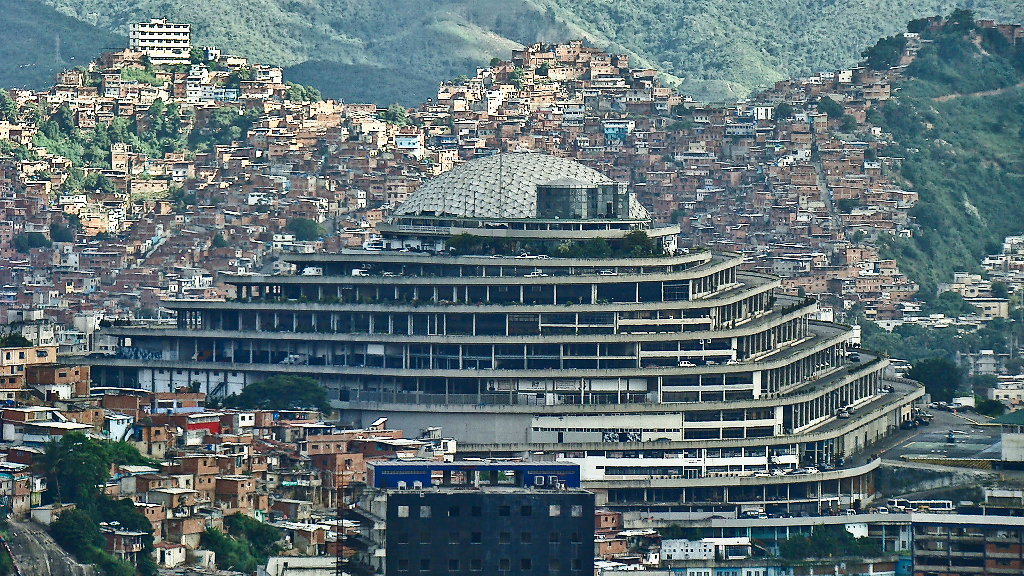
In September 2022, the mission published a report devoted to the two intelligence services. It found reasonable grounds to believe that people at several levels of SEBIN and the DGCIM “played an integral part in the targeted repression of Government opponents,” that “the structures of DGCIM and SEBIN remain the same,” and that SEBIN’s El Helicoide and the DGCIM’s Boleíta were among the sites where detainees suffered violations, which the report says included beatings, electric shocks, and sexual violence (UN Fact-Finding Mission via ReliefWeb). The mission’s chair, Marta Valiñas, said the two services “are part of machinery put in place and deployed for the execution of a government plan,” adding, “Its plan was therefore orchestrated from the highest political level.” Venezuela’s ambassador in Geneva, Héctor Constant Rosales, rejected the report as politicized and said its investigators relied on unreliable sources (Voice of America).
After the disputed July 2024 election, the mission reported in 2025 that authorities had detained 2,220 people, later releasing 2,006 while arresting about 200 more, and that some foreign nationals were held incommunicado in conditions “amounting to enforced disappearances.” Venezuela’s Attorney General’s Office said state authorities were not involved in the deaths of detainees the mission examined (JURIST). In December 2025, a further report described the National Guard’s record since 2014 as “a pattern of killings, arbitrary detentions, torture, and sexual violence against protesters and political opponents”; the government has refused the mission access to the country (JURIST).
The International Criminal Court opened its investigation, known as Venezuela I, in 2021, after finding a reasonable basis to believe that crimes against humanity were committed during the 2017 crackdown on protests. In July 2026, Foreign Minister Félix Plasencia said Venezuela had notified the United Nations of its withdrawal from the Rome Statute, citing the court’s “demonstrated geographical bias” and calling the decision “firm and irrevocable.” A withdrawal takes effect a year after notification and does not halt an investigation already under way (Al Jazeera).
A regional court has also ruled on SEBIN’s best-known building. On June 10, 2026, the Inter-American Court of Human Rights, ruling in the case of Jorge Rojas Riera, who was tortured at El Helicoide in 2003, ordered the facility permanently closed, according to CiberCuba, a Cuban exile outlet (CiberCuba).
Venezuelan intelligence in the news
Most public knowledge of Venezuelan intelligence comes from seven cases. Some rest on findings by courts or UN bodies; others remain allegations by prosecutors, governments, or reporters. In each, the response of those accused is noted.
Luis Posada Carriles and the Cubana bombing (1967–1985)
The DISIP’s most notorious Cold War link was to Luis Posada Carriles, a Cuban exile and former CIA asset. Declassified U.S. records published by the National Security Archive show that he was a senior DISIP official in charge of demolitions; a CIA summary places his DISIP service between 1967 and 1974 (National Security Archive). On October 6, 1976, Cubana Flight 455 was bombed after leaving Barbados, killing 73 people. An FBI report the next day cited a confidential source who named Posada and Orlando Bosch as responsible, and two Venezuelans arrested in Barbados reportedly worked for Posada’s security firm. A Venezuelan judge issued warrants for all four that November. Posada was held in Caracas over his alleged involvement and escaped in 1985 (National Security Archive). The archive’s records show no conviction over the bombing and do not include Posada’s response to the allegations.
Cuban advisers and the DGCIM (2008–2026)
In 2019, Reuters reported on two agreements signed in Caracas on May 26, 2008, under which Cuba’s defense ministry would oversee a restructuring of Venezuelan military intelligence and train Venezuelan officers in Havana. According to Reuters, the service, renamed the DGCIM in 2011, shifted its focus to watching Venezuela’s own officers. Cuba’s foreign minister had written, “I strongly reject repeated and false accusations” about Cuba’s role in Venezuela (Reuters via The Peninsula). After the January 3, 2026, operation, the Cuban government said 32 members of its armed forces and Interior Ministry had been killed in Venezuela, where they were serving “as part of agreements between the two countries” (AP via Stars and Stripes). In February 2026, Reuters reported, citing 11 sources, that Cuban advisers had been sidelined from the presidential guard and removed from posts inside the DGCIM; it was unclear whether Caracas ordered the exits or Havana recalled them. Neither government commented, and after a call with Rodríguez, Cuban President Miguel Díaz-Canel said Cuba would “continue strengthening the historic relations of brotherhood and cooperation” (Reuters via The Star). Our page on Cuban intelligence covers the Cuban side.
The death of Fernando Albán (2018–2021)
On October 8, 2018, Fernando Albán, an opposition city councilor in Caracas, died while in SEBIN custody, days after being detained in connection with the August 2018 drone attack on Maduro. Attorney General Tarek William Saab and the government said he had killed himself by jumping from the tenth floor of the SEBIN building at Plaza Venezuela; his party, Primero Justicia, said he was killed (DPA via Emol). Weeks later, SEBIN’s director, González López, was removed without explanation. In December 2021, Saab announced that two SEBIN officers, who admitted the facts, had been sentenced to five years and ten months each for negligent homicide, breach of custody duties, criminal association, and aiding an escape; former Attorney General Luisa Ortega Díaz, who had taken the case to the ICC, called the death “un asesinato,” a murder (EFE via Swissinfo). Critics, including the outlet Caracas Chronicles, maintain that he was tortured and killed (Caracas Chronicles).
The Cartel of the Suns (2020–2026)
On March 26, 2020, the U.S. Justice Department charged Maduro and 14 current and former officials with narco-terrorism and drug-trafficking offenses, alleging that Maduro, Diosdado Cabello, former military intelligence director Hugo Carvajal, and General Clíver Alcalá led the Cartel de los Soles. The department said “The Cartel’s name refers to the sun insignias affixed to the uniforms of high-ranking Venezuelan military officials” and that “An indictment is merely an allegation” (U.S. Justice Department). On July 25, 2025, the Treasury designated the Cartel de los Soles a Specially Designated Global Terrorist (OFAC), and on November 24, 2025, the State Department designated it a foreign terrorist organization. Foreign Minister Yván Gil said Venezuela “categorically, firmly, and absolutely rejects the new and ridiculous fabrication”; InSight Crime has described the group less as a cartel run by Maduro than as a system of corruption among military and political officials (Reuters via The Star). After Maduro’s capture, a superseding indictment described the term as a “patronage system” and a “culture of corruption” rather than an organization Maduro led, according to The New York Times (New York Times via Borderland Beat). Maduro and his wife, Cilia Flores, have pleaded not guilty, and Maduro claims immunity as a foreign head of state. The judge, Alvin K. Hellerstein, died on October 28, 2026, and his cases are to be reassigned (Vistazo).
Hugo “El Pollo” Carvajal (2020–2026)
Hugo Carvajal Barrios directed the Military Intelligence Directorate, the DGCIM’s predecessor, from about 2004 to 2011 and again in 2013. He was extradited from Spain to the United States on July 19, 2023. In June 2025, he pleaded guilty in New York to narco-terrorism conspiracy, cocaine importation conspiracy, and two weapons charges; the machine-gun count alone carries a mandatory minimum of 30 years, to run consecutively. Prosecutors said he “held multiple positions of public trust in Venezuela that he exploited to benefit the Cartel de Los Soles” (U.S. Attorney’s Office, Southern District of New York). Sentencing has been postponed repeatedly: in November 2025 the court set a hearing on his role in the Cartel de los Soles (Diario Las Américas), and in April 2026 it was postponed again with no new date. Neither the defense nor the Justice Department has confirmed reports that he is cooperating (CiberCuba). As of late October 2026, no sentence had been reported.
The services after Maduro (2026)
On January 6, Rodríguez named González López to command both the Presidential Honor Guard and the DGCIM (El Imparcial), and on March 18 she made him defense minister and gave the DGCIM to Gómez Lárez (El Diario). On January 30, she proposed a general amnesty and the closure of El Helicoide (BBC Mundo via Acento), saying the building would become “a center of social, sports, cultural and commercial services” (AP via AOL). The National Assembly approved the amnesty unanimously on February 19, 2026, covering political cases back to 1999 but excluding homicide, drug trafficking, corruption, and grave human rights violations, as well as anyone accused of promoting foreign armed action against Venezuela; at the time of the vote, the human rights group Foro Penal counted about 450 releases since Maduro’s capture and more than 600 people still held (Arab News Pakistan). In early June 2026, El Helicoide was nearly emptied and its remaining prisoners were moved to other prisons; the U.S. State Department said it had been closed, while a prisons monitoring group noted that no official list of transfers had been published (AFP via Última Hora).
How to read coverage of Venezuelan intelligence
Venezuela is a polarized information space. VTV and Telesur are funded by the Venezuelan state, and the government rejects the term “political prisoners.” Voice of America is funded by the U.S. government. Exile and opposition outlets, along with Colombian and Miami media such as NTN24 and CiberCuba, break many stories first, sometimes on thin sourcing. Rights groups such as Foro Penal are indispensable for detainee counts, which often differ from the government’s. U.S. government statements are also a party to the story.
The discipline is the one taught in our guides to trend analysis and cognitive bias: climb toward primary records. For Venezuela, that means the Gaceta Oficial, where appointments and decrees are published; the reports of the UN Fact-Finding Mission and the judgments of the Inter-American Court; federal court dockets in the Southern District of New York, where the Maduro and Carvajal cases are being heard; OFAC’s sanctions list; and the Justice Department’s public database of registered foreign agents (FARA eFile), which shows who has represented Venezuelan state entities, the opposition, and their rivals in Washington.
Frequently asked questions
What is Venezuela’s intelligence agency called?
Venezuela’s main civilian intelligence service is the Bolivarian National Intelligence Service (Servicio Bolivariano de Inteligencia Nacional, SEBIN), the successor to the DISIP, which was founded in 1969. The armed forces have a separate military counterintelligence service, the General Directorate of Military Counterintelligence (DGCIM), formerly the Military Intelligence Directorate (DIM).
Who is the head of Venezuelan intelligence?
Navy Captain Germán Gómez Lárez has directed the DGCIM since March 18, 2026, when his predecessor, Gustavo González López, became defense minister. The last publicly reported SEBIN director is Major General Alexis Rodríguez Cabello, appointed in October 2024. Both services answer to Acting President Delcy Rodríguez.
What happened to Venezuela’s intelligence services after Maduro’s capture?
They remained in place under new leadership. Acting President Delcy Rodríguez reshuffled the DGCIM and the presidential guard, Cuban advisers were eased out of the DGCIM, an amnesty law in February 2026 led to hundreds of releases of political prisoners, and SEBIN’s El Helicoide detention center was largely emptied in June 2026. UN and ICC scrutiny of both services continues.
Related reading
- Intelligence Services Around the World: Structure, History, and the Headlines
- Qatari Intelligence: History, Structure, and the Headlines
- Cuban Intelligence: History, Structure, and the Headlines
- How to Evaluate a Forecast
Competitive Futures briefs companies and governments on intelligence services, foreign influence, and Venezuela and the Caribbean; details are on the services page.