Taiwanese Intelligence: History, Structure, and the Headlines

Few intelligence services work as close to their main target as Taiwan’s. The People’s Republic of China (PRC) regards Taiwan as part of its territory; the government in Taipei, formally the Republic of China (ROC), rejects Beijing’s jurisdiction. The two sides share a language, deep family and business ties, and a narrow strait, which makes recruitment easy in both directions. Taiwan’s own prosecutors now bring dozens of espionage cases a year, many involving serving or retired military personnel, while Beijing’s security ministry publicly names Taiwanese military officers it accuses of hacking. Anyone who does business across the Strait needs a working picture of these services.
This page is a working overview of Taiwan’s intelligence and security services: where they came from, how they are organized today, and the cases that have put them in the news. It relies on Taiwan’s National Intelligence Services Act and other official records, court rulings as reported by Taiwan’s Central News Agency and other outlets, statements by Chinese authorities as carried by Chinese state media, and named scholarship and reporting. Where a claim comes from one side of the Strait, the page says so and gives the other side’s response. It takes no position on Taiwan’s political status.
Taiwanese intelligence at a glance
- National Security Bureau (NSB): Guojia Anquan Ju (國家安全局), Taiwan’s main civilian intelligence service and the coordinating body for the whole intelligence community. It was established on March 1, 1955, and has sat under the National Security Council since 1967 (Federation of American Scientists).
- Head of the NSB: Director-General Tsai Ming-yen (蔡明彥), a former deputy foreign minister who replaced Chen Ming-tong in early 2023 (South China Morning Post). President Lai Ching-te kept him in the post when his administration took office in May 2024 (Taiwan News), and he was still briefing the legislature as director-general in April 2026 (Taipei Times).
- Military Intelligence Bureau (MIB): Junshi Qingbao Ju (軍事情報局), under the Ministry of National Defense, Taiwan’s chief collector of human intelligence on the People’s Liberation Army (PLA) (Global Taiwan Institute).
- Investigation Bureau (MJIB): the Ministry of Justice Investigation Bureau (法務部調查局), which handles counterintelligence, national-security investigations, and major crime. Director-General Chen Pai-li (陳白立), previously head of the bureau’s national security division, was named on May 20, 2024, replacing Wang Chun-li (Taiwan News), and remained in post in August 2026 (Storm Media).
- Legal basis: the National Intelligence Services Act (國家情報工作法), promulgated on February 5, 2005, and amended in 2010, 2011, 2015, and 2020 (text of the Act).
- Oversight: Article 4 of the Act places national intelligence work under the oversight of the Legislative Yuan, requires the NSB director and the heads of the other agencies to report to the relevant committees each session, and Article 20 requires an annual summary report to the legislature (text of the Act).
- Relationship with the United States: close but unofficial. The United States government has no diplomatic relations with the ROC; the Taiwan Relations Act of April 10, 1979, routes relations through the American Institute in Taiwan and commits the United States to make available defense articles and services for Taiwan’s self-defense (American Institute in Taiwan).
History: from Dai Li to a democratic intelligence law
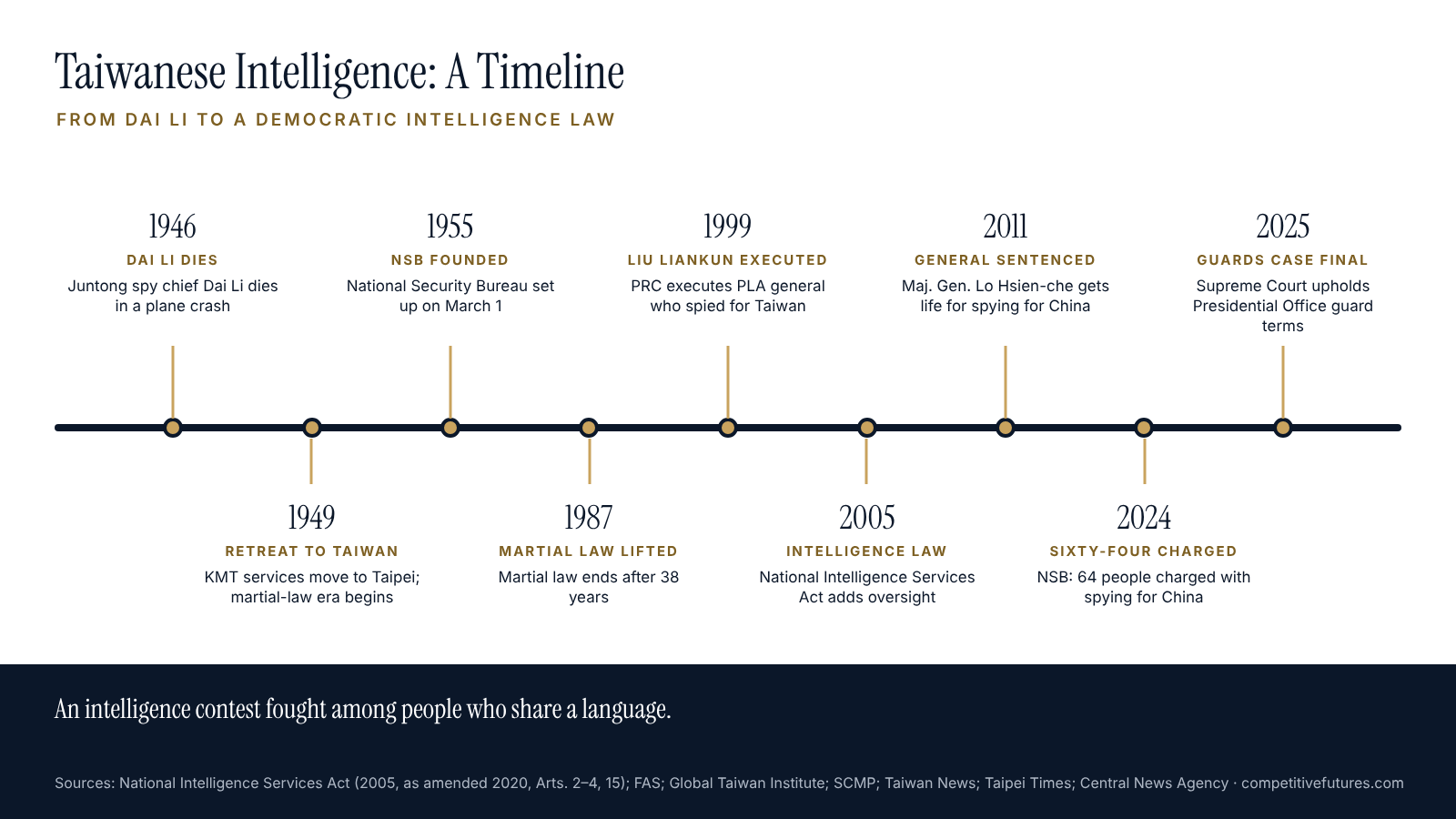
Taiwan’s intelligence services were not built on the island. They arrived with the Nationalist (Kuomintang, or KMT) government of Chiang Kai-shek when it retreated from the mainland in 1949. The most famous of their ancestors is Dai Li, whom the historian Frederic Wakeman described as chief of Chiang’s secret service during the Second World War and head of the Military Statistics Bureau (Wakeman, Spymaster, University of California Press). Dai’s organization, the Bureau of Investigation and Statistics under the Military Affairs Commission, known as the Juntong, ran the Sino-American Co-operative Organisation with Commodore Milton Miles in Chongqing from 1942 to 1945; Dai died when his plane crashed in a rainstorm on March 17, 1946 (Andrew Nathan, London Review of Books). Today’s MIB still honors him: it maintains a memorial hall to the KMT spymaster, built in 1991 (South China Morning Post).
The civilian investigative service has a parallel lineage. By its own account, the Investigation Bureau began in 1949 as the Investigation Bureau of the Ministry of the Interior, moved to Taipei with the government in December 1949, was renamed under the Ministry of Judicial Administration on June 1, 1956, and took its present name on August 1, 1980 (Federation of American Scientists, reproducing MJIB material). The NSB followed in 1955 as a coordinating body under the National Defense Council and moved under the new National Security Council in 1967; under its own organic law, it became a statutory body on January 1, 1994 (Federation of American Scientists).
For most of that period, the services worked inside a martial-law state. Under emergency provisions enacted on the mainland in 1948 and extended in Taiwan, martial law lasted 38 years, until it was lifted in July 1987 under President Chiang Ching-kuo. The scholar Mark Harrison writes that it enabled institutions such as the Taiwan Garrison Command, which “carried out the detention, torture and murder of dissidents” (Lowy Institute). The Garrison Command has since been disbanded (Taipei Times).
The reckoning with this period, known as the White Terror, is now official policy. The Transitional Justice Commission, established in 2018, reopened political cases from the authoritarian era. In one of its best-known findings, the family of Chen Wen-chen, whose body was found on the National Taiwan University campus in 1981 the day after an overnight interrogation, was told in May 2020 that he had probably been killed by the secret police (Al Jazeera); the commission’s July 2021 report said the authorities may have killed him (Taipei Times). In 2023, Taiwan’s National Human Rights Museum revised its list of state-persecution victims from the martial-law era from 8,088 to 17,941 names, including 1,824 people executed or never found (Taiwan News).
Democratization changed the legal footing of intelligence work. The 2005 National Intelligence Services Act defined the intelligence community in statute, made the NSB the competent authority, and subjected intelligence work to legislative oversight. Later amendments, especially in 2015 and 2020, raised penalties for leaks and espionage; under the current text, leaking protected information to foreign or hostile forces carries life imprisonment or at least ten years (text of the Act).
How Taiwanese intelligence is organized today
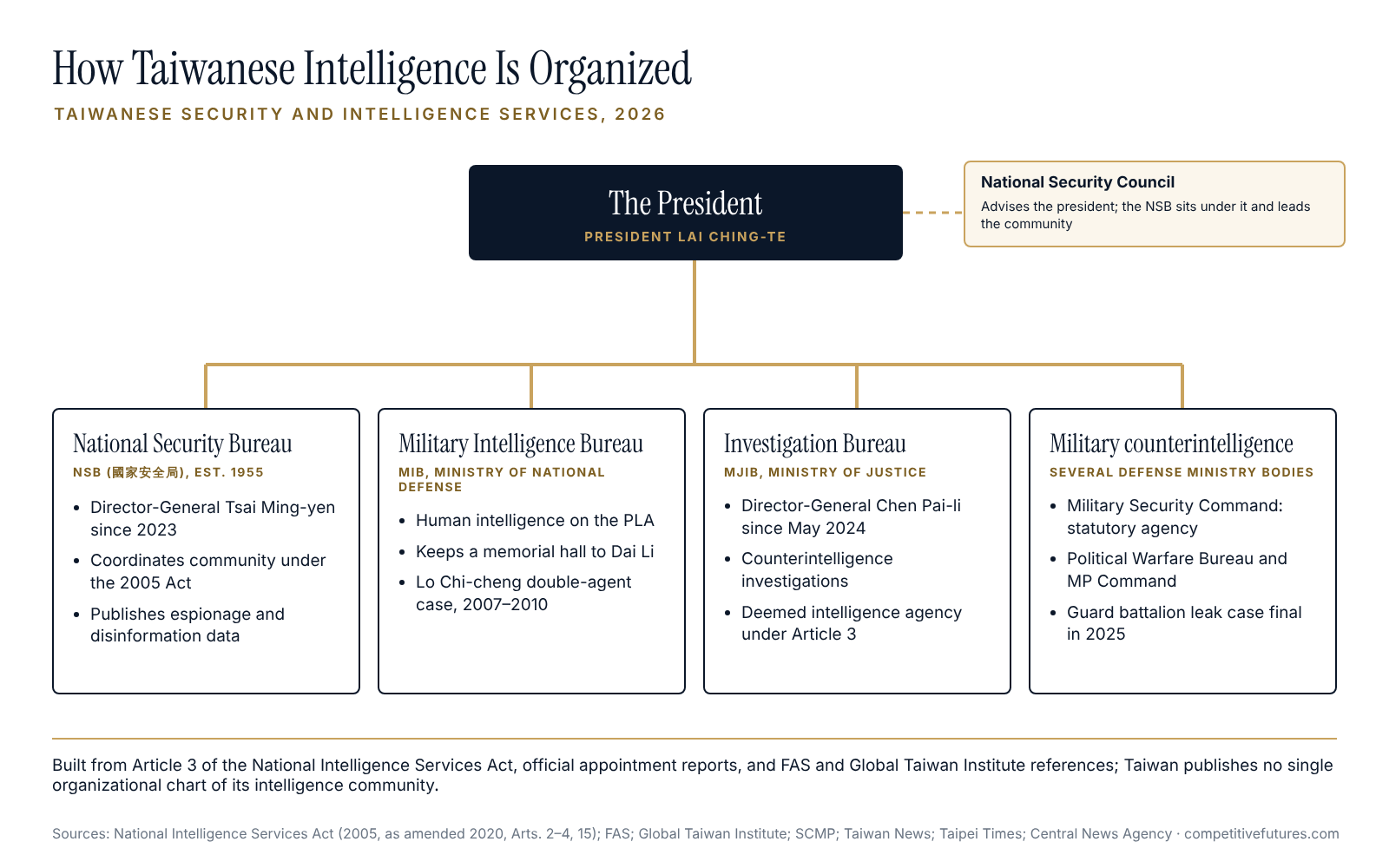
Article 3 of the National Intelligence Services Act names four intelligence agencies and lists seven more that count as intelligence agencies when they handle national intelligence matters (text of the Act).
- The National Security Bureau is the competent authority under the Act. Article 15 makes it responsible for coordinating, guiding, and supporting the other agencies. It sits under the National Security Council, which advises the president.
- The Military Intelligence Bureau collects human intelligence on the PLA for the Ministry of National Defense. A 2023 Global Taiwan Institute study by Russell Hsiao described it as reluctant to share its products with other agencies and noted reforms, including a joint intelligence operations center staffed by MIB and NSB personnel (Global Taiwan Institute).
- The Telecommunications Development Office and the Military Security Command (軍事安全總隊, sometimes translated Military Security Brigade) complete the list of four statutory intelligence agencies, both under the Ministry of National Defense.
- The Investigation Bureau, the Political Warfare Bureau and the Military Police Command of the Ministry of National Defense, the military’s Information, Communications and Electronic Force Command (ICEFCOM), the Coast Guard Administration, the National Police Agency, and the National Immigration Agency are treated as intelligence agencies within their own areas of responsibility.
Two features stand out. Military counterintelligence is spread across several bodies, with the Investigation Bureau and civilian prosecutors taking cases to court. And because legislative oversight is written into the intelligence law, intelligence chiefs regularly brief lawmakers in open committee sessions; much of what the public knows about China’s operations against Taiwan comes from those briefings.
Counterintelligence across the Strait
The NSB now publishes statistics on espionage prosecutions. In a January 2025 report, it said prosecutors charged 64 people in 15 cases of spying for China in 2024, up from 48 people in 14 cases in 2023, and from three cases in 2021 and five in 2022. Of those charged in 2024, 28 were active-duty and 15 were retired military personnel, and the bureau listed tactics including retired officers recruiting serving ones, cash inducements, and pressure on people in debt (National Security Bureau, via GlobalSecurity.org; TVBS). In May 2026, Tsai told legislators that the average sentence in espionage cases had risen from one year in 2020 to six years and two months in 2025 (Central News Agency). In April 2026, he said Beijing’s recruitment was shifting from mid-level officers toward noncommissioned officers and enlisted personnel (Taipei Times).
The bureau also tracks what Taiwan calls cognitive warfare. In its report on 2025, released in January 2026, the NSB said it recorded more than 2.314 million pieces of disinformation, up from 2.159 million in 2024, and 45,590 fake online accounts, up from 28,216, and it attributed much of the activity to Chinese information technology and marketing firms (Taipei Times; Taipei Times). These are the bureau’s own counts and have not been independently audited.
Beijing rejects this framing. Responding in February 2025 to President Lai’s remarks about rising espionage cases, Zhu Fenglian, spokesperson for China’s Taiwan Affairs Office, accused the ruling Democratic Progressive Party (DPP) of repeatedly fabricating lies and intimidating the people of Taiwan, and of treating cross-Strait exchanges as something to fear (Global Times, a Chinese state outlet).
Taiwanese intelligence in the news
Most public knowledge of the intelligence contest across the Strait comes from seven cases. In each, the allegations come from prosecutors, courts, or governments on one side, and the other side has denied them, declined to comment, or offered a competing account.
Liu Liankun and the missile crisis (1996–1999)
During the 1996 Taiwan Strait crisis, when Beijing test-fired missiles near Taiwan, PLA Major General Liu Liankun was secretly working for Taiwan. According to the South China Morning Post, he told his Taiwanese handlers that the missiles carried no warheads and that Beijing had no plan to attack; his role was indirectly exposed by remarks from Taiwan’s then-president, Lee Teng-hui, and he was executed in China as a traitor in August 1999. The MIB later honored him with a memorial tablet in its hall commemorating Dai Li (South China Morning Post).
Lo Chi-cheng, the MIB double agent (2003–2015)
Lo Chi-cheng (羅奇正), a colonel in the MIB who helped run its human-intelligence network in China, was arrested in Taipei in October 2010. Media reports said he sold lists of agents stationed on the mainland and other secret information between 2007 and 2010 (AFP via Gulf Times). According to the account of the final ruling, Lo Pin, a China-based Taiwanese businessman working with him, was detained by Chinese security in July 2006, and Lo Chi-cheng was working as a double agent from January 2007 at the latest. A military court sentenced him to life in April 2011; the Taiwan High Court reduced the term to 18 years, citing his confession, and in November 2015 the Supreme Court made the 18-year sentence final and confiscated the payments from his Chinese handlers (Taipei Times). The Jamestown Foundation reported that the NSB had been told in early 2009 to stop recruiting agents inside China (Jamestown Foundation). Beijing has not publicly described its side of the case.
General Lo Hsien-che (2004–2011)
In July 2011, Taiwan’s Military High Court sentenced Major General Lo Hsien-che (羅賢哲), former head of communications and electronic information at Army headquarters, to life imprisonment for spying for China. The court found that he delivered classified information to Beijing on five occasions; he was believed to have been recruited through a honey trap in 2004 while posted in Thailand, and may have received about US$1 million. The court spared him the death penalty because he confessed and returned the money (Taipei Times). The Supreme Military Court upheld the sentence; in 2014 Lo wrote to his family complaining of unjust treatment and seeking a retrial, and the Defense Ministry said the life sentence was deserved (Central News Agency, via GlobalSecurity.org).
The DPP staffers (2017–2026)
In June 2025, prosecutors indicted four former DPP staffers for passing information to Chinese intelligence: Huang Chu-jung (黃取榮), a former assistant to a New Taipei city councilor; Ho Jen-chieh (何仁傑), a former assistant to then-Foreign Minister Joseph Wu; Chiu Shih-yuan (邱世元), a former deputy director at a DPP-linked foundation; and Wu Shang-yu (吳尚雨), a former Presidential Office consultant. All four had been expelled from the party in May 2025. In September 2025, the Taipei District Court sentenced them to terms of 10 years, eight years and two months, six years and two months, and four years respectively (Taipei Times). On appeal in June 2026, the Taiwan High Court cut Huang’s sentence to six years, Chiu’s to five, and Wu’s to three, and acquitted Ho; that ruling can still be appealed (Focus Taiwan). In a separate National Security Act case, the High Court in July 2026 sentenced Huang to 10 years for building an organization on behalf of China, finding that he recruited Chiu in 2017; that ruling can also be appealed (Focus Taiwan). The reporting cited did not include comment from the defendants or from Beijing.
The Presidential Office guards (2022–2025)
In December 2024, prosecutors indicted four soldiers who, beginning in April 2022, photographed internal documents from the 211th Military Police Battalion, which guards the Presidential Office, and from ICEFCOM, and passed them on for payments of NT$265,900 to NT$664,100 (Central News Agency, via GlobalSecurity.org). Prosecutors identified the recruiter as Huang Tsung-yi, a Taiwanese citizen who fled to China before he could be arrested. Because the material was not formally classified, the soldiers were convicted under the National Security Act and anti-corruption law rather than for espionage (Stars and Stripes). The Taipei District Court sentenced them to between five years and 10 months and seven years in March 2025, and the Supreme Court made the sentences final in December 2025 (Central News Agency, via GlobalSecurity.org). No Chinese response was reported.
The undersea cables (2023–2025)
In February 2023, the two cables linking Taiwan’s Matsu islands to the main island were cut within six days of each other. Taiwan’s National Communications Commission said a Chinese fishing vessel and a Chinese cargo ship were suspected, but the government stopped short of calling it a deliberate act by Beijing, and there was no direct evidence the ships were responsible; China’s Taiwan Affairs Office did not respond to a request for comment (AP via KTVZ).
In February 2025, Taiwanese authorities suspected the Togo-registered, Chinese-crewed cargo ship Hong Tai 58 of severing an undersea cable near the Penghu islands by dragging its anchor. In June 2025, the Tainan District Court sentenced its Chinese captain, surnamed Wang, to three years in prison under the Telecommunications Management Act, finding that he damaged the cable intentionally; Wang said he had only been negligent, and the ruling can be appealed (Taipei Times; Reuters via The Star). In December 2025, police in Weihai, China, said two Taiwanese smugglers had controlled the ship and offered rewards for their capture, and the Taiwan Affairs Office accused the DPP of falsely claiming Beijing used the ship for sabotage. Taiwan’s Mainland Affairs Council replied that Beijing has no jurisdiction over Taiwan and should produce concrete evidence (Al Jazeera). No court has found that any government ordered a cable cut.
The ICEFCOM allegations (2024–2025)
Beijing has turned the same tools on Taiwan. In September 2024, China’s Ministry of State Security said a hacking group called Anonymous 64 was backed by Taiwan’s military and that it had opened a case against three active members of ICEFCOM; an ICEFCOM spokesman called the claims unfounded (Radio Free Asia, via GlobalSecurity.org). In March 2025, the ministry named four ICEFCOM members as ringleaders of cyberattacks and published their photographs and personal details; ICEFCOM said China had used public-domain photos and called the claim a fabrication meant to intimidate the Taiwanese public (Central News Agency, via GlobalSecurity.org). In June 2025, Guangzhou police put 20 people they described as ICEFCOM personnel on a wanted list, offering 10,000 yuan for each, according to Chinese state media (CGTN, Chinese state television). ICEFCOM denied the accusation, said most of those named had retired, and said no military database had been breached (Central News Agency, via GlobalSecurity.org). No one has been tried in these cases.
How to read coverage of Taiwanese intelligence
Almost every source on this subject belongs to a side. Taiwan’s Central News Agency and its English service Focus Taiwan are state-funded; Chinese outlets such as CGTN, China Daily, and the Global Times carry Beijing’s line, and the Ministry of State Security announces cases on social media without evidence outsiders can test. Taiwan’s own press is sharply divided along party lines, and U.S.-government-funded broadcasters such as Radio Free Asia report from an openly critical position on Beijing. None of that makes any of them wrong; it makes each of them a party.
The discipline is the one taught in our guide to cognitive bias: notice whose interest a story serves and climb toward primary records. For Taiwan, those include the text of the National Intelligence Services Act, the NSB’s annual reports to the Legislative Yuan, the Judicial Yuan’s published judgments, and indictments from district prosecutors. For influence work aimed at Washington by either side of the Strait, the U.S. Justice Department’s public database of registered foreign agents (FARA eFile) lists the lobbyists and consultants working for Taipei and for clients linked to Beijing. And keep indictments, first-instance convictions, and final rulings apart: in the DPP staffers’ case, an appeals court acquitted one defendant outright.
Frequently asked questions
What is Taiwan’s intelligence agency called?
Taiwan’s main intelligence agency is the National Security Bureau (NSB, 國家安全局), which coordinates the island’s intelligence community under the National Security Council. Other key bodies are the Military Intelligence Bureau under the Ministry of National Defense and the Ministry of Justice Investigation Bureau, which handles counterintelligence investigations.
Who is the head of Taiwanese intelligence?
Tsai Ming-yen, a former deputy foreign minister, has been director-general of the National Security Bureau since early 2023 and was kept in the post by President Lai Ching-te in 2024. Chen Pai-li has headed the Investigation Bureau since May 2024.
How many people does Taiwan prosecute for spying for China?
According to the National Security Bureau, prosecutors charged 64 people in 15 cases of spying for China in 2024, up from 48 people in 2023 and from three cases in 2021; most of those charged in 2024 were active or retired military personnel. China’s Taiwan Affairs Office has accused Taiwan’s governing party of exaggerating the threat.
Related reading
- Intelligence Services Around the World: Structure, History, and the Headlines
- Qatari Intelligence: History, Structure, and the Headlines
- Chinese Intelligence: History, Structure, and the Headlines
- Cognitive Bias: A Field Guide for Leaders
Competitive Futures briefs companies and governments on intelligence services, foreign influence, and Taiwan and the Indo-Pacific; details are on the services page.