How to Build a Foresight Culture

A foresight culture is an organization where thinking about multiple futures is a shared habit, not a department, an annual offsite or a report in a drawer. People in a foresight culture expect the world to change. They watch for signals, they bring unwelcome news forward early, and they change their minds when the evidence moves. Leaders reward them for it.
Most organizations don’t have one. They have planning, which is one future with a budget attached. Planning is necessary. It is not foresight, and the gap between the two is where most strategic surprises come from.
I have practiced strategic foresight for corporations and governments for 30 years, and I wrote the method down in Future, Inc. (AMACOM, 2007). After three decades, the lesson I’d put first is this: the method is the easy part. Building the culture that uses it is the hard part, and it’s the part that decides whether foresight is worth anything.
At a glance
- Foresight is about being useful, not being right. A correct forecast that nobody acts on is worthless.
- The method can be learned. The people side is what most organizations get wrong.
- A foresight culture is built from habits, not from a one-time study.
- It pays. Future-prepared firms measurably outperform their peers.
- AI makes foresight cheaper and faster. It doesn’t build the culture for you.
Why foresight needs a culture, not a department
Modern foresight grew out of Cold War planning at RAND, where analysts like Herman Kahn wrote detailed scenarios of futures nobody wanted, so that leaders could avoid them. The point was never to predict. It was to see what could be coming early enough that the choice was still yours.
That only works if someone reads the forecast and is able to act on it. This is why a futures department on its own rarely changes much. A single team can produce excellent scenarios that end up as shelfware: admired, filed and ignored. The value appears only when foresight becomes a shared habit among the people who make decisions.

There is hard evidence that the habit pays. René Rohrbeck and Ménès Etingue Kum measured the “future preparedness” of firms in 2008 and tracked their performance through 2015. Future-prepared firms outperformed the average with 33% higher profitability and 200% higher growth in market capitalization, while firms with foresight deficiencies faced a performance discount of 37% to 108% (Rohrbeck & Kum, Technological Forecasting and Social Change, 2018).
The easy part and the hard part
The easy part is method. Systems mapping, trend analysis, expert forecasts, implications, scenarios and communication are well-established techniques, refined over decades at Shell, RAND and in the intelligence community. Our methods pages cover the basics: systems mapping, trend analysis, scenario planning and communicating foresight.
The hard part is people. Smart, experienced leaders make predictable errors about the future, and their confidence can make those errors worse. Hierarchy, incentives and fear decide whether a warning survives the trip to the decision-maker. Cultures, including national and professional cultures inside one global firm, also differ sharply in who is allowed to deliver bad news. An organization can own every tool in the field and still be surprised, because the signal never reached anyone who could act on it. See the cognitive bias field guide and why organizations ignore warning signs.

A foresight culture is what closes that gap. It doesn’t take a big budget or a futures department. It takes deliberate habits, built into how leadership teams meet, decide and reward people, until looking ahead is simply how the organization works.
What AI changes
AI is changing the economics of foresight fast. METR, a research group that measures AI capabilities, found that the length of tasks AI agents can complete on their own has doubled roughly every seven months since 2019 (METR, 2025). Research and first-draft analysis that once took an analyst weeks can now run continuously, at a fraction of the cost.
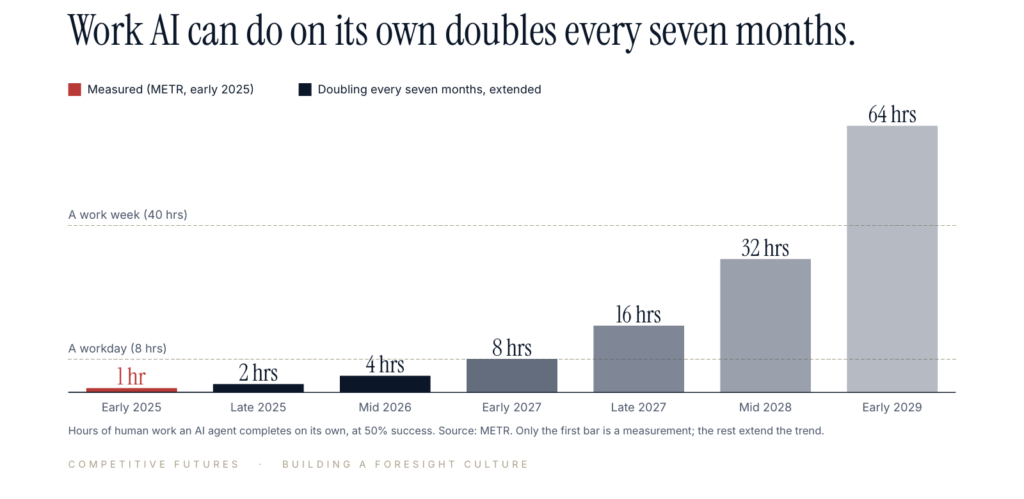
That makes the method cheaper. It doesn’t make an organization willing to act on what the method finds. An AI that surfaces uncomfortable conclusions is only as useful as the culture receiving them, and an organization that doesn’t want to hear bad news will find ways not to hear it from a machine either.
Signs your organization has a foresight culture
- People routinely name the trends they’re watching, outside their own function.
- Strategy documents contain several futures, not one plan and a downside case.
- Bad news reaches senior leaders early, and the people who bring it are rewarded.
- Leaders can point to a decision they changed because the evidence moved.
- Foresight is discussed on a schedule, not only after a crisis.
- AI tools are allowed to produce unwelcome conclusions, and someone reads them.
If most of these are missing, the problem isn’t a shortage of data or smart people. It’s culture, and culture can be built.
Frequently asked questions
What is a foresight culture?
A foresight culture is an organization in which thinking about multiple possible futures is a shared, routine habit. People watch for signals of change, bring unwelcome information forward early, and adjust decisions as evidence changes, and leaders reward that behavior.
How is a foresight culture different from strategic planning?
Strategic planning commits resources to one expected future. A foresight culture keeps several plausible futures in view, watches for signals of which one is unfolding, and revises the plan when the signals change.
Does strategic foresight actually improve performance?
Yes. In a longitudinal study, Rohrbeck and Kum found that future-prepared firms achieved 33% higher profitability and 200% higher market-capitalization growth than the average between 2008 and 2015.
Do we need a dedicated futures team?
No. A small team or an outside partner can supply method and research, but a foresight culture lives in the habits of the people who make decisions.
Can AI replace human foresight?
AI can now do much of the research and first-draft analysis cheaply and continuously. It cannot make an organization willing to act on what it finds. That remains a leadership job.
Building a Foresight Culture: the keynote
“Building a Foresight Culture: Threats, Opportunities, and New Horizons for Leadership Thinking” is a keynote for leadership conferences, partner meetings and retreats. It draws on 30 years of foresight work for corporations and governments, and it gives leaders practical habits they can start using the following Monday, along with a look at the technologies driving disruption on the scale of the industrial revolution.
We also help leadership teams build foresight into the way they decide, through custom foresight studies, scenario workshops and executive education. See our keynote topics or request a 20-minute conversation.
Related analysis from Competitive Futures
- Strategic Foresight: A Practitioner’s Guide to Seeing What’s Coming
- Scenario Planning
- Cognitive Bias: A Field Guide for Leaders Who Must Decide Under Uncertainty
- Why Smart Organizations Still Can’t See Obvious Disasters
- Communicating Foresight
References
- Garland, E. (2007). Future, Inc.: How Businesses Can Anticipate and Profit from What’s Next. AMACOM.
- Kahn, H. (1962). Thinking About the Unthinkable. Horizon Press.
- Kwa, T., West, B., et al. (2025). Measuring AI ability to complete long tasks. METR. arxiv.org/abs/2503.14499
- Rohrbeck, R., & Kum, M. E. (2018). Corporate foresight and its impact on firm performance: A longitudinal analysis. Technological Forecasting and Social Change, 129, 105–116. doi.org/10.1016/j.techfore.2017.12.013