Disruptive Strategy: What Future Intelligence Supplies
Read this page in: Français · Español · Português · Deutsch · Nederlands · Italiano · 日本語 · 한국어 · 简体中文 · Bahasa Indonesia · Polski · Čeština · Svenska · Dansk · Norsk (bokmål) · Suomi · Ελληνικά · Türkçe · Eesti
Disruptive strategy is the practice of using Clayton Christensen’s theory of disruptive innovation to decide where to compete, what to build, and how to respond when a cheaper, simpler rival appears. Harvard Business School Online teaches it in a course built on Christensen’s teaching. The theory explains with unusual precision what happens once a disruption has a foothold. It says much less about where the foothold comes from, and Christensen said so himself.
Future Intelligence supplies what disruption theory needs: a way to find the conditions for a disruption before any entrant appears. It is the six-step foresight method I set out in Future, Inc. (AMACOM, 2007): systems mapping, trend research, forecast assessment, implications analysis, scenario generation, and communication. This page shows where each step meets the disruptive strategy curriculum, and what each body of work gives the other.
Competitive Futures is not affiliated with Harvard Business School or HBS Online. This is our reading of a public syllabus and of Christensen’s published work.
At a glance
- Disruption theory is a theory of response. It predicts how incumbents and entrants behave once a simpler, cheaper offering has taken root at the low end of a market or among people who weren’t buying at all.
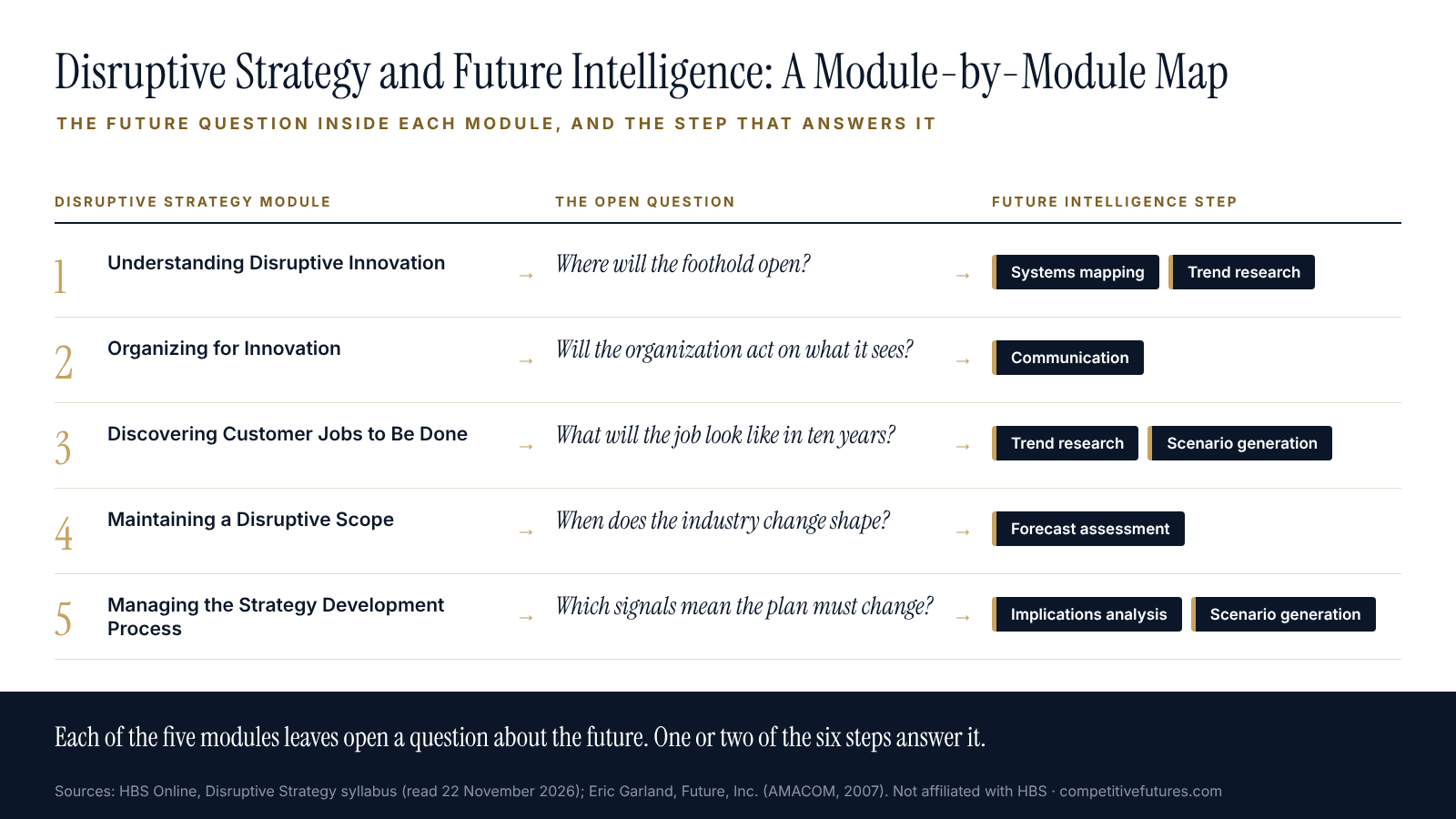
- It starts with the foothold already in view. In Competing Against Luck (2016), Christensen wrote that the theory “does not tell you where to look for new opportunities.”
- Future Intelligence looks upstream. It maps the system around an industry and researches the social, technological, economic, ecological, and political trends that create footholds before any entrant shows up.
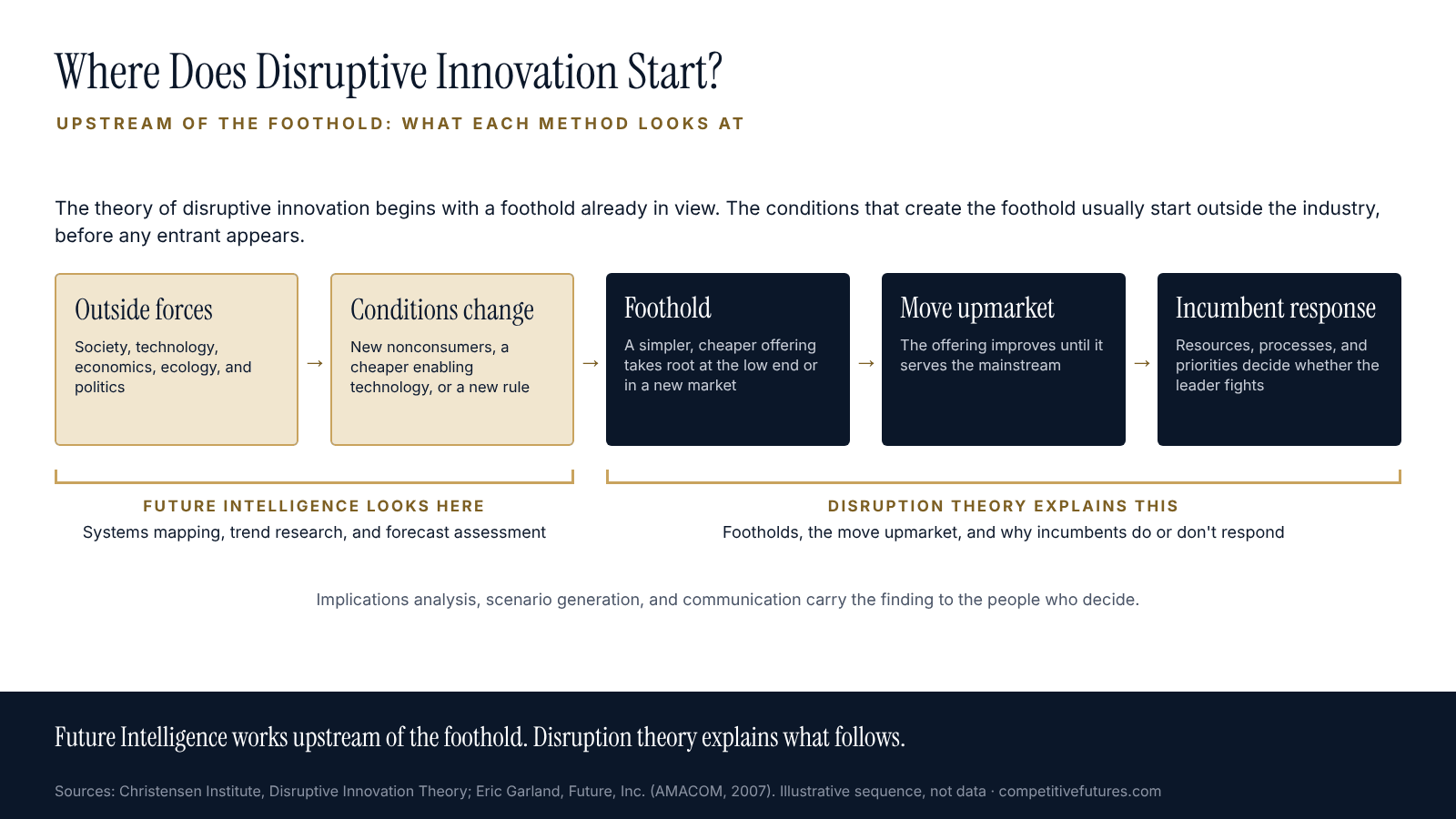
- The two fit module by module. Each of the five modules in the HBS Online course leaves open a question about the future, and one or two of the six steps answer it.
- The exchange runs both ways. Disruption theory gives foresight a causal mechanism and an explanation for why organizations ignore warnings they have already received.
What disruptive strategy teaches
Christensen’s theory describes a process. A product or service starts in simple applications at the bottom of a market, usually because it is cheaper and more accessible, and then moves upmarket until it displaces established competitors (Christensen Institute). The entrant gets in through one of two doors. A low-end foothold takes the customers the incumbent finds least profitable. A new-market foothold serves people who weren’t being served at all. The Institute lists three things a disruption needs: an enabling technology that lets the offering improve, a business model that makes it sustainable, and a coherent value network of partners and channels.
Christensen published the idea with Joseph Bower in 1995, expanded it in The Innovator’s Dilemma in 1997, and spent two decades tightening it. In 2015 he and two co-authors argued that Uber, widely called a disrupter, “doesn’t actually fit the mold” (HBR). Our page on Clayton Christensen covers the evidence, the critics, and what the theory did for competitive intelligence.
HBS Online’s Disruptive Strategy course features Christensen’s teaching alongside Professor Willy Shih. Its syllabus has five modules:
- Understanding Disruptive Innovation. The types of innovation and when each occurs.
- Organizing for Innovation. How resources, processes, and priorities define what an organization can and cannot do.
- Discovering Customer Jobs to Be Done. Why customers buy, and how to find out.
- Maintaining a Disruptive Scope. What to keep in-house, what to outsource, and how that changes as an industry evolves.
- Managing the Strategy Development Process. Balancing deliberate and emergent strategy, and how new ideas get funded.
It is a strong curriculum. Every module also depends on a judgment about the future that the theory does not make for you.
What the theory takes as given
Read the definition again and count what is already in place when the story begins: an enabling technology, a group of overlooked customers, and a business model that can sustain the offering. The theory explains what follows from those conditions. It does not explain where they come from.
Christensen was direct about this. In Competing Against Luck he wrote that the theory of disruptive innovation “does not tell you where to look for new opportunities,” and that it does not explain where to create new markets (excerpt, Porchlight). His answer was the theory of jobs to be done, which explains why customers pull a product into their lives.
That answer covers the customer as she is today. A second question remains: what will change the customer’s circumstances, the cost of the enabling technology, or the rules of the market over the next five to twenty years? Those changes usually begin outside the industry. A population ages and a new group of nonconsumers appears. A regulation changes and an incumbent’s protected margin disappears. Cheap electricity arrives and the ice vendor’s business ends, which was my example of exponential decline in chapter 3 of Future, Inc.
In the first chapter of that book I wrote that “there have been disruptive technologies and social trends in the past,” and that the harder problem now is what I called superconnection: “the interaction of multiple forces in society and technology at one time.” A disruption that looks like a technology story from inside the industry can turn out to be a demographic, economic, or political story that found a technology.
Christensen’s team saw the edge of this. Seeing What’s Next (2004) taught analysts to look for signals of change among overshot customers, undershot customers, and nonconsumers, and gave a chapter to nonmarket forces such as regulation. Future Intelligence starts where that chapter ends and treats the forces outside the market as the main subject.
Module by module: what Future Intelligence adds
1. Understanding Disruptive Innovation: where will the foothold open?
The first module teaches students to recognize a disruption. The open question is where to look for the next one. In Future Intelligence that is the work of the first two steps. A systems map lays out everything that touches the business, from suppliers to regulators to the customer’s daily life. Trend research then tests each part of the map against data, using the five STEEP categories to force attention outside the analyst’s own field. The output is a short list of places where nonconsumers are multiplying, where an enabling technology is getting cheap, or where a rule is about to change.
2. Organizing for Innovation: will the organization act on what it sees?
The second module explains why capable organizations fail to respond. Their resources, processes, and priorities are built for the existing business. Christensen and Michael Overdorf made the point in 2000 that managers in large companies can usually see disruptive change coming (HBR). Seeing is not the obstacle.
This is the problem the sixth step, communication, exists to solve. A foresight study that stays in a binder changes nothing. The method calls for writing to the most skeptical person in the organization, showing the trend data behind every conclusion, and keeping the findings in circulation after the study ends. Our page on building a foresight culture covers the organizational side. Christensen’s framework tells you which priorities will resist the message. Foresight practice gives you ways to get it heard anyway.
3. Discovering Customer Jobs to Be Done: what will the job look like in ten years?
Jobs-to-be-done research interviews today’s customers about today’s circumstances. That is the right place to start. The circumstances then move. Household size, working hours, income, health, and what people consider normal all shift over a decade, and the job shifts with them.
Trend research forecasts those circumstances. Scenario generation then puts a person inside them. Joe Coates, my mentor, used to ask what a burglar of the future would go through while robbing a house: what security he would face, what goods would be worth taking, and what he would find ordinary. I described the trick in Future, Inc. as a way to escape the trap of “assuming that people in the future will think about life exactly as we do.” A jobs interview tells you what a customer hires a product for now. A scenario asks what she will need to hire one for later.
4. Maintaining a Disruptive Scope: when does the industry change shape?
The fourth module asks which activities to keep in-house and which to outsource, and it teaches that the right answer changes as an industry evolves. That makes scope a question about timing. When will a component become good enough to buy off the shelf? When will a supplier’s capability catch up to yours?
A question with “when” in it calls for a forecast, and step three of the method is forecast assessment: collecting dated forecasts from named experts across every relevant field, and checking each one against the trend data. Knowing where a technology sits on its curve tells you how long the current scope decision is likely to hold.
5. Managing the Strategy Development Process: which signals mean the plan must change?
The last module teaches the balance between deliberate strategy, which is planned, and emergent strategy, which is discovered along the way. The practical difficulty is knowing when to switch. An organization that waits for certainty switches too late.
Steps four and five address this. Implications analysis works out the second- and third-order effects of each trend. Scenario generation turns them into four named futures sorted by probability and impact, with the indicators to watch. When the indicators for one scenario start to appear, the leadership team has agreed in advance what that means. That gives emergent strategy a set of signposts decided before the pressure arrives.
What disruption theory gives back
The exchange is not one-sided. Foresight work has three recurring weaknesses, and Christensen’s work helps with each.
- Mechanism. A trend study can show that something is changing without explaining who wins as a result. Disruption theory supplies a well-studied causal sequence for one common pattern of change.
- A filter for entrants. Not every new competitor matters. The theory says which ones to watch: those entering where the incumbent has no motive to fight.
- An account of resistance. In Future, Inc. I wrote that the cardinal rule of futurism is that findings which confirm everything you already believed are useless. Resources, processes, and priorities explain why organizations prefer those findings, and where a warning will stall.
Christensen and Michael Raynor argued in 2003 that because reliable data exist only about the past, sound theory is the way managers look ahead (HBR). Foresight practitioners agree, with one addition: the trends that will test the theory can be researched now.
The theory’s critics have argued that it fits fewer cases than its popularity suggests, and Christensen narrowed its definition himself. We treat it as one strong hypothesis about how change unfolds. Future Intelligence is no more a prediction than disruption theory is. It produces a set of plausible futures and the evidence behind them.
The course’s own exercise: AI in your industry
The first module asks students to assess AI disruption in their own industry. It is a good test of how the two approaches combine. Disruption theory asks whether AI enters at the low end or creates a new market, who is overserved today, and whether incumbents have a motive to respond. Future Intelligence adds the questions that sit around those:
- System. Who touches the work AI would change, including regulators, insurers, and suppliers?
- Trends. What is happening to the cost of the technology, the supply of skilled people, and the rules that govern its use? What shape is each curve?
- Forecasts. What have named experts said will happen, and by what date? Do the trends support them?
- Implications. If the first-order effect arrives, what does it do to pricing, hiring, and liability two steps later?
- Scenarios. What are four different ways this plays out, including one where the change turns out to be small?
- Communication. Who in the organization has to hear this, and what would make them act?
What this means for an intelligence function
- Brief the precondition before the entrant exists. Report on growing groups of nonconsumers, falling technology costs, and pending rule changes as disruption conditions. Don’t wait for a company to attach to them.
- Put a date on “good enough.” Whenever the team says a rival’s product isn’t good enough yet, ask for a dated forecast and the trend behind it.
- Scan outside the industry on purpose. Assign someone to each of the five STEEP categories. A disruption that begins in a category nobody is assigned to will arrive as a surprise.
- Tie scenarios to indicators. Every scenario should list the observable signs that it is arriving, and someone should be watching for them. Our page on competitive early warning covers the practice.
- Plan for resistance. Use resources, processes, and priorities to predict which findings your own leadership will discount, and design the briefing around that.
Frequently asked questions
What is disruptive strategy?
Disruptive strategy is the use of Clayton Christensen’s theory of disruptive innovation to make decisions about markets, products, and competitors. It covers how simpler, cheaper offerings take root in overlooked segments and move upmarket, and how incumbents can respond or launch disruptions of their own.
What does the HBS Online Disruptive Strategy course cover?
The course has five modules: understanding disruptive innovation, organizing for innovation, discovering customer jobs to be done, maintaining a disruptive scope, and managing the strategy development process. It features the teaching of Clayton Christensen and Professor Willy Shih.
What does disruption theory not tell you?
In Competing Against Luck (2016), Christensen wrote that the theory of disruptive innovation does not tell you where to look for new opportunities. It explains competitive response once a foothold exists. It does not forecast the social, economic, technological, and political changes that create footholds.
What is Future Intelligence?
Future Intelligence is the six-step strategic foresight method from Eric Garland’s Future, Inc. (AMACOM, 2007): systems mapping, trend research, forecast assessment, implications analysis, scenario generation, and communication. It looks five to twenty years ahead and produces alternative futures backed by trend data.
How do Future Intelligence and disruptive strategy work together?
Future Intelligence works upstream, finding the conditions that make a disruption possible before an entrant appears. Disruptive strategy works downstream, predicting how the competitive battle unfolds once it does. Used together, they connect long-range trends to specific strategic choices.
Is Competitive Futures affiliated with Harvard Business School?
No. Competitive Futures is an independent firm. This page is our analysis of Christensen’s published work and of the public syllabus for the HBS Online course.
Work with Competitive Futures
We help companies and governments see change coming and decide what to do about it, through strategic foresight studies, competitive early warning, and executive education. If your team has learned disruption theory and wants the foresight to go with it, request a 20-minute conversation or see our keynote topics, including “Building a Foresight Culture.”
Related reading
- Strategic Foresight: A Practitioner’s Guide
- Clayton Christensen: How Disruption Theory Made Competitive Intelligence Smarter
- Identifying Future Competitors
- STEEP Analysis: How to Scan the Forces Shaping Your Future
- Scenario Planning: How to Build Scenarios That Change Decisions
- How to Build a Foresight Culture
- Strategy Execution: What Early Warning Supplies
References
- Bower, J. L., & Christensen, C. M. (1995). Disruptive technologies: Catching the wave. Harvard Business Review, 73(1), 43–53.
- Christensen, C. M. (1997). The Innovator’s Dilemma. Harvard Business School Press.
- Christensen, C. M., & Overdorf, M. (2000). Meeting the challenge of disruptive change. Harvard Business Review, 78(2), 66–76.
- Christensen, C. M., & Raynor, M. E. (2003). Why hard-nosed executives should care about management theory. Harvard Business Review, 81(9), 66–74.
- Christensen, C. M., Anthony, S. D., & Roth, E. A. (2004). Seeing What’s Next. Harvard Business School Press.
- Christensen, C. M., Raynor, M. E., & McDonald, R. (2015). What is disruptive innovation? Harvard Business Review, 93(12), 44–53.
- Christensen, C. M., Hall, T., Dillon, K., & Duncan, D. S. (2016). Competing Against Luck: The Story of Innovation and Customer Choice. HarperBusiness.
- Clayton Christensen Institute. Disruptive Innovation Theory.
- Garland, E. (2007). Future, Inc.: How Businesses Can Anticipate and Profit from What’s Next. AMACOM.
- Harvard Business School Online. Disruptive Strategy (course syllabus, read 22 November 2026).
This page is part of our guide to Strategic Foresight.