Strategy Execution: What Early Warning Supplies
Strategy execution is the work of turning a chosen strategy into results: allocating resources, designing jobs, measuring performance, and managing risk. Harvard Business School Online teaches it in a course built on the work of Professor Robert Simons, whose “levers of control” framework is the backbone of the course. The framework asks leaders to name the uncertainties that could undo their strategy and to build a system that keeps attention on them.
It leaves open how those uncertainties are found and what the system is fed. That is the job of early warning and of Future Intelligence, the foresight method I set out in Future, Inc. (AMACOM, 2007). This page shows where intelligence work meets each part of the strategy execution curriculum, and what each gives the other.
Competitive Futures is not affiliated with Harvard Business School or HBS Online. This is our reading of a public syllabus and of Simons’s published work.
At a glance
- Execution is mostly an inside job. Job design, core values, scorecards, incentives, and internal controls all work on the organization itself.
- One lever points outward. Simons’s interactive control systems exist so that senior managers can focus on strategic uncertainties and learn about threats and opportunities as they emerge.
- Strategic uncertainties come from outside. In Simons’s own definition they are contingencies that could threaten or open up the strategy, and they are different from the things a firm already knows how to do well.
- Early warning supplies the inputs. Systems mapping and trend research find the uncertainties. Scenarios turn them into indicators. A recurring intelligence product keeps them in front of the people who decide.
- The exchange runs both ways. Simons gives intelligence a place in the management routine, a rule about scarce attention, and a way to assign ownership.
What strategy execution teaches
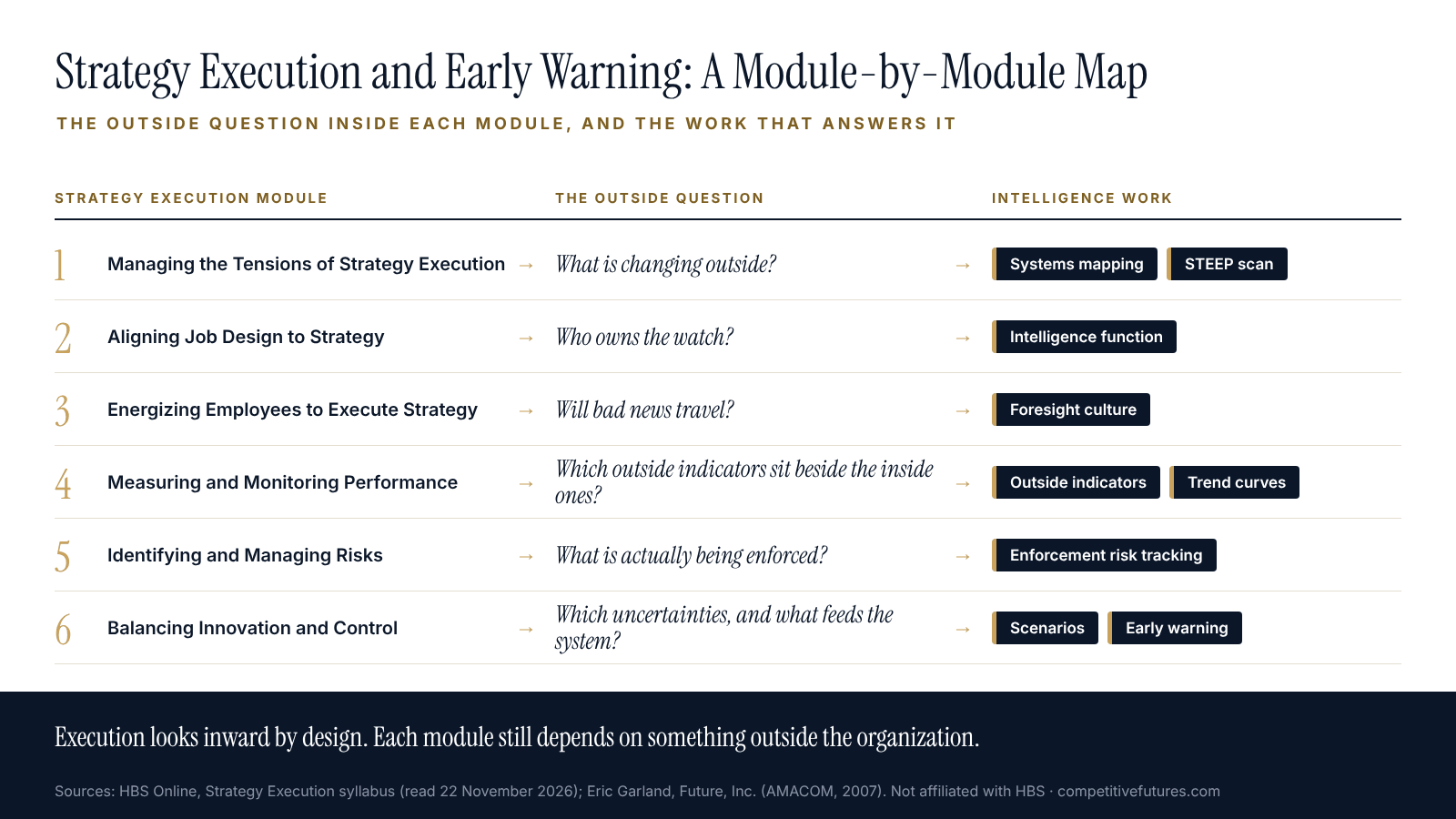
Simons’s central idea is that control and innovation pull against each other and that a manager has four levers for balancing them. He set the idea out in a 1995 Harvard Business Review article and in the book Levers of Control the same year.
- Belief systems communicate core values and give people inspiration and direction.
- Boundary systems frame the strategic domain and define the limits of freedom.
- Diagnostic control systems are the familiar ones: plans, budgets, and scorecards that track progress toward goals.
- Interactive control systems give the organization flexibility in adapting to its competitive environment and encourage learning (publisher’s description).
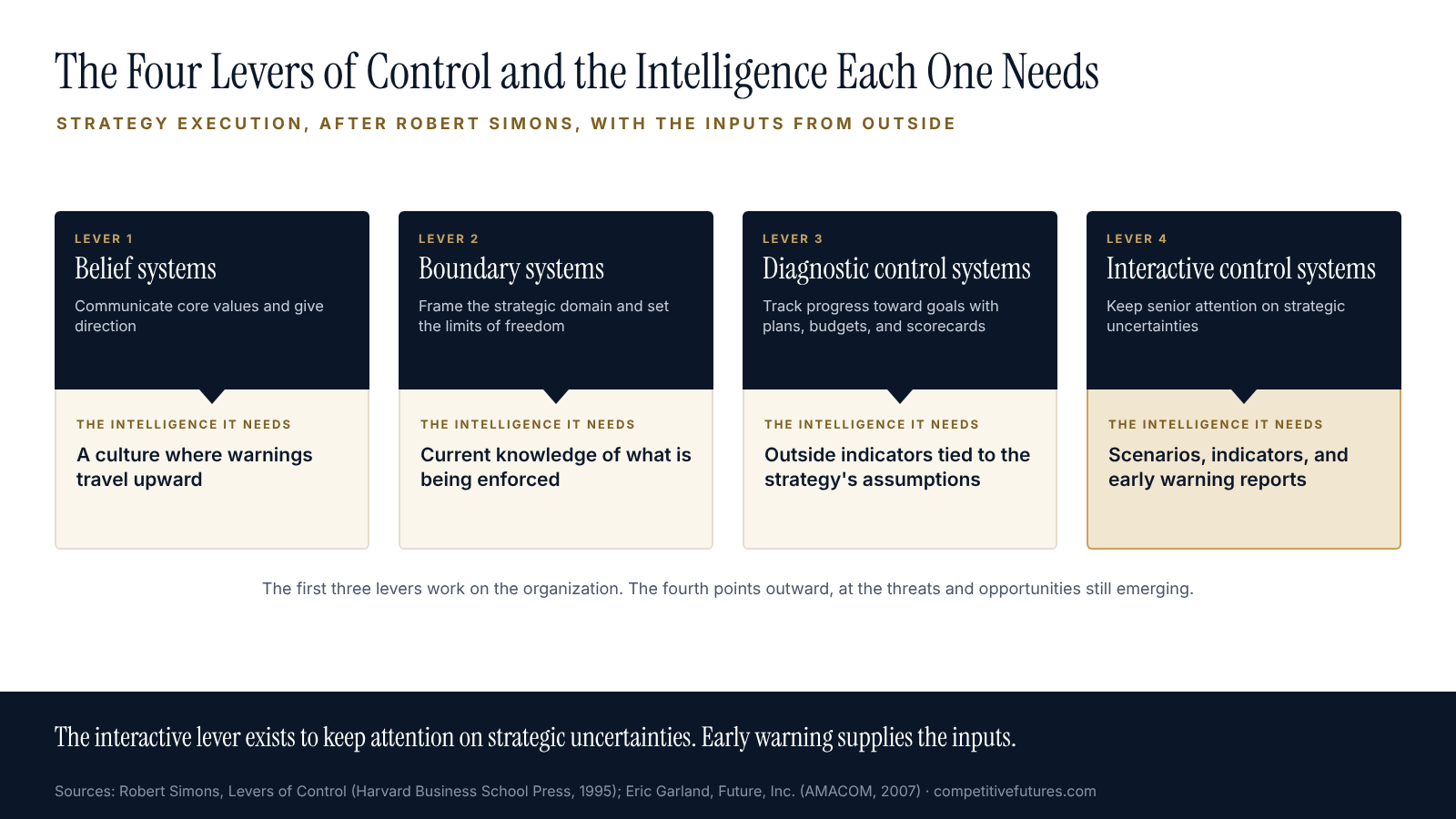
HBS Online’s Strategy Execution course, taught by Simons, has six modules:
- Managing the Tensions of Strategy Execution. Balancing innovation and control, and the other tensions that come with any strategy.
- Aligning Job Design to Strategy. Designing high-performing jobs with the Job Design Optimization Tool.
- Energizing Employees to Execute Strategy. Creative tension and core values.
- Measuring and Monitoring Performance. Diagnostic control systems, profit planning, the balanced scorecard, goals, and incentives.
- Identifying and Managing Risks. Sources of risk, internal risk pressures, internal controls, and business conduct boundaries.
- Balancing Innovation and Control. Strategic boundaries, interactive control systems, and putting the four levers to work together.
It is a rigorous curriculum, and most of it looks inward by design. Execution is about the organization. The outside world enters mainly in the last module.
What the framework takes as given
Simons gave the outside world a precise name. In a 1991 article in the Strategic Management Journal, he wrote that which systems top managers choose to use interactively depends on their assessment of strategic uncertainties. He defined those as contingencies that could provide threats or opportunities, and he separated them from critical success factors, which concern what the firm already knows how to do well (Simons, 1991). His 1995 article says interactive systems let senior managers “focus on strategic uncertainties” and learn about threats and opportunities (HBR).
In 2010 he closed a list of seven questions for stress-testing a strategy with a related one. It asks whether leaders are thinking about the right issues as they consider “how the future will change your business” (HBR, 2010).
That is the right question. The framework assumes the leader can answer it. A senior team’s list of uncertainties is often built from what its members already read, whom they already talk to, and what went wrong last time. The framework gives that list a home and a discussion. It has no method for checking whether the list is complete, for ranking what is on it, or for knowing when an item has started to move.
The sixth module of the course makes the gap concrete. Its exercise asks students to design a system that focuses attention on emerging threats and uncertainties. Designing the system is the easier half of the work. The harder half is deciding which uncertainties go into it and what evidence will flow through it every week.
Module by module: what early warning adds
1. Managing the tensions: what is changing outside?
The first module teaches that every strategy carries tensions, starting with innovation against control. How much room to give each side depends on how fast the environment is moving. A team that believes its world is stable will tighten control at the moment it should be loosening it.
The first step of Future Intelligence answers the prior question. A systems map lays out everything that touches the business, and a scan across the five STEEP categories shows where change is building. That gives the tension an outside reference.
2. Aligning job design: who owns the watch?
The second module is about designing jobs that can deliver the strategy. It teaches managers to look at what a person is asked to do against the influence and support the job provides.
Watching the outside world is a job like any other, and in most organizations it belongs to nobody. Everyone is expected to keep an eye out, so no one is accountable when a signal is missed. Our guide to building a competitive intelligence function covers what that job looks like when someone holds it.
3. Energizing employees: will bad news travel?
The third module covers creative tension and core values. Values decide whether a warning gets passed up or held back. An analyst who has learned that bearers of bad news are punished will soften the next report.
This is the cultural side of warning. Our pages on why organizations ignore warning signs and building a foresight culture cover it. In Future, Inc. I called the usual outcome “credenzaware,” a report that sits on a shelf unread, and recommended a regular newsletter on the trends that matter as “the antidote to credenzaware.”
4. Measuring and monitoring: which outside indicators sit beside the inside ones?
The fourth module teaches diagnostic control: pick the critical performance variables, set targets, and track them. These measures report on the organization’s own performance. They show a strategy failing after it has started to fail.
Early warning adds a second set of measures that report on the environment. Each one is tied to an assumption the strategy depends on: a competitor’s capacity, a regulator’s calendar, a technology’s cost curve. Reading the trend curve behind each indicator, and checking the forecasts that experts have made about it, tells you how much time you have.
5. Identifying and managing risks: what is actually being enforced?
The fifth module covers sources of risk, internal risk pressures, and the conduct boundaries that tell employees what not to do. Its named tool, the Risk Exposure Calculator, is taught alongside the assessment of internal pressures.
A boundary is only as current as the knowledge behind it. What a regulator or prosecutor treated as tolerable five years ago may be a priority case today, and the change usually shows in filings, settlements, and speeches before it reaches a company’s compliance manual. Our guide to enforcement risk covers how to track it. External risk is an intelligence question, and it needs collection.
6. Balancing innovation and control: which uncertainties, and what feeds the system?
The last module brings in interactive control systems and asks students to design one. This is where the two bodies of work join.
Scenario planning supplies the content. A set of four scenarios, sorted by probability and impact, turns a vague worry into specific futures. Of the high-probability, high-impact scenario I wrote in Future, Inc. that exploring it “will point to signs we need to watch for.” Of the wild card I wrote that it is “the blindside, the ‘We never saw it coming.'” Each scenario yields indicators, and the indicators become the agenda of the interactive system. Competitive early warning is the practice of collecting against those indicators and reporting when one moves.
What Simons gives back
Intelligence work has weaknesses of its own, and Simons’s framework helps with three of them.
- A place in the routine. Intelligence often arrives as a one-off briefing and is forgotten. Simons’s interactive systems run on regular, face-to-face discussion among managers. That gives warning a standing slot on the calendar of the people who can act.
- A rule about attention. Senior attention is scarce, and the framework is built around that fact. It forces a choice about which few uncertainties get regular discussion. Analysts who report on everything are asking for attention that does not exist.
- Ownership. Job design gives a way to say who is accountable for the watch and whether that person has the influence and support to do it.
Simons’s 2010 article recommends regular dialogue about new data, unspoken assumptions, and hard trade-offs. That describes a good intelligence briefing.
What this means for an intelligence function
- Write the uncertainties down. Ask the senior team for its list of strategic uncertainties, then test it against a systems map and a STEEP scan. Report what the list is missing.
- Tie every indicator to an assumption. For each assumption the strategy depends on, name the outside evidence that would show it failing, and who collects it.
- Get onto the interactive agenda. Find the meeting where senior managers already debate the business face to face, and make the intelligence product part of it. Don’t build a separate briefing that competes for time.
- Keep the boundaries current. Review conduct boundaries against what is being enforced now, on a schedule, and report the changes.
- Report movement as well as status. A scorecard shows where things stand. A warning product should say what changed since last time and what it would take to change the plan.
Frequently asked questions
What is strategy execution?
Strategy execution is the work of turning a chosen strategy into results. It covers allocating resources, designing jobs, setting and tracking performance goals, managing risk, and adapting when conditions change.
What does the HBS Online Strategy Execution course cover?
The course, taught by Professor Robert Simons, has six modules: managing the tensions of strategy execution, aligning job design to strategy, energizing employees, measuring and monitoring performance, identifying and managing risks, and balancing innovation and control.
What are the four levers of control?
Robert Simons’s four levers are belief systems, boundary systems, diagnostic control systems, and interactive control systems. Belief systems communicate core values, boundary systems set limits, diagnostic systems track performance against goals, and interactive systems keep senior attention on strategic uncertainties.
What are strategic uncertainties?
In Simons’s work, strategic uncertainties are contingencies that could threaten a strategy or open new opportunities. They differ from critical success factors, which concern what the firm already knows how to do well.
How does early warning support strategy execution?
Early warning finds the outside developments that could invalidate a strategy, turns them into indicators, and reports when an indicator moves. It supplies the content for the interactive control system that the strategy execution framework calls for.
Is Competitive Futures affiliated with Harvard Business School?
No. Competitive Futures is an independent firm. This page is our analysis of Robert Simons’s published work and of the public syllabus for the HBS Online course.
Work with Competitive Futures
We help companies and governments see change coming and decide what to do about it, through competitive early warning, strategic foresight studies, and executive education. If your team has learned the levers of control and wants the intelligence to feed them, request a 20-minute conversation or see our keynote topics.
Related reading
- Competitive Early Warning: How Companies See Strategic Surprise Coming, and Why So Many Still Don’t
- Disruptive Strategy: What Future Intelligence Supplies
- Why Organizations Ignore Warning Signs
- Scenario Planning: How to Build Scenarios That Change Decisions
- How to Build a Foresight Culture
- Build a Competitive Intelligence Function
References
- Garland, E. (2007). Future, Inc.: How Businesses Can Anticipate and Profit from What’s Next. AMACOM.
- Harvard Business School Online. Strategy Execution (course syllabus, read 22 November 2026).
- Simons, R. (1991). Strategic orientation and top management attention to control systems. Strategic Management Journal, 12(1), 49–62.
- Simons, R. (1995). Control in an age of empowerment. Harvard Business Review, 73(2), 80–88.
- Simons, R. (1995). Levers of Control: How Managers Use Innovative Control Systems to Drive Strategic Renewal. Harvard Business School Press.
- Simons, R. (2010). Stress-test your strategy: The 7 questions to ask. Harvard Business Review, 88(11), 92–100.
This page is part of our guide to Strategic Surprise and Early Warning.