Studies in Intelligence, 2024–2026: What the CIA’s Journal Is Debating, and Why It Matters to Our Clients
Studies in Intelligence is the professional journal of the US intelligence community, published by the CIA’s Center for the Study of Intelligence since 1955. Competitive Futures reviewed the eight most recent issues available to the public, from December 2024 to September 2026: more than 600 pages of unclassified extracts. This post sets out what the journal’s authors are concerned with, what we think about it, and why it matters to the companies and governments we work for.
At a glance
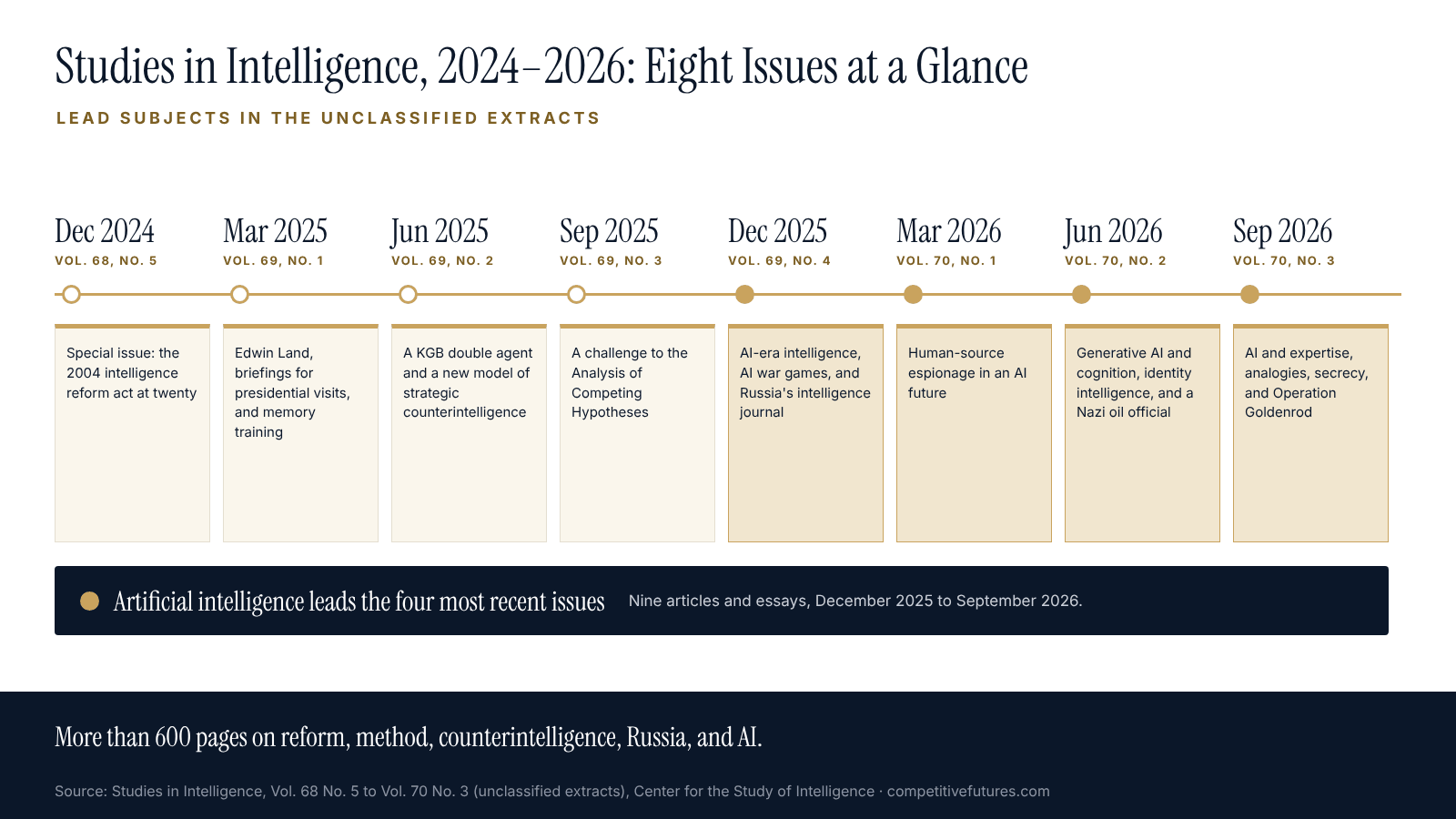
- What we read: eight issues, Volume 68 Number 5 through Volume 70 Number 3. Full issues can be classified; the public receives extracts. Articles carry the authors’ views and are not official positions of the CIA or the US government.
- The dominant subject: artificial intelligence. It leads the four most recent issues, with nine articles and essays between December 2025 and September 2026.
- The live argument: whether AI should speed up intelligence production or whether it wears away the expertise that makes analysis worth reading.
- Also under debate: the soundness of standard analytic methods, the place of counterintelligence in a contest fought with every instrument of state power, and the cost of secrecy.
- What is missing: in these extracts, long-range foresight and private-sector competitive intelligence barely appear.
What we reviewed
Sherman Kent founded the journal to give intelligence a professional literature, and it still serves that purpose. Our page on Kent tells that story. The eight issues we read fall into six groups of subjects:
- Artificial intelligence and analytic tradecraft, in every issue since December 2025.
- Analytic method: a challenge to the Analysis of Competing Hypotheses (September 2025), a method for testing historical analogies (September 2026), and an experiment with 30 participants on memory training (March 2025).
- Counterintelligence and deception: a study of a KGB double agent and a proposed new model of strategic counterintelligence (both June 2025).
- Russia: private military companies, the illegals program, regime ideology, and a review of Razvedchik, a Russian intelligence journal.
- Law enforcement and homeland security: Operation Goldenrod, identity intelligence, and the links between foreign intelligence and domestic agencies.
- Institutional reform: a full special issue (December 2024) on the Intelligence Reform and Terrorism Prevention Act of 2004 at twenty years.
The argument over AI
The journal’s authors disagree with each other, and the disagreement is the most useful thing in these issues.
One side wants speed. “Emergent Intelligence” (December 2025) proposes replacing the step-by-step intelligence cycle with human-AI teams that collect, analyze, and act at the same time. “Software-Defined Intelligence” (September 2026) argues that intelligence is an information business and should be built software-first, with AI agents in the hands of individual officers.
The other side is worried about expertise. “AI and Expertise” (September 2026) points out that analysts already see the world through layers of reporting, and that every language model adds another layer between the analyst and the subject. Its advice is to use the tools only where they bring the analyst closer to the raw material. “Judgment Under Tempo” (September 2026) describes how fast digital systems reward integration and presentation, while deep understanding and second looks fade unless leaders protect them. “The Quiet Cognitive Coup of Generative AI” (June 2026) observes that generative AI now helps frame a problem before the analyst starts reasoning about it.
Two articles report tests. In “Snow Globe” (December 2025), six human players were paired with AI personas in open-ended war games. In “Decision Advantage” (March 2025), an experienced analyst asked four commercial models for a leadership profile ahead of a presidential meeting; the results ran from unexceptional to wrong, including a reference to a trade agreement that was not under negotiation.
A ninth piece, in March 2026, argues that AI makes technical collection cheaper and fabrication easier, and that both effects raise the value of human sources.
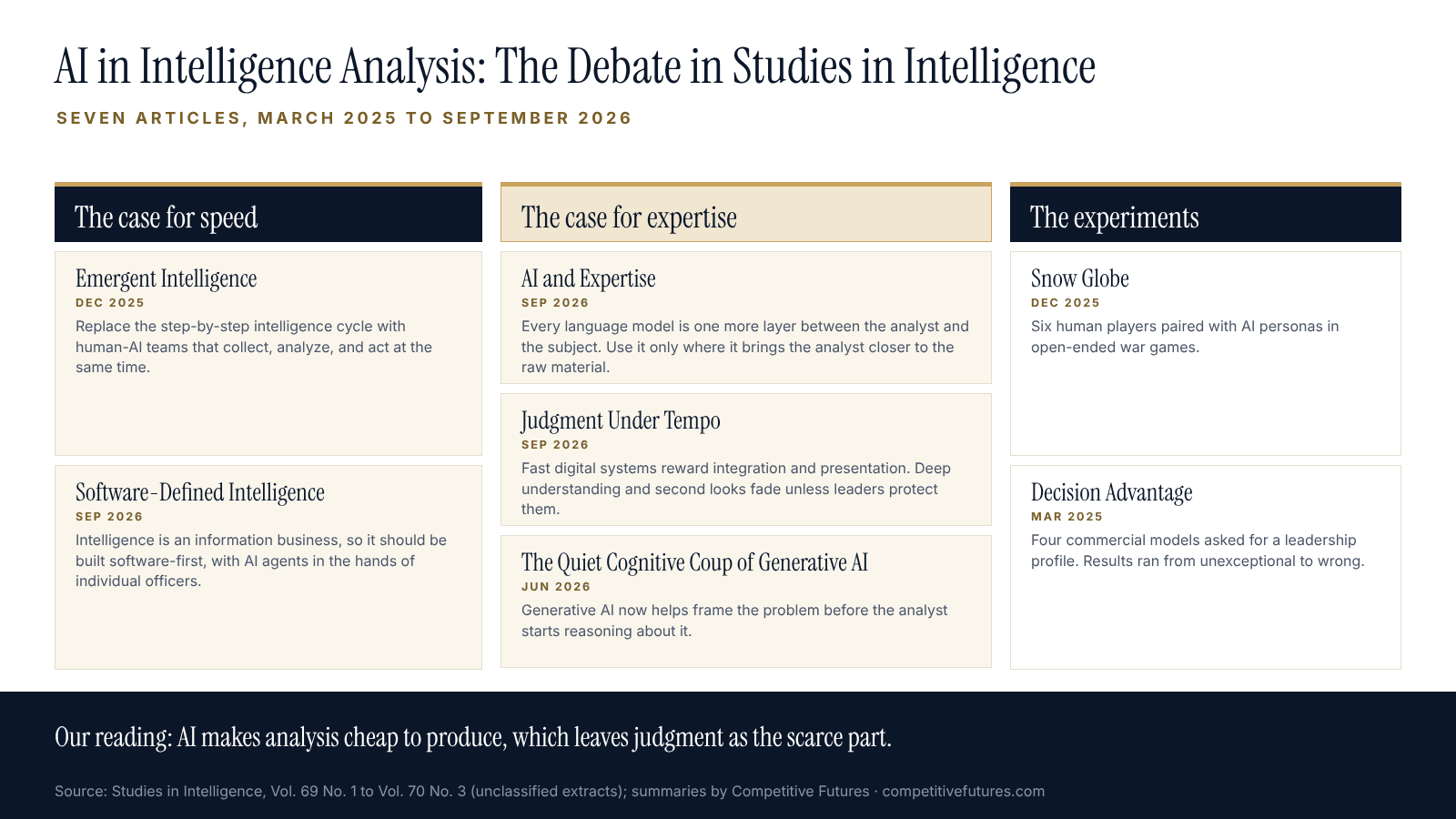
What we think. The skeptics have the stronger case. AI has made analysis cheap to produce, which leaves judgment as the scarce part. A model can summarize a thousand documents; it cannot tell a client which three matter to the decision in front of them, or what the people involved are likely to do next. Our research rests on speaking with people who know, reading the documentary record with skepticism, and three decades of archives, and we use AI to get to those sources faster. We do not use it in place of them. We have written about this in You Must Understand Cognitive Bias and AI.
The standard methods are being questioned
“Applying Epistemology to Analysis” (September 2025) challenges the Analysis of Competing Hypotheses, the method Richards Heuer developed at the CIA. The article’s argument is that the method leans too heavily on disproving hypotheses. When an adversary is concealing something, missing evidence disproves nothing. The author’s worked example is an Indian nuclear test. The article proposes a matrix that scores how well each hypothesis explains all of the evidence.
“Analogical Reasoning in Intelligence Analysis” (September 2026) takes on a different habit: reaching for a vivid historical parallel. It reviews how President Truman read Korea through the 1930s and how President Johnson’s advisers read Vietnam through Korea, and it offers a way to test an analogy before it takes over the analysis.
What we think. Both articles are right about the danger and neither retires the method. We use the Analysis of Competing Hypotheses and will keep using it, because its real value is forcing an analyst to hold several explanations at once. The criticism applies to careless use: treating silence as proof, or scoring evidence without asking who controlled what could be seen. A sound assessment grades its evidence, says what is missing and why, and states the conditions under which it would be wrong.
Counterintelligence, deception, and the reach of the law
The June 2025 issue reconstructs, from public sources, the case of a KGB officer sent in May 1987 to pose as a volunteer to the CIA’s Moscow station. The operation was designed to protect a Soviet penetration of the agency. The lesson the article draws is that a controlled source can be built to pass the very checks meant to expose it.
A companion article argues that counterintelligence has been treated as a security function and should become a strategic discipline, because rival states now compete through diplomacy, information, military power, and economics together.
The September 2026 issue tells the story of Operation Goldenrod. On 13 September 1987, US officers arrested the hijacker Fawaz Yunis in the Mediterranean and brought him to the United States for trial. He was convicted and sentenced in 1989. The article presents it as the first overseas operation of the CIA’s Counterterrorist Center, planned jointly by law enforcement, diplomats, intelligence officers, and the military so that it would stand up in court.
What we think. These articles describe a world our clients already operate in. States pursue their aims through courts, prosecutors, sanctions, and regulators as much as through armed force, and companies stand in the path of all of them. Goldenrod shows how long that has been true. The journal treats these subjects mainly as history. For a company, they are current operating conditions.
Secrecy and open sources
“Secrets and Secrecy” (September 2026) argues that practitioners rarely examine what secrecy costs them. It draws on research into a “secrecy heuristic”: people tend to rate information as better simply because it is classified.
What we think. Organizations outside government have the same weakness for the confidential tip and the exclusive report. Information should be judged by its source and its support. A large share of what a decision-maker needs can be established from open, lawful sources by people who know where to look, which is the basis of our ethics and standards.
What the journal leaves out
In the eight extracts we reviewed, scenario planning and long-range foresight appear only in passing, and private-sector competitive intelligence is not a subject of any article. The journal is strong on history and on current tradecraft. It says little about joining the two to a view of the next ten years.
Competitive Futures was founded on that observation. Organizations need current intelligence and long-range foresight from the same team, and the two professions seldom talk to each other. Our mission and doctrine page explains why.
Why it matters to our clients
- Judgment is what you are paying for. If the intelligence community’s own analysts say AI makes output cheap and judgment scarce, a company should not accept volume as a substitute for a reasoned answer.
- Expertise fades without contact. Analysts lose their feel for a subject when software stands between them and the source. A strategy team that outsources its reading faces the same loss.
- Ask how an assessment could be wrong. The methods are under debate at the highest level. A method’s name on a report guarantees nothing. The analyst’s stated assumptions and gaps tell you more.
- Sources can be built to deceive you. A professional service was misled by a source designed to pass its checks. Due diligence, market research, and partner vetting face the same risk, and AI makes fabrication cheaper.
- Companies are in the contest. State competition runs through commerce, technology, and law enforcement. Enforcement risk belongs in strategy, alongside market risk.
- A correct warning still has to be usable. A review in the June 2025 issue covers 16 warning cases and treats warning as a joint effort between analysts and decision-makers. An accurate forecast that no one can act on has failed the client.
- Structure does not fix analysis. Contributors to the reform special issue stress how much depended on working relationships and common standards after the 2004 reorganization. A company building an intelligence function should invest in people and method first.
Lessons for building an intelligence function
- Decide which tasks go to software and write the rule down. Keep analysts in direct contact with primary sources.
- Require every assessment to state its evidence, its gaps, and what would change the conclusion.
- Give someone the standing job of the second look, and protect that job when deadlines press.
- Test strategy against opponents who move. The intelligence community is experimenting with AI-assisted war games; a business war game serves the same purpose for a company.
- Staff for both horizons: what is happening now, and where it leads.
Frequently asked questions
What is Studies in Intelligence?
Studies in Intelligence is the journal of the US intelligence profession, published by the CIA’s Center for the Study of Intelligence since 1955. It carries articles on the history, practice, and theory of intelligence, along with reviews of books and other media.
Can the public read Studies in Intelligence?
In part. Complete issues may be classified. The Center for the Study of Intelligence publishes unclassified extracts and an archive of unclassified and declassified articles on the CIA’s website.
Does Studies in Intelligence state the CIA’s official position?
No. Every issue states that the facts, opinions, and analysis are those of the authors and do not necessarily reflect the views of the CIA or any other US government body.
What does the journal say about AI in intelligence analysis?
Its authors disagree. Some argue for rebuilding intelligence work around AI and software. Others warn that language models put distance between analysts and their subjects and weaken expertise. Two articles report experiments, with mixed results.
Is the Analysis of Competing Hypotheses still valid?
A September 2025 article argues that the method relies too much on disproving hypotheses when evidence may be hidden. The method remains in wide use. In our view it is sound when analysts account for missing and concealed evidence.
Why should a business read an intelligence journal?
The problems are the same: incomplete information, deceptive sources, pressure for speed, and decisions that cannot wait. The intelligence community publishes its lessons, and a company can learn from them at no cost.
Work with Competitive Futures
We produce research for decisions and train analysts and executives in the methods discussed here. If your organization is working out where AI belongs in its analysis, or needs an intelligence function that covers both the present and the long term, request a 20-minute conversation. We will reply within one business day.
Related analysis from Competitive Futures
- Sherman Kent: The Father of Intelligence Analysis
- Richards Heuer: Father of Cognitive Bias in Intelligence
- Analysis of Competing Hypotheses
- The Return of Surprise: How Intelligence Analysis Has Changed, and What Never Will
- Strategic Surprise and Early Warning
- Business War Gaming
- Intelligence Is Always Wrong. Decide Anyway.
References
- Center for the Study of Intelligence, Central Intelligence Agency. Studies in Intelligence. https://www.cia.gov/resources/csi/studies-in-intelligence/
- Studies in Intelligence 68, no. 5 (IRTPA Special, December 2024).
- Studies in Intelligence 69, no. 1 (Extracts, March 2025): “Decision Advantage: Intelligence Support for Presidential Visits”; “Memory Techniques in the Intelligence Community.”
- Studies in Intelligence 69, no. 2 (Extracts, June 2025): “Beautiful in Another Context: A Counterintelligence Assessment of GTPROLOGUE”; “Deconstructing and Reconstructing Strategic Counterintelligence: Toward a New Model”; review of Contemporary Intelligence Warning Cases.
- Studies in Intelligence 69, no. 3 (Extracts, September 2025): “Applying Epistemology to Analysis.”
- Studies in Intelligence 69, no. 4 (Extracts, December 2025): “Emergent Intelligence: Spycraft and Intelligence in the AI Era”; “Snow Globe Multi-Player AI System: Lessons from Human-AI Teaming in War Games”; “Razvedchik, Russia’s Intelligence Journal.”
- Studies in Intelligence 70, no. 1 (Extracts, March 2026): “Espionage in Our AI Future: Why Human Intelligence Still Matters.”
- Studies in Intelligence 70, no. 2 (Extracts, June 2026): “We Have Been Here Before: Joseph Becker’s Computer and the AI Question”; “The Quiet Cognitive Coup of Generative AI”; “Three Pillars of Identity Intelligence.”
- Studies in Intelligence 70, no. 3 (Extracts, September 2026): “Operation Goldenrod”; “AI and Expertise”; “Judgment Under Tempo”; “Software-Defined Intelligence”; “Analogical Reasoning in Intelligence Analysis”; “Secrets and Secrecy.”