The Return of Surprise: How Intelligence Analysis Has Changed, and What Never Will
How intelligence analysis has changed since 2012 comes down to three things: surprise returned to the world, the public record became more reliable than the coverage of it, and artificial intelligence became a tool for checking and multiplying the analyst’s work rather than doing it. What has not changed is the requirement that an analyst understand the evidence well enough to defend it out loud. This article sets out what we have seen from inside the work, with the documents behind each example.
At a glance
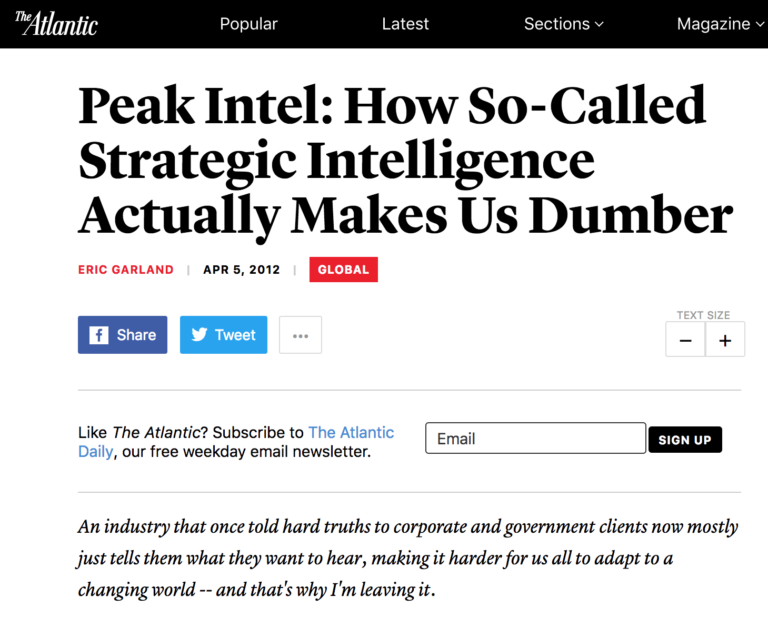
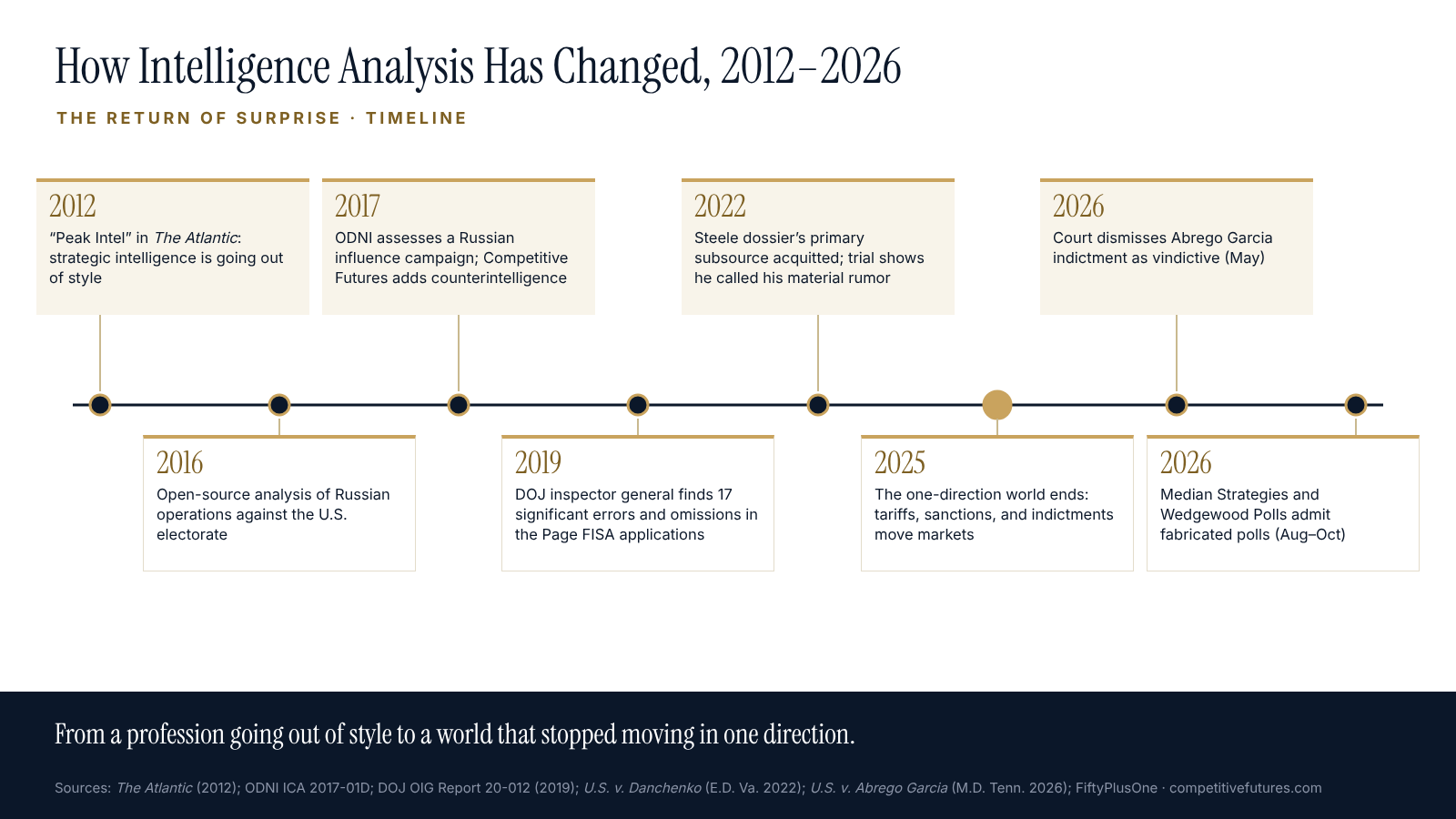
- 2012: “Peak Intel,” our principal’s article in The Atlantic, argued that so-called strategic intelligence was making organizations dumber. The profession was going out of style.
- 2016–2017: Russian intelligence operations against the American electorate showed that planning which ignores adversary operations is planning for a world that does not exist.
- 2019–2022: The Steele dossier showed what happens when coverage outruns the record. The FBI’s own files held the warning.
- 2025: The assumption that the world moved in one direction broke. Strategic surprise returned, and executives began asking for intelligence again.
- 2026: Fake pollsters reached national outlets and moved a prediction market within minutes. The analysts who caught them did it by asking for the raw data.
- Throughout: AI caught errors in our own keynotes and multiplied our output. It did not replace the analysis.
2012: the profession at its low point
In April 2012 The Atlantic published Eric Garland’s “Peak Intel: How So-Called Strategic Intelligence Actually Makes Us Dumber.” It was written three years after the financial crisis, at a time when long-range analysis was losing its place in Western organizations. Rival states were taking positions in plain sight. Russian and Chinese state media were building audiences on Western platforms, Russian fortunes were buying European clubs and property, and within eighteen months China would announce what became the Belt and Road Initiative. Strategic intelligence was treated as a cost to be cut.
The article’s central claim held up. The decade that followed punished organizations that had stopped asking what their competitors and adversaries were doing. By 2026 the Russian operations are in the open, Western governments are pushing back on Chinese state strategy, and executives are listening again.
2016: foresight without counterintelligence is incomplete
Foresight is the discipline of thinking systematically about the long-range future: trends, drivers, scenarios, and the decisions they require. For most of its history it assumed that the future arrives through trends. It does not account for an adversary who is working, quietly, to make a different future arrive.
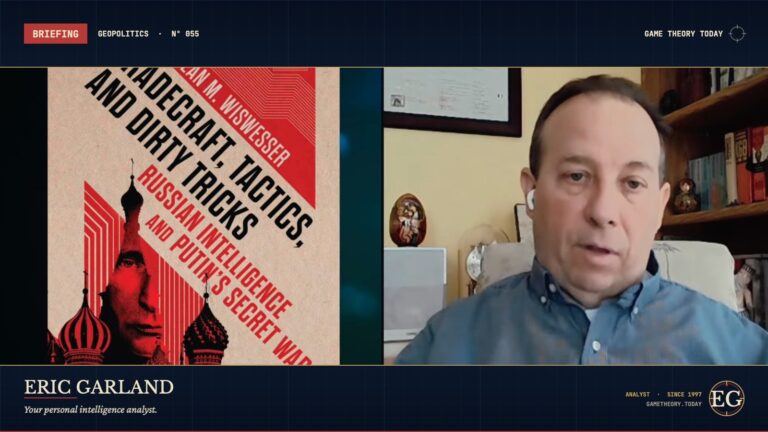
“Doing foresight without addressing spy operations is insufficient,” Eric Garland says. In December 2016 he published an open-source analysis of Russian intelligence operations against the American electorate, produced without access to classified material. In January 2017 the U.S. intelligence community published its own assessment that Russia had conducted an influence campaign aimed at the 2016 election (ODNI, 2017). In 2017 Competitive Futures added counterintelligence and geopolitical analysis to its foresight practice. In May 2022 the Russian Federation sanctioned our principal by name.
The lesson for a company is practical. A five-year plan for a market, a supply chain, or a regulated industry should include the question of who is trying to shape that market and by what means. Our Mueller investigation page sets out the documented 2016 operation.
2025: the world stopped moving in one direction
For a generation after the Cold War, most corporate planning rested on a quiet assumption: that the world was moving in one direction, toward open markets, integrated supply chains, and capital that could go wherever it liked. Under that assumption, analysis drifted toward trend extrapolation. If you knew the direction, you only needed the speed.
For many of the executives we work with, 2025 was the year that assumption broke. Donald Trump’s return to office was the occasion, but the change was larger than one election. Tariffs, sanctions, terrorist designations of drug cartels, indictments, and extraditions moved to the center of policy, and each of them reached directly into markets. Discontinuity stopped being the wild card in the scenario set and became the operating condition.
“2025 wasn’t just about Trump’s election,” Eric Garland says. “It was about surprise itself.” The demand for intelligence followed. Organizations that had cut their analytic functions found they had no one watching the instruments that were now moving their business.
Coverage of this period has concentrated on allegations about the president’s family business interests, and some of those questions have documentary support. Coverage has paid far less attention to the enforcement record against cartels, human traffickers, money launderers, and foreign intelligence services. An analyst needs both, and needs them from the record.
Read the instruments, not the coverage
The most important change in the daily work is this: the news is a less reliable guide to events than it was in 2000 or 2012, and the primary record is more available than ever. Court filings, Treasury designations, inspector general reports, and corporate disclosures are online, usually free, and usually within hours. “Now more than ever, analysts must pull the original documents and analyze them themselves,” Eric Garland says.
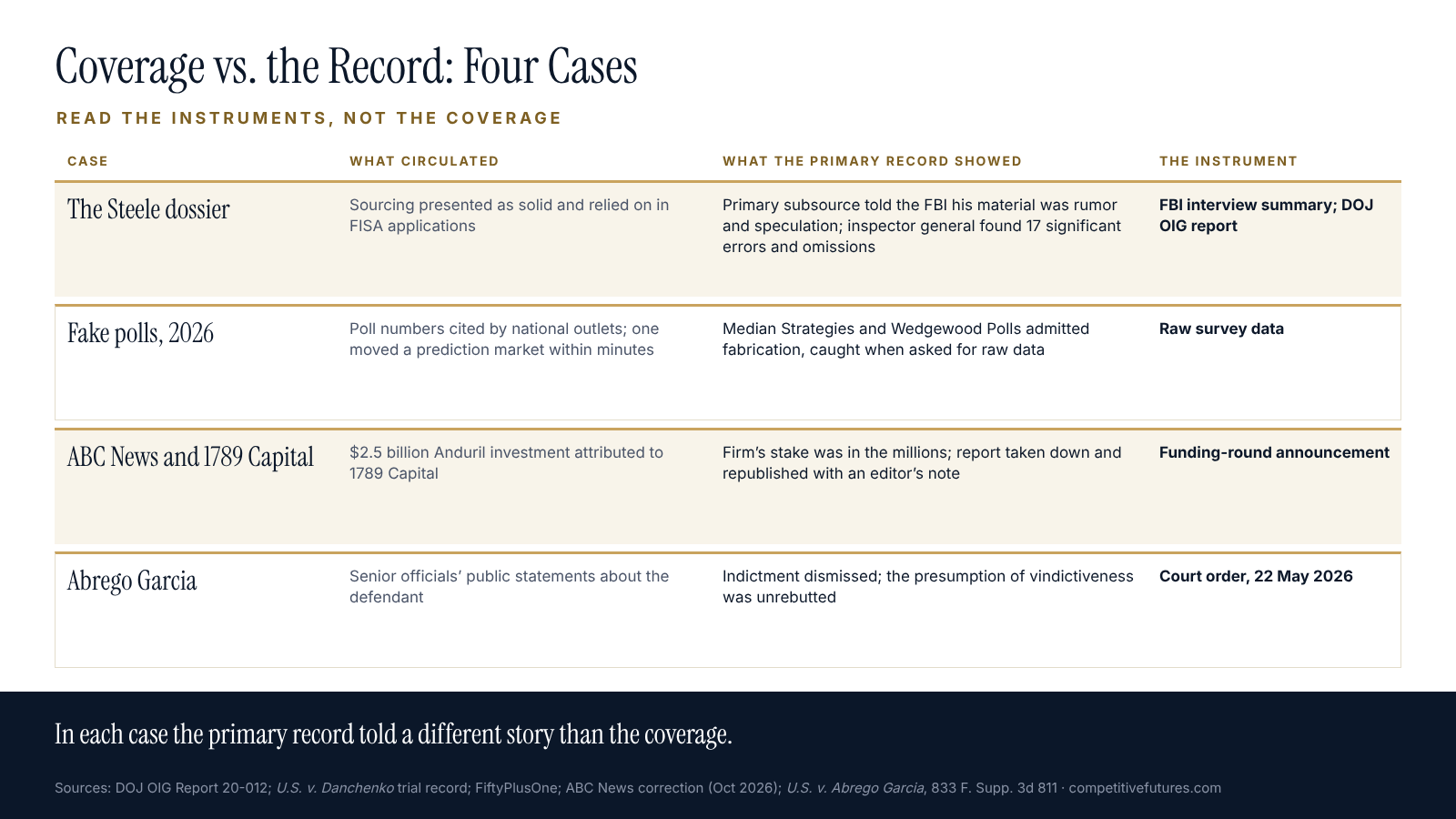
We hold every case to the same standard, whichever side it helps. Four examples:
The Steele dossier. In January 2017 the FBI interviewed the dossier’s primary subsource. At his 2022 trial, the FBI agent who handled him testified that he had told the Bureau from the start that his information was rumor and speculation he could not corroborate, and that Steele had presented the sourcing as firmer than the subsource ever claimed (trial testimony, October 2022). A summary of those interviews was public from July 2020. The Justice Department’s inspector general had already found 17 significant inaccuracies and omissions in the four FISA applications targeting Carter Page, which cited the dossier’s reporting, and also found that the investigation was opened with sufficient predication (DOJ OIG, 2019). The subsource was acquitted of lying to the FBI in October 2022. The warning was in the government’s own files years before most coverage caught up with it. The dossier’s failure also does not erase Russia’s documented 2016 operations. Both facts are in the primary record.
Fake pollsters, 2026. In August an unknown firm called Median Strategies admitted that its polls in Los Angeles, Wisconsin, and Nevada were fabricated; a Los Angeles mayoral campaign had promoted one of them, and a prediction-market contract on that race moved within minutes of the release (August 2026). In October Wedgewood Polls admitted its data were fabricated after the aggregator FiftyPlusOne asked to verify them (FiftyPlusOne). National outlets on both sides of politics had cited the numbers. A third firm, SoCal Strategies, went dark during a parallel inquiry, and two of its polls were removed from the aggregator’s database (FiftyPlusOne). The fakes were caught by people who asked for the raw data.
ABC News and 1789 Capital. In October 2026 ABC News took down a report that attributed a $2.5 billion investment in the defense company Anduril to 1789 Capital, the venture firm in which Donald Trump Jr. is a partner. The firm said its stake was in the millions. ABC republished a corrected version with an editor’s note (October 2026). The error was confusing a company’s total funding round with one investor’s share, which the round announcement would have shown.
Abrego Garcia. In May 2026 a federal judge in Tennessee dismissed a human smuggling indictment against Kilmar Abrego Garcia, finding that the government had not rebutted a presumption of vindictiveness and that, absent his successful lawsuit against his removal, the prosecution would not have been brought. Senior officials’ public statements were part of the evidence the court weighed (United States v. Abrego Garcia, 833 F. Supp. 3d 811 (M.D. Tenn. 2026)). The instrument checks the government as well as the press.
What AI actually changed
Artificial intelligence changed our work in three ways, and none of them is the one usually advertised.
It checks the analyst. AI-assisted verification found apocryphal stories and misattributed quotes in our own keynotes, delivered for years. One was the line attributed to IBM’s Thomas Watson, that there was “a world market for maybe five computers.” No contemporary source has Watson saying it. The likely origin is a 1953 remark by his son, Thomas Watson Jr., to IBM stockholders about one product, the 701: the company had expected orders for five machines and came home with orders for eighteen (Quote Investigator, 2026). A story we told as a failure of vision was a story about beating a sales forecast. The machine flagged it; finding the primary source and knowing what it meant was still analysis.
It multiplies. Research that took a week takes a day. A finding can be written up, translated, and published in many languages and formats. Graphics that once needed a designer are produced alongside the text.
It distributes. The same analysis now reaches executives in a brief, a keynote audience, and a video audience in the same week.
“AI doesn’t help me do the work,” Eric Garland says. “It helps multiply it and distribute it.” The judgment about what matters, what is true, and what to do about it still has to come from someone who can do the whole job by hand.
What never changes: the oral defense
The oldest test in the profession still decides who is an analyst. Hand the decision-maker your assessment, then answer questions about it with the document closed.
“If an analyst hands me 30 pages made possible by AI and he didn’t read and understand the trends himself, he will collapse when questioned verbally,” Eric Garland says. A polished report is now cheap. An analyst who knows which sources carry the weight, where the evidence is thin, and what would change the conclusion is not.
Our principal learned the work by hand, under the futurist Joseph F. Coates from 1999, under standards that did not bend. We hold the people who work with us to the same ones.
Lessons for building an intelligence function now
- Hire for judgment you can test aloud. In the interview, give the candidate a primary document and ask what it shows and what it does not. Their answer will tell you more than a writing sample produced with AI.
- Make primary sources the default. Require that every key judgment trace to a filing, a designation, a dataset, or a direct observation, not to coverage of one.
- Apply one evidentiary standard. Score evidence the same way whichever side it helps. The analyst who can’t is not neutral, and your decisions will inherit the bias.
- Put adversary operations in the plan. Every strategy review should ask who is trying to shape your market and with what instruments. See our guide to analysis of competing hypotheses.
- Use AI as a checker and a multiplier. Use it to verify quotations and figures, to search wider, and to publish faster. Do not use it to skip the reading.
- Expect surprise. Build scenarios in which the direction changes, not only the speed.
Frequently asked questions
How has intelligence analysis changed since 2012?
Strategic surprise has returned after two decades in which most planning assumed the world moved in one direction. Primary records such as court filings and sanctions designations have become more reliable guides than news coverage. Artificial intelligence now checks and multiplies analysts’ work.
Has AI replaced intelligence analysts?
No. AI verifies quotations and figures, speeds research, and helps publish findings widely. Deciding what the evidence means, and defending that judgment under questioning, still requires an analyst who understands the material.
Why should analysts read primary sources instead of news coverage?
Coverage is a summary written under deadline, and in recent years several high-profile stories have had to be corrected or withdrawn. Court filings, inspector general reports, Treasury designations, and raw data show what the evidence actually supports.
What is strategic surprise?
Strategic surprise is a change that an organization’s plans did not allow for, so that its assumptions fail all at once. It usually comes from a discontinuity, such as a change in direction, rather than from a known trend moving faster than expected.
Why does strategic foresight need counterintelligence?
Foresight studies the trends and drivers that shape the future. Hostile states and their proxies work to shape that future too, often covertly. A plan that ignores their operations is planning for a world that does not exist.
What should a company look for when hiring an intelligence analyst?
Look for someone who reads primary sources, applies the same standard of evidence whichever way it cuts, and can defend a conclusion in conversation without notes. Test those directly in the interview.
Work with Competitive Futures
We provide competitive intelligence, strategic foresight, and geopolitical analysis to companies and governments, and we help organizations build their own intelligence functions. If your planning assumes a world that may not hold, request a 20-minute conversation.
Related analysis from Competitive Futures
- Intelligence Analysis: How Professional Analysts Think
- Strategic Surprise and Early Warning
- Richards Heuer: The CIA Officer Who Taught Analysts How Their Minds Fail
- Cognitive Bias: A Field Guide for Leaders Who Must Decide Under Uncertainty
- How to Evaluate a Forecast
- The Mueller Investigation and the Russian Operation of 2016
- Eric Garland
References
- Garland, E. (2012, April 5). Peak Intel: How so-called strategic intelligence actually makes us dumber. The Atlantic. https://www.theatlantic.com/international/archive/2012/04/peak-intel-how-so-called-strategic-intelligence-actually-makes-us-dumber/255413/
- Office of the Director of National Intelligence. (2017). Assessing Russian Activities and Intentions in Recent US Elections (ICA 2017-01D). https://www.dni.gov/files/documents/ICA_2017_01.pdf
- U.S. Department of Justice, Office of the Inspector General. (2019). Review of Four FISA Applications and Other Aspects of the FBI’s Crossfire Hurricane Investigation (Report 20-012). https://oig.justice.gov/reports/2019/o20012.pdf
- Horowitz, M. E. (2023). Statement on FISA oversight before the U.S. House of Representatives. https://oig.justice.gov/news/testimony/statement-michael-e-horowitz-inspector-general-us-department-justice-us-house-3
- Trial testimony in United States v. Danchenko, No. 1:21-cr-245 (E.D. Va.), October 2022, as reported by the Associated Press: https://spectrumlocalnews.com/nc/coastal/ap-top-news/2022/10/13/trump-dossier-source-shocked-speculation-portrayed-as-fact ; verdict: https://www.pbs.org/newshour/politics/think-tank-analyst-acquitted-in-trial-over-discredited-donald-trump-dossier
- United States v. Abrego Garcia, 833 F. Supp. 3d 811 (M.D. Tenn. 2026) (order of 22 May 2026). https://www.courtlistener.com/docket/70476164/united-states-v-abrego-garcia/
- Associated Press. (2026, August 19). What to know about the fake election poll numbers shared and retracted by a mysterious company. https://www.pbs.org/newshour/politics/what-to-know-about-the-fake-election-poll-numbers-shared-and-retracted-by-a-mysterious-company
- Radcliffe, M. (2026, October 20). FiftyPlusOne just caught a pollster faking data. FiftyPlusOne. https://blog.fiftyplusone.news/p/fiftyplusone-just-caught-a-pollster
- Radcliffe, M. (2026, October). More pollster funny business uncovered: SoCal Strategies. FiftyPlusOne. https://blog.fiftyplusone.news/more-pollster-funny-business-uncovered-socal-strategies
- ABC News correction on 1789 Capital and Anduril, October 2026, as reported: https://mediaite.com/media/news/abc-news-acknowledges-errors-in-trump-sons-report-it-mysteriously-deleted ; https://www.adweek.com/tvnewser/editors-note-now-attached-to-abc-news-story-involving-trumps-sons/
- Quote Investigator. (2026, August 29). I think there is a world market for about five computers. https://quoteinvestigator.com/2026/08/29/market-five/
- U.S. Department of State. Foreign Terrorist Organization designations of Tren de Aragua, Mara Salvatrucha, and six cartels (Public Notice 12672). Federal Register 90, 10030–10031, 20 February 2025. https://www.govinfo.gov/content/pkg/FR-2025-02-20/pdf/2025-02873.pdf
This article is part of our guide to Intelligence Analysis.