Richards Heuer: The CIA Officer Who Taught Analysts How Their Minds Fail
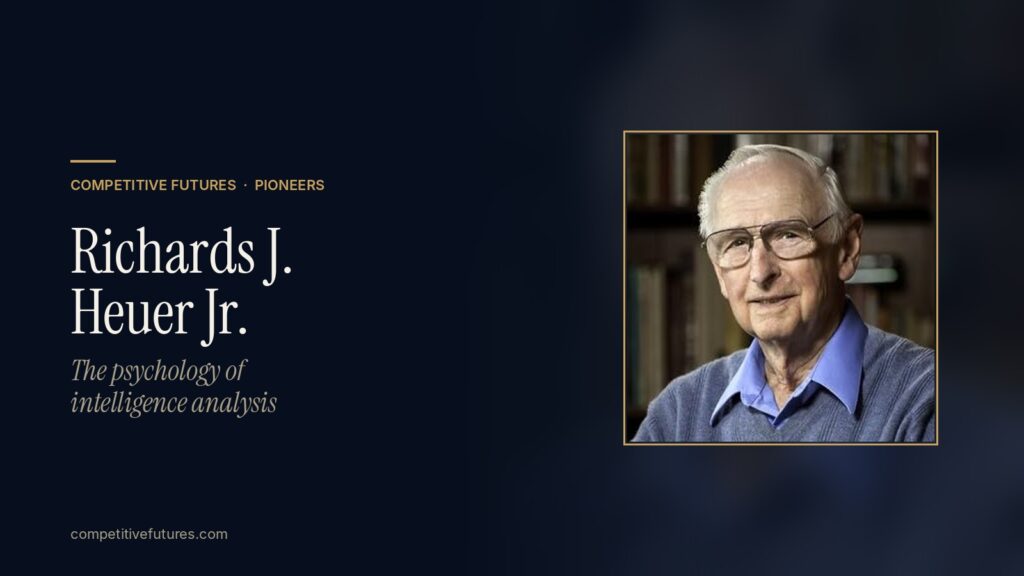
Richards J. Heuer Jr. (1927–2018) was a CIA officer, methodologist and author whose book Psychology of Intelligence Analysis (1999) taught the intelligence world that its biggest problem wasn’t a shortage of information but the way the human mind processes it. Over a career connected to the CIA for more than four decades, Heuer brought the findings of cognitive psychology into intelligence work, created the Analysis of Competing Hypotheses (ACH), and helped build the field now called structured analytic techniques.
Heuer was never famous outside the profession, and he wasn’t especially famous inside it. Jack Davis, one of the CIA’s leading thinkers on analysis, put him on a short list with Sherman Kent, Robert Gates and Douglas MacEachin, and wrote that Heuer’s impact on the quality of the Agency’s analysis “arguably has been at least as important as theirs” (Davis, Introduction to Psychology of Intelligence Analysis, CIA, 1999). For anyone who makes judgments under uncertainty, in government or business, he is the place to start.
At a glance
- Born: 15 July 1927, Philadelphia. Died: 21 August 2018, near Pacific Grove, California.
- Education: B.A. in philosophy, Williams College (1950); graduate study at UC Berkeley; M.A. in international relations, University of Southern California.
- CIA career: Directorate of Operations, 1951–1975; Directorate of Intelligence methodologist, 1975–1979; contractor and consultant for decades after retirement.
- Key works: Quantitative Approaches to Political Intelligence: The CIA Experience (editor, 1978); “Strategic Deception and Counterdeception” (International Studies Quarterly, 1981); “Nosenko: Five Paths to Judgment” (Studies in Intelligence, 1987); Psychology of Intelligence Analysis (1999); Structured Analytic Techniques for Intelligence Analysis (with Randolph Pherson, 2010).
- Lasting contributions: cognitive bias as a core subject of intelligence training; Analysis of Competing Hypotheses; structured analytic techniques.
From philosophy student to operations officer
Heuer studied philosophy at Williams College, where, by his own account, he became fascinated by a question he never really left: what is truth, and how can we know it? (Vaart, Studies in Intelligence, 2018)
In 1951, during the CIA’s buildup for the Korean War, he was a graduate student at Berkeley when Richard Helms, then a rising officer in the clandestine service and later Director of Central Intelligence, recruited him (Davis, 1999). Heuer spent the next 24 years in the Directorate of Operations, much of it overseas.
Two experiences in that period turned him back toward epistemology. One was his involvement in the case of Yuri Nosenko, the KGB officer who defected in 1964 and whose bona fides split the Agency for years. The other was graduate study in social science methodology at USC’s European campus (Davis, 1999).
The Nosenko case: a lesson in how smart people go wrong
The Nosenko affair is one of the most damaging episodes in CIA counterintelligence history. Many senior officers became convinced that Nosenko was a false defector sent to protect a Soviet “master plot” to penetrate the Agency. He was held in harsh confinement for years before the CIA eventually accepted him as genuine.
Heuer later wrote one of the definitive analyses of the case, “Nosenko: Five Paths to Judgment” (Studies in Intelligence, Fall 1987), reprinted in Yale’s anthology of declassified articles from the Agency’s internal journal. He didn’t simply argue about whether Nosenko was real. He laid out five different ways an analyst could approach the question, from looking for motive to testing predictions, and showed how each led to different conclusions. Heuer was candid that he had once found the master-plot theory persuasive himself.
That was the seed of his life’s work. The officers on the wrong side of Nosenko weren’t stupid or dishonest. They reasoned their way into error with methods that felt rigorous. Heuer spent the rest of his career asking why that happens and what can be done about it. His reflections on the case also led directly to ACH (Bruce, Studies in Intelligence, 2018).
Methodologist in the Directorate of Intelligence
In 1975 Heuer moved to the Directorate of Intelligence, joining its analytic methods group, which became the Methods and Forecasting Division in 1976 (Vaart, 2018). When he retired in 1979, he was head of the methodology unit in the DI’s political analysis office.
That period produced Quantitative Approaches to Political Intelligence: The CIA Experience (Westview, 1978), a book Heuer edited on the Agency’s experiments with forecasting and statistical methods. It also exposed him to the research that would change his focus. In the late 1970s Heuer began reading the experimental psychology of judgment, including the work of Amos Tversky and Daniel Kahneman on heuristics and biases. He concluded that intelligence’s hardest problems weren’t quantitative at all. They were cognitive.
The pioneering work: cognitive bias and intelligence analysis
Between 1978 and 1986, much of it after his retirement to the Monterey area, Heuer wrote a series of articles for internal use in the Directorate of Intelligence, several of which also ran in Studies in Intelligence. Their titles show the program: “Cognitive Biases: Problems in Hindsight Analysis” (1978), “Do You Really Need More Information?” (1979), “Strategies for Analytical Judgment” (1981) and “Biases in Evaluation of Evidence” (1981) (Vaart, 2018).
In 1999 the CIA’s Center for the Study of Intelligence collected, updated and published them as Psychology of Intelligence Analysis. The book is free from the CIA, it remains a staple of intelligence training around the world, and it’s still the best short introduction to how analysts fool themselves.
Jack Davis summarized Heuer’s argument in three points (Davis, 1999):
- The mind is poorly wired for uncertainty. That includes the natural fog around complex questions and the man-made fog of denial and deception.
- Knowing about a bias doesn’t cure it. Heuer compared cognitive biases to optical illusions: they stay compelling even after you know they’re there.
- Tools and techniques can help. Structured methods that force analysts to externalize and challenge their reasoning can improve judgment on hard questions.
Mindsets: why we see what we expect to see
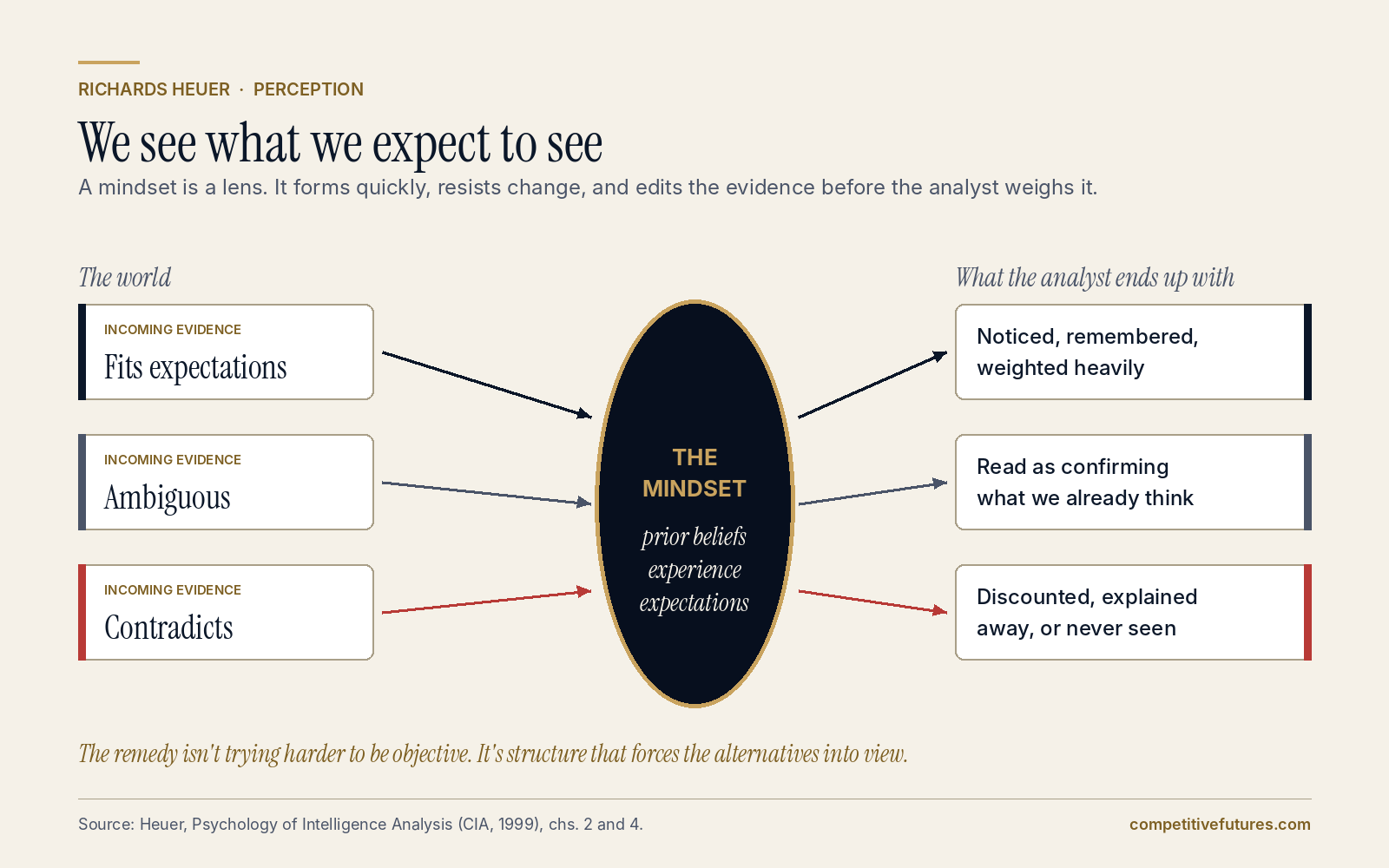
Heuer’s starting point was perception. People don’t passively record information; they construct it, and what they already believe shapes what they notice. He called the result a mindset, the lens through which an analyst sees the world. Mindsets are unavoidable and often useful, because they let experts make sense of fragments quickly. But they’re quick to form and resistant to change, so new evidence tends to be assimilated into old views rather than allowed to overturn them. That’s why gradual change gets missed and why experts can be the last to notice that their world has shifted.
More information doesn’t mean better judgment
Heuer’s most counterintuitive chapter asked, “Do You Really Need More Information?” He drew on experiments by the psychologist Paul Slovic, in which experienced horse-race handicappers predicted races using 5, 10, 20 and then 40 items of information each. Their accuracy didn’t improve as the information grew, but their confidence rose steadily (Heuer, 1999, ch. 5). With five items, the handicappers’ confidence matched their accuracy. With 40, they were badly overconfident.
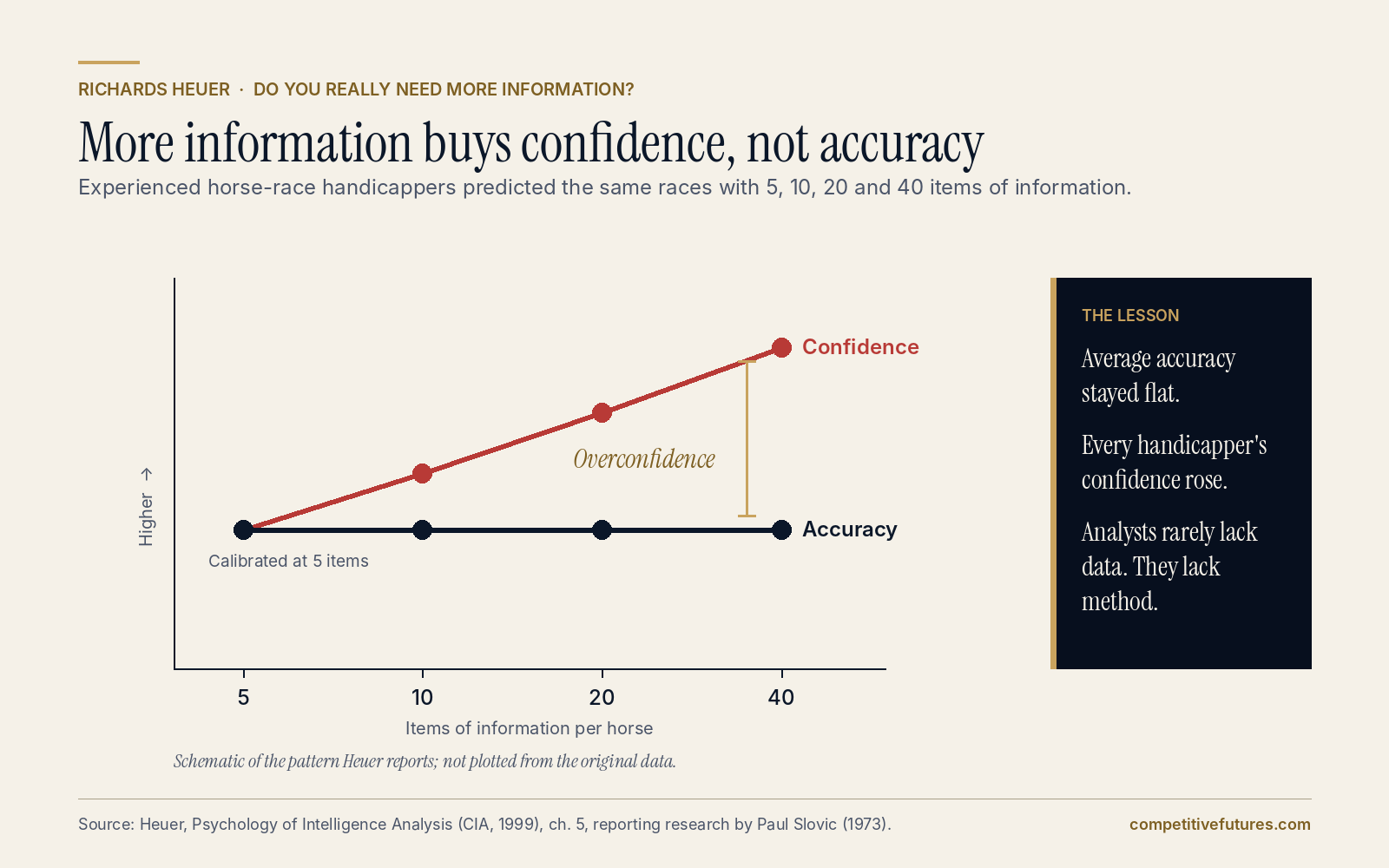
The lesson for intelligence agencies, which have always answered failure by collecting more, was uncomfortable. Analysts usually have more information than they can use well. What they need is better methods for analyzing it. That lesson applies with even more force to companies drowning in dashboards.
Biases in evidence, probability and cause
The rest of the book catalogs the specific errors. Analysts give too much weight to vivid evidence and too little to dull statistics. They fail to account for missing evidence. They keep impressions even after the evidence behind them is discredited. They see patterns and causes in random events, and they attribute other people’s behavior to character when it may be circumstance. They anchor on first estimates, misjudge probabilities, and, after the fact, believe they knew all along. For our own catalog of these errors, organized into six families, see Cognitive Bias: A Field Guide for Leaders.
Deception and counterdeception
Heuer applied the same research to the problem of being deliberately fooled. His 1981 article “Strategic Deception and Counterdeception: A Cognitive Process Approach,” written while he was affiliated with the Naval Postgraduate School, argued that the deceiver has a clear advantage, because deception seldom fails when it exploits a target’s existing preconceptions (International Studies Quarterly 25, no. 2, 1981; NPS Calhoun archive). He recommended cognitive aids to analysis and, in some circumstances, a dedicated counterdeception staff.
In the 1980s he helped plan a 1984 CIA conference on deception and co-directed the first course in deception analysis, which he taught for several years (Bruce, 2018). For an analyst, the insight is simple and lasting: an adversary doesn’t have to plant a lie you’d never believe. It only has to confirm what you already think.
Analysis of Competing Hypotheses
Heuer’s best-known method is ACH, set out in chapter 8 of Psychology of Intelligence Analysis. Instead of picking the most likely answer and gathering support for it, the analyst lists every reasonable hypothesis, tests each piece of evidence against all of them at once, and works to disprove hypotheses rather than confirm them. The answer that survives is the one with the least evidence against it. As Heuer put it, a scientist seeks to disprove a hypothesis, not to confirm it.
ACH turned Heuer’s diagnosis into a procedure. Because you can’t simply decide to be unbiased, you need a structure that forces the alternatives onto the table and makes your reasoning visible to others. In the 2000s Heuer worked with researchers at the Palo Alto Research Center (formerly Xerox PARC) on software that automated the method, and versions of it spread across the intelligence community (PARC technical description, 2004).
Research since then suggests ACH helps organize analysis but doesn’t remove bias automatically; it works best inside a disciplined team process. For the full method and an example, see our guide to Analysis of Competing Hypotheses.
Structured analytic techniques
Heuer kept working into his eighties. With Randolph Pherson, a former CIA analyst, he wrote Structured Analytic Techniques for Intelligence Analysis (CQ Press, 2010; later editions 2015 and 2019). The book gathered dozens of techniques, from key assumptions checks and indicators to red-team analysis and premortems, into a single taxonomy, and argued that structured methods should be the normal way intelligence analysis is done, especially in teams.
By then the intelligence community had moved in his direction. Its formal analytic standards now require analysts to consider alternatives and to describe the quality of their sources and the uncertainty in their judgments, ideas Heuer had been pressing since the 1970s.
Personnel security and later life
After leaving the Agency, Heuer settled in the Monterey and Carmel Valley area of California (Vaart, 2018). Alongside his analytic work, he consulted for the Defense Personnel Security Research Center (PERSEREC) in Monterey, co-authoring reports on the federal guidelines used to decide who receives a security clearance. His publisher notes that he wrote extensively on personnel security, counterintelligence, deception and intelligence analysis (SAGE/CQ Press).
Heuer died on 21 August 2018 at his home near Pacific Grove, at 91 (Naval Intelligence Professionals). The CIA’s journal, Studies in Intelligence, marked his death with two memorial essays.
What Heuer means for business and strategy
Heuer wrote for spies, but his findings describe every boardroom. In my advanced strategic analysis course, his work is where the teaching of cognitive bias begins, because his framing is the one executives recognize fastest. Four of his ideas carry straight into corporate decision-making:
- Your mindset filters the evidence before you see it. A leadership team’s shared assumptions are its biggest blind spot, and they’re invisible from inside.
- More data won’t save you. Collection makes people more confident faster than it makes them more accurate. Method matters more than volume.
- Awareness isn’t a defense. Bias training alone doesn’t work. You need procedures, such as ACH, key assumptions checks and outside reviews, that force the alternatives onto the table.
- Assume someone is working your preconceptions. Competitors, activists and foreign intelligence services all exploit what you already believe. Counterdeception starts with knowing your own expectations.
Those ideas are the foundation of how we approach intelligence analysis for companies and governments.
Frequently asked questions
Who was Richards Heuer?
Richards J. Heuer Jr. (1927–2018) was a CIA officer and methodologist who served in the Directorate of Operations and the Directorate of Intelligence and later worked as a contractor and consultant. He wrote Psychology of Intelligence Analysis (1999) and developed the Analysis of Competing Hypotheses.
What is Psychology of Intelligence Analysis about?
It applies research in cognitive psychology to intelligence work, explaining how perception, memory, mindsets and cognitive biases distort analysts’ judgments, and recommending structured methods to counter them. The CIA’s Center for the Study of Intelligence published it in 1999 and makes it available free.
What did Richards Heuer say about cognitive bias?
He argued that cognitive biases are like optical illusions: they persist even when you know about them, so awareness alone doesn’t help. Analysts need structured techniques that force them to consider alternatives and expose their reasoning.
What is Heuer’s Analysis of Competing Hypotheses?
ACH is a method in which an analyst lists all reasonable hypotheses, evaluates every piece of evidence against all of them, and focuses on disproving hypotheses rather than confirming a favorite. The hypothesis with the least evidence against it is judged most likely.
Does more information improve analysis?
Not necessarily. Heuer reported experiments in which experts given more information became more confident without becoming more accurate. His conclusion was that better analytic methods matter more than additional collection.
Work with Competitive Futures
We apply Heuer’s methods every day, in competitive intelligence for companies and in our own published intelligence products, and we teach them in executive education and our advanced strategic analysis course. If your team is making a decision where a wrong assumption would be expensive, request a 20-minute conversation.
Related analysis from Competitive Futures
- Cognitive Bias: A Field Guide for Leaders Who Must Decide Under Uncertainty
- Analysis of Competing Hypotheses
- Intelligence Analysis: How Professional Analysts Think
- Mirror Imaging: The CIA’s Warning About Predicting Iran
- Herman Kahn: The Father of Scenario Planning
References
- Bruce, J. B. (2018). Remembering Richards J. Heuer Jr.: A brief intellectual history. Studies in Intelligence, 62(3).
- Davis, J. (1999). Introduction: Improving intelligence analysis at CIA: Dick Heuer’s contribution to intelligence analysis. In R. J. Heuer Jr., Psychology of Intelligence Analysis. Center for the Study of Intelligence, CIA.
- Heuer, R. J., Jr. (Ed.). (1978). Quantitative Approaches to Political Intelligence: The CIA Experience. Westview Press.
- Heuer, R. J., Jr. (1981). Strategic deception and counterdeception: A cognitive process approach. International Studies Quarterly, 25(2), 294–327.
- Heuer, R. J., Jr. (1987). Nosenko: Five paths to judgment. Studies in Intelligence, 31(3). Reprinted in H. B. Westerfield (Ed.), Inside CIA’s Private World (Yale University Press, 1995).
- Heuer, R. J., Jr. (1999). Psychology of Intelligence Analysis. Center for the Study of Intelligence, CIA.
- Heuer, R. J., Jr., & Pherson, R. H. (2010). Structured Analytic Techniques for Intelligence Analysis. CQ Press. (2nd ed. 2015; 3rd ed. 2019.)
- Office of the Director of National Intelligence. Intelligence Community Directive 203: Analytic Standards (2015, amended 2022).
- Vaart, A. (2018). Richards J. Heuer Jr. (1927–2018): Searcher for truth and the means to recognize it. Studies in Intelligence, 62(3).
This piece is part of our guide to The Pioneers of Strategy, Intelligence, and Foresight.