Herman Kahn: The Father of Scenario Planning, and What Foresight Still Owes Him
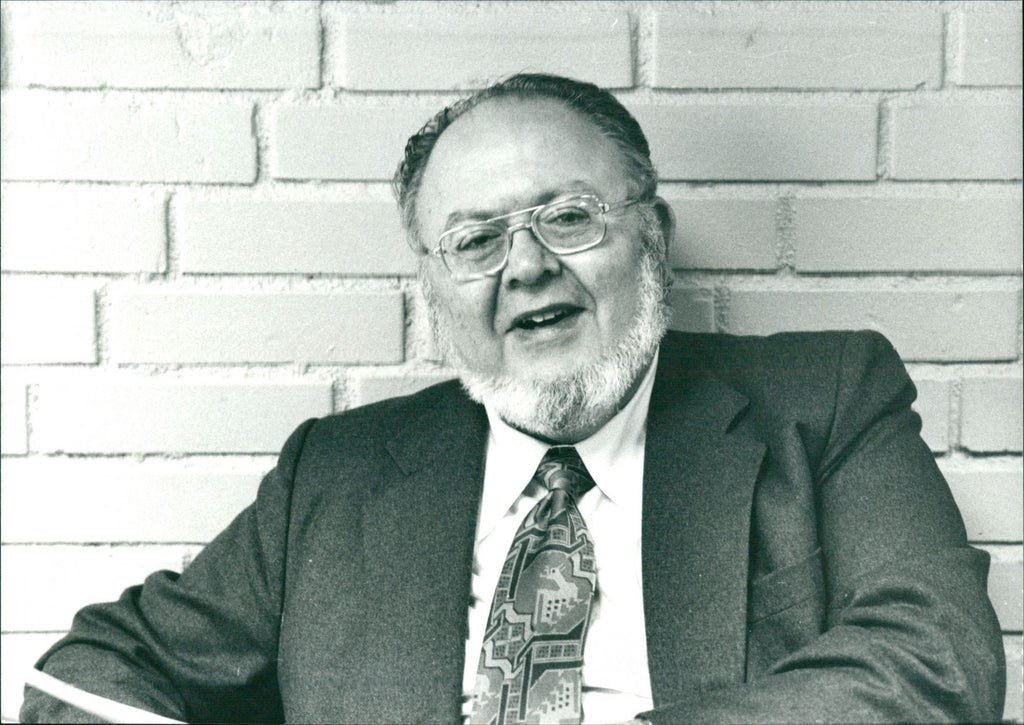
Herman Kahn (1922–1983) was an American physicist, nuclear strategist, and futurist, and the person most often credited with inventing scenario planning. At the RAND Corporation in the 1950s, he wrote detailed, step-by-step stories about how a nuclear war might start, escalate, and end, an approach that later spread from defense planning into business strategy, government, and futures studies. He founded the Hudson Institute in 1961 and spent the rest of his career forecasting the long-term future of technology, economics, and society.
Kahn is remembered as a model for Dr. Strangelove and as one of the most controversial thinkers of the Cold War. For anyone who practices foresight, he is something more useful: the person who showed that you could reason carefully about futures nobody wanted, and that doing so was a way to avoid them.
At a glance
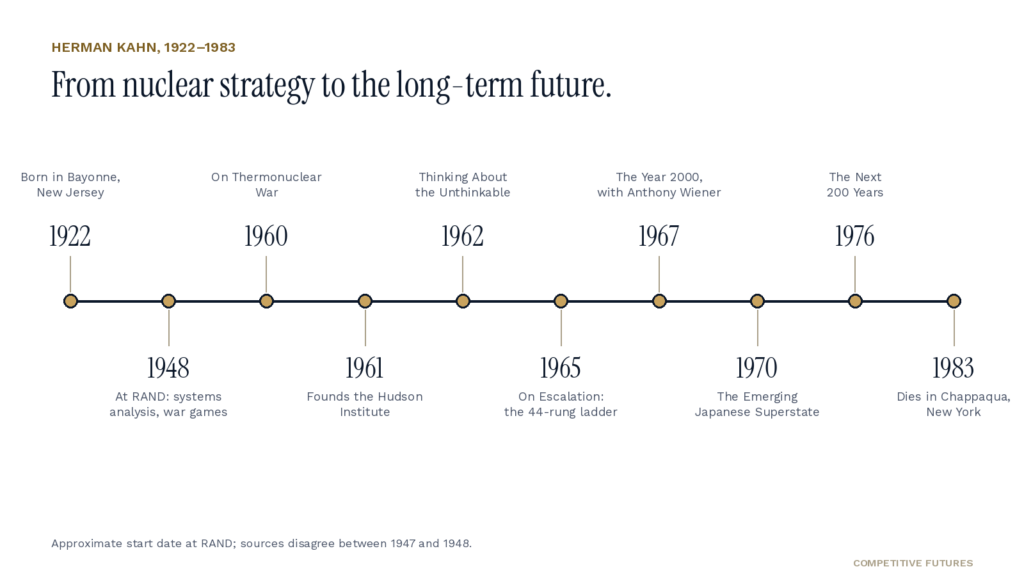
- Born: 15 February 1922, Bayonne, New Jersey. Died: 7 July 1983, Chappaqua, New York.
- Trained as: a physicist (UCLA; M.S., Caltech).
- Career: the RAND Corporation from the late 1940s; founder of the Hudson Institute in 1961.
- Key books: On Thermonuclear War (1960), Thinking About the Unthinkable (1962), On Escalation (1965), The Year 2000 (1967, with Anthony Wiener), and The Next 200 Years (1976).
- Lasting contributions: scenario planning, the escalation ladder, and the idea that rigorous thinking about the unthinkable is a public service.
From physics to RAND
Kahn was born in Bayonne, New Jersey, and grew up in the Bronx and Los Angeles. He studied physics at UCLA, served in the Army in Burma during the Second World War, and earned a master’s degree at Caltech before joining the RAND Corporation, the Air Force-funded think tank in Santa Monica.
At RAND, he moved from weapons physics into strategy, applying systems analysis and game theory to the problem of nuclear deterrence. He became known for long, unscripted briefings that walked generals and civilians through the consequences of a nuclear exchange in unsettling detail.
On Thermonuclear War and “thinking about the unthinkable”
Kahn became a public figure with On Thermonuclear War (Princeton University Press, 1960), a book that treated nuclear strategy as an application of game theory rather than a horror to be avoided in silence. He argued that a nuclear war might be survivable, that its outcomes would depend on preparation, and that leaders who refused to think about it would make worse decisions if it came.
The reaction was fierce. Critics found the book morally chilling, and its cool tone made Kahn an easy model for satire. Stanley Kubrick met with him while making Dr. Strangelove (1964), and the film’s “doomsday machine” came from Kahn’s book.
Kahn’s answer to his critics became the title of his next book, Thinking About the Unthinkable (1962): the only way to avoid a catastrophe is to think about it carefully, in alternatives, before the day comes. For foresight practitioners, that is the founding principle of the discipline.
Inventing the scenario
Kahn’s lasting method was the scenario: a structured, plausible story about how the future might unfold, written to expose the decisions and turning points along the way. The term is often credited to Kahn’s RAND colleague, the writer Leo Rosten, who borrowed it from Hollywood screenwriting.
Scenarios solved a problem that numbers alone could not. A war plan described one intended path; a scenario forced planners to imagine how events might actually develop, including the paths nobody wanted. Kahn used them to test assumptions, reveal blind spots, and make abstract risks concrete enough for decision-makers to act on.
The method traveled. The origins of scenario planning are widely ascribed to Kahn’s work at RAND, and in the 1970s Royal Dutch Shell turned scenarios into a corporate strategy tool. Today they are standard practice in governments, militaries, and companies. For how scenarios are built now, see our guide to scenario planning.
The escalation ladder

After the Cuban Missile Crisis, Kahn developed his best-known framework. In On Escalation: Metaphors and Scenarios (Praeger, 1965), he described a “ladder” of 44 rungs, from an ostensible crisis through diplomatic gestures, ultimatums, and conventional war, up to all-out nuclear war. The point was to show that escalation is a series of choices, and that leaders can climb down as well as up.
The ladder is still in use. Analysts who applied it to Russia’s war on Ukraine found that the early stages of the conflict tracked Kahn’s rungs closely. Critics, including the strategist Lawrence Freedman, warn that the ladder is too neat and can mislead if detached from Kahn’s caveats.
The Hudson Institute and the turn to the long-term future
In 1961, Kahn left RAND and founded the Hudson Institute, which became a model for the independent, interdisciplinary think tank. From the mid-1960s, he turned increasingly from military strategy to the long-term future of technology, economics, and society.
The landmark was The Year 2000: A Framework for Speculation on the Next Thirty-Three Years (1967), written with Anthony Wiener and funded in part by the American Academy of Arts and Sciences. It mapped long-term trends, proposed alternative futures, and listed 100 technical innovations “very likely” by the end of the century. Kahn went on to forecast Japan’s rise as an economic power in The Emerging Japanese Superstate (1970), and argued against the pessimism of the “limits to growth” debate in The Next 200 Years (1976).
What Kahn got right and wrong
Kahn’s forecasts have been checked. When a panel reviewed the 100 innovations in The Year 2000, fewer than half were judged good and timely. But accuracy varied widely by field: forecasts in computers and communication were about 80% correct, while the other fields scored 50% or less.
That pattern is the useful lesson. Where steady, measurable trends existed, like the falling cost of computing, long-range forecasts held up. Where the future depended on politics, culture, and choices, they didn’t. Wiener himself said the goal was never prophecy but clarification: reducing thoughtlessness in the choices societies make.
That’s the right way to read Kahn today. His value was never a list of correct predictions. It was a method for laying out alternatives clearly enough that people could choose among them. See how to evaluate a forecast for how to judge long-range claims.
Kahn’s legacy for foresight today
Four of Kahn’s ideas remain at the core of strategic foresight:
- Think about the unthinkable. The futures an organization refuses to discuss are usually the ones that hurt it.
- Use scenarios, not single forecasts. A set of plausible stories prepares you for more than one future.
- Treat escalation and change as a series of choices. Turning points can be named and watched in advance.
- Separate trends from choices. Measurable trends can be projected; human decisions have to be explored in alternatives.
Kahn’s methods only matter if leaders are willing to engage with what they reveal, which is why we write about building a foresight culture as well as the techniques themselves.
Frequently asked questions
Who was Herman Kahn?
Herman Kahn (1922–1983) was an American physicist, nuclear strategist, and futurist who worked at the RAND Corporation and founded the Hudson Institute in 1961. He is best known for On Thermonuclear War, the escalation ladder, and pioneering scenario planning.
Why is Herman Kahn called the father of scenario planning?
At RAND in the 1950s, Kahn developed the practice of writing detailed, plausible stories about how future events might unfold, to test assumptions and expose decision points. That scenario method later spread to business, most famously at Royal Dutch Shell, and to governments worldwide.
Was Herman Kahn the inspiration for Dr. Strangelove?
He was one of the models. Stanley Kubrick consulted Kahn while making the 1964 film, and its “doomsday machine” came from Kahn’s On Thermonuclear War.
What is Herman Kahn’s escalation ladder?
It is a framework from On Escalation (1965) describing 44 rungs of increasing conflict, from an ostensible crisis to all-out nuclear war. It is still used to analyze crises, including Russia’s war on Ukraine.
How accurate were Herman Kahn’s forecasts?
Mixed. In a review of the 100 innovations predicted in The Year 2000 (1967), fewer than half were judged good and timely, but forecasts in computers and communication were about 80% correct.
Work with Competitive Futures
We practice the discipline Kahn helped invent: scenarios, trend analysis, and structured foresight for companies and governments. Request a 20-minute conversation, or see our keynote topics, including “Building a Foresight Culture.”
Related analysis from Competitive Futures
- Scenario Planning
- Strategic Foresight: A Practitioner’s Guide to Seeing What’s Coming
- How to Build a Foresight Culture
- How to Evaluate a Forecast
- Analysis of Competing Hypotheses
References
- Albright, R. E. (2002). What can past technology forecasts tell us about the future? Technological Forecasting and Social Change, 69(5), 443–464.
- Bruce-Briggs, B. (2000). Supergenius: The Mega-Worlds of Herman Kahn. North American Policy Press.
- Ghamari-Tabrizi, S. (2005). The Worlds of Herman Kahn: The Intuitive Science of Thermonuclear War. Harvard University Press.
- Kahn, H. (1960). On Thermonuclear War. Princeton University Press.
- Kahn, H. (1962). Thinking About the Unthinkable. Horizon Press.
- Kahn, H. (1965). On Escalation: Metaphors and Scenarios. Praeger.
- Kahn, H., & Wiener, A. J. (1967). The Year 2000: A Framework for Speculation on the Next Thirty-Three Years. Macmillan.
- Kahn, H., Brown, W., & Martel, L. (1976). The Next 200 Years. Morrow.
This piece is part of our guide to Pioneers of Strategy, Intelligence, and Foresight.