Strategic Intelligence Research

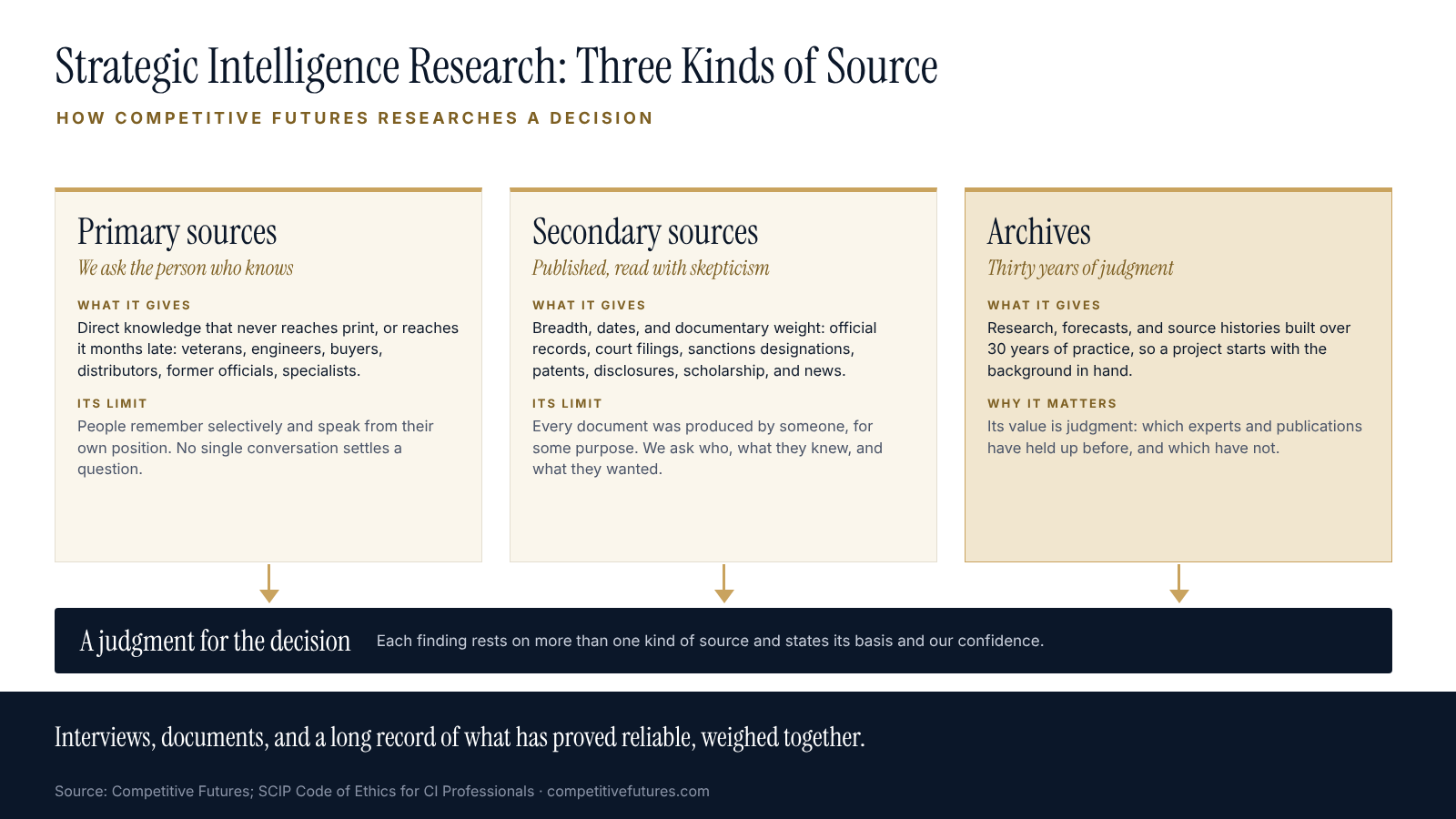
Strategic intelligence research at Competitive Futures rests on three kinds of source: the people who know, the published record, and an archive built over 30 years. We combine them to give a decision maker the intelligence a decision needs, quickly, accurately, ethically, and at a cost that makes sense against what the decision is worth.
At a glance
- Primary sources: we ask the people who know, openly and lawfully.
- Secondary sources: we read published material with skepticism, and we ask who produced it and why.
- Archives: 30 years of research, forecasts, and source histories that tell us which voices and documents have held up.
- The standard: fast, accurate, ethical, and economical.
- Terms: most work is a contract for a defined scope; an hourly retainer is available for questions that arrive on short notice.
- The test: if success will not be worth at least 100 times our budget to the client, we generally decline the work.
Why Research Is the Product
A client does not hire an intelligence firm for pages. Software can now produce hundreds of pages on any subject in minutes. What a decision maker needs is a small number of findings that are true, that bear on the decision, and that will survive scrutiny from a board, a minister, or a counterpart across the table.
Those findings come from research. Analysis can only be as good as the material under it, and the material is only as good as the judgment used to gather and weigh it. That is why we describe research as the core of the company’s work, and why every engagement starts with the sources.
Primary Sources: We Ask the Person Who Knows
The fastest route to the truth about a market, a technology, a regulator, or a rival is often a conversation with someone who has direct knowledge of it. Industry veterans, engineers, buyers, distributors, former officials, and academic specialists know things that never reach print, or reach it months late.
We conduct primary research openly. Before an interview, we identify ourselves and our organization, and we do not misrepresent who we are or why we are asking. That is the profession’s ethical standard, set out in the code of ethics of the Strategic and Competitive Intelligence Professionals, and we follow it. We do not have to name the client, and we do not.
Primary sources have limits. People remember selectively, speak from their own position, and sometimes tell an interviewer what they think the interviewer wants. No single conversation settles a question. That is why primary research never stands alone.
Secondary Sources: Published, and Read With Skepticism
Secondary sources are everything already published: official records, court filings, regulatory submissions, sanctions designations, patents, financial disclosures, peer-reviewed research, trade press, and news. They give breadth, dates, and documentary weight that interviews cannot.
We read all of it with skepticism. Every published source was produced by someone, for some purpose, at some moment. A press release is written to persuade. A government report reflects the agency that wrote it. A news story is a first draft, and the second draft sometimes disagrees with it. Before a published claim enters an assessment, we ask who produced it, what they knew, what they wanted, and whether anything independent supports it. Primary documents, such as filings, official records, and scholarship, carry the most weight.
Archives: Thirty Years of Judgment
The third source is the one a new firm cannot buy. Over 30 years of practice, which began before the company’s founding in 2002, Eric Garland and the company have built an archive of research, forecasts, and source histories across industries, technologies, and governments.
The archive matters less for the facts it holds than for the judgment it supports. It tells us which kinds of experts have been right about a field before and which have not, which publications reliably lead events and which repeat them, and which forecasts aged well. When a primary source makes a claim or a secondary source reports one, the archive lets us weigh it against a long record instead of taking it at face value. It also lets us start a project with the background already in hand, which is a large part of why our work is fast and economical.
Fast, Accurate, Ethical, and Economical
Clients usually assume they must choose among speed, quality, and cost. Our research model is built so they do not have to.
- Fast. The archive means we rarely start from zero. A defined-scope project usually delivers in weeks, and an on-demand question can come back in days.
- Accurate. Every judgment rests on more than one kind of source, and each states its basis and our confidence in it.
- Ethical. We collect lawfully and openly, follow the profession’s code of ethics, and do not alter findings to suit anyone. Our Ethics and Standards page sets out the full policy.
- Economical. We scope the research to the decision, not to the largest possible study. The client pays for what the decision needs.
How Clients Buy Research
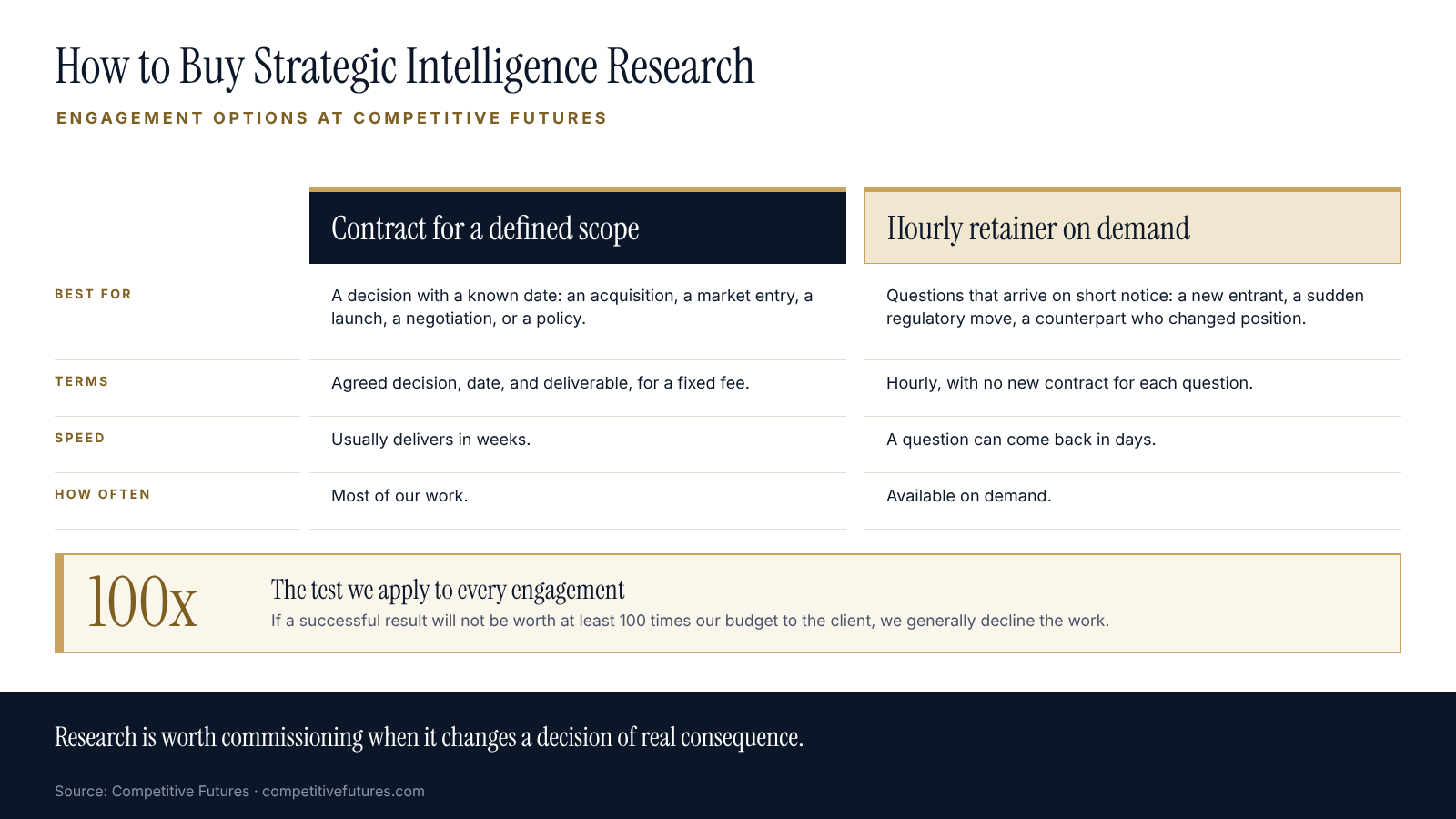
A contract for a defined scope. Most of our work is done this way. We agree on the decision the research must support, the date it is needed, the deliverable, and a fixed fee. How an Engagement Works describes each stage.
An hourly retainer on demand. Some clients need answers as questions arise: a new entrant, a sudden regulatory move, a counterpart who changed position overnight. For them we offer an hourly retainer, so a question can go to work the day it arrives without a new contract each time.
The 100x Test
Before we accept an engagement, we ask one question: if the research succeeds, will the result be worth at least 100 times our budget to the client? If the answer is no, we generally decline the work.
The test protects the client. Research is worth commissioning when it changes a decision of real consequence, such as an acquisition, a market entry, a product launch, a negotiation, or a policy. When the stakes are smaller than that, a client is usually better served by spending less or spending nothing, and we will say so.
Lessons for Building an Intelligence Function
- Use all three kinds of source. Interviews alone tend toward opinion, documents alone miss what has not been published, and both need a record of what has proved reliable.
- Keep the record. An intelligence function that does not file its research and score its forecasts loses its judgment every time a person leaves.
- Collect in the open. Honest identification costs very little and protects the organization’s reputation and legal position.
- Price research against the decision. If no decision of consequence depends on the answer, the research is probably not worth commissioning.
Frequently Asked Questions
What is strategic intelligence research?
It is research gathered and weighed to support a specific decision, such as a market entry, an acquisition, or a policy choice. Its product is a small set of findings with their basis and level of confidence, not a general report on a topic.
What is the difference between primary and secondary sources?
A primary source is a person with direct knowledge whom we interview. A secondary source is published material, such as official records, court filings, scholarship, and news. We use both, and we read the published record with skepticism.
Why do the company’s archives matter?
Thirty years of research, forecasts, and source histories let us judge which experts and publications have held up over time, and let us begin a project with the background already in hand.
Do you identify yourselves when you interview sources?
Yes. We identify ourselves and our organization and do not misrepresent our purpose, following the profession’s code of ethics. The client’s identity stays confidential.
Do you work on retainer or only by contract?
Most work is a contract for a defined scope and a fixed fee. We also offer an hourly retainer for clients who need answers on short notice.
What engagements does the company decline?
Among others, engagements where a successful result would not be worth at least 100 times our budget to the client. In those cases the client is usually better served by a smaller effort.
Work With Competitive Futures
If a decision of real consequence depends on information you do not yet have, tell us about it. The company will respond. Request a consultation
Related
- How an Engagement Works
- Ethics and Standards
- Mission and Doctrine
- Competitive Intelligence
- Business War Gaming
- Strategic Intelligence Services
References
- Strategic and Competitive Intelligence Professionals (SCIP), Code of Ethics for CI Professionals.
- Garland, Eric. Future, Inc.: How Businesses Can Anticipate and Profit from What’s Next. AMACOM, 2007.
Back to Strategic Intelligence Services.