Ethics and Standards at Competitive Futures
Intelligence ethics at Competitive Futures come down to four rules: we collect lawfully, we say who we are, we screen every engagement before it begins, and we do not change a finding because a client asks. This page sets out those rules and the reasons for them.
At a glance
- Collection: lawful sources and honest interviews only.
- Identity: we state who we are and why we are engaging interview subjects.
- Findings: honest and realistic conclusions, with the basis stated.
- Products: original analysis. No propaganda and no attacks on reputations.
- Screening: law, conflicts of interest, and the interests of existing clients, checked before work begins.
- Confidentiality: work under a non-disclosure agreement as a matter of course.
The Code We Follow
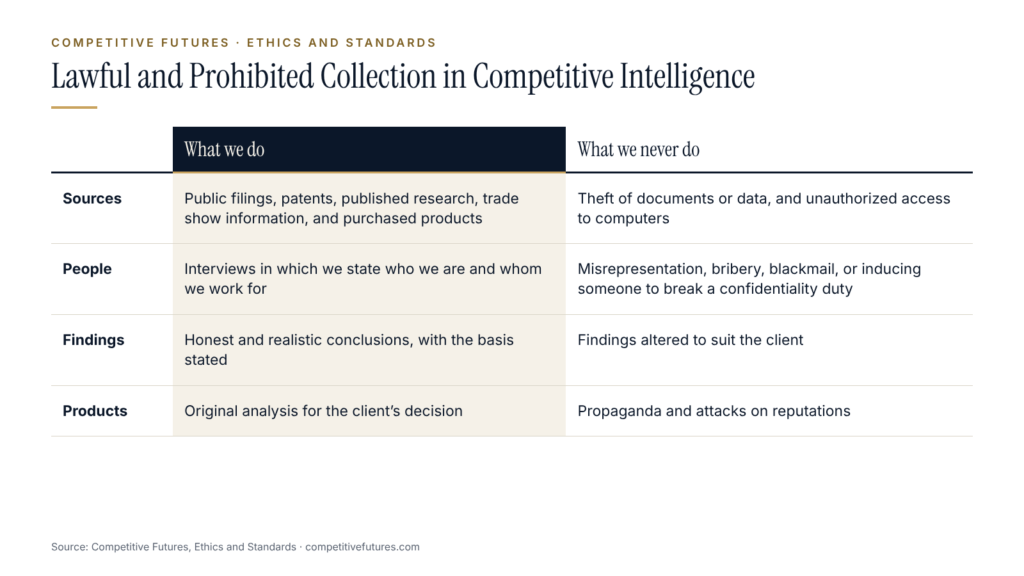
Competitive intelligence has a professional code. The SCIP Code of Ethics asks practitioners “to comply with all applicable laws, domestic and international,” “to accurately disclose all relevant information, including one’s identity and organization,” and “to provide honest and realistic recommendations and conclusions.” Our founder, Eric Garland, was named a Fellow of the Council of Competitive Intelligence Fellows in 2018, and the company holds itself to that code. We discuss it at length on our page about the SCIP Code of Ethics.
How We Collect
We work from public filings, patents, published research, trade show information, purchased products, and interviews in which we identify ourselves honestly. We do not use theft, bribery, blackmail, misrepresentation, unauthorized access to computers, or any inducement to break a duty of confidentiality.
The law draws part of this line. The Economic Espionage Act makes theft of trade secrets a federal crime, and civil cases have held that even a technically legal act can be an improper means of discovery. Ethics sets the line further inside the law.
Intelligence services of states recruit sources with money, ideology, coercion, and ego. That is espionage, and it is not competitive intelligence. The company cannot and does not bribe or blackmail anyone. A well-designed lawful program, drawing a little from many sources, is also the better method. It is more accurate than reliance on one compromised source, and it leaves the client far less exposed.
How We Source and Write
Every product is original analysis built on primary sources and high-quality secondary sources. Each judgment states what it rests on and how confident we are in it. All of our work is done in the unclassified space.
What No Client Can Buy
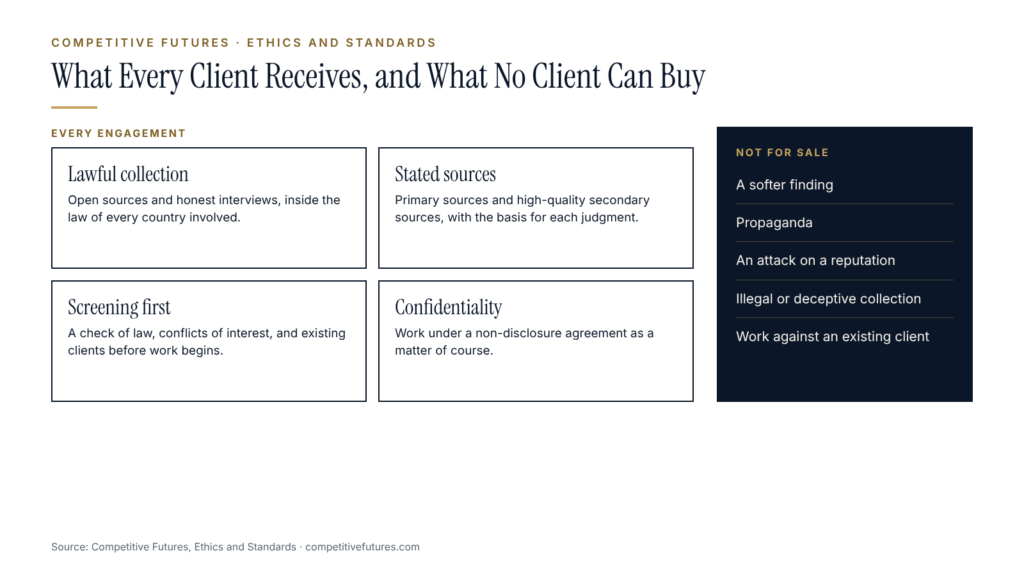
- A softer finding. We do not alter conclusions to suit a client.
- Propaganda. We do not produce material designed to mislead the public.
- An attack on a reputation. We do not research or write to damage a person.
- Illegal or deceptive collection. No fee changes this.
- Work against an existing client. We do not take work aimed at an existing client.
People in this business are asked to cross these lines. A senior figure at a large technology company once asked us to soften a risk assessment before it reached the board. We refused, the client was angry, and the assessment saved that company about $150 million.
Screening Before We Begin
Every engagement is screened before work starts. We check that the work is lawful, including under sanctions law. We check for conflicts of interest. We check the interests of existing clients. If an engagement fails any of the three, we decline it.
Confidentiality and Client Names
We work under a non-disclosure agreement as a matter of course. Most engagements are confidential. We name clients only in general terms, and we never name a client when describing a specific problem inside an engagement or the money at stake.
Lessons for Building an Intelligence Function
- Write the rules down before the first project. A code agreed in advance is easier to hold than one invented under pressure.
- Make honest identification a hard rule. Most legal exposure in this field begins with someone pretending to be someone else.
- Protect the finding. Decide who may edit an assessment, and make sure the answer is not the person who dislikes it.
- Ask counsel early. Anything near a gray area deserves a conversation before it happens.
Frequently Asked Questions
What are the intelligence ethics Competitive Futures follows?
Lawful collection, honest identification, screening before every engagement, and findings that are not changed at a client’s request. The company follows the SCIP Code of Ethics.
Is competitive intelligence legal?
Yes, when it relies on public sources, purchased products, and interviews conducted with honest identification. It becomes unlawful when information is obtained through theft, bribery, misrepresentation, or unauthorized access.
Will Competitive Futures change a finding if the client asks?
No. We do not alter findings to suit a client, and we have declined to do so under pressure.
Does the company use classified information?
No. All work is done in the unclassified space from open sources and lawful research.
How does Competitive Futures handle conflicts of interest?
Every engagement is screened for conflicts of interest and for the interests of existing clients before work begins.
Does the company name its clients?
Only in general terms. A client is never named in connection with a specific problem inside an engagement.
Work With Competitive Futures
If you need analysis you can defend in front of a board, a regulator, or a court, tell us about the question. The company will respond. Request a consultation
Related reading
- Mission and Doctrine
- The SCIP Code of Ethics
- Ethical Collection in Competitive Intelligence
- The Economic Espionage Act
- Competitive Intelligence in Court
- Corporate Counterintelligence
References
- Strategic and Competitive Intelligence Professionals. SCIP Code of Ethics.
- Economic Espionage Act of 1996, 18 U.S.C. §§ 1831 and 1832.
- Council of Competitive Intelligence Fellows, roster of Fellows, class of 2018.
Back to About Competitive Futures.