Competitive Intelligence in Court: Civil and Criminal Cases, and Why Ethics Keeps You Out of Prison

The vast majority of competitive intelligence never comes near a courtroom. It is built from filings, patents, job postings, conference talks, product teardowns, and honest conversations, and it is entirely lawful. Occasionally, practitioners cross the line. As such, the field has a long paper trail of cases in which a company’s effort to learn about a rival ended in a lawsuit, a settlement, a government penalty, or a prison sentence. Professionals study those cases, because all four of these things are bad.
This page is the companion to Competitive Futures’ overview of the Economic Espionage Act, which covers state-sponsored theft and federal trade secret prosecutions. Here, the subject is narrower and closer to home: companies, their employees, and their contractors whose intelligence gathering got them sued or charged, under any law. Each claim is linked to a court opinion, a government release, or contemporaneous reporting. Where a dispute settled without findings, the claims are described as allegations.
This is a general overview of public records, not legal advice; specific questions belong with counsel.
The relevant statutes
Correct and skillful competitive intelligence runs afoul of no laws. Bad intelligence practices are covered by a number of laws, criminal and civil.
- State trade secret law. The Uniform Trade Secrets Act covers trade secrets obtained by improper means, which can include otherwise lawful conduct. Completed in 1979 and amended in 1985, the law defines “improper means” as including “theft, bribery, misrepresentation, breach or inducement of a breach of a duty to maintain secrecy, or espionage through electronic or other means.” Its official comment lists proper means, including independent invention, reverse engineering, observation of an item “in public use or on public display.” It also exempts “obtaining the trade secret from published literature” (Uniform Trade Secrets Act, via WIPO Lex). Nearly every state has adopted it; a 2018 Foley Hoag analysis identified “New York, and possibly North Carolina and Alabama” as the only jurisdictions that had not (Legal 500).
- Defend Trade Secrets Act of 2016. This law gave trade secret owners a federal civil action, with injunctions, damages, up to double damages for willful and malicious misappropriation, and, “only in extraordinary circumstances,” court-ordered seizure of property without notice to the other side (18 U.S.C. § 1836). Its definition of improper means tracks the uniform act, adding that it “does not include reverse engineering, independent derivation, or any other lawful means of acquisition” (§ 1839(6)). Competitive Futures addresses the criminal side, the Economic Espionage Act, here.
- Computer Fraud and Abuse Act. It punishes accessing a computer “without authorization” or by exceeding authorized access, and allows civil suits by victims (18 U.S.C. § 1030). In Van Buren v. United States (2021), the Supreme Court narrowed the “exceeds authorized access” clause: it “covers those who obtain information from particular areas in the computer—such as files, folders, or databases—to which their computer access does not extend,” but “does not cover those who, like Van Buren, have improper motives for obtaining information that is otherwise available to them” (opinion). This criminalizes the attempt to get into a rival’s computers, adding another cause of action to potential economic espionage.
- Telephone Records and Privacy Protection Act of 2006. Passed after the Hewlett-Packard affair described below, it makes obtaining phone records through false statements to a carrier a federal crime punishable by up to 10 years (18 U.S.C. § 1039).
- Wire fraud. A scheme to obtain money or property “by means of false or fraudulent pretenses, representations, or promises” using interstate wires carries up to 20 years (18 U.S.C. § 1343). Wire fraud is never good, and federal prosecutors have broad jurisdiction under this statute.
- Breach of confidence and related torts. The Restatement rule adopted in many states makes a person liable for disclosing or using a trade secret obtained by improper means or in “breach of confidence reposed in him” (DuPont v. Christopher, quoting Restatement of Torts § 757). Plaintiffs commonly add tortious interference, a claim against a defendant “who wrongfully and intentionally interferes with the plaintiff’s contractual or business relationships,” such as an employee’s confidentiality agreement (Cornell LII).
Relevant cases
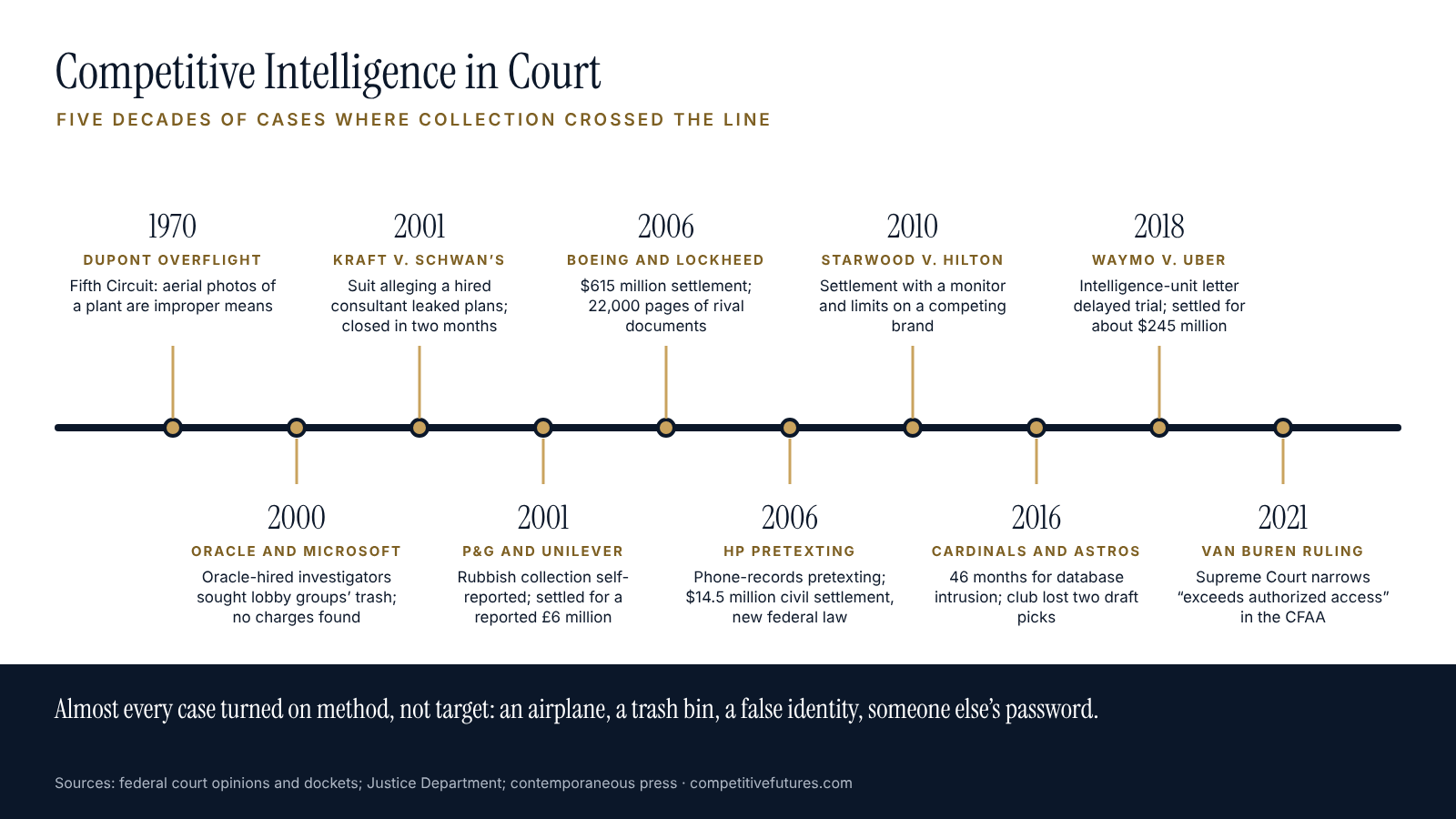
The episodes below, in date order, range from a federal appellate opinion that still anchors the law to private settlements that never produced a finding. Together they map the methods that get CI programs in trouble: aerial and physical surveillance, trash collection, hired insiders, pretexting, unauthorized computer access, and a rival’s documents walking in the door with a new hire.
This is short of prosecution under the Economic Espionage Act, but definitely not good.
DuPont v. Christopher: the airplane over the plant (1969–1970)
On March 19, 1969, two Beaumont, Texas, photographers hired by an undisclosed client took sixteen aerial photographs of a DuPont methanol plant under construction. DuPont said the exposed layout would let a skilled person deduce its secret, unpatented process. The photographers argued that they had flown in public airspace, broken no aviation rule, and breached no confidence. The Fifth Circuit disagreed, opening with the line “This is a case of industrial espionage in which an airplane is the cloak and a camera the dagger.” It held that “aerial photography of plant construction is an improper means of obtaining another’s trade secret,” and explained: “To require DuPont to put a roof over the unfinished plant to guard its secret would impose an enormous expense to prevent nothing more than a school boy’s trick” (E.I. duPont deNemours & Co. v. Christopher, 431 F.2d 1012 (5th Cir. 1970)).
The same opinion preserved room for legitimate CI: “for our industrial competition to remain healthy there must be breathing room for observing a competing industrialist. A competitor can and must shop his competition for pricing and examine his products for quality, components, and methods of manufacture.” The ruling was an interlocutory appeal; it allowed DuPont’s suit to proceed and affirmed an order compelling the photographers to name their client. The Supreme Court declined review, and the drafters of the Uniform Trade Secrets Act cited the case for the principle that “Improper means could include otherwise lawful conduct which is improper under the circumstances” (Uniform Trade Secrets Act comment).
Oracle, Microsoft, and the trash of Washington lobby groups (2000)
This case is fascinating because it’s a matter of dueling covert operations. In June 2000, while the government’s antitrust case against Microsoft was under way, Oracle chairman Larry Ellison confirmed that Oracle had hired a detective agency, Investigative Group International, to investigate groups that he said were Microsoft-funded fronts, naming the Independent Institute, the National Taxpayers Union, and the Association for Competitive Technology. “It is absolutely true that we set out to expose Microsoft’s covert activities,” he said, and he offered that Oracle would “send all of our garbage to Redmond and they can go through it” (CNNfn). The Wall Street Journal had reported an attempt to buy the trash of the Association for Competitive Technology’s Washington office. Computerworld reported the association’s allegation that IGI staff offered an office cleaning crew $1,200 for its trash, which the association called bribery; Ellison said, “I authorized them to investigate Microsoft’s covert activities,” but denied knowledge of the methods: “I didn’t go through Bill’s garbage” (Computerworld). Oracle’s position, through a spokeswoman, was that the groups “could have influenced the outcome of one of the most important antitrust cases in US history” (The Register).
We found no record of criminal charges or civil suits arising from the episode. The lesson for CI practitioners and clients: authorizing an investigation does not end responsibility for how a contractor carries it out.
Kraft and Schwan’s: the pizza consultant (2001)
In February 2001 Kraft, maker of DiGiorno and Tombstone frozen pizzas, sued Schwan’s, maker of Red Baron and Freschetta, accusing it of “stealing trade secrets by hiring a corporate spy.” According to FoodNavigator’s account of the suit, Kraft alleged that Schwan’s hired a Kraft consultant with intimate knowledge of Kraft’s marketing strategies; Schwan’s declined to comment (FoodNavigator). The case, Kraft Pizza Co. v. Schwan’s Sales Enterprises, No. 1:01-cv-00977, was filed in federal court in Chicago on February 12, 2001, and the docket shows it terminated on April 4, 2001, less than two months later (N.D. Ill. docket). We could not find a public report of the terms on which it ended, and no court made findings on Kraft’s allegations. A consultant who knows two competitors’ plans is a conflict of interest waiting to become a complaint.
In our experience, this is a major risk for competitive intelligence vendors who do not hold fast to the SCIP Code of Ethics when it comes to conflicts of interest. Choose your vendors wisely.
Procter & Gamble and Unilever (2001)
In 2001, Procter & Gamble disclosed to Unilever that investigators working for it had gathered information on Unilever’s hair-care business by methods that broke P&G’s own rules, including going through Unilever’s rubbish. P&G fired three employees, and its chairman, John Pepper, said “none of the information has been used or will be used in any P&G plans.” The companies settled privately in September 2001, for a sum reported at about £6 million (Irish Times). Trade press reported that people had posed as market analysts and that P&G commissioned a third-party audit (Just Food). No criminal charges were brought. Self-reporting was the right response, and it was still expensive.
Boeing and Lockheed Martin’s launch documents (2003–2006)
Before the Air Force awarded Evolved Expendable Launch Vehicle contracts in October 1998, “Boeing obtained more than 22,000 pages of documents from Lockheed Martin,” some of them confidential, competition-sensitive, or proprietary, according to the Justice Department. The government alleged that Boeing used some of that information to help its bid. When the Air Force learned of it, it rebalanced the launch contracts and imposed a record 20-month suspension of three Boeing business units from government contracting.
In June 2006 Boeing agreed to pay $615 million, a $565 million civil settlement and a $50 million penalty, resolving that matter and a separate procurement conflict-of-interest scandal; Boeing agreed “to accept responsibility for the conduct of its employees in these matters,” and the United States agreed “not to bring criminal charges related to the conduct that is the subject of the settlement” (Justice Department).
Defense contractor competitive intelligence should be approached with significant attention to ethics, as one or more nation-states may be interested in the information collected. Those states’ criminal and counterintelligence investigative institutions may as well. This area is not for amateurs.
Hewlett-Packard pretexting (2006–2007)
Hunting boardroom leakers, investigators working for HP obtained the phone records of directors, employees, and journalists by tricking telephone companies. California charged former chairman Patricia Dunn and others with felonies. In March 2007 a judge dismissed the charges against Dunn; three other defendants pleaded no contest to a misdemeanor, with dismissal promised after community service and restitution, and another man pleaded guilty to federal identity theft and conspiracy charges (NBC News). HP paid $14.5 million to settle a civil suit by California’s attorney general (JURIST). Congress then passed the Telephone Records and Privacy Protection Act of 2006, which punishes obtaining phone records through false statements with up to 10 years (18 U.S.C. § 1039). HP was a leak hunt, not competitor research, but pretexting is the method CI interviewers are most tempted to use.
In our experience, ethics do not simply help you sleep better at night—they are prophylaxis against legal repercussions.
Starwood and Hilton (2009–2010)
Starwood sued Hilton in 2009, alleging that two executives who moved to Hilton took hundreds of thousands of electronic documents and used them to build a competing lifestyle brand. In the December 2010 settlement, a monitor was appointed and Hilton accepted limits on launching a similar brand and hiring Starwood staff; its chief executive said Hilton “regrets the circumstances surrounding the dispute” (Hotel Executive). The settlement resolved the suit without a court finding on Starwood’s allegations.
The St. Louis Cardinals and the Houston Astros’ database (2015–2017)
Christopher Correa, a former St. Louis Cardinals scouting director, took advantage of a former Cardinals colleague who had moved to the Houston Astros: using a modified version of the password the colleague had used on his Cardinals laptop, Correa got into his accounts on the Astros’ private “Ground Control” database, which held scouting reports, statistics, and contract information, and his Astros email. He pleaded guilty in January 2016 to five counts of unauthorized access of a protected computer, the offense defined in the Computer Fraud and Abuse Act, and in July 2016 was sentenced to 46 months in prison and ordered to pay $279,038.65 in restitution to the Astros (Justice Department). In January 2017 Major League Baseball placed him on its permanently ineligible list and ordered the Cardinals to give the Astros their top two draft picks and pay $2 million; the league found “no evidence that anyone besides Correa was responsible,” but held the club responsible for putting him in a position to use the data for its benefit (MLB.com).
Waymo v. Uber and the “Jacobs letter” (2017–2018)
Waymo’s trade secret suit against Uber centered on self-driving car files a former Google engineer took when he left, a story told on our Economic Espionage Act page. Weeks before trial it took a turn that matters to CI practitioners. A 37-page letter from the lawyer for Richard Jacobs, Uber’s former manager of global intelligence, alleged that a Marketplace Analytics group “exists expressly for the purpose of acquiring trade secrets, codebase, and competitive intelligence,” and described the use of ephemeral messaging and “non-attributable” devices. Judge William Alsup postponed the trial after learning that the letter had not been disclosed. Uber’s lawyers called the letter “extortionist”; a company spokesperson said “we haven’t substantiated all the claims in this letter” and that the company’s new leadership would compete honestly. Uber had paid Jacobs a $4.5 million settlement (TechCrunch). The letter’s claims were never adjudicated. In February 2018 the companies settled the underlying suit, with Waymo receiving an Uber equity stake reported at about $245 million; Uber’s chief executive said, “While I cannot erase the past, I can commit, on behalf of every Uber employee, that we will learn from it” (NPR). The lesson: a CI unit’s practices, including how it keeps records, can become evidence in litigation it never expected to touch.
What the cases have in common
Four patterns repeat across five decades.
- Method, not information, decides liability. DuPont’s process could have hypothetically been learned lawfully by independent research; the airplane made it improper.
- Third parties insulate clients from risk so long as they keep to legal and ethical practices. Oracle, P&G, and HP acted through outside investigators, and the clients carried the consequences.
- Employees can be a risk after their employment. Boeing, Starwood, and Waymo turned on documents that, it was alleged, arrived with individuals. The risks aren’t done once the employee has given up their badge and their parking spot.
- Organizations pay for individuals. MLB found no one but Correa responsible, and the Cardinals still paid. Firing bad actors does not cauterize the risk.
The SCIP Code of Ethics, read against the law
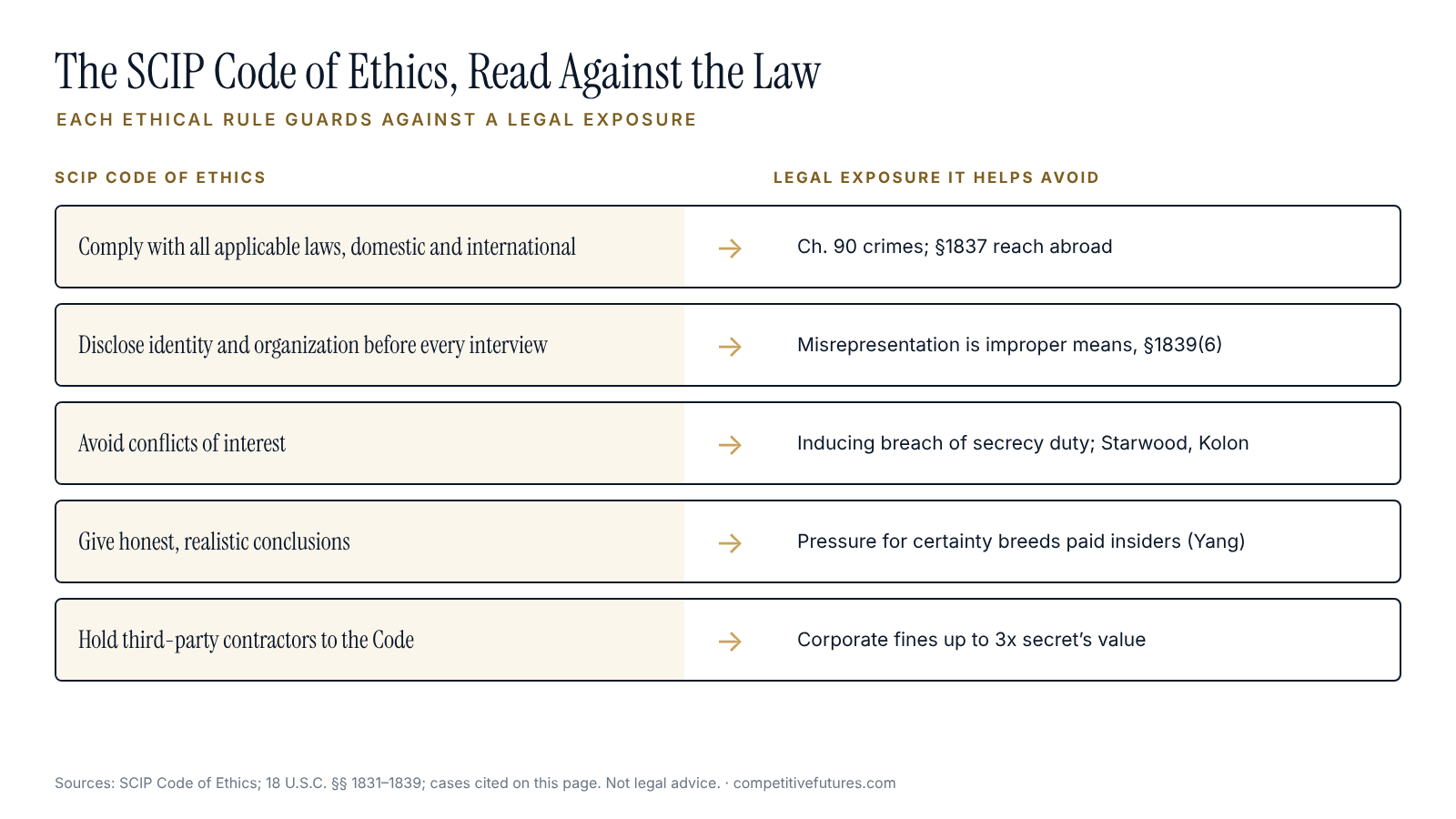
SCIP’s seven-point Code of Ethics (SCIP) maps directly onto the conduct these cases punished.
- “To comply with all applicable laws, domestic and international.” That means state trade secret law, the Defend Trade Secrets Act and the Economic Espionage Act, the phone-records statute, computer intrusion laws, and foreign law where the work is done. Follow the law, and you’ll have far fewer problems.
- “To accurately disclose all relevant information, including one’s identity and organization, prior to all interviews.” Trade secret statutes name “misrepresentation” as improper means, and the phone-records law makes false statements to a carrier a felony. Pretexting is the fastest way a CI interview becomes evidence, as the reported posing as market analysts in the P&G matter and the HP prosecutions show. In other words, lying isn’t just lazy intelligence work, it’s a one-way ticket to a courtroom.
- “To avoid conflicts of interest in fulfilling one’s duties.” A consultant who has worked for a rival, as alleged in Kraft, or a new hire carrying a former employer’s files, as alleged in Starwood, puts the client on the wrong side of “inducement of a breach of a duty to maintain secrecy.” Play fair, avoid court.
- “To provide honest and realistic recommendations and conclusions.” Honest analysis is the lawful alternative to stolen certainty. The pressure to deliver a rival’s exact plan is what leads to trash runs, paid insiders, and borrowed passwords. It also may show that your intelligence program is heavy on collection and weak on analyzing what information means to your strategy. Take the energy that might go into stealing secrets and think harder about the problem.
- “To promote this Code of Ethics within one’s company, with third-party contractors and within the entire profession.” Oracle, P&G, and HP all involved outside investigators. You are only as immune to risk as your contractors are skilled and ethical. Work with the best, and avoid court.
- “To faithfully adhere to and abide by one’s company policies, objectives and guidelines.” A written collection policy is evidence of good faith, and of the line a rogue contractor crossed. P&G’s own rules are what allowed it to identify and disclose the breach. Mistakes happen. Be honest and honorable, and avoid court.
Why ethics keeps you out of prison
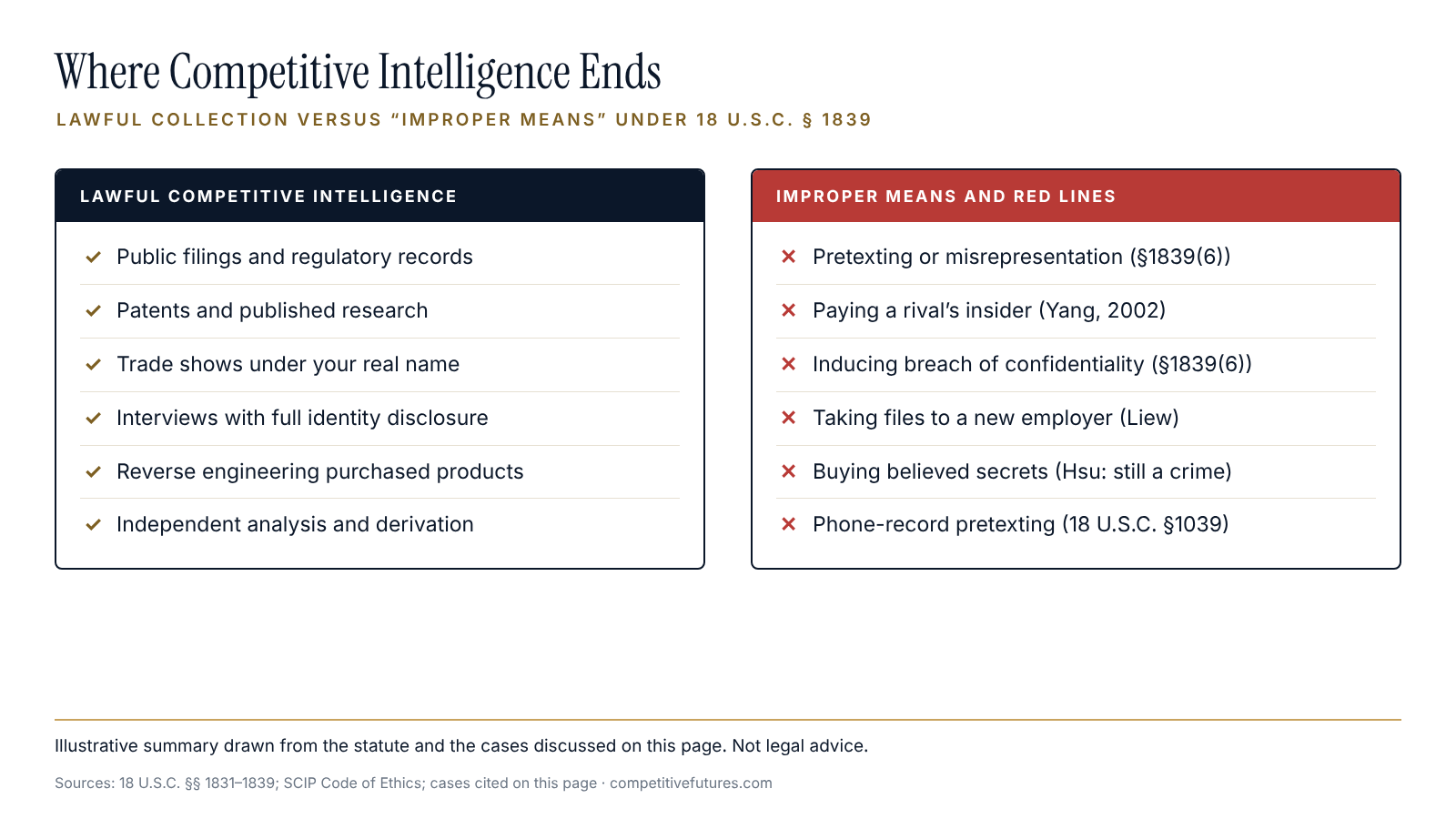
Ethics in CI is usually sold as reputation management. That undersells the stakes. A single collection decision can create four kinds of exposure at once.
The first is personal: the collector who breaks into a rival’s system or lies to a phone company is the one charged, as Correa’s 46-month sentence and the HP prosecutions show, and under the federal trade secret cases it is no defense that the material proved worthless.
The second is corporate: organizations answer for employees and agents acting within the scope of their work, as Boeing’s $615 million resolution shows.
The third is civil: injunctions, double damages, attorney fees, and in extraordinary cases seizure of computers without notice.
The fourth is commercial, which in Starwood meant a monitor and limits on launching a brand, and for the Cardinals meant surrendering draft picks to a rival.
Compliance costs far less. A defensible program includes:
- a written collection policy, approved by counsel, binding employees and contractors alike;
- legal review of collection plans that involve human sources;
- a rule that collectors identify themselves and their organization before every interview;
- no payments to, or solicitation of confidential information from, a competitor’s current or former employees;
- no physical surveillance of non-public sites, no trash collection, and no use of credentials that are not one’s own;
- a clean-room procedure that quarantines unsolicited competitor material and routes it to counsel unread;
- onboarding rules that keep new hires’ former-employer documents out of the building;
- conflict checks on consultants who have worked for competitors;
- training, and source documentation that shows where every finding came from.
None of this weakens intelligence. Most of what a competitor will do shows up in its hiring, filings, patents, and public statements. Discreet collection is still essential, but ethical collection is just as potent as dumpster diving when done by experts.
Time spent meeting with your general counsel (or, worse, defense attorneys) is time spent away from inventing new things and delighting customers. Stay out of court, stay out of jail, and prosper!
Frequently asked questions
Is competitive intelligence legal?
Yes. Gathering and analyzing public filings, patents, published research, trade show information, purchased products, and interviews conducted with honest identification is lawful. The Uniform Trade Secrets Act comment lists reverse engineering, independent invention, observation of items on public display, and published literature as proper means. It becomes unlawful when information is obtained through theft, bribery, misrepresentation, inducing a breach of confidentiality, unauthorized computer access, or espionage.
Can a legal act still be “improper means”?
Yes. In DuPont v. Christopher the photographers broke no aviation rule, yet the Fifth Circuit held their overflight an improper means of discovering a trade secret, a principle the Uniform Trade Secrets Act comment adopts.
Is it legal to go through a competitor’s trash?
It is a well-documented way to end up in a dispute. P&G’s rubbish collection at Unilever led to a reported £6 million settlement, and the reported attempt to buy a lobby group’s trash in the Oracle episode produced a bribery allegation and lasting embarrassment. Whether it is unlawful depends on the jurisdiction and the circumstances, so the practical answer for a CI program is to prohibit it.
Is pretexting illegal?
Obtaining telephone records by false statements is a federal crime under 18 U.S.C. § 1039, enacted after the HP affair. More broadly, trade secret statutes list misrepresentation as improper means, and false-identity schemes can support fraud charges. The SCIP Code of Ethics requires collectors to disclose their identity and organization before every interview.
Does the Computer Fraud and Abuse Act still matter after Van Buren?
Yes. Van Buren held that the “exceeds authorized access” clause does not reach people who misuse information they are entitled to access, but it still covers anyone who enters systems, files, or databases beyond their access. Using another person’s password to enter a rival’s database, as in the Correa case, is the kind of conduct the statute plainly reaches.
What should a CI team do if it receives a competitor’s confidential material?
Stop, do not read further or circulate it, quarantine it, and route it to counsel. P&G’s decision to disclose its investigators’ conduct to Unilever, and the trade press account of its third-party audit, show the response that limits damage.
Related reading
- The Economic Espionage Act: History, Case Law, and Controlling Precedent
- Intelligence Services Around the World: Structure, History, and the Headlines
- Cognitive Bias: A Field Guide for Leaders
- Strategic Foresight
Competitive Futures builds competitive intelligence programs that are effective and lawful; details are on the services page.