Intelligence Is Always Wrong. Decide Anyway.

In my 2011 satire How to Predict the Future…and WIN!, the fictional consultants of Hornsdog Partners offered Tip 10: wait for complete information before concluding, deciding and acting. Before you take any future force seriously, they advised, make sure the data has been “collected, alphabetized, converted to PowerPoint slides, exported to PDF files, arranged by color code” and inspected by error-sniffing dogs.
Underneath the joke, I made an admission that surprised some readers, coming from someone who sells intelligence for a living:
“Intelligence is always wrong, it’s just a question of by how much.”
Fifteen years on, I believe that more than ever. The world of 2026, with a war in the Gulf, supply chains used as weapons and artificial intelligence rewriting whole industries, has not become easier to read. Waiting for certainty is still the most popular way for organizations to make a decision without admitting they made one. This post is about the alternative.
Why intelligence is always wrong
In the book I described what any intelligence study really is. A finite group of researchers, usually fewer than ten, reads what it can find and calls the people it can reach. Good analysts may end up knowing more about a subject than anyone else alive, and they still cannot capture the whole of a world that keeps moving while they write. The result, I wrote, is “a ray of light on the darkness, a ray full to the brim with observational bias, ignorance, and limited wisdom.”
That is not an argument against intelligence. It is an argument for being honest about it. As I put it then: “this is vastly preferable to not doing it at all.” The goal is not to be right. The goal is to be less wrong than the alternative, which is deciding on instinct, habit or whatever the boss already believed.
Even the professionals disagree about what “likely” means
The U.S. intelligence community learned this the hard way. In March 1951, National Intelligence Estimate 29-51 judged that a Soviet bloc attack on Yugoslavia “should be considered a serious possibility.” Sherman Kent, the father of American estimative analysis, later asked the board members who had agreed on that phrase what odds they had in mind. The answers ranged from a 20 percent chance of attack to an 80 percent chance. The same words, read by the people who wrote them, meant opposite things (Sherman Kent, “Words of Estimative Probability,” CIA Center for the Study of Intelligence).
Kent’s fix was to attach numbers to words. Today, Intelligence Community Directive 203 requires analysts to express and explain the uncertainty behind every major judgment, using a fixed scale: “unlikely” means 20 to 45 percent, “likely” means 55 to 80 percent, “almost certain” means 95 to 99 percent. Nothing on the scale reaches 100. The standard admits, in writing, that intelligence is always wrong by some amount, and then asks analysts to say roughly how much.
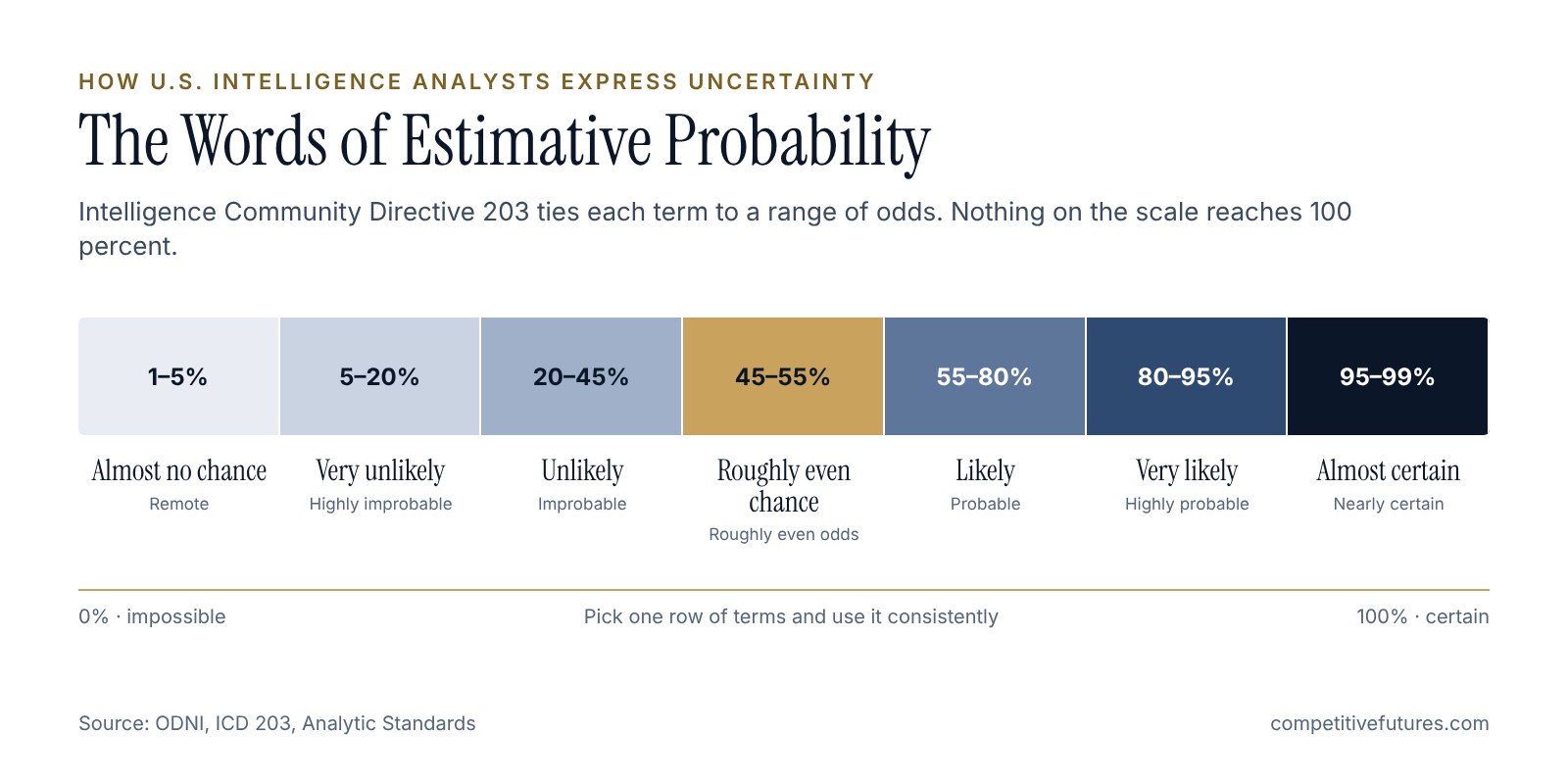
Most companies have no such discipline. A strategy deck says a risk is “possible” or a market “should” grow, and every executive in the room silently assigns a different number. That is NIE 29-51 all over again, without the excuse of 1951.
You can get less wrong
The good news is that being wrong by less is a skill. Starting in 2011, the year my book came out, the Intelligence Advanced Research Projects Activity ran a multi-year forecasting tournament on real geopolitical questions. The winning team, the Good Judgment Project led by Philip Tetlock, Barbara Mellers and Don Moore, found that accuracy improved with training in probability and cognitive bias, with working in teams that had to explain their reasoning, and with putting the best forecasters together. The best performers shared one trait above all: a willingness to change their minds when the evidence changed (Association for Psychological Science).
None of them waited for complete information. They made a call, put a number on it, and updated. That is the whole job. Studying the cognitive biases that bend our judgment is part of how you get better at it.
Decide before you are comfortable
In 2011 I wrote that with future megatrends, “you will never have enough data to make you feel nice and comfortable until it is too late.” Five years later, Jeff Bezos put a number on the same idea in his 2016 letter to Amazon shareholders: “most decisions should probably be made with somewhere around 70% of the information you wish you had” (Amazon).
The exact figure matters less than the principle. The waiting is itself a decision, and usually a bad one. While the organization gathers one more report, the competitor launches, the regulation passes, the strait closes. In the book I listed what leaders were waiting on in 2011: more data on oil prices, on climate, on aging populations. Every one of those questions is still open, and the organizations that waited for them to close have already paid.
How to decide anyway
- State the judgment and the odds. Replace “possible” with a number or a defined term from a scale like ICD 203’s. Make everyone in the room say what they think the odds are before you discuss them.
- Say what would change your mind. For each major judgment, name the evidence that would move it up or down. Those become your signposts.
- Match the decision to the stakes, not to the comfort level. A reversible decision can be made fast on thin information. An irreversible one, such as a plant, a fleet or an acquisition, deserves more evidence, but never complete evidence, because that does not exist.
- Buy options. When you cannot know which future is coming, spend a little to stay ready for several. A tool like the Impact/Probability Matrix shows where a hedge is worth paying for.
- Protect the messenger. In 2011 I warned that analysts who bring bad news are often treated as if they were calling the boss an idiot. They are not; they are reading the situation. As I wrote then, “The more we punish people, the worse our organizational intelligence will become.” If your analysts are afraid to put a number on a threat, you will learn about it from the news.
- Keep score. Write the forecast down with its date and its odds, and grade it later. I did that with my own book in my fifteen-year scorecard. It was humbling. It was also the only way to learn which of my instincts deserve trust.
Courage, with a footnote
I closed that chapter with a value I called courage. Leading an organization into an uncertain future, I wrote, “is a gamblers game.” My example was Nokia: when its biggest customer, the Soviet Union, was collapsing, Nokia’s leadership under Jorma Ollila bet the company on mobile phones, and the world called him a visionary.
The footnote, written by history since then, is that Nokia sold its phone business to Microsoft in 2013 (Microsoft). One brave decision under uncertainty does not buy you a permanent pass. The smartphone changed the game, and the next decision had to be made with the same incomplete information as the first one.
That is the real lesson. Intelligence will always be wrong by some amount. Decisions will always be made before the picture is clear. The organizations that do well are not the ones that wait to be sure. They are the ones that decide, measure how wrong they were, and decide again.
Frequently asked questions
What does “intelligence is always wrong” mean?
No intelligence assessment can capture the full picture of a changing world. Analysts work with limited time, sources and people, so every judgment carries some error. The goal is to be less wrong than deciding without analysis, and to say how uncertain the judgment is.
What are words of estimative probability?
Standard terms that tie verbal judgments to ranges of odds. Under Intelligence Community Directive 203, for example, “likely” means 55 to 80 percent and “almost certain” means 95 to 99 percent. The idea traces back to Sherman Kent at the CIA.
How much information do you need to make a decision?
Never complete information. Jeff Bezos has suggested most decisions can be made with about 70 percent of the information you wish you had. Reversible decisions can be made faster; irreversible ones deserve more evidence.
How can organizations make better decisions under uncertainty?
State judgments with explicit odds, name the evidence that would change them, buy options against several scenarios, protect analysts who bring bad news, and keep score of forecasts so you learn which judgments to trust.
How to Predict the Future…and WIN! is still available in paperback and on Kindle.
Related analysis from Competitive Futures
- I Wrote a Book About Predicting the Future in 2011. Here’s My Scorecard.
- The Future Is More Down-and-Dirty Than Sexy
- Cognitive Bias: A Field Guide for Leaders Who Must Decide Under Uncertainty
- The Impact/Probability Matrix: A Scenario Planning Tool
Want this kind of analysis for your organization? Contact Competitive Futures or learn more about Eric Garland.
About Competitive Futures
Competitive Futures has provided strategic intelligence and foresight to corporate and government clients since 2002. Its principal, Eric Garland, publishes analysis here, on Game Theory Today, and in the Systemics Quarterly Brief.
Read next
- Seventy Countries, Six Cities: The Global Network Behind Iran
- The Systemics Quarterly Brief: 2026 Prospectus
- Strategic intelligence services for executives and governments
- All analysis from Competitive Futures
Stay in touch
Leave your email and a note about the Brief, a briefing for your team, or this piece, and we will be in touch.