The SPLC Informant Case Is a Warning for Every Private Intelligence Program

The Southern Poverty Law Center is under federal indictment in Montgomery, Alabama, for the way it paid its informants. The second superseding indictment, returned August 11, 2026, charges SPLC with 14 counts: wire fraud conspiracy and six counts of wire fraud against donors, conspiracy and four counts of false statements to federally insured banks, and conspiracy and one count of concealment money laundering. Heidi Beirich, a former SPLC official the indictment says oversaw the informant payments, is charged in the three conspiracy counts. The government alleges that from at least 2007 to 2023, SPLC moved more than $4.1 million in donor money through nine fictitious businesses to pay sources inside the Klan, the Aryan Nations, the National Alliance, and other groups. Trial is set for February 1, 2027.
Most coverage has treated this as a story about the prosecution of an anti-Trump civil rights non-profit. It is more useful as a story about private intelligence. SPLC ran a human-source collection program on American soil, which is not something that was disclosed to the public or its donors. The case is revealing the potential risk when a program has neither the legal protections of a federal agency nor the ethical discipline the private intelligence profession has spent forty years writing down.
Every corporation, law firm, investigator, or advocacy group that collects from human sources should read it as a case study. The story is still unfolding.
SPLC’s program broke nearly every rule in the SCIP Code of Ethics
The standard for private-sector intelligence in the United States is the Code of Ethics of SCIP, the Strategic and Competitive Intelligence Professionals. It has seven rules.
Now, SPLC was never a SCIP member and never claimed to follow the code, which is rather the point. The SCIP Code is the closest thing private intelligence has to a professional rulebook, and based on the government’s allegations, SPLC’s program ran afoul of all seven.
| SCIP rule | What the record shows |
|---|---|
| Always in compliance: comply with all applicable laws | Fourteen federal counts. The indictment also alleges that F-9 (Field Source #9) broke into an extremist group’s headquarters in 2014 and took about 25 boxes of documents across state lines, and that donor money paid F-39 about $6,000 to falsely claim the burglary. |
| Transparent: disclose one’s identity and organization before any interview | The program was designed to do the opposite. For only one example, two sources were told to say they worked for a rare-books company helping college students write essays when they were, in reality, allegedly funding extremist groups. |
| Conflict-free: avoid conflicts of interest | The director of SPLC’s Intelligence Project, the department that ran the informant program, allegedly shared a house and two bank accounts with F-9, her source and her lover. About 66 percent of everything deposited in those accounts came from SPLC through a cover company. |
| Honest: provide honest and realistic conclusions | SPLC published “Extremist File” pages on men it was paying, used them to raise money from the public, and softened F-30’s page at his request so it would not scare off his recruits. |
| Strategically aligned: abide by one’s organization’s policies and objectives | SPLC’s stated mission was to dismantle these groups, but they were allegedly keeping them going, paying for their operations. Per the indictment, it paid F-30 to keep leading a group he wanted to leave, and urged F-31 and F-32 to stay in the Klan when they asked for help getting out. |
| Ambassador: promote the code with third-party contractors | The paid neo-Nazis did not promote the SCIP Code of Ethics. |
| Elevate the profession: increase the recognition and respect of the profession | They allegedly burned crosses, committed burglary, discussed destroying evidence, and supported hate groups while lying to banks. That’s not the competitive intelligence profession. |
Now, on the other hand, covert infiltration of violent groups is not competitive intelligence, and no private-sector code permits it. That is exactly why the comparison matters. SPLC took a method that belongs only to governments, with their statutes, guidelines, and oversight, and ran it under none of the rules that bind either governments or the private profession.
This week’s motion attacks the witness, not the bank forms
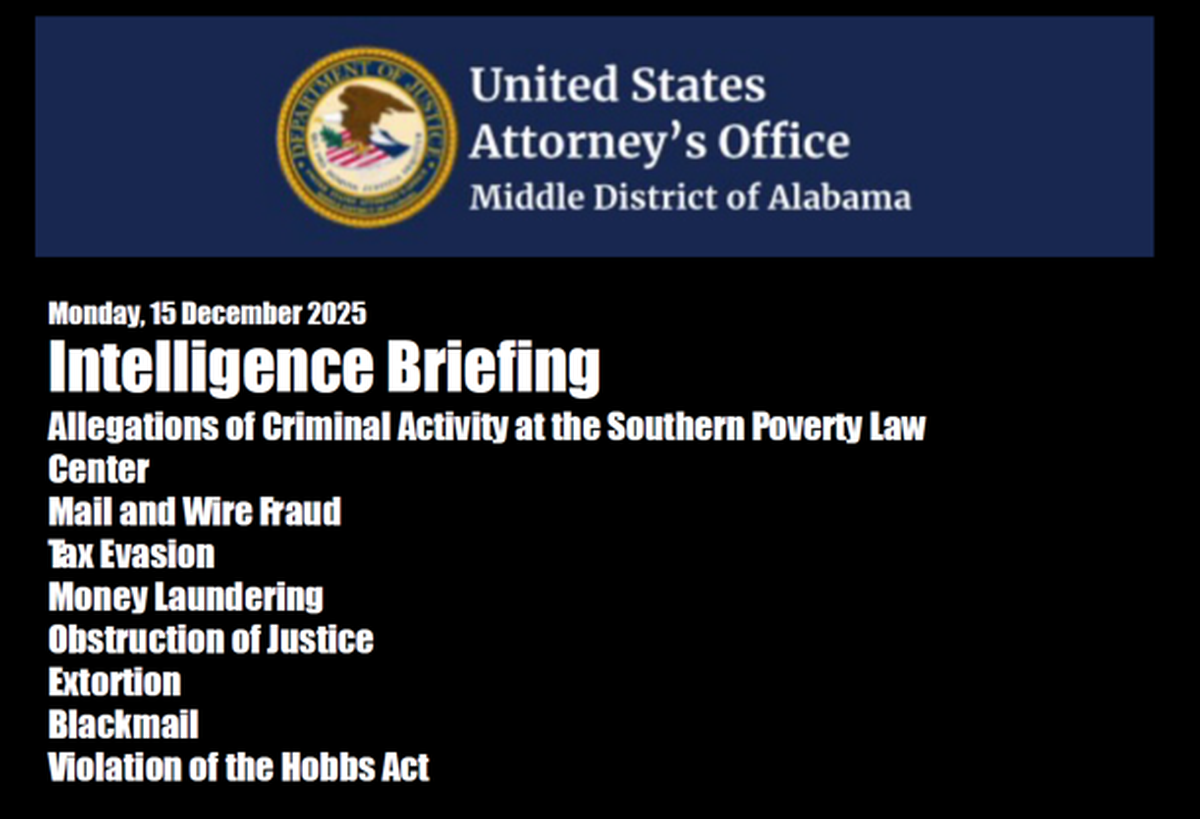
On October 28, the Southern Poverty Law Center filed a 29-page motion in its federal criminal case in Montgomery. It asks the court to order the government’s star informant, a man the filings call F-9, to preserve everything in his house and storage unit, and to let SPLC subpoena it. The motion is a long, detailed, and frankly entertaining account of a paid source gone sideways: payment demands, immunity requests, PowerPoint “Intelligence Briefings” stamped with the FBI seal, and a shredder under the desk.
It appears that their strategy is to claim that an individual they paid to be part of racial hate groups for more than 20 years lacks integrity. What the motion does not do is say the bank paperwork was true. Not once in 29 pages.
That gap is the story. SPLC ran something that looks, in every operational particular, like an FBI confidential human source program: numbered sources, cover payments, infiltration of target organizations, and a department called the Intelligence Project to run it. What it did not have is the legal architecture that makes that work lawful when the FBI does it. The indictment is, in effect, an itemized bill for every piece of that architecture SPLC skipped.
A note on posture before we go further. Everything in the indictment is an allegation. SPLC and Heidi Beirich are presumed innocent, and a jury in the Middle District of Alabama will decide whether the government can prove it. What follows is an analysis of legal exposure, built from the second superseding indictment (ECF 115) and SPLC’s own motion (ECF 184).
The FBI can pay a Klansman because Congress and the Attorney General wrote the rules first
When the FBI recruits a source inside a violent extremist group, it does not improvise. It operates inside a stack of law that took decades and several scandals to build. Five layers matter here.
Authority for cover. Congress has written into appropriations law, reproduced as a statutory note to 28 U.S.C. § 533, specific permission for FBI undercover operations to set up “proprietary corporations or business entities” and to deposit funds in banks, notwithstanding the statutes that would otherwise forbid it. Each use requires written certification by the FBI Director and the Attorney General, or their designees, that it is necessary. The Bureau also reports to Congress annually on those operations. A fake company opened by the FBI is a lawful instrument because a statute says so, in advance, in writing.
Authority to break the law. The Attorney General’s Guidelines Regarding the Use of FBI Confidential Human Sources, signed by Alberto Gonzales in December 2006, define “otherwise illegal activity.” A source who must commit a crime to keep his cover needs authorization in advance and in writing, from a Special Agent in Charge and, for the serious tier, from a federal prosecutor. Authorizations expire after 90 days unless renewed.
Rules for the handler. The same Guidelines bar agents from business or financial transactions with their sources, from exchanging anything of more than nominal value, and from socializing with them beyond what operations require. They also require telling the source, at the time of payment, that the money “may be taxable income that must be reported to appropriate tax authorities.”
Privilege. Since Roviaro v. United States in 1957, the government has held a qualified privilege to withhold an informer’s identity. It is not absolute, but it exists, and courts know how to apply it.
Oversight. The FBI’s source program answers to the Justice Department’s Inspector General, to the Judiciary Committees, and to defense lawyers armed with Brady and Giglio. Oversight is a burden. It is also a shield: a handler following written rules has a defense when the operation gets ugly.
A private organization gets none of this. No statute authorizes its cover companies. No guideline authorizes its sources’ crimes. No privilege protects its sources’ names by default. No inspector general writes the report that says the program was run by the book. Whatever it builds, it builds under the ordinary criminal law that applies to everyone else.
SPLC built the operation but skipped the legal and ethical architecture
The indictment describes a source network that would be recognizable to any case officer. Starting in the 1980s, SPLC recruited people inside, or placed people inside, violent extremist organizations. Senior staff called them “field sources,” or “the Fs.” Each received a number, assigned in chronological order. F-9, the source at the center of this week’s motion, was paid for more than 20 years.
The payments also ran through cover. Between at least 2007 and 2023, the government alleges, SPLC moved at least $4.1 million in donor funds through bank accounts in the names of nine businesses that “were never incorporated, had no bona fide employees, and conducted no legitimate business”: Center Investigative Agency, Fox Photography, North West Technologies, Tech Writers Group, Rare Books Warehouse, Imagery Ink, J&J Electronics, Kelly’s Marine, and Turner Personnel.
Yes, the paymaster account was called CIA. Somebody in Montgomery had a sense of humor.
Sources on “Rare Books” pay cards were documented to the bank as “Rare Books” employees. Two of them were allegedly told that if anyone asked, they helped college students research and write essays.
After Bank-1 opened an internal investigation in 2020, an SPLC employee asked the bank to close the main cover accounts and sweep the balances into SPLC’s operating account. The payments then moved to ACH transfers labeled “RAREBOOKS050” and “IPRESEARCHCON050,” which continued through August 2023.
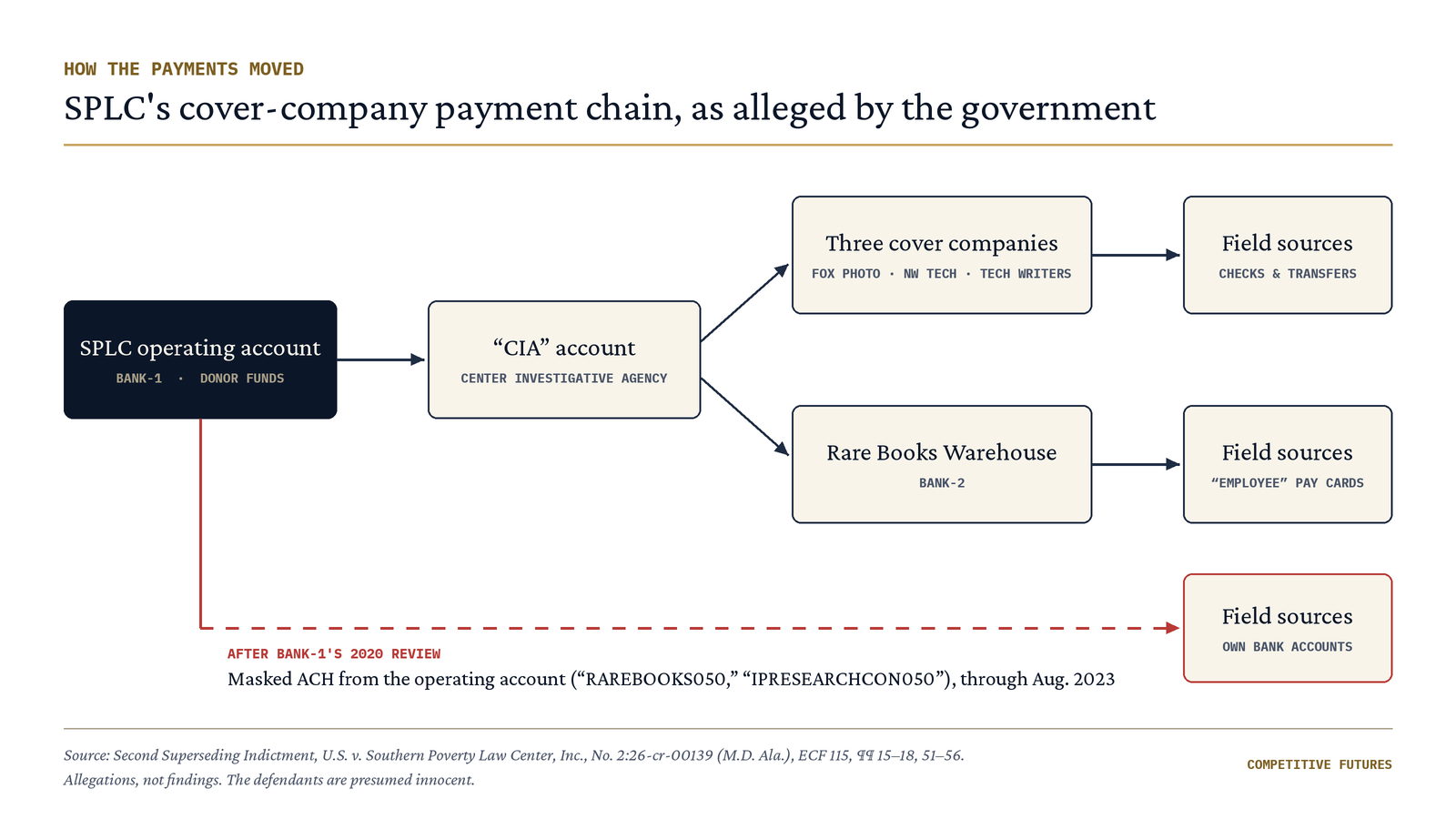
SPLC’s own motion confirms the skeleton. It calls F-9 SPLC’s “longest-contracted informant,” refers to the “F program” and to sources by F-number, and identifies the Intelligence Project as “the department that oversaw the informant program.” Recruitment, numbering, cover payments, a collection department, and finished products in Hatewatch and the Intelligence Report. That is the full cycle of human-source collection, run by a 501(c)(3) with no statutory protection behind any of it.
Also, as a quick aside, there is no evidence that any of these people were trained by a professional. Which might be obvious by the fact that all this information comes from a Federal charging document. Training is the kind of thing that lowers the risk of employees or contractors systematically committing crimes with potential prison sentences of up to 20 and 30 years.
Without a statute, a cover company is a false statement to a bank
This is where the absence of architecture becomes a felony. The FBI may open an account for a proprietary company because Congress certified, in advance, that it may. SPLC had no such certificate, so every bank form that described a cover entity as something it was not is analyzed as what it literally was.
Counts Nine through Twelve are four documents. On December 20, 2016, according to the indictment, the employee who would become SPLC’s Chief Financial Officer signed Sole Proprietorship Resolution of Authority forms at Bank-1 certifying that she was “the sole owner” of Center Investigative Agency, Fox Photography, North West Technologies, and Tech Writers Group. Four forms, four counts under 18 U.S.C. § 1014, false statements to a federally insured bank.
Section 1014 is an unforgiving statute. In United States v. Wells (1997), the Supreme Court held that materiality is not an element: the government need not prove the lie mattered to the bank, only that it was knowingly false and made for the purpose of influencing the bank. The purpose is built into this particular lie. Nobody tells a bank he owns Fox Photography except to get the bank to open and maintain Fox Photography’s account.
Source protection is a motive, and motive is not a defense. SPLC can explain why it wanted the money hidden. Every word of that explanation confirms it meant to hide the truth from the bank.
Nor does the later confession help. On September 9, 2021, SPLC’s President and CEO and its Board Chair wrote to Bank-1 that the accounts “were opened for the benefit of Southern Poverty Law Center operations and operated under the Center’s authority.” That letter is honest, and it is also the government’s best exhibit: SPLC’s leadership confirming in writing that the “sole owner” certifications were false. Congress knows how to write a recantation safe harbor; the perjury statute has one in 18 U.S.C. § 1623(d). Section 1014 has none. The offense was complete when the form went in.
The timing does not help either. The letter came about a year after the bank started asking. By the indictment’s account, the payments then continued for nearly two more years under masked ACH labels, and one of those transfers is a money-laundering count of its own. Prosecutors will call that a change of method, not a change of heart.
Without guidelines, directing a source looks a lot like funding the target
The FBI’s otherwise-illegal-activity rules exist because every source program hits the same problem. To stay credible inside a violent group, a source has to act like a member. He goes to the rallies, pays the dues, and recruits. A government program answers that problem with written, time-limited, supervisor-approved authorizations. The record shows where the line was drawn, who drew it, and why.
SPLC had no such paperwork, and the indictment fills the gap with the government’s version of what the money bought:
- F-31 and F-32 were reimbursed with donor money for cross-burning expenses, “to include the wood and fuel used.”
- F-37, paid more than $300,000, was in the online leadership chat that planned the 2017 Unite the Right rally, attended “at the direction” of SPLC, and helped arrange transportation for others.
- F-30, paid to keep leading an Aryan Nations faction he had told SPLC he wanted to leave, asked SPLC to soften his “Extremist File” page so it would not scare off recruits. SPLC agreed.
- F-9, while paid through the Tech Writers account, was also fundraising for the National Alliance.
The government charges this as wire fraud on donors. The theory is that SPLC solicited money to “dismantle” these groups and did not tell donors that some of it was paying their leaders. SPLC will argue that this is what dismantling looks like from the inside. Its motion previews that defense: it credits F-9’s work with uncovering a bomb lab on National Alliance property that was passed to law enforcement.
That argument would land better with an authorization file behind it. Without one, the jury hears about cross-burning fuel receipts and a 501(c)(3) editing a neo-Nazi’s web profile at his request, with no contemporaneous record of anyone weighing the intelligence value against the harm. And the legal ground has moved against SPLC. In Kousisis v. United States (2025), the Supreme Court upheld the fraudulent-inducement theory: inducing someone to part with money through a material deception can be wire fraud even if the victim suffered no net economic loss. “Donors got the anti-hate work they paid for” is now a harder answer than it was two years ago.
The principle here cuts in every direction. A union infiltrating an employer, a corporation planting a source inside an activist group, or an activist group planting one inside a corporation faces the same question SPLC now faces. When your source does something terrible to keep his cover, what document proves you were collecting intelligence and not underwriting the activity?
Without handling rules, the source becomes the witness
Handling discipline exists to protect the operation, but it also protects the organization from its own sources. F-9 is a case study in what happens without it. Every failure below is described by SPLC itself, in a filing meant to make him look bad.
The handler and the source shared a household. The indictment alleges that Heidi Beirich, who oversaw payments to the Fs, was in a romantic relationship with F-9, and that they shared a house and two bank accounts. It alleges that about $140,000 in donor money flowed through the Tech Writers account into those joint accounts between 2015 and 2021, about 66 percent of everything ever deposited there. SPLC’s motion does not name her, but it confirms the relationship: while under contract, F-9 had a “long-term relationship with an SPLC employee” that later ended. Recall the FBI rule: no financial transactions with your source, and no socializing beyond operational need. A shared checking account is a long way past that line.
Nobody handled the taxes. SPLC’s motion says F-9 “chose not to pay taxes on his income for 30 years,” and quotes him conceding he was “on the hook for 30 years’ worth of payments that are indeed taxable.” The FBI’s guidelines require telling a source, at the time of payment, that the money may be taxable. Whether SPLC ever said anything comparable, or reported the payments, is a question neither filing answers. What the motion does establish is that by the early 2020s there was a federal inquiry into “SPLC informants not paying taxes”—plural—and that this inquiry is where F-9’s cooperation began.
Nobody compartmented anything. A field source should know about his target and little else. By SPLC’s own description, F-9 ended up holding SPLC board minutes, Intelligence Project files, “stuff that was used for lawsuits by the Center,” and a recording of a March 2019 senior leadership meeting in which SPLC’s Legal Director participated. He also told agents about six steel file cabinets, roughly 37,000 photographs, and 1,800 pages of notes he says he will not turn over.
Nobody planned the exit. Between December 2021 and July 2023, the motion says, F-9’s SPLC income was cut, his relationship ended, the program was shut down, and federal agents called about a meeting with IRS Criminal Investigation, all while he knew about his tax exposure. In counterintelligence terms, this is the textbook profile of a walk-in: money trouble, wounded ego, a grievance, and a house full of documents. Any service that terminates a long-term source plans that transition with great care. SPLC appears not to have planned it at all.
This is why the motion argues the margins. Its case is that F-9 is biased, paid, immunized, and selective, and much of that is persuasive. None of it touches the four bank forms. Those come from Bank-1’s files and SPLC’s own 2021 letter, and F-9 does not need to testify for any of them. The organization that skipped the handling rules is now asking a federal court to supply them retroactively, by order, to the one source it lost control of.
The government is now running the same man the same messy way
Fairness requires the other half of the ledger, and SPLC’s motion supplies it. If the defense’s account is accurate, the government’s handling of F-9 has its own problems.
- F-9 asked for immunity on at least 11 occasions between February 2023 and February 2026, and for money repeatedly: “I need payment in cash,” “Can you people lend me $15,000,” a monthly stipend, $10,000 “at least.”
- In August 2026 he received immunity covering “actions you took regarding U.S. v. The Southern Poverty Law Center or for statements you have made to government personnel and government officials, up to this date.”
- He delivered four “Intelligence Briefings,” 162 slides in all, to audiences that included the U.S. Attorney. The decks carried FBI, IRS, and U.S. Attorney’s Office seals and laid out which charges he thought should be brought.
- When the lead agent offered to serve a grand jury subpoena on his storage unit, F-9 said nothing in it was pertinent. The agent replied, “If there’s not, that’s okay. We don’t have to.”
- In July 2026, on the phone with a witness the FBI was trying to locate, F-9 texted the agent: “Telling him nothing. Denying any contact with feds.”
- He told an IRS agent he had intended to shred boxes of material that included National Alliance records, which feature in the indictment, and the defense says no agent told him to preserve anything.
These are the problems the Attorney General’s Guidelines were written to prevent, and they will come up at trial through Giglio. The irony is complete: a prosecution about a private organization that ran sources without rules depends heavily on a source the government has handled loosely. Neither side kept its F-9 on a short leash. The difference is that the government has a statute and a privilege to fall back on, and SPLC never did.
Any private organization running sources needs a lawyer before it needs a handler
SPLC is not the only private entity in America running human sources. Corporate security departments do it. Private investigators do it on behalf of law firms. Activist groups across the spectrum do it to each other. Opposition researchers do it in every election cycle. Most of them have never asked what this indictment asks: which of our tradecraft is legal only for the government?
For any board or general counsel, the SPLC case turns that into five questions:
- How do we pay sources? Any payment routed through an entity that misdescribes its ownership to a bank is a potential § 1014 count, and a potential money-laundering count if the underlying funds are tainted. The FBI’s cover companies are legal because a statute makes them legal. Yours are not.
- What do we tell our funders? If donors, shareholders, or clients are told the money does one thing while some of it does another, Kousisis makes the gap a fraud exposure even when the work itself is valuable.
- Who authorizes a source’s misconduct, and where is it written down? With no authorization file, the organization’s intent is reconstructed by prosecutors from receipts.
- What are our handlers forbidden to do? No financial ties, no shared households, no gifts, and documented contact. These are not courtesies. They are the difference between a source relationship and a co-conspirator relationship.
- What happens when it ends? Every source program eventually produces a former source. Plan for the day he is broke, angry, and talking to the IRS, because that day is the one that ends up in court.
The Southern Poverty Law Center may win at trial; juries are unpredictable, and the government’s own handling of F-9 gives the defense real material. But SPLC’s motion has already established the larger point. Handling sources needs to be done by the rules. They’re calling out the FBI as part of their defense, but they got indicted because, allegedly, they followed no rules.
One last thing: The SCIP Code of Ethics isn’t just so you sleep better at night! It’s so nobody ends up in the news much less in prison! Be smart out there!
Eric Garland is a Fellow of the Council of Competitive Intelligence Fellows, a strategic intelligence analyst with 30 years in competitive intelligence and futures analysis, the founder of Competitive Futures, and the host of Game Theory Today.