The Impact/Probability Matrix: A Scenario Planning Tool

Scenarios are the basic tool for any serious strategic planning effort. If your organization does trend analysis and/or collects expert forecasts, then these can be used to form different visions of the future known as scenarios.
At Competitive Futures, when creating strategic scenarios for clients, we recommend a minimum of four scenarios based on the uncertainties identified for that client. In our experience, one scenario becomes the Official Future, two scenarios create a false binary, three scenarios seduces executives into false moderation by choosing the “middle” scenario, and four or more scenarios makes leaders really think through the implications of what’s next.
There is another tool we use to organize these various scenarios: the Impact Probability Matrix.
I first published the Impact/Probability Matrix in my book Future, Inc. (AMACOM, 2007), and it remains the tool I reach for most often when a client has more possible futures than they can think about at once. Here is how it works, why it uses four scenarios, and how to build one yourself.
What is the Impact/Probability Matrix?
The Impact/Probability Matrix is a scenario planning tool that arranges four alternative futures on two axes: how likely each one is, and how much it would change your organization. Not all scenarios are equally probable or equally drastic, and the matrix makes those differences visible at a glance.
Two terms need to be clear before you use it:
- Impact is your estimate of how disruptive a scenario would be, from mildly disruptive, requiring a few new practices, to disturbing enough to change your business altogether.
- Probability is a judgment of how likely a scenario is, and of which events would have to happen to bring it about.
Probability here is a structured judgment, not a calculation. The point is not to assign a precise percentage. It is to force a team to say out loud which futures they consider likely, which they consider remote, and why.
The four quadrants
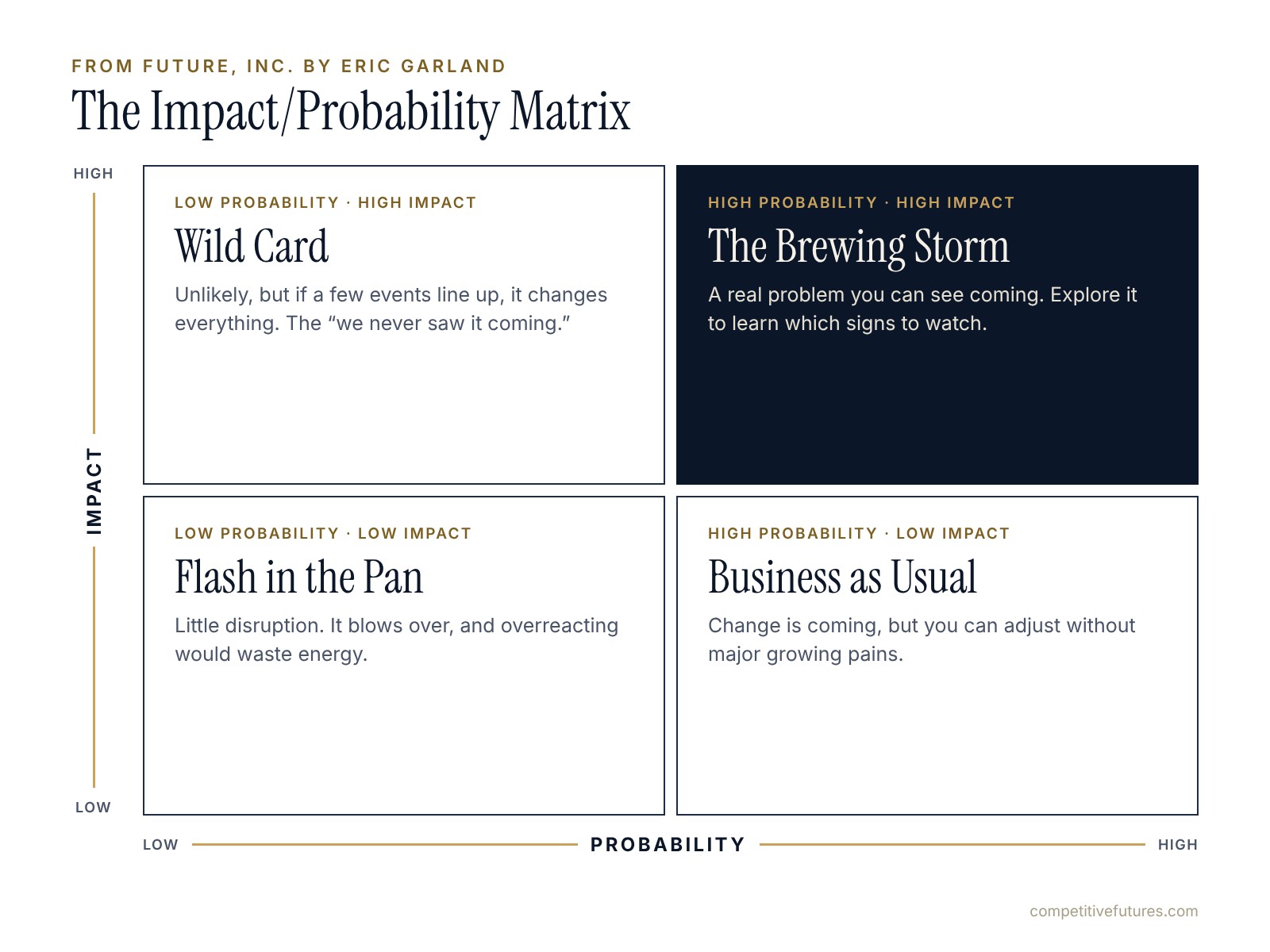
Low probability, low impact: Flash in the Pan
A future with little disruption. It is premised on the idea that the coming change will not be a big deal, or that it will blow over quickly. In this scenario, any overreaction would be wasted energy.
High probability, low impact: Business as Usual
A change is coming, but the organization can adjust to it without major growing pains. You need to watch the forces at play to see whether some things will shift, but the business remains fundamentally the same.
High probability, high impact: The Brewing Storm
This is the scenario executives usually focus on most: a real problem, and you can see its path. Exploring this future tells you which signs to watch for as it approaches.
Low probability, high impact: Wild Card
Wild cards are unlikely, but they could arrive if a few events come in rapid succession and change everything. This is the blindside, the “we never saw it coming.” The stars would really have to line up, but if they did, a lack of preparation would have severe consequences.
People routinely downplay wild cards. Propose one out of context and you may be called an alarmist, a Chicken Little. Yet wild cards happen all the time. Imagine trying to forecast geopolitics or global business in the 1990s from the vantage point of the mid-1980s without considering the possibility, however slim, that the Soviet Union would simply collapse. Few people made plans for a world in which the Soviets called it quits.
Why four scenarios?
The number of scenarios you present changes how your colleagues react to them:
- Two creates a football-match mentality: our side or theirs, good or bad.
- Three lets people choose the middle, an often falsely moderate position.
- Five or more can be confusing and hard to hold in your head.
- Four gives a real range of possibilities with no middle option. Decision-makers have to consider the evidence and choose.
That is the matrix’s quiet strength. It does not give anyone an easy way out, and it arranges a set of scenarios without prejudicing any one of them.
A worked example: clinical trial disclosure
In 2006, I used the matrix on a project about the future of pharmaceutical regulation, and wrote it up for The Futurist in “Scenarios in Practice: Futuring in the Pharmaceutical Industry.” Scandals had erupted after it emerged that data about the effects of Vioxx had been obscured and that the maker of Paxil had withheld studies about its effects on children. The questions were: how much disclosure will be mandated, and how will it change strategy at pharmaceutical companies?
The four scenarios were:
- False Alarm (low probability, low impact). The media tires of the scandal and the crisis goes away.
- Self-Regulation (high probability, low impact). The government assumes that as long as companies change their behavior, no new legislation is needed.
- Government Regulation (high probability, high impact). The government concludes companies will not change without strong rules, and new legislation forces greater transparency in clinical trials.
- Total Disclosure (low probability, high impact). The nightmare scenario: public trust is so shaken that the government demands all activities go into a public database, and companies must learn to compete in a world where everybody knows what they are doing years in advance.
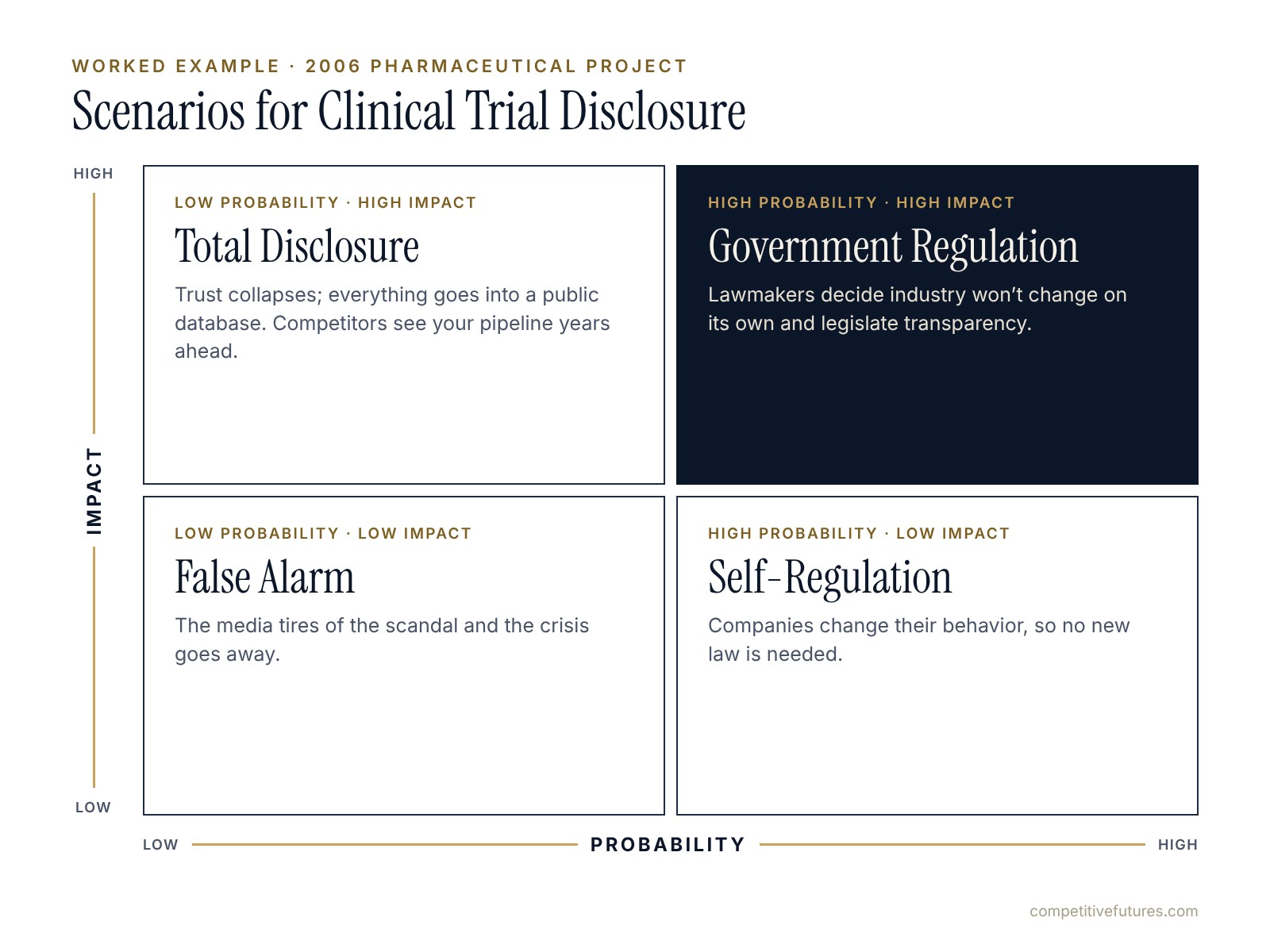
What happened next is a useful test of the method. In September 2007, Congress passed the Food and Drug Administration Amendments Act, whose Section 801 required many clinical trials to be registered on ClinicalTrials.gov and, for the first time, to report their basic results there (Public Law 110-85). That is close to the Government Regulation quadrant. The companies that had already rehearsed that future were not caught flat-footed by it.
How to build an Impact/Probability Matrix

- Ask a focused question. Broad questions, such as whether global prosperity will lift a whole continent, are interesting but too general to be useful to any one organization. Ask something short-term and specific to your situation, the kind of question that makes every executive in the room turn their head.
- Gather the trends and forecasts that bear on it. Look beyond your own industry. A STEEP analysis (Society, Technology, Economics, Ecology, Politics) helps make sure you have not missed a whole category of change. See also how to use future trends in business strategy.
- Draft one scenario for each quadrant. Push each issue four different ways. Resist the temptation to make the Wild Card silly or the Flash in the Pan a straw man; each should be plausible enough to argue about.
- Name each scenario. Memorable names make scenarios easier to discuss and harder to forget. “Government Regulation” and “Total Disclosure” are plain; “Frat Party of the Future” works too.
- List the signposts. For each scenario, write down the events that would tell you it is starting to unfold. These become your early-warning indicators.
- Decide what you would do. Note the response each scenario would demand, then look for actions that make sense across several of them. Revisit the matrix as the signposts move.
Common mistakes
- Planning only for the Brewing Storm. It is the scenario everyone already sees. The value of the matrix lies in the three futures the room was not discussing.
- Dismissing the Wild Card. Low probability is not zero probability. The cost of a little preparation is usually small next to the cost of being blindsided.
- Treating probability as precision. The axes are relative judgments. Arguing over whether a scenario is 30 or 35 percent likely misses the point.
- Asking too broad a question. If the scenarios could apply to any company in any industry, the question is not focused enough to drive a decision.
- Letting bias pick the quadrants. Teams tend to rate the futures they want as likely and the ones they fear as remote. (More on that in Cognitive Bias: A Field Guide.)
How it relates to other scenario planning tools
Many scenario planners build a two-by-two from two critical uncertainties, the approach associated with Shell’s scenario work, so that each quadrant is a different combination of how those uncertainties resolve. The Impact/Probability Matrix starts from a different place. It sorts scenarios by consequence and likelihood, which makes it fast to build, easy to explain to executives, and well suited to a single focused question. The two approaches work well together. For the full method, from systems mapping to communicating the results, see my guide to strategic foresight.
Try it today
Pick one development you are nervous about: a new regulation, a new competitor, a shift in your customers. On a sheet of paper, draw four quadrants and write a potential future in each: Flash in the Pan, Business as Usual, The Brewing Storm and Wild Card. Get used to thinking about every important issue going four different ways. It is the habit that matters more than the chart.
Frequently asked questions
What is an Impact/Probability Matrix?
A scenario planning tool from Eric Garland’s book Future, Inc. that places four alternative futures on two axes, impact and probability, producing four quadrants: Flash in the Pan, Business as Usual, The Brewing Storm and Wild Card.
Why does the matrix use four scenarios?
Two scenarios become a contest between good and bad, three invite people to pick the middle, and five or more are hard to keep in mind. Four give a real range with no middle option, so decision-makers must weigh the evidence and choose.
What is a wild card scenario?
A low-probability, high-impact future: unlikely, but transformative if a few events line up. The collapse of the Soviet Union is a classic example.
How is it different from a 2×2 scenario matrix built on critical uncertainties?
A critical-uncertainties matrix uses two unresolved drivers as its axes, so each quadrant is a combination of outcomes. The Impact/Probability Matrix instead sorts scenarios by consequence and likelihood, which makes it quick to build around a single focused question.
Related analysis from Competitive Futures
- Cognitive Bias: A Field Guide for Leaders Who Must Decide Under Uncertainty
- Best books to get you started in futures studies
- An effective tool to use scenarios in your business planning
Want this kind of analysis for your organization? Contact Competitive Futures or learn more about Eric Garland.
About Competitive Futures
Competitive Futures has provided strategic intelligence and foresight to corporate and government clients since 2002. Its principal, Eric Garland, publishes analysis here, on Game Theory Today, and in the Systemics Quarterly Brief.
Read next
- Seventy Countries, Six Cities: The Global Network Behind Iran
- The Systemics Quarterly Brief: 2026 Prospectus
- Strategic intelligence services for executives and governments
- All analysis from Competitive Futures
Stay in touch
Leave your email and a note about the Brief, a briefing for your team, or this piece, and we will be in touch.