Seventy Countries, Six Cities: The Global Network Behind Iran
The U.S. war with Iran continues unabated with no apparent end in sight. When Trump launched the war, some people even from his own administration questioned whether Iran really posed a threat — the former director of the National Counterterrorism Center, Joe Kent, resigned in March saying Iran “posed no imminent threat to our nation.” Trump’s opponents in Congress spread the same doubt. Which raises the question: were they a threat? The basic answer is very clear. Through their proxies, Iran has been shooting at Americans for a decade — Houthi cruise missiles at the USS Mason in 2016, militia rockets and drones at our bases in Iraq and Syria, three soldiers killed at Tower 22 in Jordan in January 2024 — escalating right up until we made a direct assault on their military-industrial base, air force, and navy.
But there’s a larger question about why the regime doesn’t just surrender in the face of force majeure. And that is the subject of this report. Because Iran’s threat is not just from a single country. They have friends that made the threat global. And by the end of this report, you’ll understand that menace in detail.
Key findings
- Seventy countries on six continents profit from, supply, or shelter Iran’s sanctioned trade — including U.S. trading partners and NATO members.
- One customer: China took 99.4 percent of Iran’s crude exports in 2025, per the U.S. Energy Information Administration.
- Four networks — oil, parts, drones and organized crime — run on the same rails, through about six cities: Dubai, Istanbul, Hong Kong, Basra, Muscat and the waters off Johor, Malaysia.
- Since 2022 Iran has gone from arms buyer to drone franchisor, with production lines in Russia, Tajikistan and Venezuela, and reportedly Belarus.
- Iran rents deniability from criminal gangs in Sweden, Canada, the Netherlands, Britain, Germany and Australia for attacks abroad.
- A sanctioned economy is not a dead economy. It is a rerouted one — and the routes are written down by the governments sanctioning it.
Right now, the waiting game is ongoing, with the United States systematically degrading Iran militarily and economically. Its real onslaught is coming not just through Secretary of War Pete Hegseth, but through Secretary of the Treasury Scott Bessent, with his Operation Economic Outcast. Iran apparently has drastically reduced military capacity. Much of its leadership is dead. And it is being choked off from money. So what’s going on? Why not surrender and get on to the next phase of life?
Because Iran is not alone. It’s not just a single country after the last 47 years of the Islamic Regime. It’s a network of illicit actors who depend on its sanctioned oil and military hardware and espionage operations for their own malign ends.
How many countries is that, really? How many nation-states are in bed with this clearly malevolent, terror-supporting regime?
In this report, I’ll take you through all the countries that partner with Iran with the goal of predicting when this global network might be broken, forever changing the Middle East and the balance of power in the world.
It’s not a small list! It’s seventy countries on six continents.
That’s one of the reasons this is taking so long. Over almost half a century, Iran built a global network for its sanctioned oil, weapons, and stolen technology. Dozens of nations, some of them our trading partners, make money off the Islamic Regime. And it’s time to call them all out so that we can understand the totality of the threat by the Iranian regime in Tehran and why it hasn’t been taken out so easily.
How this assessment was built
As prelude, let’s talk about methodology: everything in this report is open source. Nothing to follow comes from leaked government documents or proprietary human intelligence. Everything here is something you can look up yourself; the starting points are listed at the end. I took U.S. Treasury sanctions designations, Justice Department indictments, UN Panel of Experts reports, security-service statements out of Europe—everything reliable, detailed, and verifiable. And instead of asking “what did Iran do,” I asked a different question. Who got paid?
Who bought the oil? Who relabeled it? Who flagged the tankers?
Who sold the servomotors that end up in the drones? Who bought the drones? Who took the contract to throw a grenade at an embassy in Stockholm?
Where did Iran get stolen technology? Who got it from them? What did they make with it? How did it get used against democracies?
And that list was so much larger than Iran itself. Seventy countries. Not seventy enemies of the United States. In fact, the United States is on the list, right next to Canada! Seventy places where somebody — a refinery, a free-zone shell company, a flag registry, a general, a motorcycle gang — made money, or got weapons, or got protection, from a country that is supposed to be the most sanctioned economy on Earth.
So why is it taking so long to shut Iran’s regime down permanently? Because there have been a lot of people making money off this group of autocratic religious leaders.
And here’s the thing I want you to take away from this report: Iran’s threat is bigger than the sum of its parts. Some public voices tried to argue that just because it can’t put an aircraft carrier into blue water and attack San Francisco with aircraft, missiles, and Marines, that it isn’t really a threat. I think when you hear the totality of activities that Iran was up to, all over the world, you will conclude that that isn’t true. That the oil, the aircraft parts, the drones, and the hit men all run on the same networks, through the same cities, and very often through the same people.
The information in this report comes from three source categories. You see, I’m not a journalist; I do intelligence assessments, and they’re always built of sources of varying quality.
Lower versus higher quality doesn’t mean you’re building a view based on bad stuff, but that you just need to understand when some source confers less confidence than another.
For example, a national study based on all public documentation about a recognized phenomenon over 10 years is probably more reliable than a single story from an eyewitness. Not always, but most of the time. So we just need to keep that in mind—which is why this assessment draws from three categories.
Category One is what I’ll call the official record. A U.S. Treasury sanctions designation. A Justice Department indictment or forfeiture filing. An Energy Information Administration report to Congress. A UN Panel of Experts report. A security service — Dutch, Swedish, British, Australian — saying on the record, “Iran did this.” Those documents have names, dates, vessel numbers, company registrations. They can be wrong, but they are signed.
Category Two is credible reporting that hasn’t been mirrored in a government action yet. Reuters. Bloomberg. Semafor. France 24. Trackers like United Against Nuclear Iran, or the Institute for Science and International Security, who count tankers and satellite images for a living. Good, checkable, but one step further from a courtroom.
Category Three is single-source, denied, or memorandum-of-understanding stage. A deal that one outlet reported and nobody confirmed.
Now the analytical frame. At Competitive Futures we keep coming back to a way of looking at the world where various systems interact to form the patterns of facts we can analyze to predict world events. We call it Systemics. And this is why we’re not just seeing Iran as a single group of guys and a single border around a country, but the systems of systems that come together to create and sustain this conflict between the Islamic Republic and the rest of the world. And I think that worldview is buttressed by looking at what the United States is currently doing to destroy the regime in Tehran. Obviously, the Pentagon could nuke all of the major cities or invade with the Army—but that isn’t the effect they want. In addition to being legally and literally atrocious, it would be counterproductive and miss a broader opportunity. Instead of annihilating a weaker opponent, the U.S. is actually disassembling the systems that allowed Iran to terrorize the world for all these decades. And if they can re-form Iran, like they are with Venezuela, then there’s a better chance they can remediate Cuba, Myanmar, and North Korea.
In time, the U.S. could be inaugurating a strategy to change Russia and China from dictatorships to free republics. That’s my forecast, not the record — and I’ll tell you when I switch back to the record.
Which is now. What this means in practice is that the best intelligence on Iran’s global reach is not in a single leaked cable that tattles on the Mullahs. It’s from a Treasury press release with a boring title like “Treasury Targets Network Supporting Iran’s Oil Exports.” Treasury has its own intelligence office and its own financial intelligence unit, FinCEN, and it sits inside the intelligence community with access to what CIA, NSA and DIA collect, before it makes those decisions. What emerges is just the salient details. Those press releases are lists of companies with addresses. And an address is a country. And a country is a beneficiary.
So the method is: read the list, write down every jurisdiction, ask what it did, and then — this is the step everybody skips — put the four lists side by side and look for the same names. What emerges likely isn’t the absolutely complete list of intelligence out there, but it is what we can see in the visible light spectrum, and since it fills a report this long from open sources alone, it’s plenty.
One more thing on vocabulary before we start, because it matters. I’m going to say “illicit” a lot, and you should know that word is doing U.S. legal work. When Pakistan smuggles Iranian diesel over the Balochistan border, that’s illegal in Pakistan too. When Afghanistan buys Iranian gasoline, that is completely legal in Afghanistan — it’s only a problem under American secondary sanctions. When India imports Iranian bitumen, same thing. I’ll try to say “sanctioned” where that’s the accurate word and “smuggled” where that’s the accurate word. Because the point isn’t to call seventy countries criminals. The point is to show you how a sanctioned economy actually works, and who it works for.
Four networks. We’re going to do oil first, because oil is the real big money, and that cash is what pays for everything else.
The oil: one customer
Let me give you the single most important number in this report, and it comes from the U.S. Energy Information Administration, which is required by law now to report to Congress on Iranian oil exports.
In 2023, China took 88 percent of Iran‘s crude exports. In 2024, 96 percent. In 2025 — 99.4 percent. One point five seven million barrels a day.
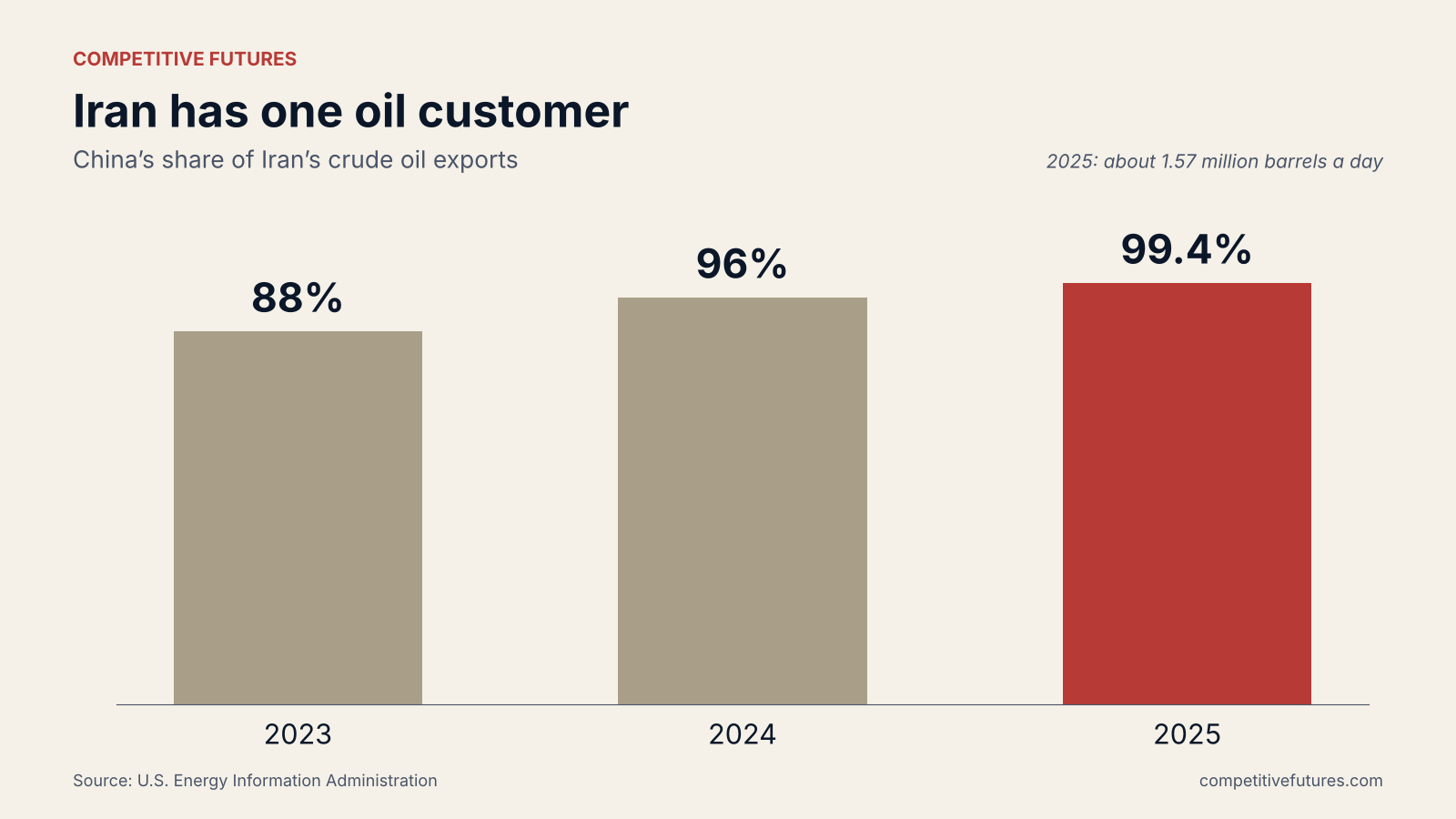
Ninety-nine point four percent. Iran is not a country with oil customers. Iran is a country with an oil customer. Every other name I’m about to give you in the oil section is either a middleman for that one customer, or somebody Iran pays in fuel instead of cash.
Who in China? Not the big state companies — they have too much to lose in dollar markets. The buyers are what the trade calls “teapots” — independent refineries, mostly in Shandong province, that were built to run cheap, difficult crude and that don’t have a New York listing to protect. Nevertheless, Treasury has started naming them.
This spring they designated Hengli Petrochemical in Dalian — which Treasury itself describes as China’s second-largest teapot — for buying, quote, billions of dollars of Iranian oil since at least 2023. They’ve hit Shandong refineries by name. They’ve hit the terminal operators in Zhoushan and Dalian. And they’ve put out something called a teapot risk alert, which is Treasury’s way of saying to every bank in the world: if you touch these refineries, you’re next.
Now, what’s the benefit to China? Discount crude, delivered by a fleet that absorbs all the sanctions risk. How big a discount? The EIA report says — in plain English — “we do not have information on prices Iran charged to Chinese crude oil purchasers.” They estimate Iran’s crude revenue at something like 38 billion dollars in 2022, 43 billion in 2023, 49 billion in 2024. But they’re computing that off a benchmark price, and they tell you they don’t know the real number because so much of this is barter and swap. Barter and swap for what exactly? Ah, that’s a real question.
So when you hear a confident figure for how much Iran makes on oil — the U.S. government’s own energy statisticians won’t give you one, and neither can I. “On the order of forty to fifty billion” is as far as the record goes.
And it comes with a warning I want to put on the table right now, because I’ve seen this mistake ruin a lot of otherwise smart commentary: never say Iran is broke. Never say Iran can’t fund its proxies. This was the failure a ton of analysts had—including me—when estimating the size of Russia’s economy and ability to fund intelligence operations. Just because a country has a black market, off-book, mafia economy that doesn’t show up in the CIA World Factbook doesn’t mean they have no money. You couldn’t estimate the size of Russia’s real economy without factoring in what the Russian Mafiya kicked up to the State, and vice-versa!
In Iran’s case, ninety-nine percent of one and a half million barrels a day was and is a real economy. A sanctioned economy is not a dead economy. It’s just a rerouted one. And rerouting is what the next section is about.
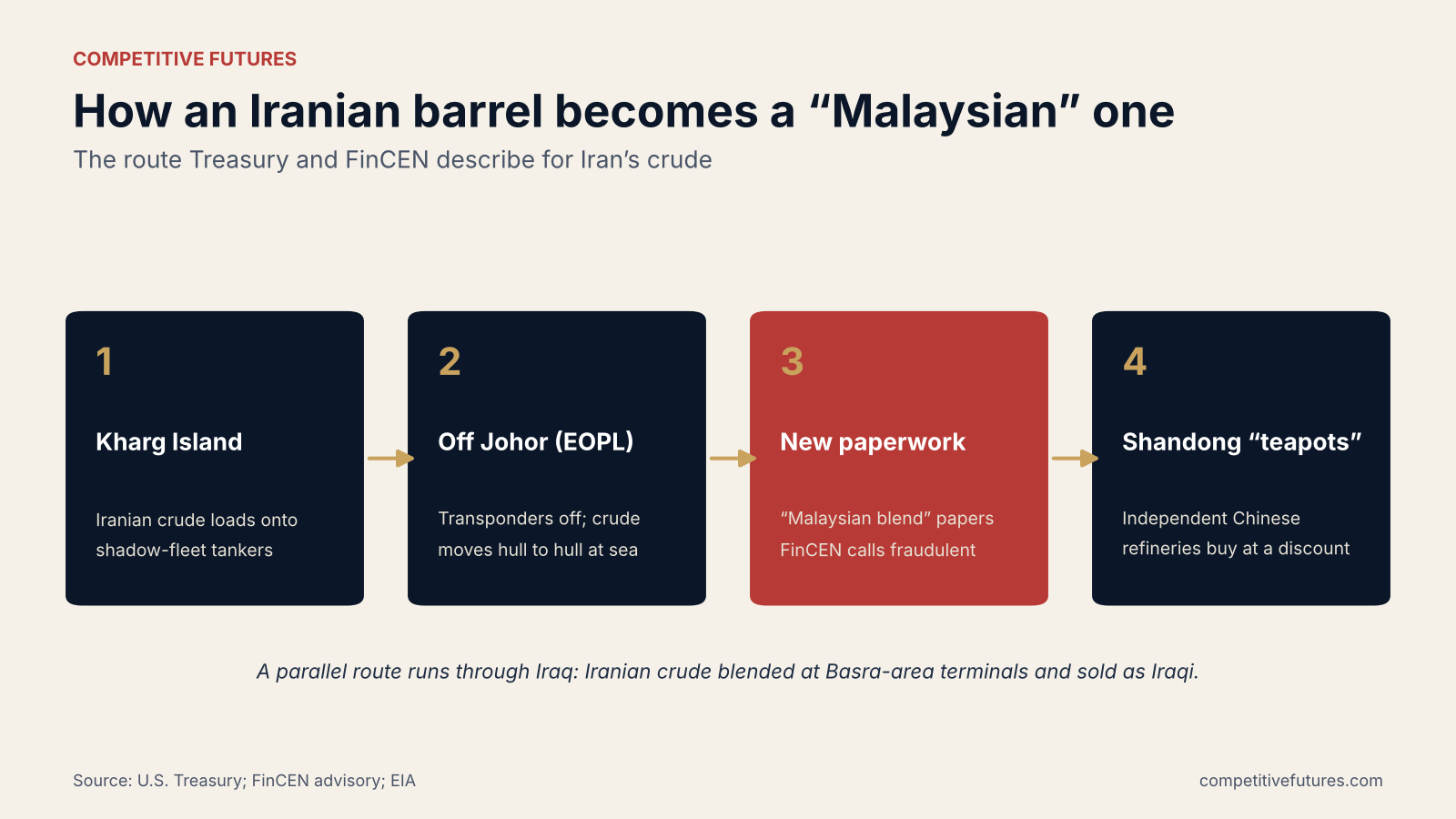
One more thing on the customer. There’s a piece of paperwork Treasury has been going after, and it’s called “Malaysian blend.” Keep that phrase in your head. Because Iranian oil does not sail from Kharg Island to Shandong with a sign on it. It sails to a patch of ocean off Malaysia, gets transferred to a different ship, and gets new documents that say it came from Malaysia. Malaysia produces very little oil. The Financial Crimes Enforcement Network — FinCEN, Treasury’s financial intelligence unit — calls those documents forged and falsified. So that’s our first middleman, and our first laundromat.
The oil: the laundromats
Four places do most of the laundering. Malaysia, the United Arab Emirates, Iraq, and Hong Kong. Each does a different job.
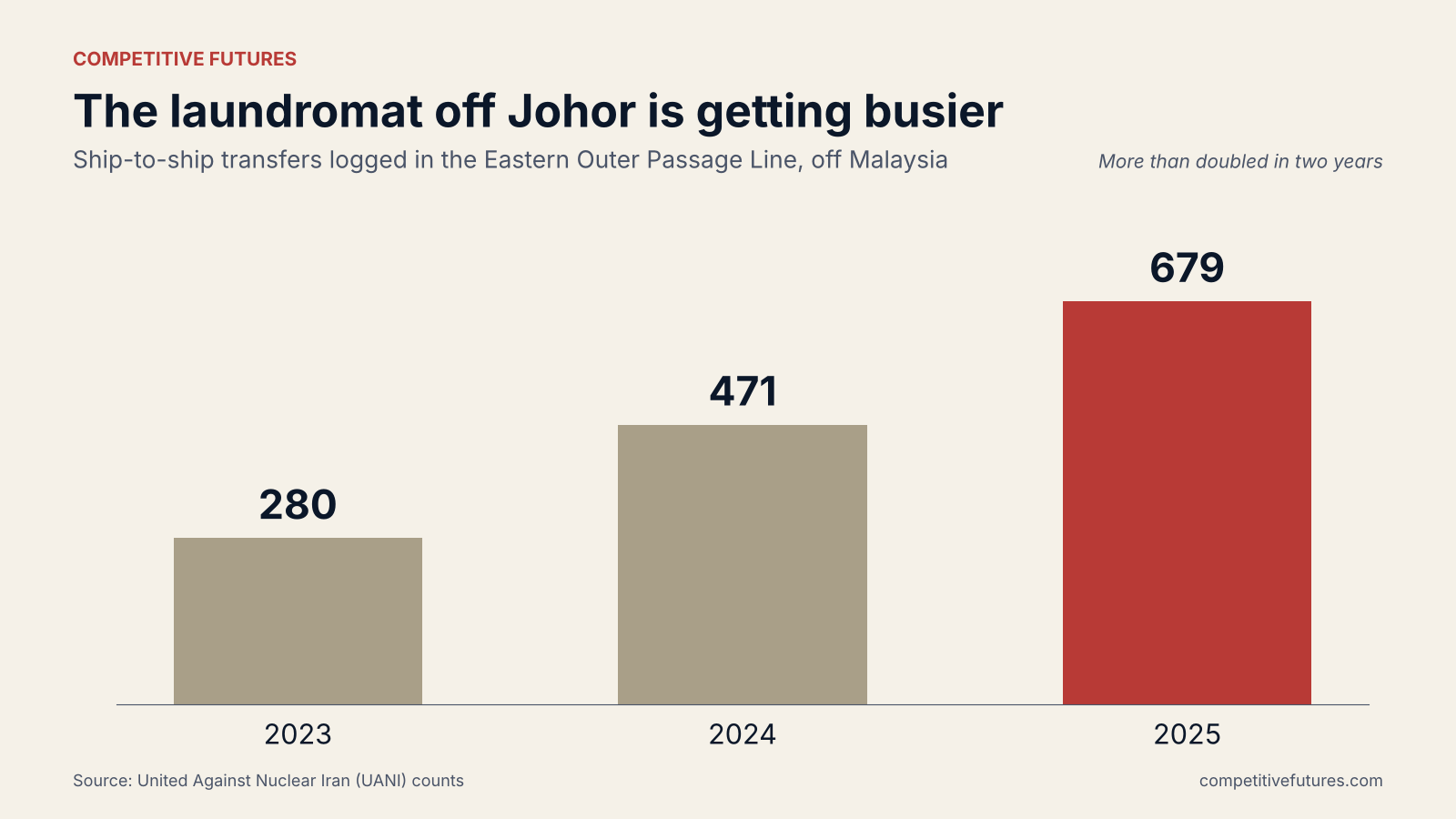
Malaysia is the physical laundromat. There’s a stretch of water off Johor that the trackers call the Eastern Outer Passage Line — EOPL. It’s where tankers go dark, turn off their transponders, sit next to each other, and move crude from one hull to another. United Against Nuclear Iran, which counts these, logged 280 of those ship-to-ship transfers in 2023. 471 in 2024. 679 in 2025. That’s more than doubling in two years. And Malaysia’s own officials have described it, in public, as exploiting a “maritime loophole” — the transfers happen just outside their jurisdiction. Malaysian ports show up in the EIA data too: Port Klang, Pengerang, Tanjung Langsat.
What Malaysia gets is a service economy — bunkering, storage, inspection companies that issue paperwork, and a re-export trade in a product it barely produces.
The UAE is the corporate laundromat, and this is a name you’re going to hear in all four sections, so stick a pin in it. FinCEN’s advisory calls the Emirates the primary location for the companies that own and manage these vessels. Free-trade-zone shell companies. General trading LLCs. And — this is the key part — the exchange houses. Iranian money doesn’t move through banks; it moves through currency exchange houses in Dubai that convert rials and yuan and dirhams and dollars. Treasury has named them. But the UAE isn’t just paper. Fujairah, Hamriyah, Jebel Ali, Sharjah all appear in the EIA data as places Iranian crude and product physically discharge. So Dubai launders the paper and Fujairah launders the oil.
Iraq is the newest laundromat and the one growing fastest, and it’s the one I’d watch. Here’s the scheme, and it’s in a Treasury press release from September 2025. Iranian crude gets moved by ship-to-ship transfer in the Gulf, or into Iraqi ports — Khor al-Zubair, a facility called the VS Oil Terminal, floating storage off Basra — and it gets blended with Iraqi crude. Then it’s sold as Iraqi. Iraqi oil isn’t sanctioned. So a barrel that was Iranian at Kharg Island is a legal barrel by the time it hits a refinery. Treasury’s conservative estimate for one network — run by an Iraqi businessman with a St. Kitts passport and companies in Dubai — is about 300 million dollars a year to Iran and its partners. Nine tankers, managed out of a Dubai company called Babylon Navigation.
There’s a separate scheme Reuters found in late 2024, and please don’t add these two numbers together because they’re different products. Iranian fuel oil — the heavy bottom-of-the-barrel stuff — being laundered as Iraqi, to the tune of at least a billion dollars a year, with the profits split between Iran and allied Iraqi militias. So the same militias that get Iranian drones are being paid in an oil-laundering franchise. Hold that thought for the drones section.
Hong Kong is the shell factory. If you read any Treasury oil designation from the last eighteen months, the entity list is a wall of Hong Kong limited companies with names like Lisboa Shipping, Great Sail Shipping, Vigorous Trading, Starshine Petrochemical. FinCEN’s description is precise: recently incorporated, minimal web presence, banking through Chinese non-resident accounts. They own the tankers on paper, they invoice the oil, and they’re disposable — when one gets designated for U.S. Treasury sanctions, you just register another, easy-peasy.
Then there’s a supporting cast. Singapore as a transshipment stop. Vietnam — a Vietnamese company got designated this year for operating Iranian product tankers. Oman — both a real recipient of Iranian product and a favorite origin to write on fake paperwork, because Omani crude sounds plausible. Indonesia keeps detaining Iranian-linked tankers in its waters, which tells you the route runs through its territory. And Türkiye, which was the biggest financial beneficiary of the last decade — some of you will remember the Halkbank case, the gold-for-oil scheme that went to trial in New York — and which still shows up today as the home base of exchange-house operators.
Here’s the pattern I want you to see. None of these countries buys much Iranian oil. They sell a service to the one country that does. Malaysia sells ocean. Dubai sells paperwork and currency. Iraq sells its own name on a barrel. Hong Kong sells companies. And that service economy — that’s where the sanctions enforcement has been aiming, and it’s why you keep seeing designations with Malaysian and Emirati and Hong Kong addresses on them. Treasury isn’t confused about who buys the oil. They’re going after who makes it possible to buy.
The oil: paid in fuel
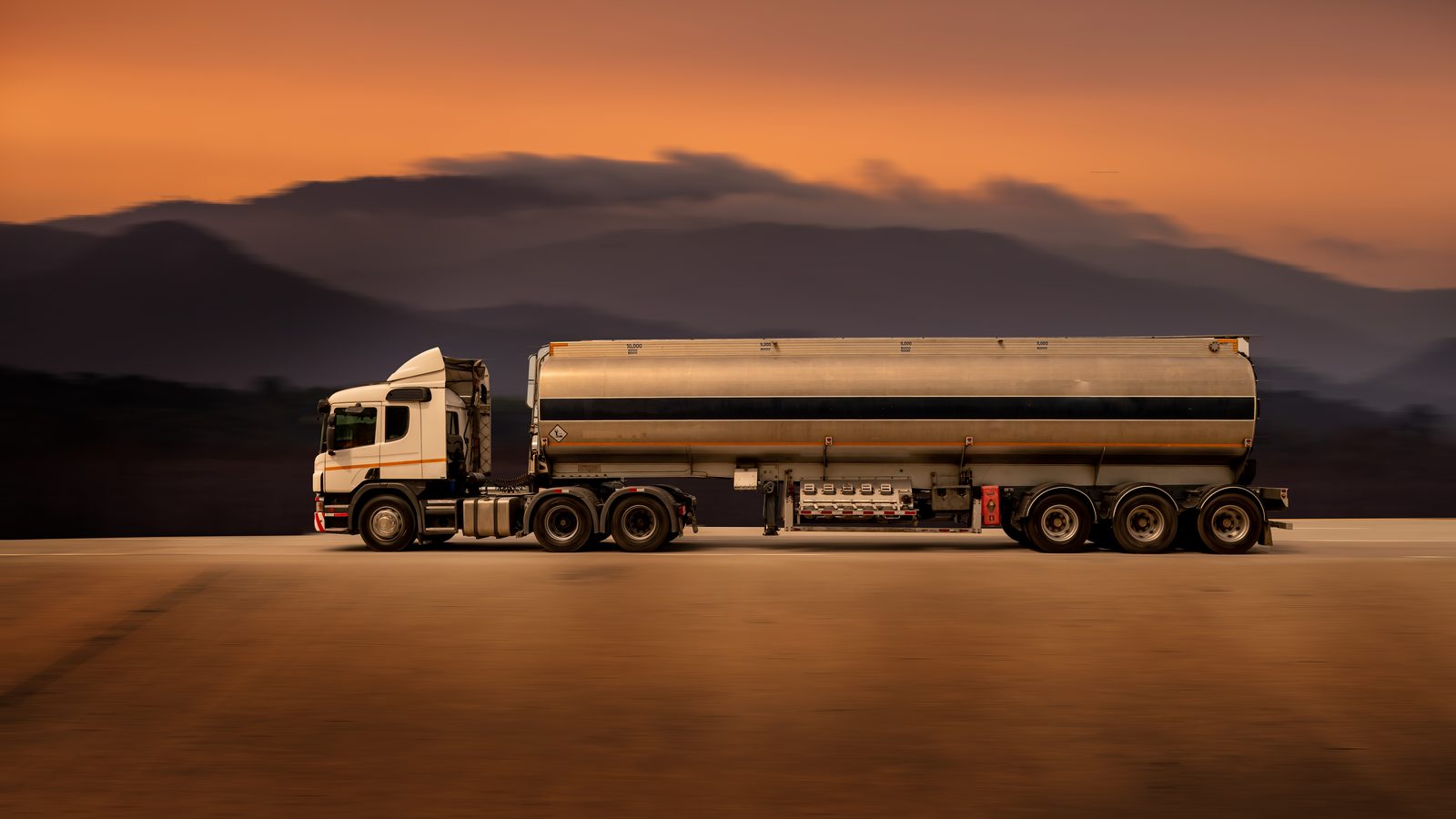
Now the second category. Countries that don’t launder Iranian oil — they get it. Some buy it, some smuggle it, and some are paid in it because Iran can’t pay them any other way.
Pakistan is the biggest overland case, and the numbers here come from Pakistan’s own military, so attribute this intel to them. In August 2024, the Pakistani army’s spokesman said Iranian fuel smuggling had come down from fifteen to sixteen million liters a day, to five or six million a day, after a crackdown. Think about the first number. Sixteen million liters a day of diesel and gasoline coming across the Balochistan border in trucks and boats. An intelligence report earlier that year put it at about fourteen percent of Pakistan’s total fuel consumption, worth over a billion dollars a year, and said up to two-point-four million people in Balochistan depend on that trade to live. That’s not a sanctions story. That’s a regional economy.
Afghanistan. The Taliban formally buys Iranian fuel — they asked Iran to resume exports in 2021 and Iran did. That’s legal in Kabul. It’s revenue in Tehran. Nobody’s going to sanction the Taliban’s gas stations, so it just runs.
India is more interesting than people think. India stopped buying Iranian crude in 2019 when the U.S. waiver expired — that’s the headline. But the EIA lists more than a dozen Indian ports receiving Iranian products through 2025. Fuel oil, bitumen, petrochemicals. Legal under Indian law. Sanctionable under American law. And — mark this for later — India just got named by the State Department in a different context entirely.
Bangladesh gets crude and LPG at Chittagong and Mongla. Myanmar, Brunei, minor volumes. Sri Lanka has a tea-for-oil barter to settle an old Iranian debt, which is a wonderfully nineteenth-century way to evade a twenty-first-century sanctions regime.
Then the political clients. This is where Iran uses oil the way a bank uses credit.
Syria under Assad was the biggest. For thirteen years Iran shipped Syria oil on a credit line that was never going to be repaid. A Syrian economist named Karam Shaar who tracks this puts it at around 78,000 barrels a day in the last five years of the regime, about 14 billion dollars over the whole period. When Assad fell in December 2024, there was an Iranian tanker in the Red Sea headed for Syria, and it literally turned around. The flow stopped that week. Russia took over the supply.
Venezuela used to be a two-way street. Iran started sending gasoline in 2020 when Venezuela’s refineries collapsed. Then they did something clever — Iran sent condensate, which is light oil, so Venezuela could dilute its own heavy crude enough to export it to China. Iranian technicians were repairing Venezuelan refineries under contracts worth hundreds of millions. Venezuela bought Iranian-built tankers. So Venezuela wasn’t just a customer. It was another sanctioned oil state until the U.S. actions in January 2026.
Cuba is downstream of that. And this is the case I’d point you to if you want to see the whole rotten system in one document. In December 2025 the U.S. seized a tanker called the Skipper in international waters. It was flying a false Guyanese flag. It had been sanctioned back in 2022 under a different name. The Justice Department’s forfeiture filing says it served the Revolutionary Guard, including the Qods Force, from at least 2021. In 2024 it carried about three million barrels from Iran to Syria. In November 2025 it loaded 1.8 million barrels of Venezuelan crude, and about 1.1 million of those were for Cuba’s state oil company. One ship. Iranian oil to Syria, Venezuelan oil to Cuba, same account. That’s not four networks. That’s one logistics operation with several clients.
And notice what Iran gets from these clients. Not money. Loyalty, votes, basing, and — in Venezuela’s case — a partner in crime. Iran is paying people in fuel because fuel is the currency it has.
The flags
Quick one, because it’s the section with the most countries and the least money.
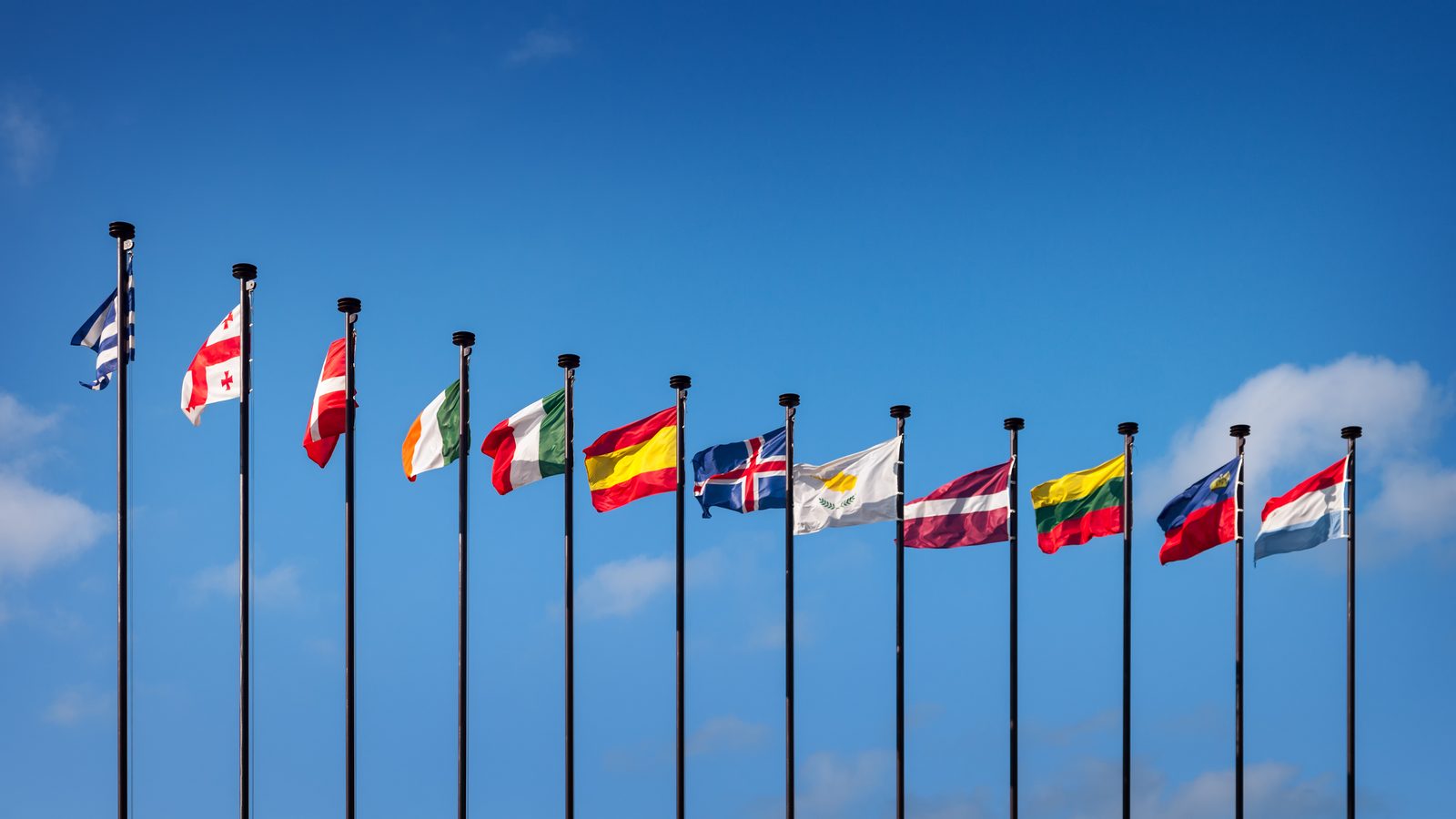
Every ship needs a flag, and a flag is a country. The Treasury designations from this year list Iranian shadow-fleet vessels flagged in Panama, Liberia, the Marshall Islands, Barbados, Palau, San Marino — landlocked San Marino, the one inside of Italy with no access to, like, the sea — Cameroon, Comoros, Gabon, Vanuatu, the Cook Islands, Sierra Leone, and St. Kitts and Nevis. The Skipper was flying a Guyanese flag that Guyana never issued.
What do these countries get? Registration fees. A few thousand dollars a ship. They are the smallest beneficiaries in the whole system and the easiest to squeeze, which is why you’ve seen some registries — Panama especially — start pulling flags when the pressure comes. And the ownership sits one layer up in the British Virgin Islands, the Cayman Islands, the Marshall Islands, Panama, Hong Kong, and Dubai free zones. Same list. Same rails.
Here’s your first reusable tool. When you read a sanctions press release and you see a flag state, don’t think “Cameroon is helping Iran.” Think “Cameroon sells flags, and the buyer is in Dubai.” The flag tells you where the shell is, and the shell tells you where the money is.
The parts: same rails, opposite direction
Now we flip the direction of travel. Oil goes out. Parts come in. And the thing that should jump out at you is that they use the same map.
Iran builds drones and missiles, and, like many countries, it can’t make everything it needs. Servomotors — the little actuators that move a drone’s control surfaces. Engines. Gyroscopes. Electronics. Carbon fiber. The chemical precursors for solid rocket fuel. It has to buy those abroad, and it’s not allowed to, so it buys them through the same cities that launder its oil.
Start with the record. In one Treasury action this year, they designated an Iranian company for procuring, quote, “thousands of servomotors with one-way attack UAV applications, which have been found in downed Shahed-136 UAVs.” Thousands. Found in the wreckage in Ukraine.
Where do those come from? Overwhelmingly, China and Hong Kong.
The Justice Department charged an Iranian company in April 2025 for a five-year scheme to buy drone parts — servo motors, pneumatic masts, engines, electro-optical systems — and the criminal complaint names Chinese suppliers for the motors, shell companies in the UAE for the payments, a company in Belgium they impersonated, and a business in Brooklyn, New York that was the unwitting source of some of it. The end use was the Mohajer-6 — and a Mohajer-6 shot down in Ukraine in September 2022, quote, “contained parts made by several U.S. companies.”
So the American-made part goes from Brooklyn, to a Belgian front, to a Dubai shell, to Tehran, to a drone over Kharkiv. That’s the route.
You get why intelligence agencies have to do this work, right? Super complex, is it not?
Türkiye is the second most-designated country in this network after the UAE, super awkward what with them being in NATO! Three Turkish companies moved more than a million dollars to buy what Treasury calls “sensitive machinery” for the Revolutionary Guard’s Aerospace Force. A Turkish textile firm shipped, quote, “hundreds of shipments of cotton linters” to Iran. Cotton linters are what you make nitrocellulose from, and nitrocellulose is solid rocket propellant. A textile company. Shipping cotton. For missiles. That’s what procurement evasion looks like — it’s boring on purpose.
The UAE — again. A Dubai company sourced U.S.-origin aircraft components for Mahan Air. And Treasury named an Iranian trading company that procured sodium perchlorate, a ballistic-missile propellant precursor, for Parchin Chemical Industries.
And here’s the one that’s new. In November 2025 the State Department sanctioned 32 entities and individuals in Iran’s missile and drone procurement networks, and the country list was Iran, China, Hong Kong, the UAE, Türkiye — and India. India is now formally on the procurement map. Treasury separately named India, along with Iraq, China, Thailand, and Pakistan, as countries providing “material, logistical, and other support” to Mahan Air flights. Mahan Air is the Revolutionary Guard’s airline. It flies the parts in and the drones out.
Then a UN document that ties this whole thing to the next section. The UN Panel of Experts on Yemen traced how drone components reach the Houthis. Hong Kong companies ship the parts by air to Bangkok, then to Muscat, and then they’re smuggled across the Omani border into Yemen. And when the Panel took apart what was seized on a dhow in the Arabian Sea, the component origins were Japan, China, Iran, Belarus, the Czech Republic, and Germany. Japanese and German companies didn’t sell to the Houthis. They sold to a distributor who sold to a Hong Kong company who sold to Bangkok. Every one of those legitimate exporters got paid. That’s the sense in which they’re beneficiaries.
Now step back. Oil laundromats: Malaysia, UAE, Iraq, Hong Kong, Singapore, Oman, Türkiye. Parts network: China, Hong Kong, UAE, Türkiye, India, Iraq, Thailand, Malaysia, Singapore, Oman. Same names. The Dubai free zone that owns the tanker owns the trading company that buys the servomotor. The Turkish exchange house that settles the oil settles the machinery. And the physical carrier — Mahan Air one way, the tanker fleet the other — is Revolutionary Guard logistics in both directions.
That’s the finding. It’s not that Iran has an oil network and a separate procurement network. It’s that Iran has a logistics network, and oil and parts are two things it carries.
The drones: from buyer to franchisor
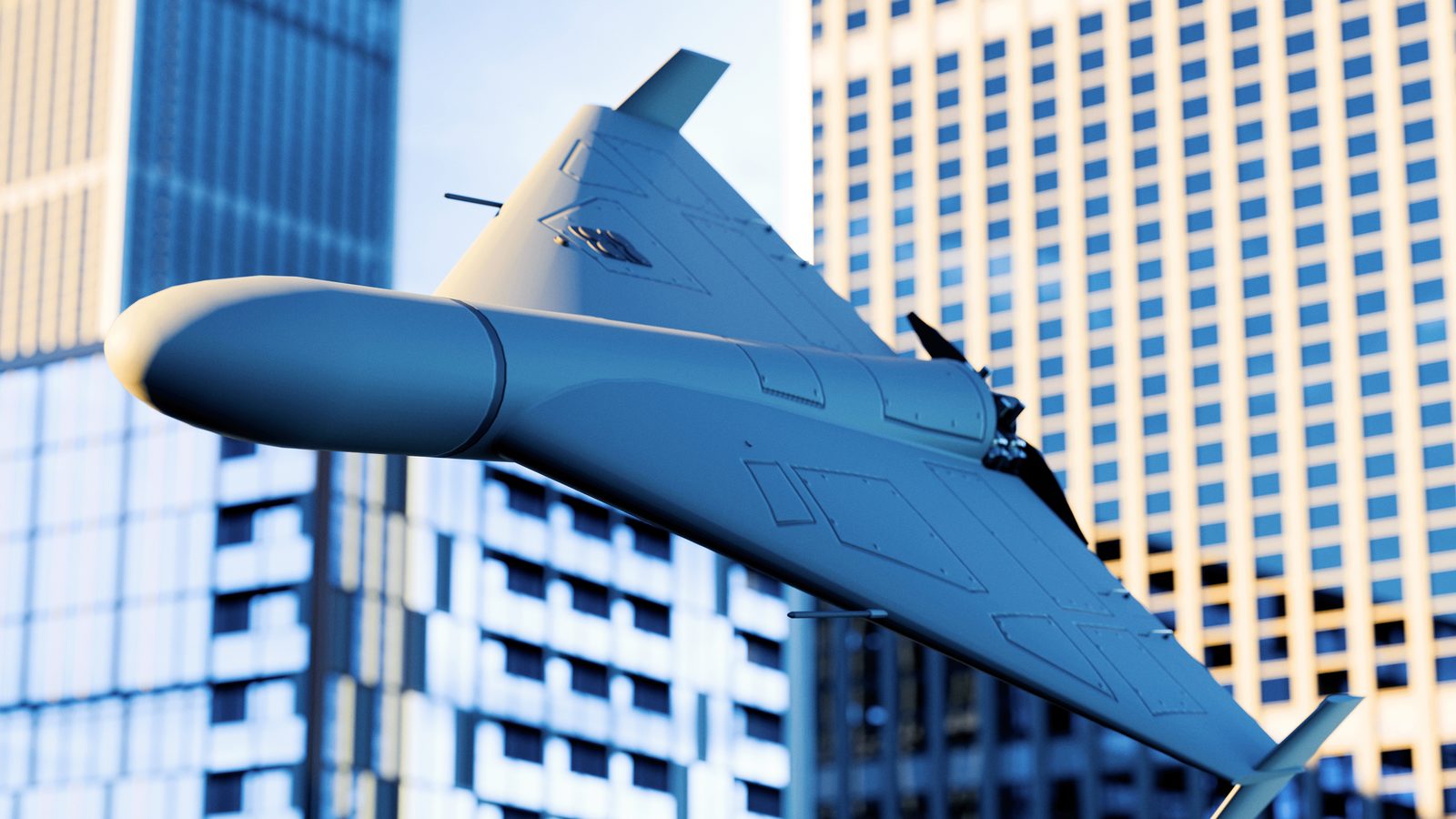
Now the product. What does Iran do with the parts? It builds drones and missiles, and increasingly, it exports them — and this is where the strategic picture changed in the last four years.
Remember, this report started with the counterterrorism director, Joe Kent, saying Iran posed no imminent threat. This is the intelligence that argument has to set aside, and it’s not really up for debate among honest analysts.
For most of its history Iran was an arms buyer. It bought Russian jets, North Korean missile designs, Chinese anti-ship missiles. Around 2022, it became an arms seller. And more than a seller — a franchisor. Let me walk you through the recipients from the most documented to the least.
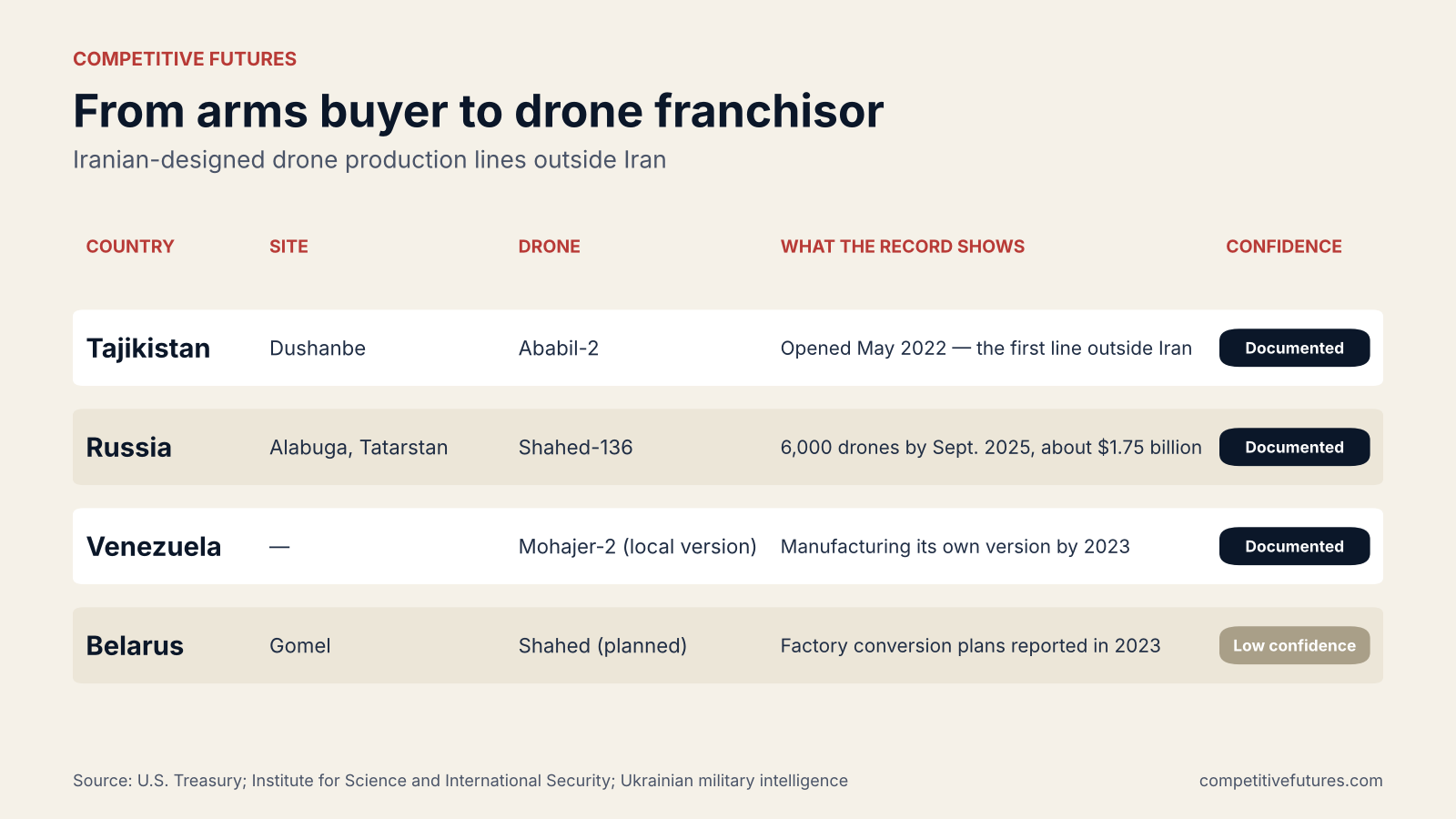
Russia. The largest arms export in the history of the Islamic Republic, and it’s in Category One and Category Two both. In 2022 Iran started shipping Shahed-136 attack drones to Russia for use in Ukraine — the U.S. National Security Advisor announced it. Then Russia did something smarter than buying drones. It bought the factory. There’s a special economic zone at Alabuga in Tatarstan where, under a deal the Institute for Science and International Security has documented from leaked internal files, Iran agreed to deliver 6,000 Shaheds by September 2025 for about 1.75 billion dollars — and to help Russia build them itself. Alabuga went from about twelve drones a workday in 2023 to about twenty a day in early 2024. By April 2024 they’d delivered around 4,500. Now Russia calls it the Geran-2, modifies the design, makes its own warheads at other Russian plants, and gets raw materials and parts from — you guessed it — China. Russia has also received Mohajer-6 drones, and in September 2024 the State Department said Iran had transferred short-range ballistic missiles as well.
What does Russia pay with? Cash, gold, fighter jets, and — reportedly — captured Western weapons from Ukraine for Iran to reverse-engineer. So Russia sits on both sides of the ledger: Iran’s biggest customer and one of its suppliers.
Tajikistan. This is the one people miss. In May 2022 Iran inaugurated a drone factory in Dushanbe, building the Ababil-2. That was the first Iranian drone production line outside Iran — the prototype for what Alabuga became.
Belarus. Ukraine’s National Resistance Center reported in 2023 that there were plans to convert a factory in Gomel to Shahed production. That’s Category Two — one Ukrainian government source, not a Treasury designation. I would call this assessed with low confidence. But Belarus also shows up as a component source in the UN’s Houthi analysis, so it’s in the system either way.
Venezuela. The oldest customer. Venezuela has flown Iranian Mohajer-2 surveillance drones since the early 2000s. After the UN arms embargo on Iran expired in 2020, it got the armed Mohajer-6. And by 2023 Venezuela was manufacturing its own version of the Mohajer-2 under a local designation. Treasury has sanctioned the Iranian company that builds the Mohajer over drone sales and assembly in Venezuela, and separately over the drones it sent to Russia. So that’s four countries with Iranian drone production on their soil: Russia, Tajikistan, probably Belarus, and Venezuela.
Now the deliveries without factories.
Sudan. Sudan has bought Iranian drones for years — Ababil and Mohajer models going back to 2008. In the current civil war, Bloomberg and Semafor reported in early 2024 that Iran was supplying the Sudanese army with Mohajer-6 attack drones. Iran International reported in 2025 on Revolutionary Guard-operated aircraft landing at Port Sudan with weapons. Those Iranian drones are widely credited with helping the army turn the war around Khartoum. Category Two, but three separate outlets.
Ethiopia. Two Mohajer-6 drones by summer 2021, used in the Tigray war. The State Department confirmed the delivery; Bellingcat found them on satellite imagery at Semera airport.
Armenia. Here’s a Category Three case, and I’ll show you how to handle one. In July 2024 Iran International reported a 500 million dollar deal — Shahed-136s, Shahed-129s, Mohajers, and several Iranian air defense systems. It’s one outlet. Armenia has not confirmed it. It’s consistent with what Iran is doing in the Caucasus, and it’s consistent with Armenia shopping for weapons after losing Nagorno-Karabakh. Call that RUMINT, rumors intelligence, but noteworthy.
Syria under Assad, obviously — they were a full-spectrum recipient until the regime fell.
Iraq — Iran’s defense ministry displayed its missiles and drones at Baghdad’s own military expo in 2025, an expo the Iraqi prime minister opened, which is a reasonably clear statement about who wants to supply the Iraqi armed forces. And this after the decades at each others’ throats! I guess you can see who won America’s wars in Iraq—the Islamic Republic of Iran!
Then there are the non-state customers, which is where Iran’s drone program started and where it still does most of its work.
The Houthis in Yemen fly a Shahed-136 they call the Waid-2, plus their own Samad series and the Quds-1 cruise missile — the UN found one with Farsi labels still on it.
Hezbollah in Lebanon has Ababil, Mohajer, and Shahed variants. It’s no wonder Israel has considered Iran a clear and present danger—that’s their backyard.
Iraqi militias used Iranian one-way attack drones against U.S. bases.
Hamas was building its own Ababil-2 in Gaza before the war.
And the UN now documents al-Shabaab in Somalia as a Houthi partner for smuggling and training, which puts an Iranian supply chain in East Africa.
And then the wish list. Bolivia signed a defense agreement with Iran in 2023 and said it wants Iranian drones for border surveillance.
Niger was reported by Africa Intelligence to be negotiating drones and air defense in exchange for uranium yellowcake — unconfirmed. Wait, yellowcake from Niger? Isn’t that how we got into Iraq in 2003? Stick a pin in that one.
Nicaragua, Cuba — there were cooperation agreements, no deliveries I can document.
Algeria and the Polisario — Moroccan allegations.
Serbia, Kyrgyzstan — expressed interest. Iran itself claims 22 customer countries. Israel has said as many as fifty. Low or no confidence on those assessments.
Here’s why this section matters more than the oil. You can interdict a tanker. You can seize a dhow full of drone engines. You cannot interdict a blueprint. Once there’s a production line in Tatarstan and one in Dushanbe and one in Venezuela, the sanctions problem stops being about stopping Iranian exports and becomes about stopping a design that’s already left the country. Iran took the Turkish model — the Bayraktar, built for export, sold with a factory — and turned it against the sanctions regime.
That’s the single most important strategic development in this whole map, and it happened in about three years.
Again, returning to the fundamental question: was Iran a threat when the U.S. and Israel launched a war in 2026? Well, look at the trend line of the Iranian regime arming terrorists. They were more of a virulent threat than ever.
The crime: renting deniability
The fourth network, and the one that’s easiest to prove, because these cases went to court. We love courts because evidence gets made public and in some cases put before a jury of our peers. There’s no secret squirrel stuff—it’s in the open.
So here’s the pattern. Iran’s Ministry of Intelligence — MOIS — and the Revolutionary Guard want to kill or intimidate people abroad. Dissidents. Journalists. Israeli and Jewish targets. They don’t want an Iranian passport-holder caught doing it. So they hire criminals. And in the last few years, Western security services have stopped hinting at this and started saying it out loud.
Sweden is the cleanest case because Treasury designated it. In March 2025 the Treasury sanctioned a Swedish gang called the Foxtrot Network and its leader, Rawa Majid, for — in Treasury’s words — orchestrating an attack on the Israeli embassy in Stockholm in January 2024 “on behalf of the Government of Iran,” in direct cooperation with Iranian intelligence. They lobbed a grenade at an embassy. Foxtrot is a drug and contract-killing organization; that’s what it does for a living. The same network threw grenades at the Israeli embassy in Brussels that May. A rival Swedish gang called Rumba is tied to a second Stockholm embassy shooting — and the suspect the Swedish police detained was just fourteen years old. The Iranian state was recruiting from gangs that recruit children.
And here’s the detail that I think is the tell for how Washington now sees this. Treasury didn’t designate Foxtrot under the Iran sanctions program. They used the transnational organized crime authority — Executive Order 13581. The U.S. government decided the gang is the target, not just the state behind it.
Canada and the United States. In January 2024 the Justice Department indicted a man named Naji Sharifi Zindashti. Zindashti is an Iranian drug trafficker, based in Iran, who — according to the indictment — runs assassinations and kidnappings for Iranian intelligence. And who did he hire for a hit on an Iranian defector living in Maryland? A member of the Hells Angels in Canada, Damion Ryan, and an associate. Price: 350,000 dollars plus 20,000 in expenses. They arranged it over an encrypted phone network. Those two are indicted, not convicted — not just yet.
Zindashti’s network is also tied to a journalist murdered in Istanbul in 2019 and a dissident kidnapped from Türkiye in 2020 — Turkish courts convicted the kidnappers in 2022 and named Iranian intelligence as the client. So Türkiye is his operating base and his crime scene.
Now hold onto Zindashti, because I’m coming back to him.
The Russian mob. The plot to kill the journalist Masih Alinejad in Brooklyn in 2022 was carried out by members of the Eurasian criminal fraternity called the vory v zakone, or, the Thieves-in-Law — the Azerbaijani wing of the Russian mob. Two of them were convicted in New York in March 2025 of doing it on the Revolutionary Guard’s behalf, and in October they each got twenty-five years. That’s a conviction, Category One. And it wasn’t the first time. Back in 2011 the Qods Force tried to hire what it thought was a Mexican cartel — Los Zetas — to kill the Saudi ambassador in Washington. The “Zeta” was a DEA informant. We’ve got evidence of Iran using the Mob to execute its state goals going back 14 years.
So when you hear anyone in American politics mourning the Ayatollah — this is part of what they’re mourning.
Germany. The Revolutionary Guard tasked a fugitive Hells Angels boss — a German-Iranian dual national named Ramin Yektaparast — with organizing attacks on synagogues in Bochum and Essen in 2022. He was later shot dead in Iran. Israeli media credit the Mossad; Tehran says it was a personal dispute. Either way, he didn’t get a pension.
The Netherlands. In January 2019 the Dutch government, citing its intelligence service, AIVD, said publicly that there were strong indications Iran was behind two murders on Dutch soil: an opposition figure in Almere in 2015 and the founder of an Arab separatist movement in The Hague in 2017. The European Union sanctioned MOIS over it. Dutch prosecutors have tied the actual shooters to the Dutch-Moroccan cocaine underworld — what the Dutch press calls the Mocro Maffia. There were new arrests in 2025, and this March the Dutch government reached a settlement with the family of one of the victims. Ten years to get there.
The United Kingdom. In October 2024 the head of MI5 said on the record that since the beginning of 2022 his service had responded to twenty Iran-backed plots, and that Iranian state actors, quote, “make extensive use of criminals as proxies.” One documented recruit was a people-smuggler hired to kill presenters at Iran International, a Persian-language channel in London.
France — prosecutors have named a drug trafficker from the Lyon area, operating from Iran, as an intermediary. Cyprus in 2021 and Greece in 2023 — criminal-for-hire plots against Israeli targets. Denmark — the security service attributed attacks in Copenhagen to Iran’s recruitment from the Swedish gang scene. And Australia — in August 2025, ASIO concluded that the Revolutionary Guard had directed arson attacks on a kosher restaurant in Sydney and a synagogue in Melbourne, run — in the ASIO director’s words — “through a series of overseas cut-out facilitators” down to hired locals, and Australia expelled Iran’s ambassador. Penny Wong said it was the first time Australia had expelled an ambassador since the Second World War.
Now — back to Zindashti, because he’s the hinge.
Zindashti isn’t just a hit-contractor. According to Iran International’s reporting, he runs one of the largest drug operations inside Iran — something like a fifth of the country’s supply and a third of Tehran’s — and he does it with the Revolutionary Guard’s protection. The Guard controls the transit routes. He pays in bribes and product. His circle reportedly includes Guard officers, security council members, and members of parliament. So the man Iran uses to hire Hells Angels in Canada is the man the Revolutionary Guard hosts as a drug lord in Tehran. The domestic crime economy and the foreign assassination program are the same guy.
And that connects to the drug map more broadly. Afghan heroin moves through Iranian Balochistan and Kurdistan on Guard-protected routes into Türkiye and up the Balkan corridor into Europe. In Iraqi Kurdistan the narcotics corridors run alongside the fuel-oil corridors — same militias, same protection. In Lebanon and Syria, Hezbollah — Iran’s principal proxy — was inside the captagon trade that the Assad regime ran as a state industry.
And then the oldest branch of all of this, which the DEA spent a decade on under something called Project Cassandra: Hezbollah’s relationship with Latin American cartels. Multi-ton cocaine deals with the Medellín successor cartel, La Oficina de Envigado. A Lebanese-Colombian kingpin named Ayman Joumaa moving cocaine to Los Zetas and laundering the proceeds through a Lebanese bank. Venezuela’s Cartel de los Soles functioned as the state-level bridge. Money laundered through used-car exports in Belgium, France, Germany, and Italy — that was Operation Cedar in 2016. Colombia, Mexico, Venezuela, Paraguay, Brazil, Argentina, West Africa.
And the money rails underneath all of it — this year Treasury sanctioned a cryptocurrency exchange in Georgia, with shell companies in Poland and Dubai, for moving Revolutionary Guard funds. Iran’s biggest domestic crypto exchanges are all designated. Analysts have traced their flows into Russian-linked exchanges. So the crypto layer is Georgia, Poland, the UAE, and Russia. And the exchange-house layer — the Dubai and Istanbul currency houses I mentioned in the oil section — is where the hit money settles. Treasury designated a network this year whose board member sat in Türkiye.
Same rails.
The overlap
Let me do the thing I told you I’d do at the start. Four lists, side by side, look for the same names.
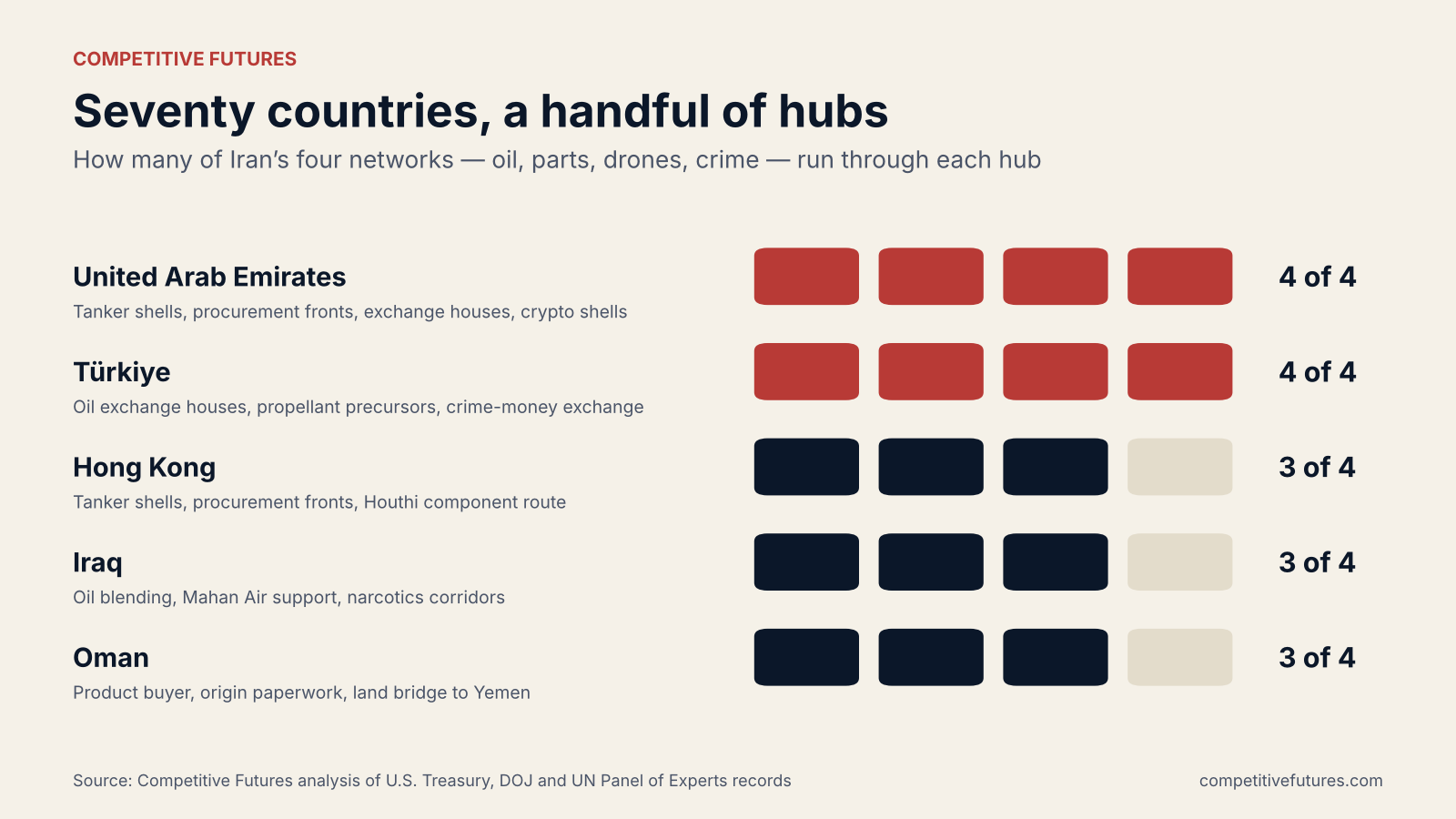
The United Arab Emirates appears in all four. Tanker shells, procurement fronts, exchange houses, crypto shells. Every single product line settles its payments in Dubai.
Go back and consider the Emirati investment in Western technology and defense. It’s looking riskier now, isn’t it?
Türkiye appears in all four. Oil exchange houses. Missile propellant precursors and machinery finance. Zindashti’s home base. The crime-money exchange house. Quite a lot for a member of the NATO alliance.
Hong Kong appears in three. Tanker shells, procurement fronts, the Houthi component route. For a city that used to sell the world on its rule of law, it backs up some heavy dictatorships.
Iraq appears in three and hosts the militias that get the drones. Oil blending. Mahan Air support. Narcotics corridors. And the militia that launders fuel oil is the militia that flies the Shahed. Their remediation since Saddam Hussein could use some spit-polish.
Oman appears in three. Product buyer, origin paperwork, land bridge to Yemen.
Russia is a customer for drones, a supplier of jets, a partner in the shadow fleet, and a crypto off-ramp. But let’s be fair, it’s not like we expect any better from Putin.
Venezuela is an oil partner, a drone factory, and a cartel bridge. Sorry. Was. That’s done now.
And the carriers are the same. Mahan Air. The National Iranian Tanker Company and its ghost fleet. One ship — the Skipper — that ran Iranian oil to Syria and Venezuelan oil to Cuba on the same Revolutionary Guard account. One man — Zindashti — who is a drug lord at home and an assassination contractor abroad.
Seventy countries, but the system runs through about six cities. Dubai. Istanbul. Hong Kong. Basra. Muscat. Kuala Lumpur — or more precisely, a patch of water off Johor.
That’s why I don’t think “Iran’s oil network” or “Iran’s drone program” or “Iran’s terror plots” are the right units of analysis. They’re products. The unit of analysis is the rail. And the rail is what the U.S. government has actually been targeting — go back and look at the designation pattern of the last two years. Teapot refineries and the banks that serve them. The ship-to-ship zone. The Basra blending terminals. The Dubai exchange houses. And a Swedish street gang, sanctioned as organized crime. They’re not chasing barrels. They’re chasing the rails of this trafficking network.
How to read a sanctions designation yourself
Here’s the payload — the part you can reuse the next time any of this is in the news.
When you see a Treasury or State Department press release about Iran — or Russia, or anybody — don’t read the headline. Scroll to the entity list. Then ask three questions.
One: what country is each address in? Not the target country. The addresses. That’s your beneficiary list, and it’s usually not who the headline is about.
Two: what did each one do — supply, launder, carry, flag, or buy? Those are the five jobs. Every entity on the list does one of them. A textile company in Türkiye shipping cotton is a supplier. A Hong Kong limited company that owns a tanker is a flag-and-launder. A Shandong refinery is a buyer.
Three: have I seen this address before, on a different list? That’s the whole game. When the Dubai company on the oil designation shares an address with the Dubai company on the drone designation — that’s not a coincidence, and it’s not a conspiracy theory. It’s a logistics network with two customers.
Where to look (links below): the Treasury press release page — search “Iran.” OFAC’s sanctions list search, where you can type in a company name and see when it was designated and under what authority. The EIA’s report on Iranian oil exports — it’s a PDF, it’s free, and it’s the source for the ninety-nine percent number. The Justice Department’s press releases — search “IRGC.” And the UN Panel of Experts reports on Yemen, which are the best open-source documents on the drone supply chain that exist.
None of that is classified. None of it needs a source in the government. It’s the government telling you, in its own words, who’s on the payroll. All it takes is reading the list instead of the headline — and writing down the addresses.
One customer, six cities, the same ship
I said at the start it’s seventy countries, and it is. But I hope what you’re taking away is that seventy isn’t the number that matters. The number that matters is one customer, six cities, and the same ship. China is the indispensable partner in this mess. And it should make every nation reconsider its diplomatic position toward the country.
As for Iran, a sanctioned economy is not a dead economy. It’s a rerouted one. And the routes are written down — by the people sanctioning it. Read those, and you’ll understand more about how Iran actually operates in the world than you will from a hundred hours of people arguing about it on television.
Keep thinking.