How to Think About Iran Negotiating with Trump
President Trump gave whoever left in Iran with the ability to negotiate 48 hours to surrender, or he will supposedly destroy Iran’s electrical grid to the point that it will take roughly a quarter century to rebuild.
Intelligence analysts are wondering who is even left to negotiate?
This is a key question because Trump’s first move in the war was a decapitation strike killing the Supreme Leader and his entire inner circle. The question is—who has the authority to speak for all of Iran? And if they have the authority, do they have the popular support for whatever position they take in the negotiation?
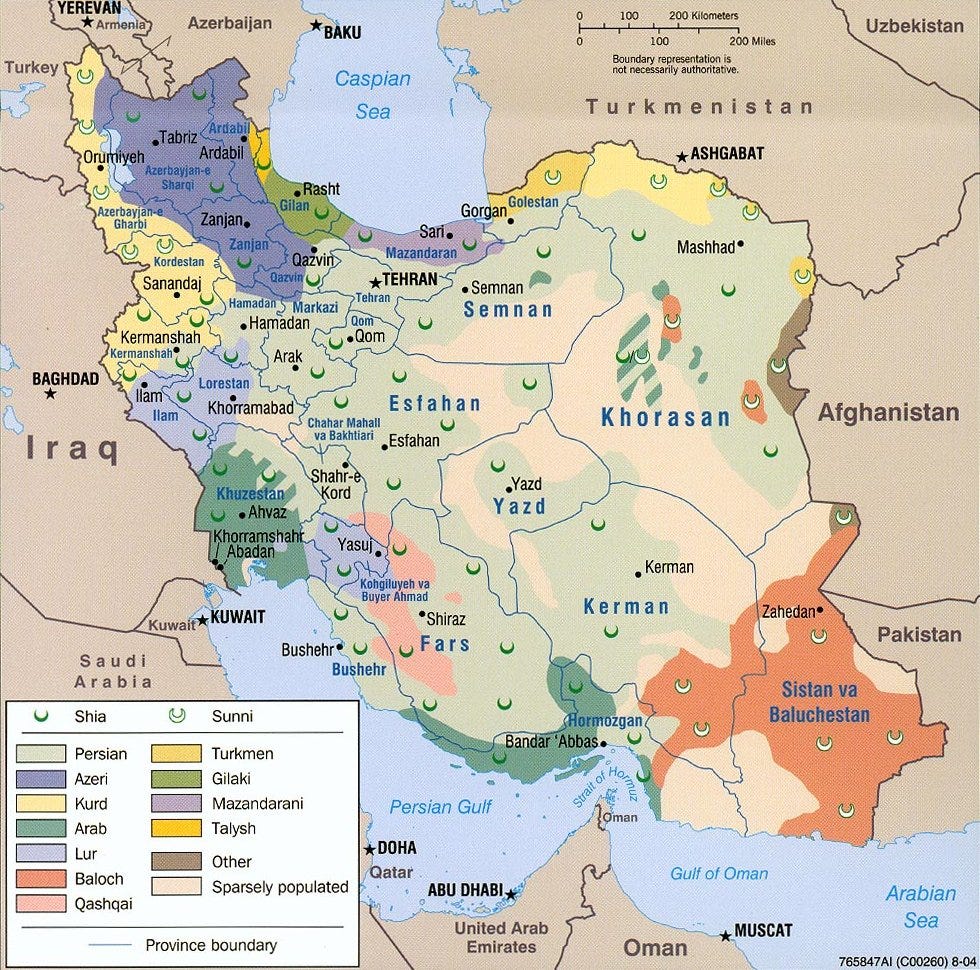
Iran’s regime was a brutal Persian-ethnic theocracy in a country where only 57% of the population speaks Persian as their mother tongue. There are Azeri Turks, Kurds, and other ethnic minorities that make up a powerful plurality in the country.
Beware of Centralization Bias
There is a natural tendency to assume that one group is still in charge of a country. It’s called the bias toward centralized direction. It comes from Richards Heuer’s Psychology of Intelligence Analysis — the man who literally wrote the training manual for how CIA analysts are supposed to think.
According to Heuer, human beings have a natural tendency to assume that what happens in a country is the result of centralized, intentional planning by whoever appears to be in charge.
We see a flag. We see a Supreme Leader. We assume that leader controls the action.
But at moments like this one, that assumption needs to be tested against the best intelligence available—because the old regime might collapse entirely. Long-repressed ethnic groups might see an opening to negotiate for themselves. Factions once loyal to the Mullahs might see such loyalty as fatal if the regime appears to be doomed, giving foreign intelligence operatives a chance to buy some new friends.
So we are waiting to see what “Iran” does in response to Trump’s demand—but there might not be a single regime capable of formulating a position for a negotiation. Having shattered their normal methods of communication, the remaining power player could have real difficulty reaching an agreed-upon position, which is still desirable even with dictatorships.
There might not still be an Iranian regime capable of surrendering to the United States. We shall see.
The case of Venezuela shows that the United States seems capable of communicating with a new regime even after a decapitation strike. Two weeks after we arrested Nicolas Maduro, the Director of the CIA was able to come for a visit, and before long the United States even re-opened its embassy in the country.
Once Iran is potentially stabilized, Cuba will be next.
These are fascinating times for intelligence analysts!
Keep thinking.
If you would like to improve your company’s analytic capabilities, consider a training session from Competitive Futures.
Looking for a keynote speaker on geopolitics or future trends? I’m represented by the lovely professionals at Executive Speakers Bureau. Check out my latest.
First published on Game Theory Today (Substack), April 4, 2026.
Related analysis from Competitive Futures
- The Facts Are Clear: The New Iran Deal Is a Vast Improvement — how the deal came out
- Trump vs. Iran: Negotiating With the Black Knight — the negotiation, on video
- Seventy Countries, Six Cities: The Global Network Behind Iran — why Iran can’t simply surrender
Want this kind of analysis for your organization? Contact Competitive Futures or learn more about Eric Garland.
About Competitive Futures
Competitive Futures has provided strategic intelligence and foresight to corporate and government clients since 2002. Its principal, Eric Garland, publishes analysis here, on Game Theory Today, and in the Systemics Quarterly Brief.
Read next
- Seventy Countries, Six Cities: The Global Network Behind Iran
- The Systemics Quarterly Brief: 2026 Prospectus
- Strategic intelligence services for executives and governments
- All analysis from Competitive Futures
Stay in touch
Leave your email and a note about the Brief, a briefing for your team, or this piece, and we will be in touch.