Sherman Kent: The Father of Intelligence Analysis and the Words of Estimative Probability
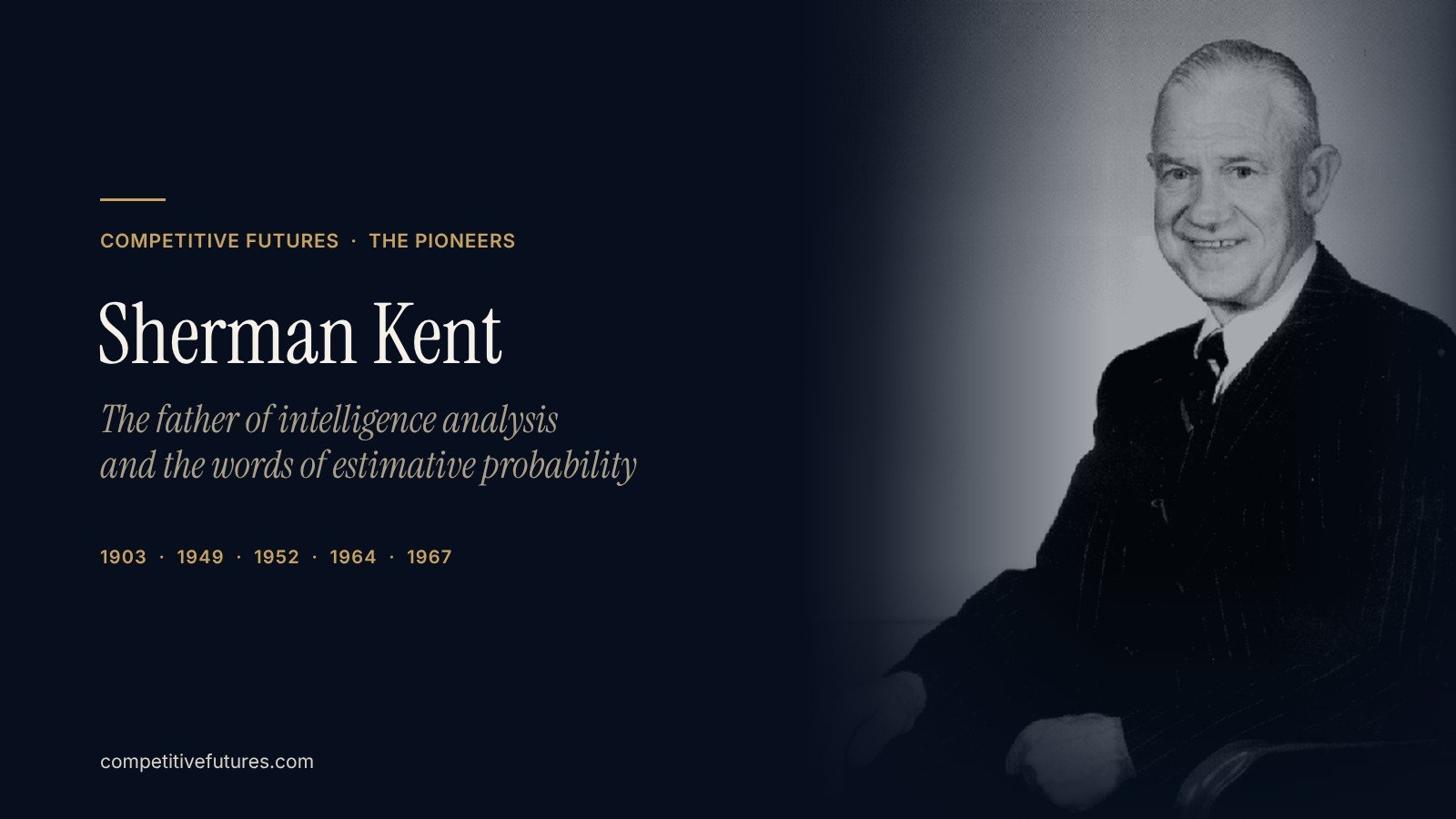
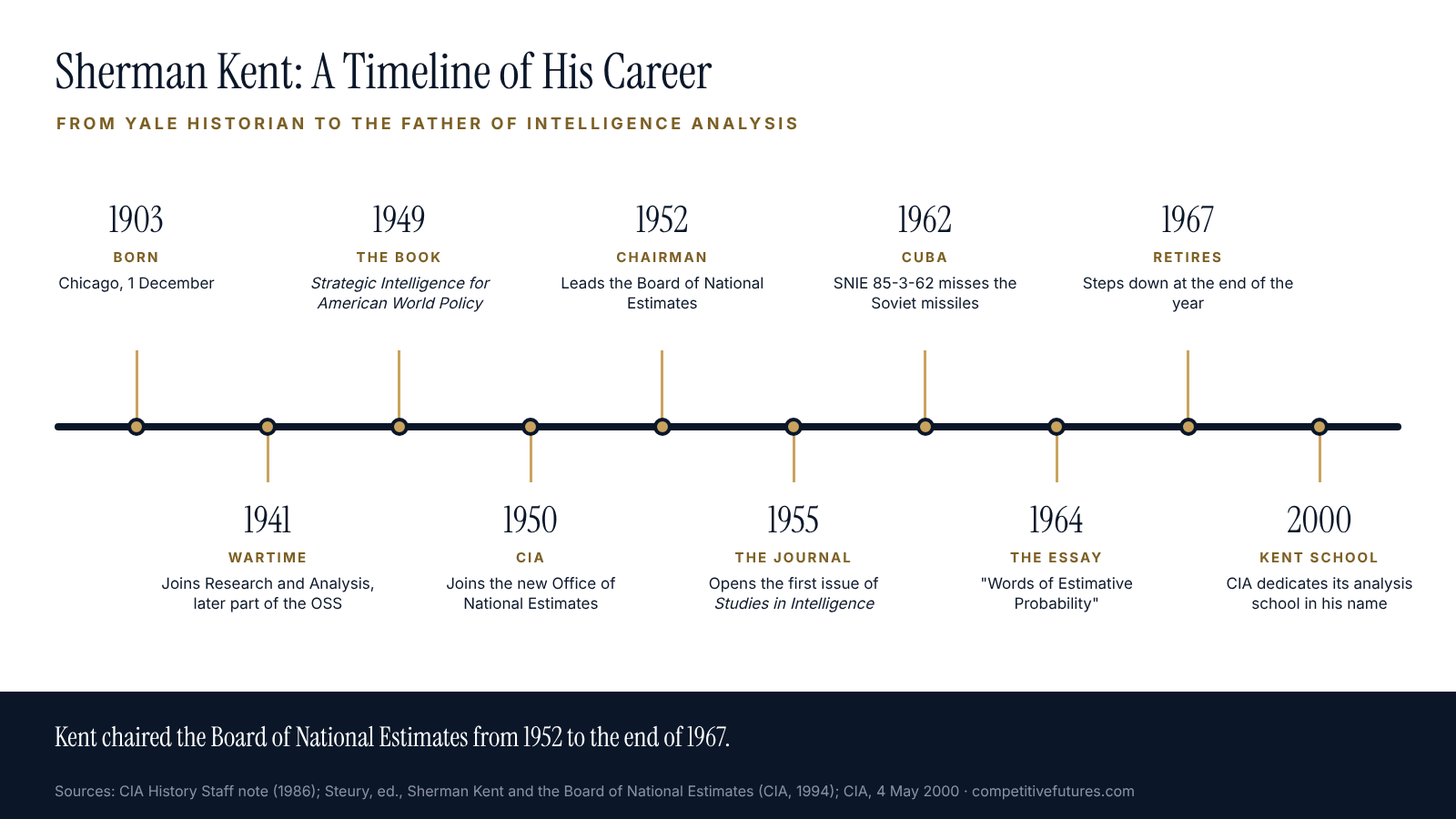
Sherman Kent (1903–1986) was a Yale historian who spent the Second World War in the Research and Analysis Branch of the Office of Strategic Services and then 17 years at the Central Intelligence Agency, where he chaired the Board of National Estimates from 1952 to 1967. He wrote the first serious American book on intelligence analysis, founded the profession’s journal, and argued that analysts should attach consistent odds to the words they use for likelihood. He is often called the father of intelligence analysis.
That last argument, set out in his 1964 essay “Words of Estimative Probability,” is the part of his work most people meet first. It is also the part that matters most to anyone who has to read a forecast and act on it. When an analyst writes “probable,” the reader should know whether that means a coin flip or three chances in four.
At a glance
- Born: 1 December 1903, Chicago. Died: 11 March 1986, Washington, D.C.
- Education: Ph.B. (1926) and Ph.D. in history (1933), Yale University. His field was 19th-century French politics.
- Wartime: Research and Analysis Branch, Coordinator of Information and then OSS, from 1941; chief of the Europe-Africa Division from January 1943.
- CIA: Joined the new Office of National Estimates in November 1950; chairman of the Board of National Estimates from early 1952 until the end of 1967.
- Key works: Strategic Intelligence for American World Policy (Princeton University Press, 1949); “The Need for an Intelligence Literature” (Studies in Intelligence, 1955); “Words of Estimative Probability” (Studies in Intelligence, 1964).
- Legacy: National Intelligence Estimates as a disciplined product; a professional literature of intelligence; a fixed vocabulary for likelihood; the CIA’s Sherman Kent School for Intelligence Analysis, dedicated in 2000.
From Yale historian to wartime analyst
Kent was born in Chicago, the son of William Kent, who served three terms in Congress from California, and he spent much of his childhood in California and Nevada. He took his undergraduate degree at Yale in 1926 and his doctorate there in 1933, and taught history at Yale from 1928. His scholarship was on French electoral politics in the 1820s and 1840s, and in 1941 he published Writing History, a short guide to historical method.
That method is what he brought to intelligence. In 1941 he joined the Research and Analysis Branch, the group of academics that became the analytic core of the OSS, and in January 1943 he became chief of its Europe-Africa Division. The branch’s job was to answer questions for planners from open and secret sources: what a country produced, how its railways ran, how its population would respond. Kent learned there that good analysis looked a great deal like good scholarship, done fast and for a customer.
Strategic Intelligence for American World Policy
After the war Kent worked briefly at the State Department, taught at the National War College, and returned to Yale, where he wrote Strategic Intelligence for American World Policy (Princeton University Press, 1949). It is still the starting point for the field.
The book is built in three parts: intelligence is knowledge, intelligence is organization, and intelligence is activity. Kent divided the knowledge itself into three elements. The descriptive element covers what a country is: its resources, industry, population, and institutions. The reportorial element tracks what is changing. The speculative-evaluative element, the hardest, judges what is likely to happen next. Much of what intelligence services call “basic,” “current,” and “estimative” intelligence follows that division.
He also set out the problem that has run through the profession ever since: the relationship between analysts and the officials they serve. Kent wanted analysts independent enough to stay objective and close enough to policymakers to stay relevant. The political scientist Willmoore Kendall, reviewing the book in 1949, argued that this kept intelligence too far from the decisions it was supposed to inform. The Kent-Kendall debate is still taught, and both sides of it still show up in every intelligence organization, in government or in business.
The Board of National Estimates
In November 1950, during the Korean War, the new Director of Central Intelligence, General Walter Bedell Smith, brought the Harvard historian William Langer and Kent into the CIA to rebuild its analysis. They set up the Office of National Estimates and its Board of National Estimates, a small group of senior experts who drafted and argued over National Intelligence Estimates before they went to the President. When Langer returned to Harvard early in 1952, Kent succeeded him, and he chaired the Board until he retired at the end of 1967.
Under Kent the National Intelligence Estimate became a recognizable product, with its own conventions for how judgments were reached, coordinated across agencies, and written. He had a working definition of the task that has outlasted him: “Estimating is what you do when you do not know.”
He also argued that the profession needed a written record of its own methods. In “The Need for an Intelligence Literature,” published in the first issue of Studies in Intelligence in September 1955, he made the case for a journal in which officers would write down what they had learned. Studies has published ever since.
The phrase that started it: NIE 29-51
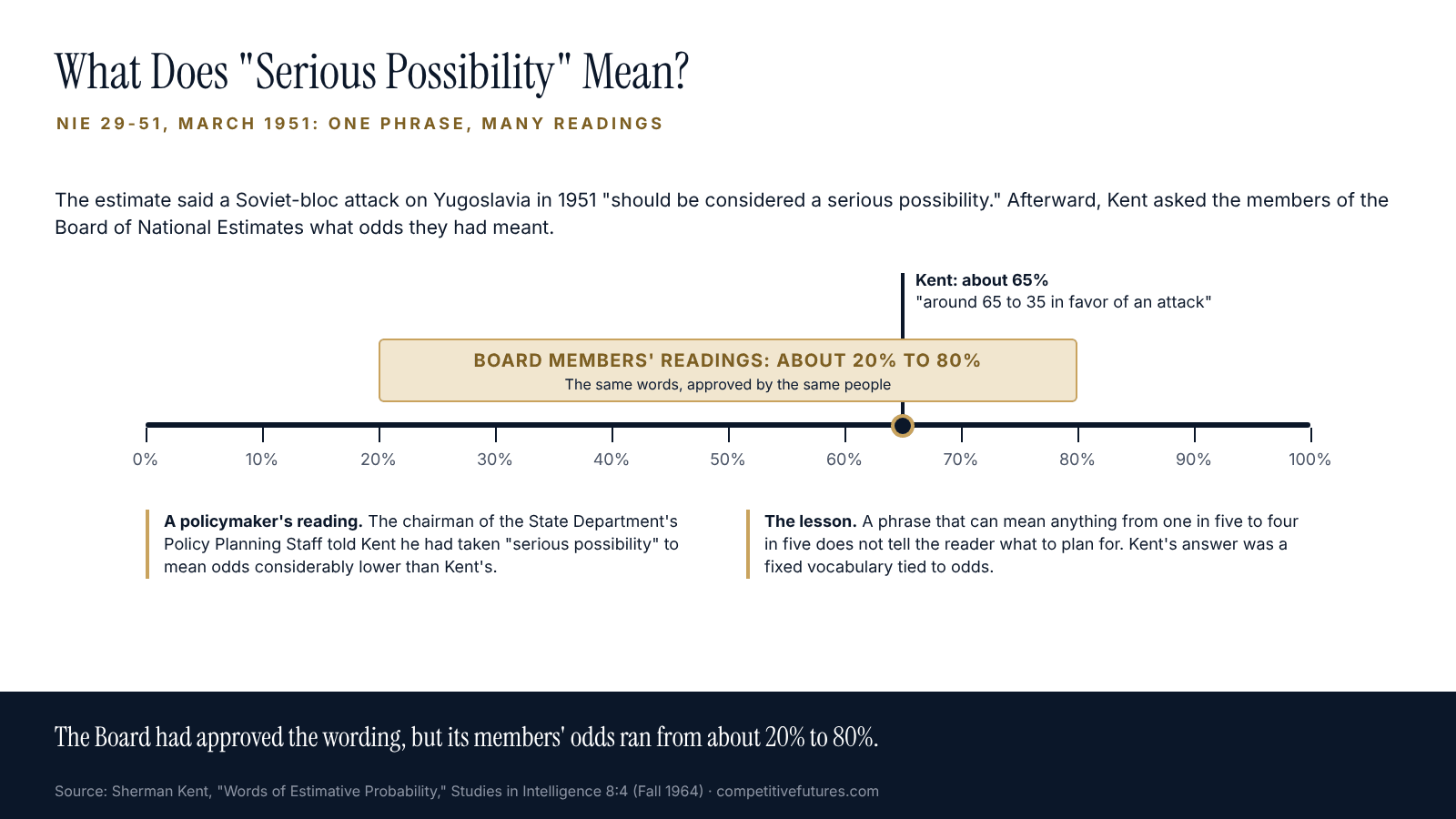
In March 1951 the Board issued NIE 29-51, on the probability of a Soviet-bloc invasion of Yugoslavia that year. Its key judgment was that an attack “should be considered a serious possibility.”
Afterward, the chairman of the State Department’s Policy Planning Staff asked Kent what odds that meant. Kent’s own reading was “around 65 to 35 in favor of an attack.” The State Department reader had taken it to mean something considerably lower. Kent then asked his colleagues on the Board, the people who had approved the wording, what odds they had in mind. Their answers ran from about 20 percent to about 80 percent.
The estimate had passed through the full process, and the people who wrote it agreed on every word. They did not agree on what the words meant, and the reader had no way to find out.
Words of estimative probability: the chart
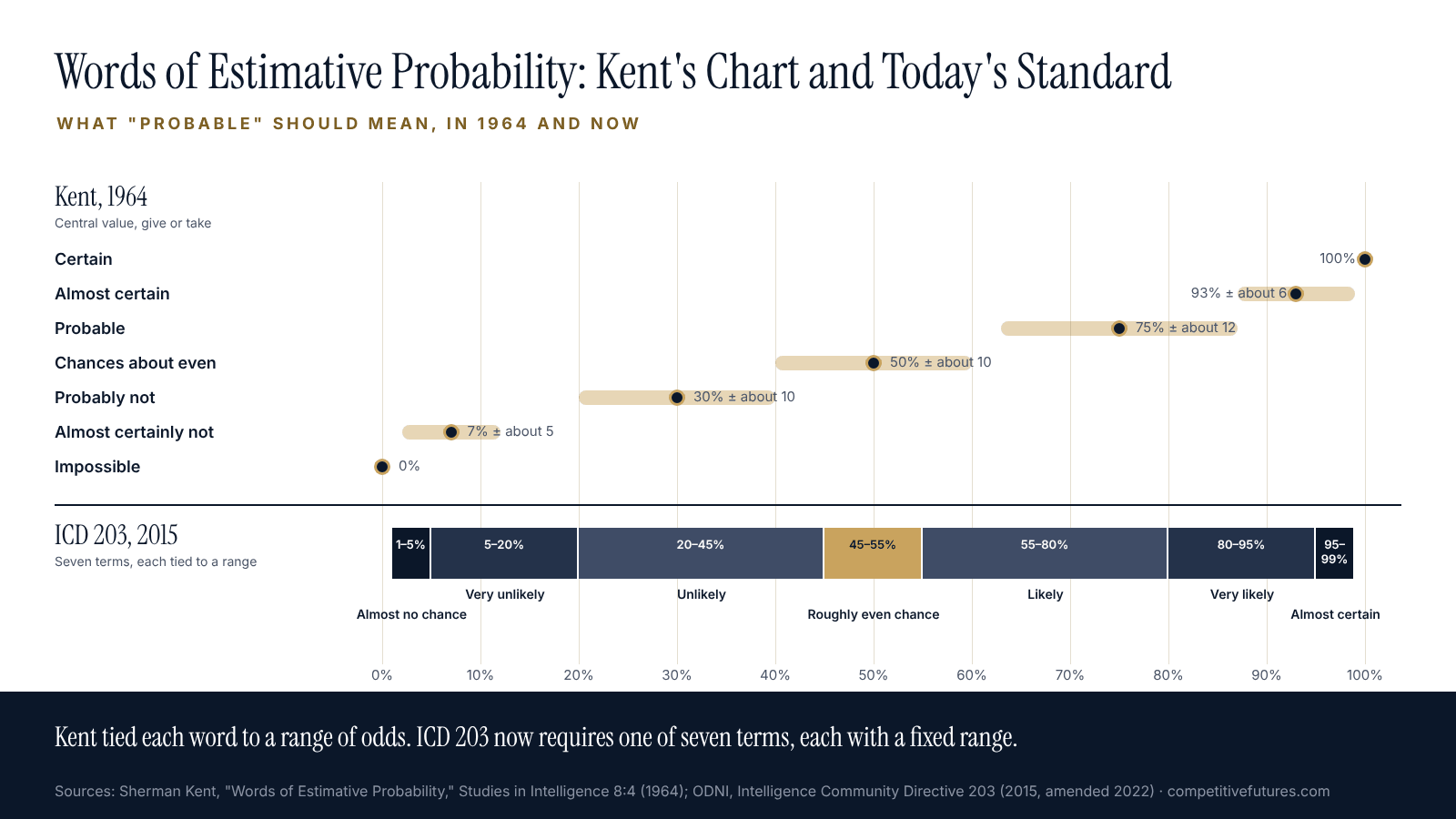
Kent’s answer, worked out with a colleague and published in the Fall 1964 issue of Studies in Intelligence, was a short list of terms tied to ranges of odds:
| Term | Kent’s odds |
|---|---|
| Certain | 100% |
| Almost certain | 93%, give or take about 6% |
| Probable | 75%, give or take about 12% |
| Chances about even | 50%, give or take about 10% |
| Probably not | 30%, give or take about 10% |
| Almost certainly not | 7%, give or take about 5% |
| Impossible | 0% |
Each row came with acceptable synonyms. “Likely,” “we believe,” and “we estimate” sat with “probable.” “Unlikely,” “improbable,” and “we doubt” sat with “probably not.” “Highly likely” and “virtually certain” sat with “almost certain.”
Kent was strict about one word. “Possible” and its cognates, he wrote, must not be modified. If the odds could not be judged, analysts should say an event was possible and stop there, without implying a number they did not have. Phrases like “serious possibility” were exactly what had gone wrong in 1951.
He knew he was fighting his own colleagues. He called the analysts who resisted numbers “poets,” people who believed the full range of English was needed to convey a judgment and that fixed definitions would make prose wooden. He called his own side “mathematicians.” The poets largely won in his lifetime: the essay itself admits that the Board did not adopt the scale.
Cuba, 1962: the estimate Kent got wrong
Kent’s reputation does not rest on a perfect record. On 19 September 1962 the United States Intelligence Board approved Special National Intelligence Estimate 85-3-62, “The Military Buildup in Cuba.” It judged that placing Soviet offensive missiles in Cuba would be incompatible with Soviet practice to date. U-2 photographs taken on 14 October showed the missiles.
Kent wrote about the failure himself, in “A Crucial Estimate Relived,” published in Studies in Intelligence in 1964. He did not dodge it: “There is no blinking the fact that we came down on the wrong side.” He argued that the Board had reasoned carefully from the evidence it had and from Soviet behavior up to that point, and that the Soviet leader had made a choice that broke with that behavior. Critics have argued since that the Board leaned too heavily on what Moscow had done before. Both readings are useful. An estimate built on past behavior is most likely to fail at the moment an adversary decides to change it, which is when the estimate matters most.
Kent’s influence today
Kent retired at the end of 1967. He received the National Civil Service Award in 1961 and the President’s Award for Distinguished Federal Service in 1967. In retirement he wrote monographs for the CIA History Staff, later collected as Sherman Kent and the Board of National Estimates (1994), and returned to French history. He died in Washington on 11 March 1986.
In 1997 the CIA named him one of its 50 “trailblazers.” In December 1999 its analytic directorate created the Sherman Kent School for Intelligence Analysis, a training school Kent had first proposed in December 1953, and the school was formally dedicated on 4 May 2000.
His vocabulary idea has had a longer life than the Board that rejected it. The US intelligence community’s analytic standards, Intelligence Community Directive 203 (first issued in 2007; current version signed in 2015 and amended in 2022), require analysts to explain the uncertainty in their major judgments. For likelihood, products must use one of a fixed set of terms, each tied to a range: almost no chance (1–5%), very unlikely (5–20%), unlikely (20–45%), roughly even chance (45–55%), likely (55–80%), very likely (80–95%), and almost certain (95–99%). The ranges differ from Kent’s, and the directive pairs them with a separate statement of the analyst’s confidence, but the underlying rule is the one Kent argued for in 1964.
What Kent means for business and strategy
Every company that buys a forecast has the NIE 29-51 problem. A market study says a competitor is “likely” to enter. A risk memo calls a supply disruption “possible.” A board paper calls a regulatory change a “real risk.” Each reader translates the phrase into a number privately, and the numbers are rarely the same. Decisions then rest on a disagreement nobody can see. Kent’s work points to five habits for an intelligence function:
- Fix the vocabulary. Agree on a short list of likelihood terms and the range each one means, write it down, and use it in every product. A reader should never have to guess.
- Separate what you know from what you judge. Kent’s three elements still work: describe the situation, report what is changing, and then estimate, and make clear which is which.
- Say how confident you are, separately. Likelihood and confidence are different questions. A judgment can be “likely” on thin evidence or on strong evidence, and the reader needs to know which.
- Stay independent, and stay relevant. An intelligence function that reports to the people whose plans it assesses will drift toward their conclusions. One that never talks to them will answer the wrong questions.
- Review your misses in writing. Kent wrote up Cuba himself. Recording what went wrong, and why, is how an intelligence function improves its next estimate.
In our own intelligence products we tier the evidence behind each judgment and keep likelihood language consistent from one report to the next, because a client comparing two of our assessments should be able to compare the odds too.
Frequently asked questions
Who was Sherman Kent?
Sherman Kent (1903–1986) was a Yale history professor who served in the OSS Research and Analysis Branch during the Second World War and then at the CIA from 1950 to 1967, chairing the Board of National Estimates from 1952. He wrote Strategic Intelligence for American World Policy (1949) and is often called the father of intelligence analysis.
What are words of estimative probability?
Words of estimative probability are the terms analysts use to express how likely something is, such as “probable,” “unlikely,” or “almost certain.” Sherman Kent’s 1964 essay of that name argued that each term should be tied to a defined range of odds, so that readers understand a judgment the way the analyst meant it.
What odds did Sherman Kent assign to “probable”?
In his 1964 chart, Kent defined “probable” as about 75 percent, give or take about 12 percent. “Almost certain” was about 93 percent, “chances about even” about 50 percent, “probably not” about 30 percent, and “almost certainly not” about 7 percent.
Why is Sherman Kent called the father of intelligence analysis?
He wrote the field’s foundational book, ran the CIA’s National Intelligence Estimates for 15 years, founded the journal Studies in Intelligence to build a professional literature, and pushed for disciplined, consistent language in analytic judgments. The CIA named its school for analysts after him in 2000.
Did the US intelligence community adopt Kent’s scale?
Not in his time. The Board of National Estimates did not adopt it, and Kent acknowledged as much in 1964. The idea came back in Intelligence Community Directive 203, which now requires analysts to use one of a fixed set of likelihood terms, each with a defined percentage range, though the ranges differ from Kent’s.
What did Sherman Kent get wrong?
In September 1962 the estimate he oversaw on Cuba, SNIE 85-3-62, judged that the Soviet Union was unlikely to place offensive missiles there. U-2 photographs showed the missiles on 14 October. Kent wrote openly about the miss in 1964, which is one reason his work is still taught.
Work with Competitive Futures
We write intelligence for companies and governments that have to decide before the facts are complete, and we teach analysts and executives how to read and write judgments that hold up. If your team’s forecasts mean different things to different readers, request a 20-minute conversation.
Related analysis from Competitive Futures
- Richards Heuer: Father of Cognitive Bias in Intelligence
- Analysis of Competing Hypotheses
- Intelligence Analysis: How Professional Analysts Think
- The Return of Surprise: How Intelligence Analysis Has Changed, and What Never Will
- Strategic Surprise and Early Warning
- Herman Kahn: The Father of Scenario Planning
References
- Central Intelligence Agency, DCI History Staff. Biographical note on Sherman Kent, 12 March 1986. CIA-RDP91-00587R000100670007-3. https://www.cia.gov/readingroom/document/cia-rdp91-00587r000100670007-3
- Central Intelligence Agency. “Tenet Dedicates New School for Intelligence Analysis.” Press release, 4 May 2000.
- Davis, J. (1992). The Kent-Kendall debate of 1949. Studies in Intelligence, 35(2). https://www.cia.gov/resources/csi/studies-in-intelligence/1992-2/the-kent-kendall-debate-of-1949
- Kent, S. (1949). Strategic Intelligence for American World Policy. Princeton University Press.
- Kent, S. (1955). The need for an intelligence literature. Studies in Intelligence, 1(1). https://www.cia.gov/resources/csi/studies-in-intelligence/archives/vol-1-no-1/the-need-for-an-intelligence-literature/
- Kent, S. (1964). Words of estimative probability. Studies in Intelligence, 8(4). https://www.cia.gov/resources/csi/static/Words-of-Estimative-Probability.pdf
- Kent, S. (1964, Spring). A crucial estimate relived. Studies in Intelligence, 8. https://www.cia.gov/resources/csi/static/A-Crucial-Estimate-Relived.pdf
- Office of the Director of National Intelligence. Intelligence Community Directive 203: Analytic Standards (2015, amended 2022). https://www.dni.gov/files/documents/ICD/ICD-203.pdf
- Scoblic, J. P. (2018). Beacon and warning: Sherman Kent, scientific hubris, and the CIA’s Office of National Estimates. Texas National Security Review, 1(4). https://doi.org/10.15781/T2J38M448
- Steury, D. P. (Ed.). (1994). Sherman Kent and the Board of National Estimates: Collected Essays. Center for the Study of Intelligence, CIA. https://www.cia.gov/resources/csi/books-monographs/sherman-kent-and-the-board-of-national-estimates-collected-essays-2
- United States Intelligence Board. Special National Intelligence Estimate 85-3-62, “The Military Buildup in Cuba,” 19 September 1962.
- Yale University Library, Manuscripts and Archives. Guide to the Sherman Kent Papers (MS 854).
This piece is part of our guide to The Pioneers of Strategy, Intelligence, and Foresight.