Iran Helped Russia Attack Ukraine and NATO: What the Public Record Shows
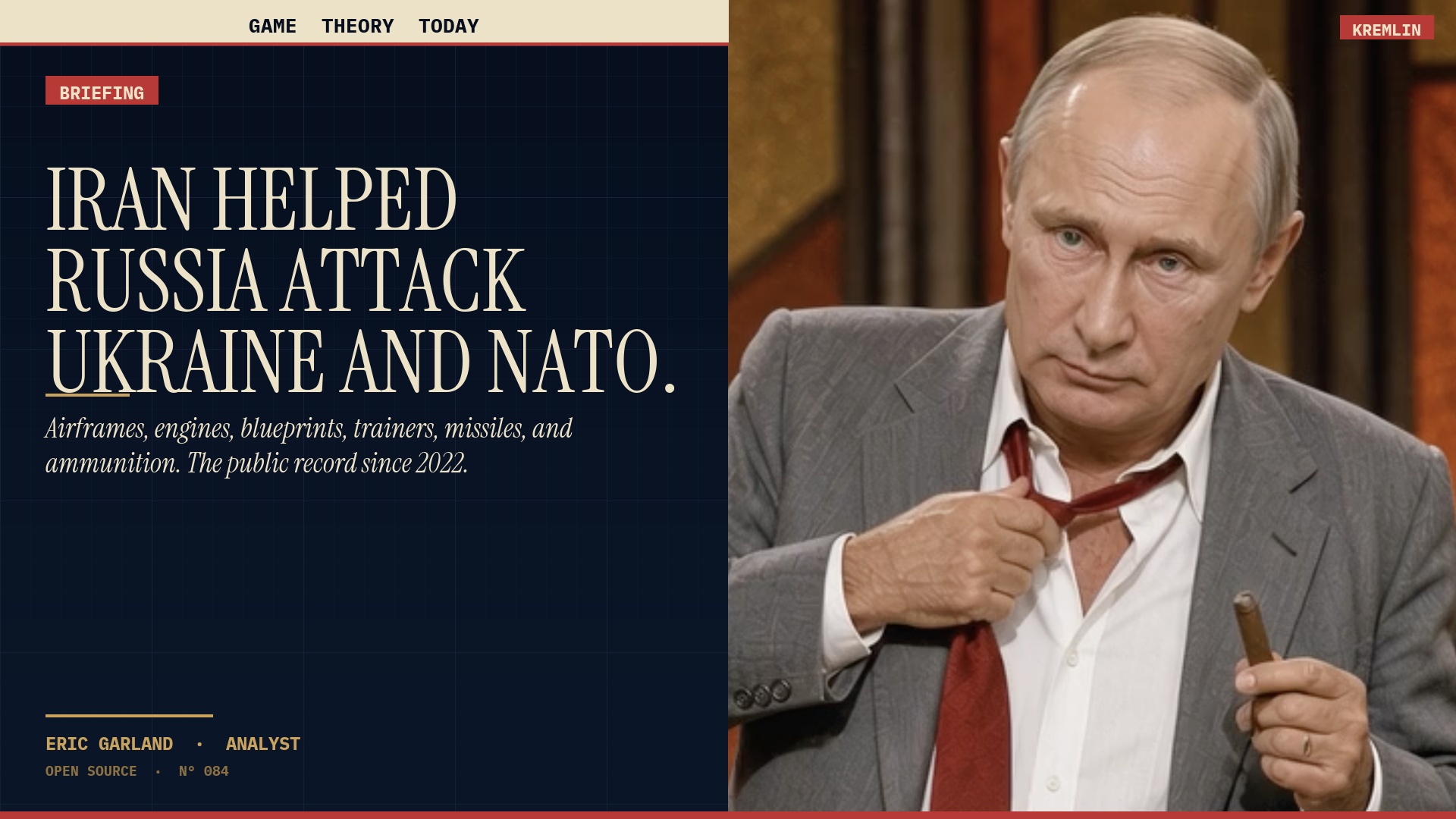
A claim has been circulating since the start of the Iran war in February 2026, often from people who otherwise want Ukraine to win and NATO defended: Iran was a regional problem, a nuclear problem, a human-rights problem, but never a threat to the United States or Europe. In the episode of Game Theory Today embedded above, Eric Garland tests that claim against the public record. This page sets out the same record in writing, limited to the period after Russia’s full-scale invasion of Ukraine in February 2022, so that readers can check each item themselves.
The short version: between 2022 and 2024, Iran supplied Russia with attack drones, the designs and training to build them, close-range ballistic missiles, and artillery ammunition. Three NATO governments called one of those transfers a direct threat to European security. The weapon Iran designed has since crossed into NATO airspace. None of this is contested by the governments involved, and most of it is documented in sanctions notices, court filings, and testimony to Congress.
The drones, 2022 to 2023
On July 11, 2022, the White House said U.S. intelligence showed Iran preparing to send Russia up to several hundred drones and to train Russian forces on them. The first Shahed-136 and Shahed-131 shipments arrived in Russia in mid-August. On September 8, the U.S. Treasury sanctioned Safiran Airport Services for coordinating the Russian military flights that carried them, along with the Iranian companies that built them. On September 13, the first wreckage turned up near Kupiansk in Kharkiv oblast, with “Geran-2” in Cyrillic over an Iranian part number.
On October 20, 2022, the White House said Iranian military personnel were in Crimea, training Russian crews and providing technical support. The same day the United Kingdom sanctioned the chief of staff of Iran’s armed forces, the general who negotiated the drone deal, and the commander of the Revolutionary Guard’s drone force. On November 5, Iran’s foreign minister acknowledged, for the first and only time, that Iran had given Russia drones. He said the number was small and the delivery predated the war. Every other government involved says hundreds, during the war.
The forensic record followed. In February 2023 the Defense Intelligence Agency published an unclassified visual comparison of components recovered in Ukraine against Iranian drones from the Middle East, and updated it in August with debris from an attack in Iraq that Iran had publicly claimed. Conflict Armament Research, which disassembles weapons in the field, identified the Iranian engine maker and found a component manufactured in January 2023 inside a drone shot down in April 2023, a supply-to-battlefield cycle of about 3 months. In May 2023 the United Kingdom told the UN Security Council that Iran had transferred more than 400 attack drones to Russia in breach of Resolution 2231. Russia blocked a UN examination of the debris.
The factory, 2023 to 2025
The transfers became a production line. On June 9, 2023, the White House released satellite imagery and a shipping route: drones built in Iran, carried across the Caspian from Amirabad to Makhachkala, and Iranian materials flowing to a new plant in the Alabuga Special Economic Zone in Tatarstan. Leaked internal documents from the plant, published in August 2023, described a deal for 6,000 Geran-2 drones by summer 2025 in 3 stages, from assembling Iranian kits to full local production, with Iran demanding payment in dollars and gold and about 300 Russian staff and students sent to Iran for training.
Treasury sanctioned the Alabuga zone itself, its general director, and a dozen subsidiaries on February 23, 2024, stating that Alabuga held a contract with the Russian military to assemble Iranian-shipped drones while localizing production. On April 25, 2024, Treasury sanctioned Sahara Thunder, a front for Iran’s Ministry of Defense, and put a figure on the contract: $1.75 billion. In April 2025, General Christopher Cavoli, then Supreme Allied Commander Europe, told the Senate Armed Services Committee in writing that Iran had sold Russia thousands of Shaheds and transferred the licenses and technology to produce them in Russia.
The Justice Department has two cases on the supply chain. A December 2023 indictment charged an Iranian national with procuring U.S. microelectronics for the Revolutionary Guard’s one-way attack drone program, with components found in drones used in Ukraine. An April 2025 criminal complaint in the Eastern District of New York concerned parts for the Mohajer-6, citing a drone shot down over Ukraine in September 2022 that contained components made in Brooklyn. The cases span two administrations.
The scale is now Russian. Ukraine’s Air Force counted 54,500 Shahed-type drones launched in 2025 alone. Ukrainian military intelligence estimates Russia now builds about 3,000 jet-powered Geran-4 and Geran-5 drones a month. The line began with an Iranian blueprint.
The missiles, 2024
On September 10, 2024, the United States confirmed that Russia had received Iranian Fath-360 close-range ballistic missiles, and the Pentagon confirmed it the same day. Treasury designated 10 people, 6 entities, and 4 ships and set out the chain: a contract signed in late 2023 for hundreds of missiles, Russian crews trained in Iran in summer 2024, and a first shipment received in early September aboard the vessel Port Olya-3.
The same day, the United Kingdom, France, and Germany issued a joint statement calling the transfer “a direct threat to European security” and cancelled their bilateral air service agreements with Iran. The European Union followed with sanctions in October and November 2024.
The ammunition, and the flow reverses
In February 2023 the White House said Iran had supplied artillery and tank rounds to Russia the previous November. In September 2024 the State Department designated, by name, ships that carried munitions from Iran to Russia across the Caspian. General Cavoli told the Senate that Iran had donated large quantities of artillery ammunition. Estonia’s foreign intelligence service estimates that 5 to 7 million artillery rounds reached Russia from Iran and North Korea combined since 2023.
Russia has since paid in kind: Yak-130 trainer aircraft, Su-35 fighters built for an Iranian customer, and, since the Iran war began on February 28, 2026, targeting intelligence, satellite imagery, upgraded Shahed variants, drone components, and explosives moving back across the same Caspian route. The Chairman of the Joint Chiefs of Staff told the Senate in April 2026 that Russia is “definitely acting to support Iran.” This week Russia was reported to have contracted to supply Iran with 90 helicopter-mounted missile launchers of the type used in Ukraine. The Institute for the Study of War describes the result as a complete technological feedback loop: Iranian drones, improved by 3 years of use against Ukraine, returning to Iran for use against American forces.
Why this reaches NATO
Ukraine is not a NATO member, and the objection is predictable: where is the threat to the alliance? There are 3 answers in the record.
First, 3 NATO governments have already said so. The UK, France, and Germany called the missile transfer a direct threat to European security in writing in September 2024, 18 months before the Iran war, and have not withdrawn the statement.
Second, the weapon has crossed the line. In September 2025, Shahed-type drones entered Polish airspace and NATO invoked Article 4. Those drones exist in the thousands because Iran sold Russia the design, the kits, the trainers, and the production know-how. A Russian drone over Poland, Romania, or the Baltics is an Iranian-origin threat whether or not Tehran pressed the button.
Third, the capability came home improved. Drones Iran supplied to Russia returned to Iran upgraded and were fired at American forces in 2026, while Russian satellites watched U.S. air bases in the Gulf. A state that built Russia’s cheap long-range strike capability is not a bystander to the war against Ukraine. It is a co-belligerent, and the threat to the alliance follows from that by construction.
What the record does not show
Iran’s direct supply peaked in 2023 and 2024. Russia has localized about 90% of the drone line and switched to Chinese engines, and by 2026 Iran’s share of the Shahed supply chain is minor. North Korea replaced Iran as Russia’s main source of shells. The last documented Iranian cargo into Russia was a ship Ukraine struck at Port Olya in August 2025.
The accurate statement is therefore not “Iran is arming Russia today.” It is that Iran built the capability Russia uses against Ukraine and NATO, was paid in gold for it, and is now being repaid in kind. Iran’s role shrank because Russia learned to build the weapon itself, not because of a change in policy in Tehran. A supplier replaced by his own customer was still the supplier.
What this means for companies and governments
- Sanctions exposure is layered and durable. The Iran-Russia supply chain is covered by overlapping U.S., UK, and EU designations dating from 2022 to 2026, including front companies, shipping, and the Alabuga zone. Counterparties in Türkiye, the UAE, Central Asia, and the Caspian shipping trade carry the highest risk. Our guide to U.S. sanctions and OFAC covers how designations propagate.
- Dual-use procurement is the enforcement target. Both Justice Department cases turn on ordinary electronics bought through intermediaries. Exporters of microelectronics, navigation modules, and engines should expect continued end-use scrutiny.
- The threat model for European facilities has changed. Cheap long-range drones in the thousands, now built in Russia, are the standing risk for infrastructure on NATO’s eastern flank. The Polish incident of September 2025 is the reference case.
- Expect the loop to keep turning. Russian support to Iran since February 2026 means lessons from Ukraine reach the Gulf quickly. Planning assumptions for the region should treat the two theaters as one supply chain.
Frequently asked questions
Did Iran give Russia the Shahed drones used in Ukraine?
Yes. The White House, the U.S. Treasury, the Defense Intelligence Agency, the United Kingdom, and independent forensic examiners all documented Iranian-built Shahed-136 and Shahed-131 drones in Russian service from August 2022. Iran’s own foreign minister acknowledged a transfer in November 2022. Russia later localized production at Alabuga under a $1.75 billion contract.
Did Iran supply Russia with ballistic missiles?
Yes. On September 10, 2024, the United States confirmed delivery of Iranian Fath-360 close-range ballistic missiles to Russia. Treasury designated the people, companies, and ships involved, and the UK, France, and Germany called the transfer a direct threat to European security.
Is Iran still arming Russia?
Only marginally. Iran’s direct supply peaked in 2023 and 2024. Russia now builds about 90% of the drone line itself, and North Korea became the main source of artillery shells. Since February 2026 the flow has largely reversed, with Russia supplying Iran.
How does Iranian support for Russia threaten NATO?
Three ways documented in the record: the UK, France, and Germany formally described the missile transfer as a direct threat to European security; Shahed-type drones built from the Iranian design crossed into Polish airspace in September 2025, triggering NATO Article 4 consultations; and the drones returned to Iran improved and were used against American forces in 2026.
Related reading
- Iranian Intelligence
- Russian Intelligence
- U.S. Sanctions Risk (OFAC)
- Intelligence Services Around the World
Competitive Futures briefs companies and governments on sanctions exposure, dual-use supply chains, and the Russia-Iran axis; details are on the services page.