What Is a Futurist? What They Do and How They Work
Read this page in: Français · Español · Português · Deutsch · Nederlands · Italiano · 日本語 · 한국어 · Bahasa Indonesia · Polski · Čeština · Svenska · Dansk · Norsk (bokmål) · Suomi · Ελληνικά · Türkçe · Eesti
A futurist is a professional who studies the trends that could change an industry, an institution, or a country, works out what those changes would mean, and helps leaders decide what to do about them. A futurist does not predict the future. Nobody can. The job is to give decision makers a better view of what is coming than they would have had otherwise, early enough to act on it.
At a glance
- What a futurist does: researches trends, evaluates other people’s forecasts, traces their implications, builds scenarios, and communicates the results to the people who have to decide.
- What a futurist does not do: tell fortunes, promise certainty, or sell today’s technology as “the future.”
- Who hires them: corporations planning long-lived investments, and governments. Finland, Singapore, the European Commission, and the U.S. Government Accountability Office all have standing foresight bodies.
- How long the field has existed: the methods date to the 1940s through the 1960s. The first graduate program opened in 1974.
- How to judge one: by sources, stated assumptions, more than one scenario, and a published record that includes the misses.
A working definition
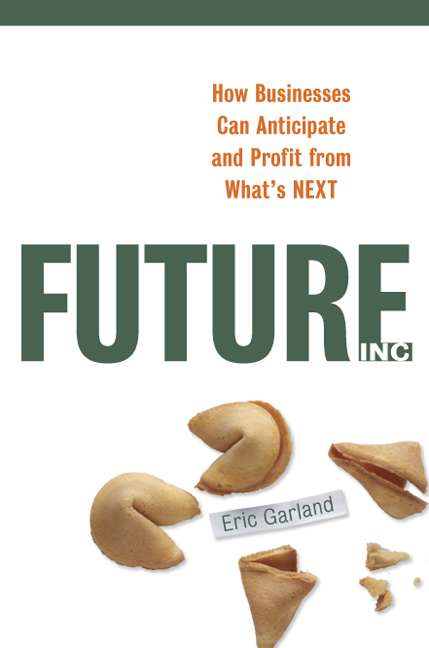
In Future, Inc. (AMACOM, 2007) I defined the work in one sentence: “Futurism is the process of discovering what trends will change our world, analyzing their potential impact on specific activities, and then communicating to colleagues what lies ahead.”
Three verbs carry that sentence. Discovering means research, most of it outside the client’s own industry. Analyzing means working out what a trend would do to a specific product, market, or policy. Communicating means getting the findings to people who did not ask for them and may not want them. A futurist who does only the first is a researcher. One who does only the third is a speaker.
The field goes by several names. Futures studies is the academic term. Strategic foresight is what governments and corporations tend to call the applied practice. Futurology is an older word, coined in the 1940s by the German political scientist Ossip Flechtheim, and it survives mainly in the press. Futurism is also the name of an Italian art movement launched by F. T. Marinetti’s 1909 manifesto, which has nothing to do with any of this.
What a futurist actually does
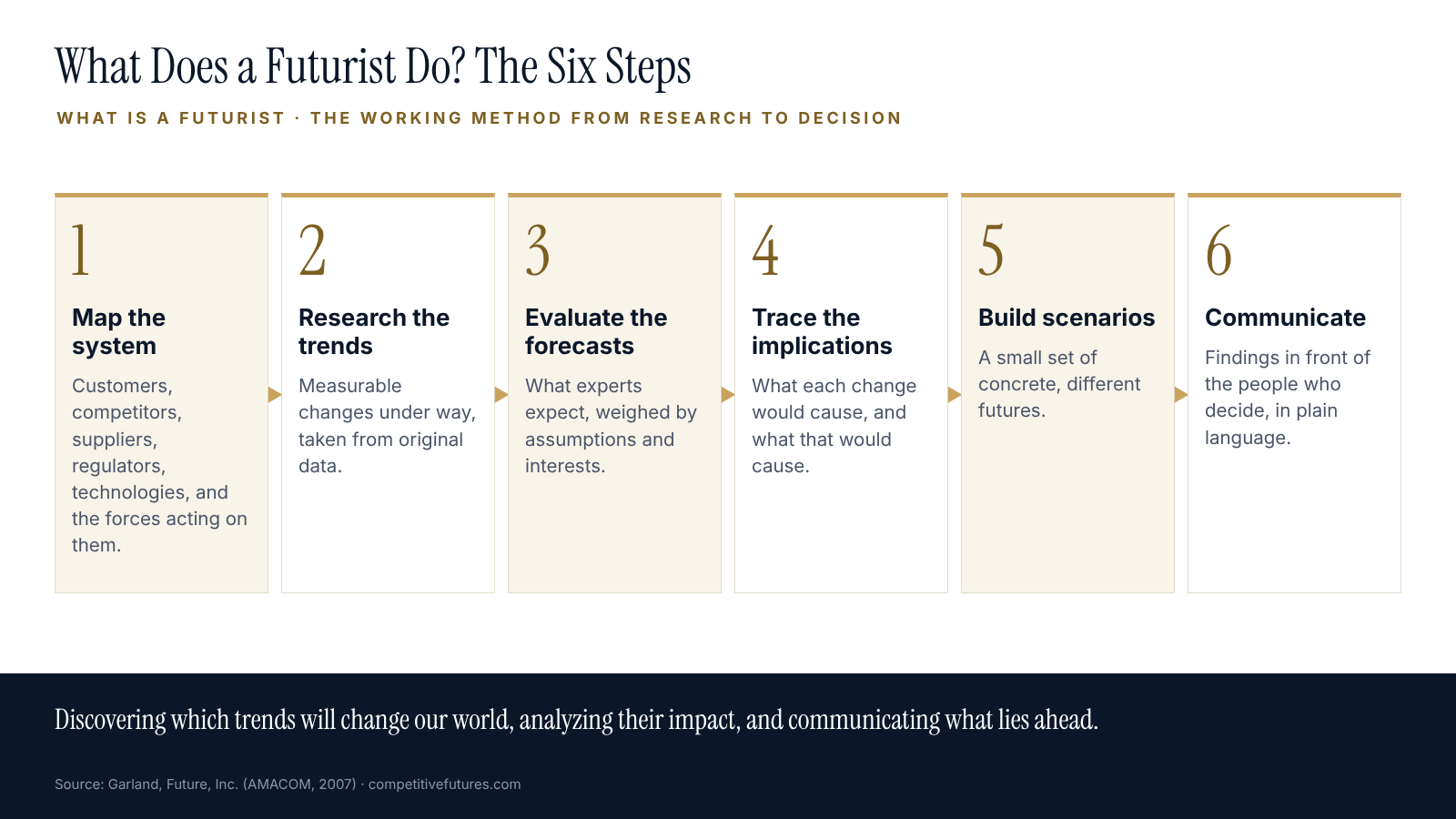
The method I teach has six steps. Each has its own guide on this site.
- Map the system. Lay out everything that touches the question: customers, competitors, suppliers, regulators, technologies, and the forces acting on them. See systems mapping and STEEP analysis.
- Research the trends. Find the measurable changes under way, from original data. See trend analysis.
- Evaluate the forecasts. Collect what experts expect and weigh each claim by its assumptions and its author’s interests. See how to evaluate a forecast.
- Trace the implications. Ask what each change would cause, and what that would cause. See second-order effects and the Futures Wheel.
- Build scenarios. Turn the research into a small set of concrete, different futures. See scenario planning.
- Communicate. Put the findings in front of the people who decide, in language they will not ignore. See communicating foresight.
Two short cases from the book show what the work produces.
In 1999, consumer goods companies wanted to know how the future would change packaging. Working with futurists, their packaging engineers looked past cardboard and plastic to trends in electronics and retailing. They saw that radio-frequency ID tags were getting cheap enough to put on a box, and that their largest customers, the big-box retailers, were digitizing their operations. The conclusion was that packaging would have to become part of the digital economy. By the time I wrote the book, seven years later, tagged shipments were a commercial product.
In 2000, an engineering executive could not accept a forecast that construction workers in 2015 would use handheld computers on the job site. They do not use computers now, he said. One observation moved him: even poor kids had PlayStations. The least skilled worker of 2015 would have grown up with software, menus, and controllers. He had assumed tomorrow’s workers would be today’s workers, and he had not known he was assuming it.
What leaders get from it
Chapter 1 of Future, Inc. names four things an organization gains from studying the future.
- A broader perspective. Daily management crowds out the larger picture. Specialization narrows it further. Foresight is scheduled time to look up.
- A challenge to basic assumptions. This is the benefit clients least expect and most need. The book states what I called the cardinal rule: “if the findings confirm everything you ever thought about the world and where it is going, it is useless.”
- The ability to detect threats and opportunities. One trend is rarely fatal. Several arriving together can be. The book’s example is the farm stores of New England, where a housing boom, big-box retail, larger-scale agriculture, and the migration of farming to the Midwest and California converged, and a cooperative with a hundred-year history sold its assets.
- An understanding of your role in history. Leaders of large institutions shape the lives of people who are not yet born. Foresight lets them look at the world they are building.
What a futurist is not
Not a fortune teller. The book opens the subject by telling readers to forget “the tea leaves, wizard hats, crystal balls, and ESP.” It also says this: “it is impossible to know exactly how the future will turn out—and if anyone ever promises that, keep one hand on your wallet.”
Not a technology promoter. A speaker who holds up this year’s device and announces that the future has arrived is selling the present. Real foresight asks what the next ten years will do to that device and to the industry around it.
Not a substitute for deciding. A futurist gives a leadership team several plausible futures and the signs that would show which one is arriving. Choosing remains the team’s job. As I wrote at the end of the book, “Blurry vision is better than none.”
I have a complicated relationship with the word myself. It has been attached to enough stage acts that serious practitioners often avoid it, and in 2012 I wrote about my own reservations. The method is what matters. I learned it from Joe Coates, one of the people who built the field, and said so in the book’s acknowledgments: he was the futurist “from whom I have stolen every idea I could possibly write down or remember.”
Futurist, forecaster, planner, analyst
The four roles get confused, and they answer different questions.
| Role | Core question | Typical horizon | What you get |
|---|---|---|---|
| Forecaster | What will this number be? | Months to a few years | An estimate with a range |
| Futurist | What could change, and what would it mean for us? | 5 to 20 years | Trends, implications, and scenarios |
| Strategic planner | What will we do? | 1 to 5 years | A plan and a budget |
| Intelligence analyst | What is happening, and what are others about to do? | Now to 2 years | Assessments for a decision |
A well-run organization uses all four and makes sure they talk to each other.
Where the profession came from, and who employs it now
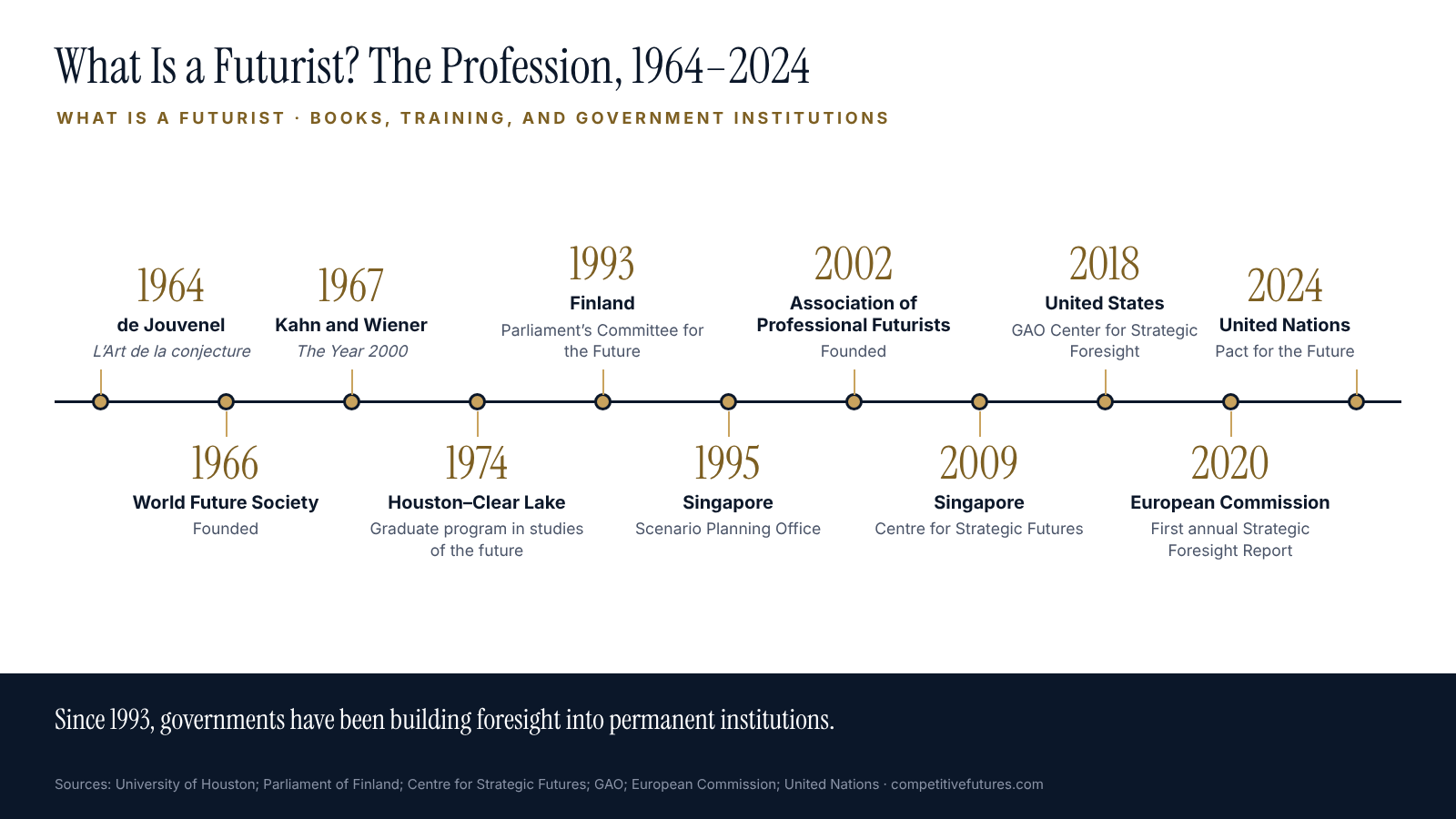
The modern field took shape between the 1940s and the 1960s, in a few places at once. In the United States it grew out of long-range planning for government and defense. In France, Bertrand de Jouvenel published L’Art de la conjecture in 1964 and argued that the future should be studied as a set of possibilities. Herman Kahn and Anthony Wiener’s The Year 2000 appeared in 1967. The World Future Society was founded in 1966.
Training followed. The University of Houston–Clear Lake started a graduate program in studies of the future in 1974; the university describes it as the longest-running master’s program of its kind. The Association of Professional Futurists was founded in 2002.
Governments have built foresight into their permanent machinery:
- Finland. Parliament established its Committee for the Future in 1993 and made it a permanent standing committee in 2000.
- Singapore. The government set up a Scenario Planning Office in the Prime Minister’s Office in 1995 and the Centre for Strategic Futures in 2009.
- United States. The Government Accountability Office created its Center for Strategic Foresight in 2018.
- European Union. The European Commission adopted its first annual Strategic Foresight Report on 9 September 2020.
- United Nations. On 22 September 2024, member states adopted the Pact for the Future, with a Declaration on Future Generations annexed to it.
I have practiced strategic foresight for corporations and governments for 30 years, including work for the governments of France and Monaco. The pattern in that list matches my experience: the organizations that invest in foresight are the ones that expect to exist in twenty years and are responsible for people who will be affected by what they do.
How to judge a futurist
Joe Coates wrote in his foreword to Future, Inc. that one purpose of the book was to “make people wiser sponsors, buyers, and users of future studies and their claims.” Five checks do most of that work.
- Sources. Can they show the data behind each trend, and does it come from the original source?
- Assumptions and time frame. Do they say what they are assuming and how far out they are looking?
- More than one future. A single confident scenario is a sales pitch.
- Discomfort. Did the work tell you something you did not want to hear? If it confirmed everything you believed, apply the cardinal rule.
- A record. Have they published past calls, including the ones that missed? Ours are on the forecasting page.
Charisma is not on the list. In How to Predict the Future…and WIN! (2011), the fictional Dr. Egon recommends valuing forecasts “by the charisma of the person delivering them.” It is one of the 25 foresight mistakes.
What this teaches about building an intelligence function
A futurist is a role before it is a job title. Every intelligence function needs someone doing this work, whether or not anyone carries the name.
That means three things in practice. Someone is assigned to look five or more years out, and that person’s time is protected from the daily queue. The long view and the current intelligence picture are produced by people who talk to each other, so that today’s reporting is read against where the system is heading. And the function is allowed to challenge the organization’s assumptions in front of leadership, because foresight that only confirms the plan has, by the book’s own rule, taught nobody anything.
Frequently asked questions
What does a futurist do?
A futurist researches trends, evaluates forecasts, traces their implications, builds scenarios, and communicates the results to decision makers so they can prepare for change.
Can a futurist predict the future?
No. A futurist identifies plausible futures and the early signs of each. Anyone who promises to know exactly how the future will turn out should be treated with caution.
What is the difference between a futurist and a futurologist?
They mean the same thing. “Futurologist” is an older term, more common in the press and in Europe. Practitioners today usually say futurist, foresight practitioner, or strategic foresight analyst.
How do you become a futurist?
There is no license. Some practitioners hold degrees in foresight or futures studies. Most come from another field, such as economics, engineering, intelligence, or the humanities, and learn the methods on the job or from a mentor.
Who hires futurists?
Corporations with long investment horizons, such as energy, health care, defense, and consumer goods, and governments. Several national governments and international bodies have permanent foresight units.
Is futurism related to the Italian Futurist art movement?
No. Italian Futurism was an artistic and literary movement that began in 1909. The profession of studying the future developed separately in the mid-twentieth century.
Work with Competitive Futures
Competitive Futures conducts foresight studies and scenario projects for companies and governments, and provides keynote speakers on building a foresight culture. To discuss a study or an event, contact the company.
Related reading
- Strategic Foresight: A Practitioner’s Guide
- The Pioneers of Strategy, Intelligence, and Foresight
- Herman Kahn: Scenario Planning, RAND, and the Year 2000
- Bertrand and Hugues de Jouvenel: Futuribles and La Prospective
- Elegy for My Mentor, Joe Coates
- Futures Studies Books
- Forecasting: Methodology and Our Track Record
- 25 Foresight Mistakes
References
- Garland, Eric. Future, Inc.: How Businesses Can Anticipate and Profit from What’s Next. New York: AMACOM, 2007. Foreword by Joseph F. Coates; chapter 1, “Futurism: The Antidote to Chaos.”
- Garland, Eric. How to Predict the Future…and WIN! Wallingford Press, 2011. Tip 8.
- de Jouvenel, Bertrand. L’Art de la conjecture. Monaco: Éditions du Rocher, 1964.
- Kahn, Herman, and Anthony J. Wiener. The Year 2000: A Framework for Speculation on the Next Thirty-Three Years. New York: Macmillan, 1967.
- University of Houston. “Futurists Will Celebrate Past and Look Ahead,” 30 April 2009. https://www.uh.edu/news-events/stories/2009articles/april2009/043009futurestudiescelebration.php ; and “Future Studies Degree,” March 2008. https://uh.edu/news-events/stories/2008articles/mar08/303_future_studies.php
- Parliament of Finland. “Committee for the Future.” https://www.eduskunta.fi/EN/valiokunnat/tulevaisuusvaliokunta
- Centre for Strategic Futures, Singapore. “Who We Are.” https://www.csf.gov.sg/who-we-are/
- U.S. Government Accountability Office. “Center for Strategic Foresight.” https://gao.gov/about/what-gao-does/audit-role/csf
- European Commission. “2020 Strategic Foresight Report.” https://commission.europa.eu/strategy-and-policy/strategic-foresight/2020-strategic-foresight-report_en
- United Nations. “Pact for the Future.” https://www.un.org/en/node/222117
Part of the Strategic Foresight guide from Competitive Futures.