Foreign-Language OSINT: Reading the World in More Than One Language

Read this page in: Français · Español · Português · Deutsch · Nederlands · Italiano · 日本語 · 한국어 · Bahasa Indonesia · Polski · Čeština · Svenska · Dansk · Norsk (bokmål) · Suomi · Ελληνικά · Türkçe · Eesti
Foreign-language OSINT is the practice of collecting and reading open sources in the language they were written in. Most of what is published about any company, market, or government is published in its own language, for its own people. An analyst who works only in English is reading the part of the record that someone chose to translate. I worked as a translator and interpreter before I became an intelligence analyst, and nothing in thirty years has changed my view that the second language is where the advantage is.
At a glance
- What it is: open-source intelligence drawn from sources in their original languages, not from English summaries of them.
- Why it matters: home-language sources carry different assumptions, different facts, and often more detail than the version prepared for foreign readers.
- Who has done it longest: governments. The United States has monitored and translated foreign media as an organized function since 1941.
- What machine translation changes: it makes triage possible in dozens of languages. It does not replace a qualified reader for anything a decision rests on.
- What it takes: a map of the languages that matter to you, access to the public record in each, and people who can read it at a professional level.
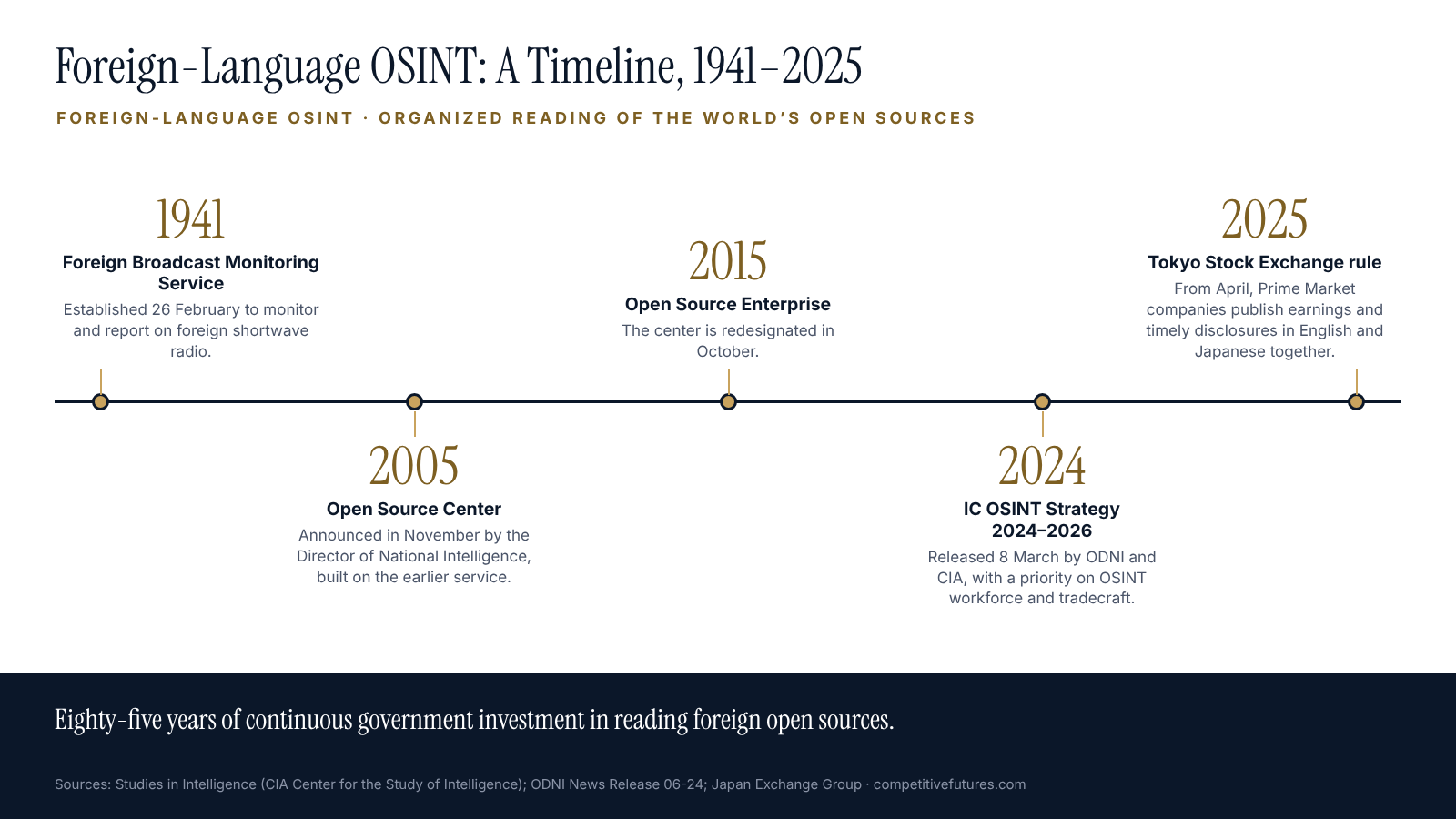
Governments have treated this as a core function since 1941

On 26 February 1941, President Franklin Roosevelt established the Foreign Broadcast Monitoring Service to listen to foreign shortwave radio and report what was being said. It became the Foreign Broadcast Information Service, and for decades its translated daily reports were a basic reference for American analysts.
The function has been reorganized and never abandoned. In November 2005 the Director of National Intelligence announced an Open Source Center built on the old service. In October 2015 it was redesignated the Open Source Enterprise. On 8 March 2024 the Office of the Director of National Intelligence and the Central Intelligence Agency released the IC OSINT Strategy 2024–2026, which sets four priorities: coordinating open-source data acquisition and sharing, integrated collection management, innovation, and developing the next-generation OSINT workforce and tradecraft.
Eighty-five years of continuous investment by the U.S. government is a fair measure of how much is in the foreign-language record. Most companies have never assigned anyone to read it.
Three reasons to read the original
In How to Predict the Future…and WIN! (Wallingford Press, 2011), the fictional consultant Dr. Egon advises readers to “Take All Of Your Sources From One Country, Preferably Your Own.” If something is worth knowing, he says, it is worth putting in English. My answer in the book: “You cannot study the global future while ignoring most of the globe.” I gave three reasons.
1. Different sources carry different assumptions. As the book puts it, “The greatest thing about data sources from other countries is the diverse assumptions automatically included in their analysis.” Every national press has its own authorities and its own idea of what counts as normal. Reading only your own country’s sources means every forecast you build inherits your country’s blind spots. Reading someone else’s is the cheapest check on your own.
2. Organizations say different things in different languages. This is the reason that matters most for competitive intelligence. A company’s public statements are managed. But the teams that manage them are rarely global and rarely controlled from one place, and most words have no exact counterpart in another language. In the book I drew the practical conclusion: “you cannot enforce strict language discipline between countries, and organizations are likely to release different information in every country, giving a more complete picture of their operations.”
3. Simple coverage. Most of the world’s regulators, courts, trade journals, and local newspapers do not publish in English. If your supplier, competitor, or customer operates there, the decisions that affect you are being announced in a language you may not be reading.
This matters most for Anglo-American analysts, who are often limited to one or two languages. In the book I said the tip was “mostly aimed at the famously monolingual American readers.” Many analysts elsewhere in the world speak five. Whichever group you are in, the rule is the same: get the intelligence in the original whenever possible.
Where the home-language record is richer
The gap is widest in the routine public record, the documents nobody writes for a foreign audience:
- Corporate filings and registries. Annual reports, ownership records, and director appointments filed with national authorities.
- Court records and legal notices. Lawsuits, insolvency notices, and enforcement decisions.
- Public procurement. Tenders, awards, and contract amendments.
- Patents and standards filings. Often filed first at home.
- Trade and local press. The industry weekly and the newspaper in the town where the plant is.
- Job postings. Hiring in a given city, in a given specialty, is an early sign of intent.
- Official gazettes and regulatory dockets. Draft rules, consultation responses, and licensing decisions.
Many countries run a national disclosure system for company filings, such as EDINET in Japan, DART in South Korea, the Unternehmensregister in Germany, and BODACC in France. All are public. All are written first for domestic readers.
Japan shows how much sits behind the language line even in an open, well-regulated market. Since April 2025, the Tokyo Stock Exchange has required companies on its Prime Market to publish earnings reports and timely disclosure information in English at the same time as in Japanese. The exchange’s survey for the end of 2025 counted 1,598 Prime Market companies, of which 96 had been given until April 2026 to comply. The rule covers one market segment and a defined set of documents. Other filings, and companies listed on the exchange’s other markets, are not covered by it.
That is the most internationally minded tier of one of the world’s largest economies. In most markets the English layer is thinner.
What machine translation changes, and what it does not
Machine translation has changed the economics of this work. An analyst can now scan a thousand headlines in a language she does not read and find the twenty that matter. Ten years ago that took a staff.
It has not changed what a decision should rest on. The U.S. government’s own standard is a useful benchmark. The Interagency Language Roundtable scale runs from 0 to 5. Level 2 is “Limited Working Proficiency.” Level 3 is “General Professional Proficiency,” and the Roundtable notes that many U.S. agencies require Level 3 as a minimum. A machine output read by someone with no knowledge of the language is not a Level 3 reading.
What gets lost is predictable:
- Register. Whether a statement is routine, defensive, or alarmed.
- Terms of art. Legal and regulatory words that look like ordinary ones.
- Euphemism and omission. What a careful writer chose not to say.
- Names. People, companies, and places transliterated three different ways.
- Who is speaking. The standing of the outlet and the author inside their own system.
The working rule is to let machines do the triage and to have a qualified person read anything a decision will rest on.
How to build foreign-language coverage
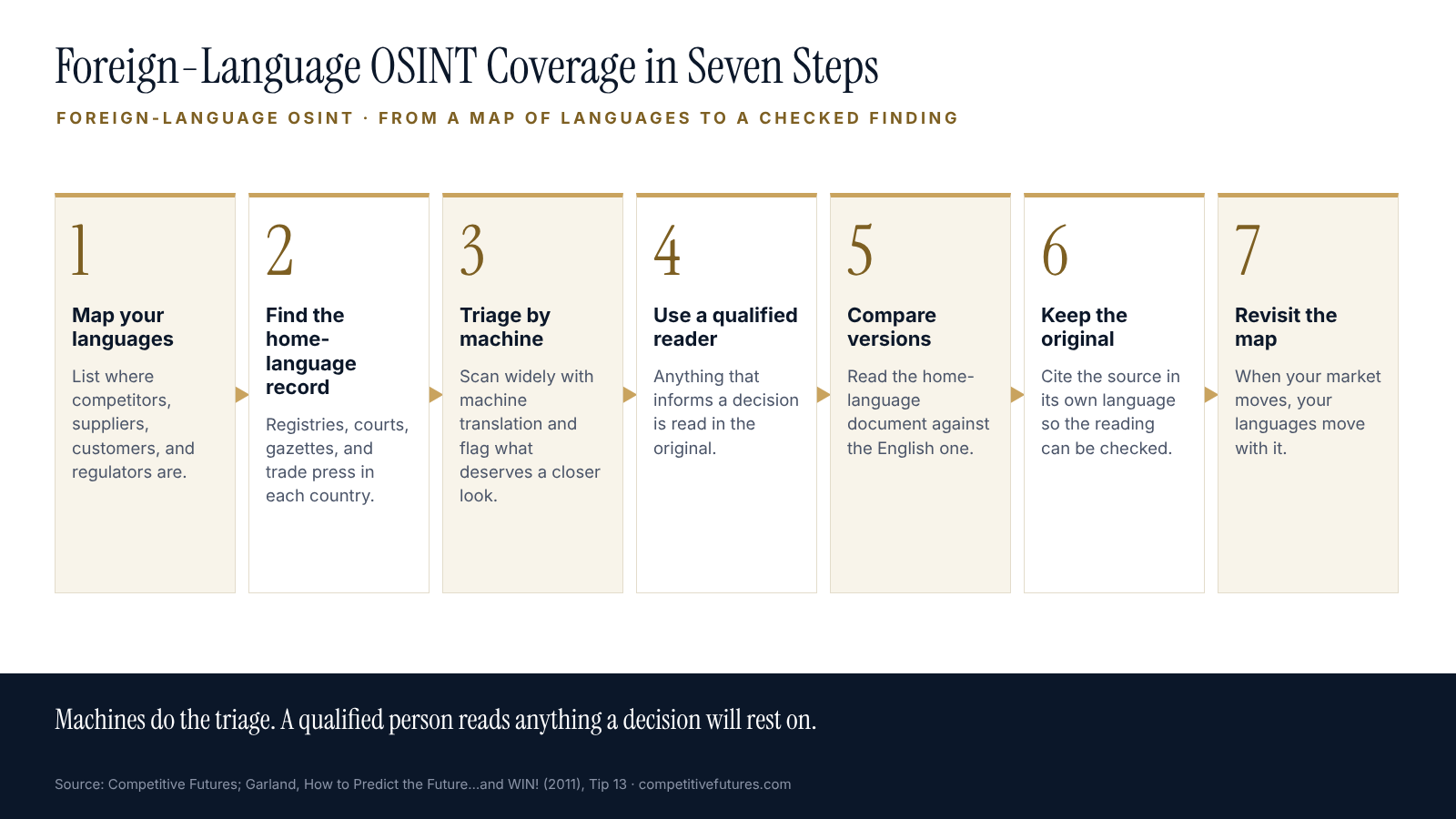
- Map your languages. List where your competitors, suppliers, customers, and regulators are. The languages that matter follow from the map, not from which ones your staff happens to speak.
- Find the home-language record. For each country, identify the public registries, courts, gazettes, and trade press.
- Triage by machine. Use machine translation to scan widely and flag what deserves a closer look.
- Put a qualified reader on what matters. Anything that will inform a decision is read in the original by someone with professional proficiency.
- Compare versions. Read the home-language document against the English one. The differences between them are a finding in themselves.
- Keep the original. Cite the source document in its own language, with the translation, so the reading can be checked.
- Revisit the map. When your market moves, your languages move with it.
Staying inside the lines
Everything on this page concerns public information lawfully obtained. Foreign-language collection raises the same ethical questions as any other collection, plus one: the law that governs a source is the law of the country it sits in. A registry that is open to anyone at home may carry terms of use for foreign access. Check before you build a process around it. Our guide to OSINT and intelligence collection covers the ethical framework.
Common mistakes
- Treating English coverage as the event. If a development reaches the English-language press, competitors with local readers saw it first.
- Relying on one bilingual employee. A person who speaks a language at home is not automatically able to read a securities filing in it.
- Translating everything. Volume is not coverage. Triage first.
- Ignoring the outlet. A translated article with no sense of who published it and why is half a source.
- Dropping the original. A finding that cannot be traced to a document in its own language cannot be verified.
What foreign-language OSINT teaches about building an intelligence function
The book’s advice on staffing was in capital letters, and I would repeat it more quietly now: hire language graduates. Universities produce them every year, and many have no idea what to do with the degree. An intelligence function is one of the few places in a company where reading Portuguese court filings is a core skill.
The value I attached to this tip in the book was cosmopolitanism: “There is no way to understand the future without a deep and abiding commitment to understanding the amazing diversity of thought around the world.” For an intelligence function that translates into three commitments. Language skill is a hiring criterion for analysts. Coverage is planned by country and language. And the function reports what sources abroad are saying to each other as well as what they say to us.
Frequently asked questions
What is foreign-language OSINT?
Open-source intelligence collected from sources in their original languages, such as local news, national registries, court records, and trade publications, instead of from English-language summaries.
Why are foreign-language sources important in intelligence analysis?
They carry different assumptions from your own country’s sources, they often contain details that organizations do not repeat in English, and they cover regulators, courts, and markets that publish only in the local language.
Can machine translation replace human linguists for OSINT?
For triage, largely yes. For analysis that informs a decision, no. Machine output misses register, legal terms of art, euphemism, and the standing of the source.
Which languages matter most for competitive intelligence?
The ones spoken where your competitors, suppliers, customers, and regulators operate. Start from a map of your own business, not from a list of major world languages.
What level of language skill does an analyst need?
For professional reading, the benchmark used by many U.S. government agencies is Level 3, General Professional Proficiency, on the Interagency Language Roundtable scale.
Is collecting foreign-language open sources legal?
Collecting public information is lawful in most places, but the rules are set by the country where the source is located. Check local law and each source’s terms of use.
Work with Competitive Futures
Competitive Futures conducts intelligence research across languages for companies and governments, and publishes its own reference pages in more than a dozen of them. To discuss coverage of a market, a competitor, or a regulator abroad, contact the company.
Related reading
- OSINT and Intelligence Collection: A Guide for Business
- Competitive Intelligence: A Complete Guide for Leaders
- Research Pro Tip: OpenCorporates
- Geopolitical Risk for Business
- STEEP Analysis
- 25 Foresight Mistakes
References
- Garland, Eric. How to Predict the Future…and WIN! Wallingford Press, 2011. Tip 13.
- Leetaru, Kalev. “The Scope of FBIS and BBC Open-Source Media Coverage, 1979–2008.” Studies in Intelligence (CIA Center for the Study of Intelligence), 2010. https://www.cia.gov/resources/csi/static/The-Scope-of-FBIS.pdf
- Office of the Director of National Intelligence. “ODNI and CIA Release the Intelligence Community OSINT Strategy for 2024–2026.” News Release No. 06-24, 8 March 2024. https://www.dni.gov/index.php/newsroom/press-releases/press-releases-2024/3784-odni-and-cia-release-the-intelligence-community-osint-strategy-for-2024-2026
- Interagency Language Roundtable. “Skill Level Descriptions” and “Frequently Asked Questions.” https://www.govtilr.org/
- Japan Exchange Group. “Summary Report of the English Disclosure Implementation Status Survey as of the End of December 2025,” 26 January 2026. https://www.jpx.co.jp/english/corporate/news/news-releases/0060/20260126-04.html
This piece is part of our guide to OSINT and Intelligence Collection.