Quebec Oath to the King: Could Quebec Join the United States?
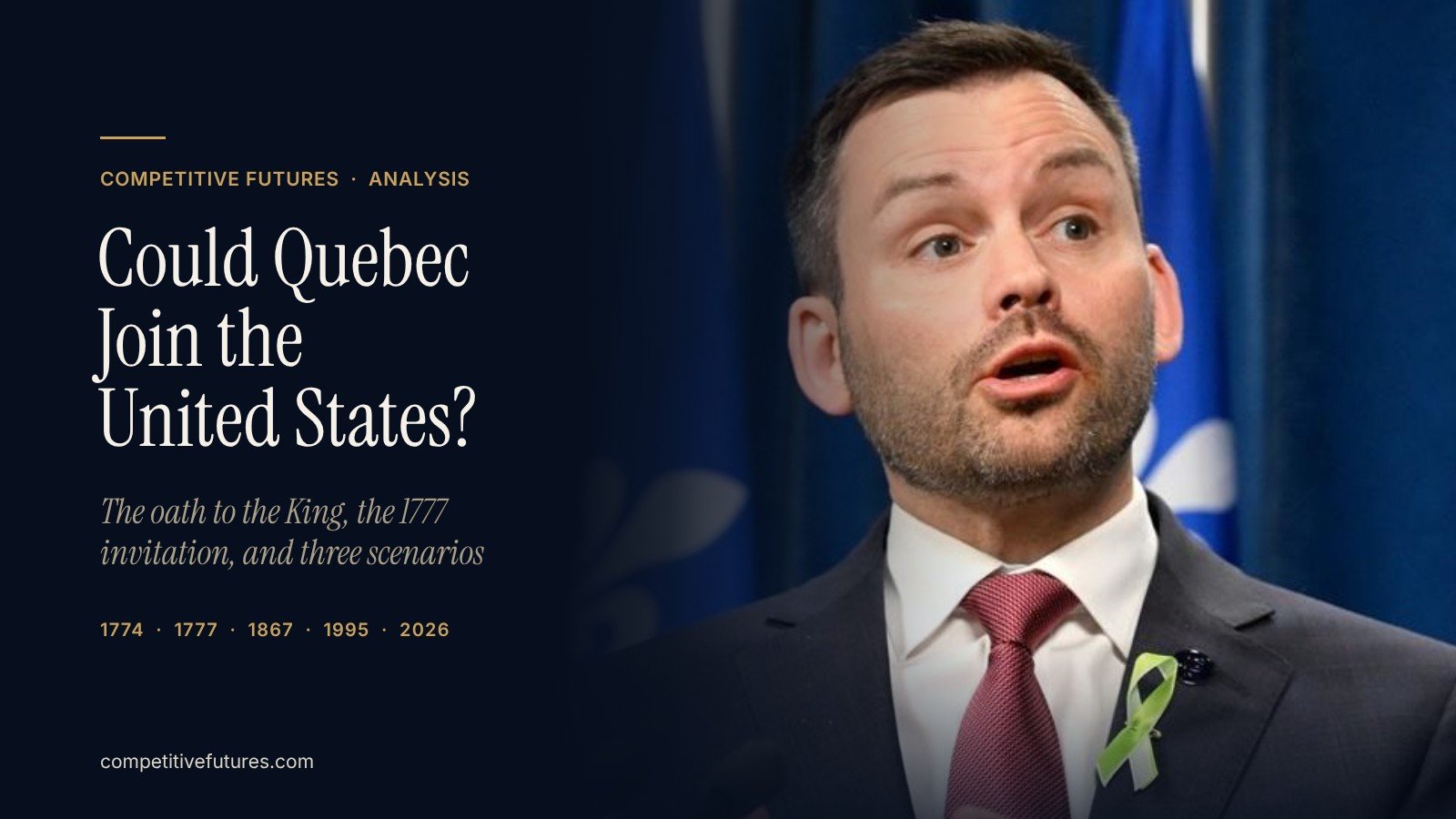
The Quebec oath to the King is back in force. On 23 November 2026, Quebec Superior Court suspended the provincial law that had made the oath optional, and the province’s separatist Premier said he would not take it. The dispute has revived an old question, which is whether Quebec could leave Canada and join the United States. We set out what the court did, where the oath came from, and how likely each outcome is.
Watch the short version above. The analysis below goes further than the video and reaches a more cautious estimate.
At a glance
- The ruling: Justice Ian Demers suspended Quebec’s 2022 law on the oath until the case is heard in full. It is a temporary order.
- The stakes: the judge wrote that laws passed by members who had not taken the oath would be unconstitutional and would have to be passed again.
- The numbers: none of the 127 members elected on 5 October 2026 has sworn allegiance to the King. All swore an oath to the people of Quebec.
- The government: the Parti Québécois holds 60 of 127 seats and governs as a minority. It has appealed.
- The next date: the National Assembly is due to return on 1 December 2026.
- The pattern: Quebec has long used the prospect of sovereignty to win powers inside Canada. What is new is that Ottawa is in a dispute with Washington at the same time.
- Our assessment: Quebec is likely to remain a province through January 2029. Statehood in the United States is a remote outcome.
What the Court Ruled
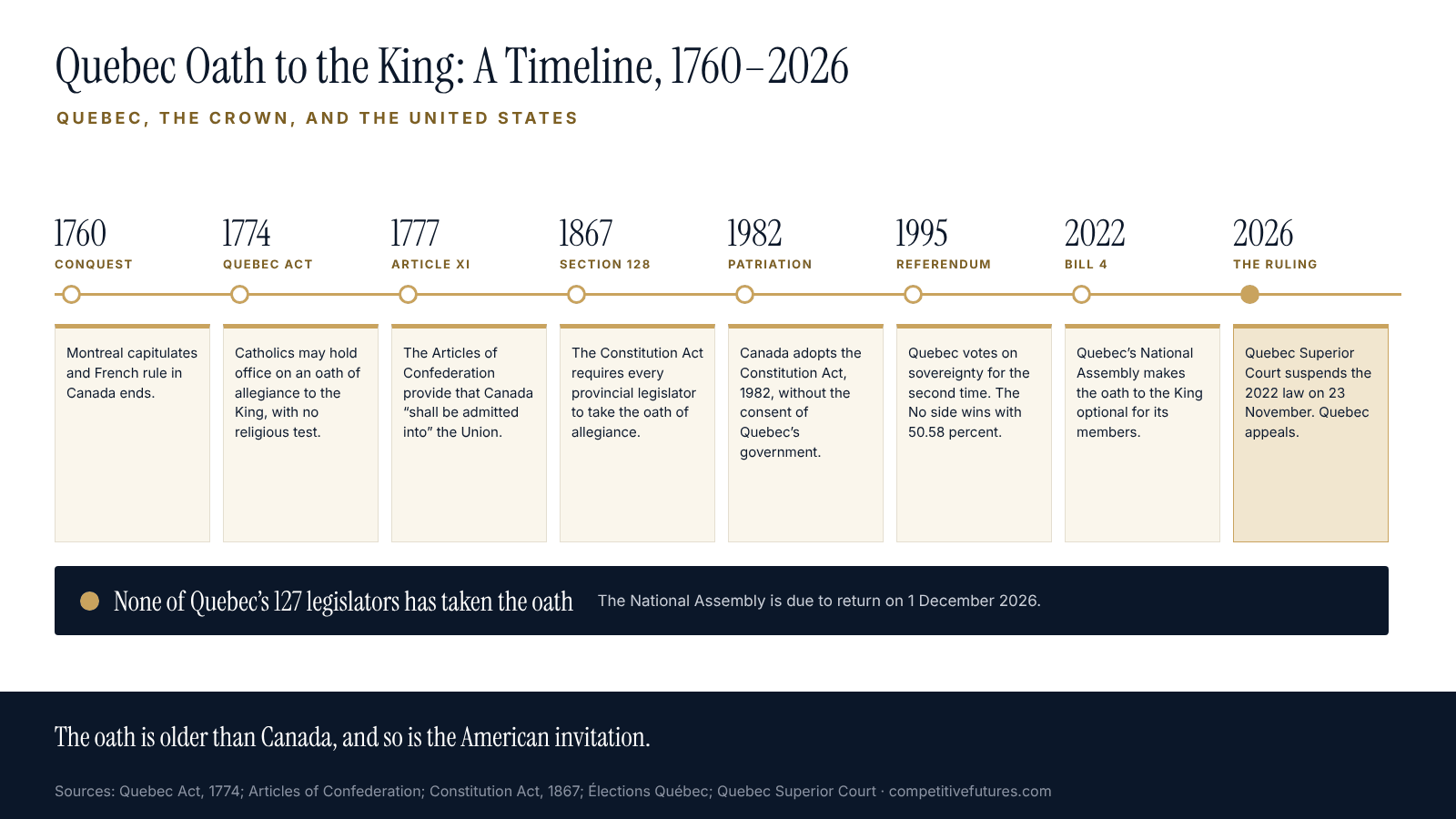
The oath comes from Section 128 of the Constitution Act, 1867. It requires every member of a provincial legislature to take the oath of allegiance set out in the Act’s Fifth Schedule before taking a seat. The oath is a single sentence of faith and true allegiance to the reigning monarch.
In December 2022 the National Assembly passed a law, known as Bill 4, to end that requirement for its own members. The law added a line to the Constitution Act, 1867, that reads, “Section 128 does not apply to Quebec.” Members have since sworn only the oath to the people of Quebec that provincial law also requires.
Lawrence David, a law professor, asked the court to suspend the 2022 law while his challenge is heard. Justice Demers agreed. He found that the Assembly could not remove the oath on its own authority, and that leaving the law in place would put every statute the Assembly passes at risk.
The order is a stay. The court has not yet heard the case on its merits. The government has said it will ask the Quebec Court of Appeal to overturn the stay and to suspend it in the meantime. The Premier, Paul St-Pierre Plamondon, has also pointed out that the order suspends a law and does not, in its operative part, direct any member to swear. He has said the next Speaker of the Assembly will rule on the matter.
Why the Oath Exists
Britain took Canada from France by force. Montreal capitulated in 1760, and France ceded the colony in 1763. London then governed a population that was French-speaking and Catholic, at a time when British law barred Catholics from public office through a religious oath.
The Quebec Act of 1774 changed that. It guaranteed the free exercise of the Catholic religion, restored French civil law, and replaced the religious oath with a new one. A Catholic could hold office by swearing to be faithful and bear true allegiance to King George. The oath was the instrument that let French Canadians take part in government without giving up their faith.
The same form of words passed into the Constitution Act, 1867, and it is the oath now in dispute.
The American Invitation
The thirteen colonies to the south objected to the Quebec Act and tried to bring Canada into their rebellion. The Continental Army invaded in 1775 and failed to take Quebec City.
The offer stayed on paper. Article XI of the Articles of Confederation, the first constitution of the United States, adopted by Congress in 1777, provided that Canada “shall be admitted into” the Union if it chose to join. Any other colony needed the agreement of nine states. The Articles were replaced by the Constitution in 1789, and the invitation lapsed with them.
The idea returned in 1849, when a group of Montreal merchants and politicians published a manifesto calling for annexation to the United States. It did not win broad support.
The Sovereignty Record
Quebec has voted twice on leaving Canada. In 1980 about 60 percent voted No. In 1995 the No side won with 50.58 percent.
Between those votes, Canada adopted the Constitution Act, 1982, without the consent of Quebec’s government. No Quebec government has endorsed it since. The Premier’s statement on the ruling returns to this point, and argues that the constitutional rules behind the judgment lack legitimacy in Quebec.
The Supreme Court of Canada set the legal path in 1998. A province has no right to secede on its own. A clear majority on a clear question would oblige the rest of Canada to negotiate.
Where Things Stand in November 2026
The Parti Québécois won the election of 5 October 2026 with 28.02 percent of the vote. Its leader pledged during the campaign that no referendum would be held before 20 January 2029.
Since taking office, the Premier has opposed the federal government’s matching tariffs on American goods. He has written to 59 newly elected or re-elected United States senators and governors to propose direct cooperation with Quebec, and he answered the Prime Minister’s objection by saying that Mr. Carney is not his boss. President Trump congratulated him publicly on 27 October.
Public opinion has not moved with the government. A poll taken from 13 to 16 November put support for sovereignty at 26 percent. A national poll in 2025 found that 9 percent of Canadians wanted their country to join the United States.
Sovereignty as Leverage, and What Is New
Quebec has a long record of using the prospect of sovereignty to reach its goals as a nation inside Canada. The pattern is older than either referendum. Quebec obtained its own pension plan in the 1960s, when the rest of the country joined a federal one. It obtained control over the selection of its immigrants in an agreement with Ottawa in 1991. In 2006 the House of Commons recognized the Québécois as a nation within a united Canada. Each gain came while independence was a live possibility, and so far each has been made within the federation.
Read against that record, a refusal to swear the oath is a familiar move. It raises the price of the status quo for Ottawa without requiring Quebec to leave.
The difference in 2026 is the second front. Ottawa is in a trade confrontation with Washington at the same moment it faces a sovereigntist government in Quebec City, and that combination has no precedent. In 1980 and 1995 the United States stated a preference for a united Canada and said the choice belonged to Canadians. This time the federal government has chosen to match American tariffs dollar for dollar, the Premier of Quebec has opposed that policy and opened his own channel to American officials, and the President has congratulated him.
Ottawa is therefore fighting on two fronts, and the two opponents have reason to talk to each other. That raises the value of Quebec’s leverage even if nothing else changes. A threat to leave carries more weight when the neighbor next door is in a dispute with the same capital.
Three Scenarios
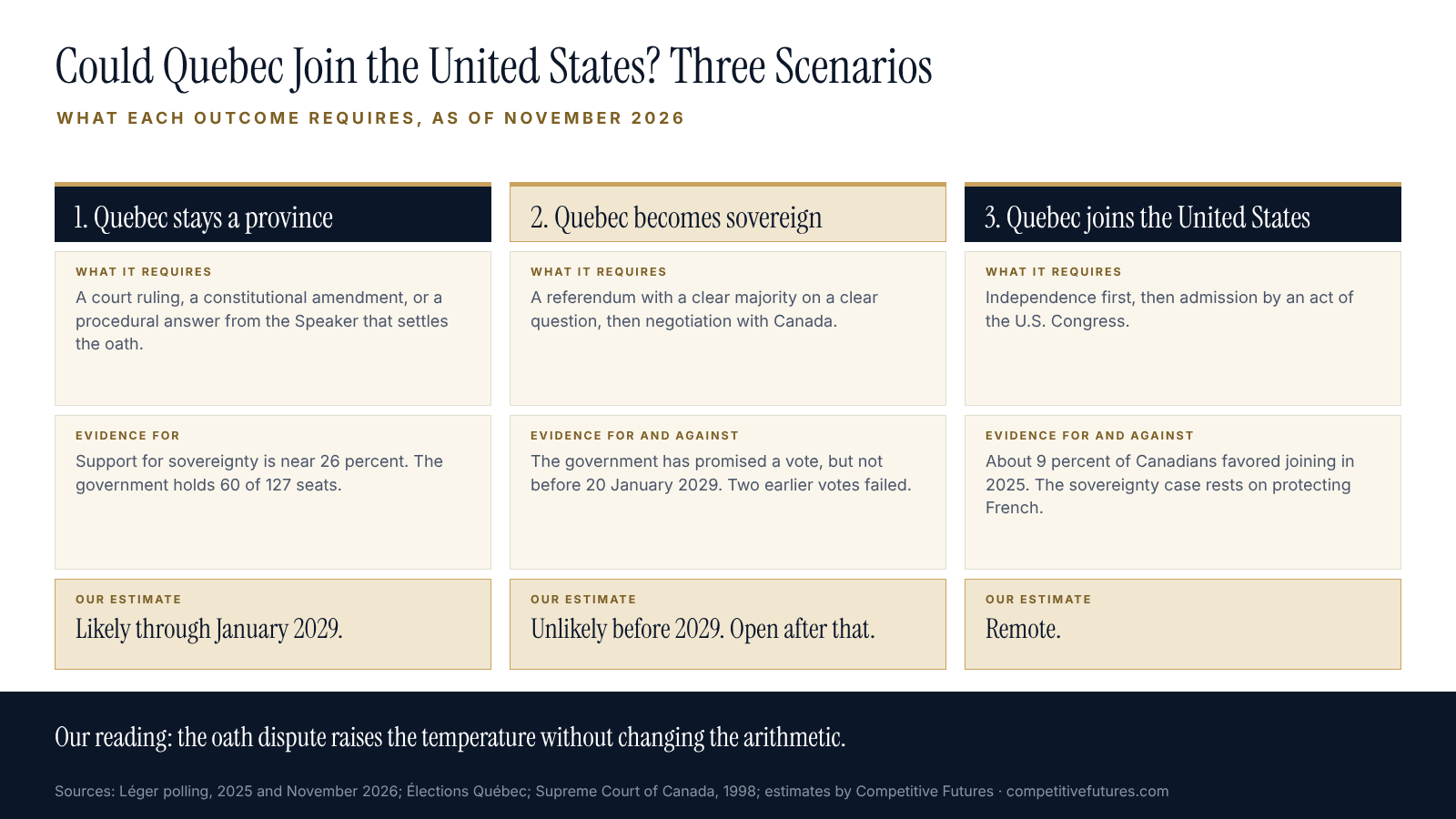
1. Quebec stays a province. The oath dispute ends in a court ruling, a constitutional amendment, or a procedural answer from the Speaker. Support for sovereignty is near a quarter of the electorate, and the government lacks a majority. We judge this outcome likely through January 2029.
2. Quebec becomes a sovereign state. This requires a referendum with a clear majority on a clear question, followed by negotiation with Canada. The government has promised a vote, though not before 2029, and two earlier votes failed. We judge it unlikely before 2029 and open after that.
3. Quebec joins the United States. This requires independence first and then admission by an act of the United States Congress. The case for sovereignty rests on protecting the French language, which membership in an English-speaking federation would not serve. We judge this outcome remote.
A fourth possibility sits between the second and third. A sovereign Quebec would need a currency, a trade agreement, and a defense arrangement, and the United States is the nearest supplier of all three. Close alignment without statehood is more plausible than statehood.
Our Assessment
The ruling changes the calendar more than the balance of forces. It gives the government a dispute with the Crown that it can use at home, and it puts a date on the confrontation. It does not add votes for sovereignty.
The more important change is in Ottawa’s position. Quebec’s usual method is to press for powers under the shadow of departure, and the federal government has usually been able to answer with its full attention. It now has to answer while managing a trade dispute with the United States. We expect Quebec to ask for more than it otherwise would, and we expect Ottawa to concede more than it otherwise would. The likeliest result of this episode is a stronger Quebec inside Canada.
The government’s outreach to American officials deserves attention on its own terms. A province that builds direct relationships in Washington and the state capitals is preparing options, whatever it intends to do with them.
What we are watching:
- the Court of Appeal’s decision on the stay;
- whether any member takes the oath before 1 December;
- the Speaker’s ruling when the Assembly returns;
- the hearing on the merits;
- monthly polling on sovereignty;
- any statement by a United States official about Quebec’s status;
- any new demand by Quebec for powers over trade, immigration, or language, and Ottawa’s reply; and
- any Quebec proposal on currency, defense, or trade made directly to Washington.
Lessons for Building an Intelligence Function
- Read the order. A stay and a final judgment are different events. Some early accounts said the law had been struck down, which it had not.
- Separate what a leader says from what the numbers allow. A minority government with a quarter of the public behind its central project has limited room.
- Treat history as evidence of options. Article XI shows that accession was once contemplated. It says nothing about what anyone intends in 2026.
- Count the fronts. An actor that can manage one dispute may not be able to manage two. Ask who else is in a contest with the same counterpart.
- Write the indicators before the next headline. A list made in advance keeps the analysis from following the news cycle.
- State the estimate in plain words. “Likely,” “unlikely,” and “remote” can be checked later. “Could” cannot.
Frequently Asked Questions
What is the Quebec oath to the King?
It is the oath of allegiance to the monarch that Section 128 of the Constitution Act, 1867, requires of every provincial legislator before taking a seat.
What did the Quebec Superior Court decide in November 2026?
It suspended Quebec’s 2022 law that made the oath optional, until the challenge to that law is heard in full. The government has appealed.
Why does the Premier of Quebec refuse the oath?
Paul St-Pierre Plamondon leads a party that seeks independence. He says his government is loyal only to the people of Quebec and that he cannot swear allegiance to the King.
Could Quebec legally join the United States?
Only in two steps. Quebec would first have to become independent through a referendum and negotiation with Canada, and the United States Congress would then have to admit it as a state.
Did the United States ever invite Canada to join?
Yes. Article XI of the Articles of Confederation provided that Canada would be admitted if it chose to join. That document was replaced in 1789.
How much support is there for Quebec sovereignty?
A poll taken in mid-November 2026 put support at 26 percent. The 1995 referendum failed with 49.42 percent in favor.
Work With Competitive Futures
We build scenario and indicator sets for organizations exposed to political risk in North America. Request a consultation
Related
- Analysis of Competing Hypotheses
- How to Evaluate a Forecast
- Decision Making Under Uncertainty: Intelligence Is Always Wrong
- Scenario Planning
- For Governments
- Mission and Doctrine
References
- Quebec Superior Court, Justice Ian Demers. Judgment on the application to stay the 2022 law on the oath of allegiance, 23 November 2026.
- Premier of Quebec. “Le premier ministre du Québec réagit au jugement de la Cour supérieure sur le serment au roi.” Statement, 23 November 2026. https://www.newswire.ca/fr/news-releases/le-premier-ministre-du-quebec-reagit-au-jugement-de-la-cour-superieure-sur-le-serment-au-roi-836401536.html
- Constitution Act, 1867, Section 128 and Fifth Schedule. https://laws-lois.justice.gc.ca/eng/Const/section-128.html
- Quebec Act, 1774, 14 Geo. III c. 83. https://avalon.law.yale.edu/18th_century/quebec_act_1774.asp
- Articles of Confederation, Article XI. https://avalon.law.yale.edu/18th_century/artconf.asp
- Élections Québec. Results of the general election of 5 October 2026. https://www.electionsquebec.qc.ca/en/results-and-statistics/
- Élections Québec. 1995 referendum on Québec’s accession to sovereignty. https://www.electionsquebec.qc.ca/en/results-and-statistics/1995-referendum-on-quebecs-accession-to-sovereignty/
- Supreme Court of Canada. Reference re Secession of Quebec, [1998] 2 S.C.R. 217.
- Léger. Quebec poll, 13 to 16 November 2026; Canada poll on joining the United States, March 2025.
- Radio-Canada. “Le serment au roi est obligatoire, statue la Cour supérieure du Québec,” 23 November 2026. https://ici.radio-canada.ca/article/info/2302476/jugement-serment-roi-lawrence-david
- Le Devoir. “PSPP écrit aux élus américains, Carney vante les avantages d’un négociateur unique,” 10 November 2026. https://www.ledevoir.com/politique/1023872/pspp-ecrit-elus-americains-carney-vante-avantages-negociateur-unique
- The Globe and Mail. “PQ delays push to hold sovereignty referendum until after Trump leaves office,” 18 August 2026. https://www.theglobeandmail.com/politics/article-pq-will-not-hold-quebec-independence-referendum-until-after-trump/
Back to Analysis.