25 Foresight Mistakes: How Organizations Ruin Their View of the Future
Read this page in: Français · Español · Português · Deutsch · Nederlands · Italiano · 日本語 · 한국어 · Bahasa Indonesia · Polski · Čeština · Svenska · Dansk · Norsk (bokmål) · Suomi · Ελληνικά · Türkçe · Eesti
Foresight mistakes are rarely about method. Most organizations that get the future wrong had the data, the budget, and smart people in the room. What failed was behavior: who was listened to, what was allowed to be said, how far ahead anyone was willing to look, and what happened to the findings afterward. In 2011 I collected 25 of these behaviors in a book. This page lists all of them, with the fix for each.
At a glance
- What this is: the complete list of 25 behaviors from How to Predict the Future…and WIN! (Wallingford Press, 2011), each paired with the corrective and the value I attached to it in the book.
- Who commits them: in the book’s words, “nobody is innocent – from cabinet ministers and CEOs down to interns, and even us futurist consultants.”
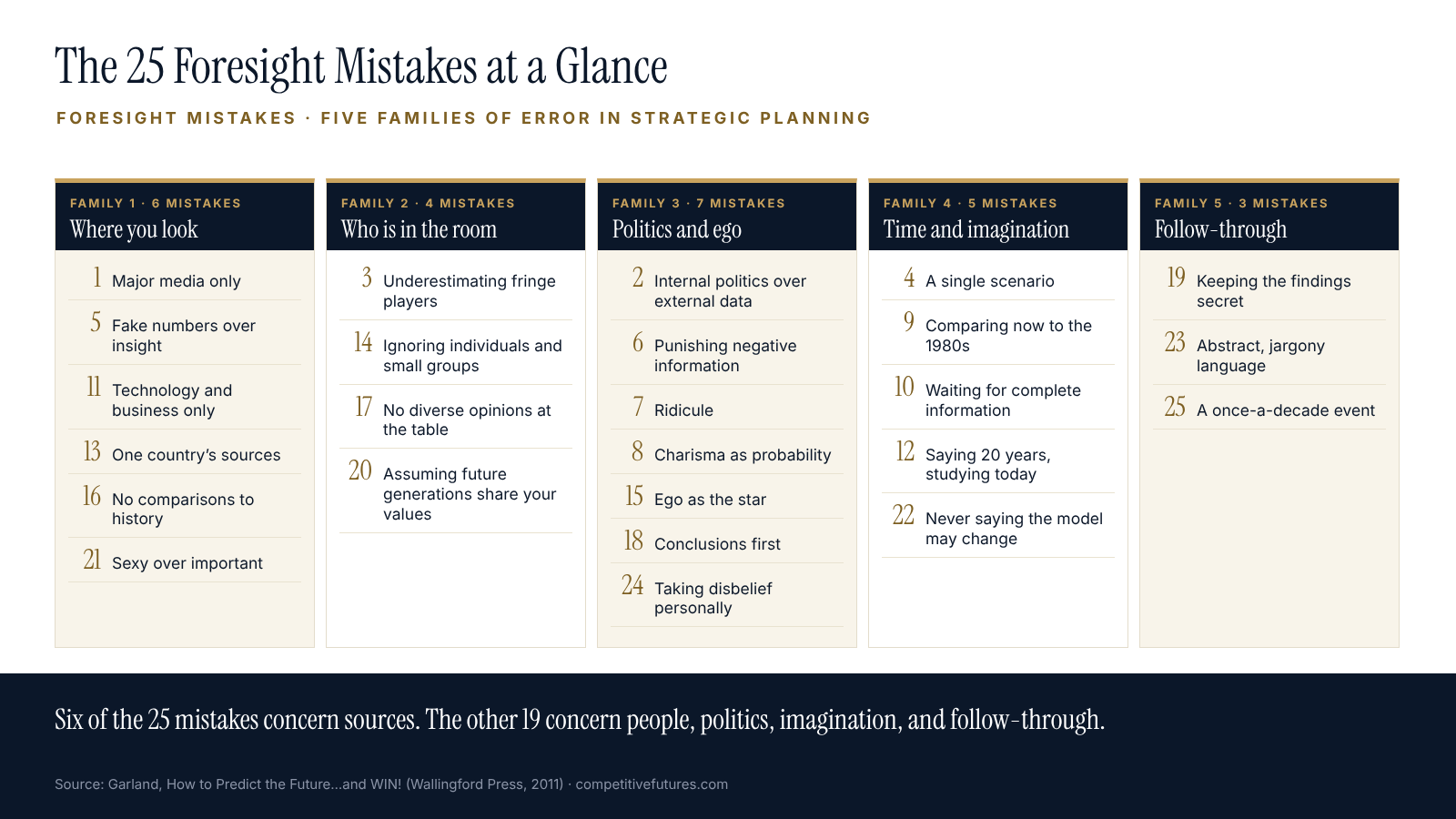
- How they sort: into five families. Where you look, who is in the room, politics and ego, time and imagination, and follow-through.
- How to use the list: as an audit. Score your last strategy or foresight project against it before you start the next one.
- Where to go next: each row links to a longer guide where we have published one.
Where the list came from
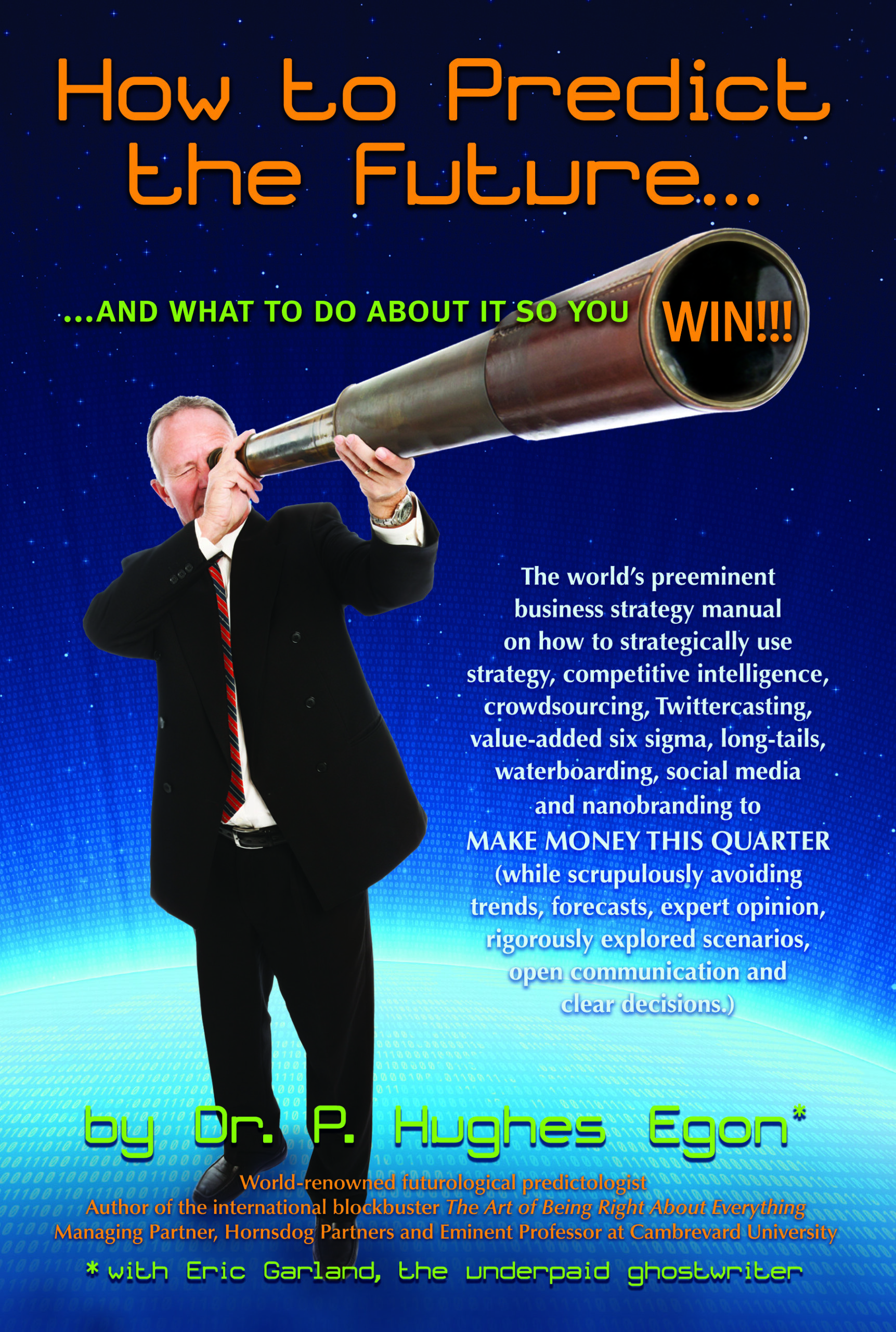
How to Predict the Future…and WIN! is a satire of the business-strategy book. Its narrator is Dr. P. Hughes Egon, a fictional “world-renowned futurological predictologist” who offers 25 tips for predicting the future. Every tip is a real behavior I had watched damage a client’s planning, stated as if it were good advice.
Egon is not based on one person. I described him in the book as “the collective id of the legions of expensive-suit-clad faux-intellectuals in the public arena who use the word ‘future’ to passionately describe the status quo.” After each of his tips I answered with what the book calls the future intelligence view, “my philosophy of rational, data-driven foresight,” and with one positive value that an organization would need in order to stop making the mistake.
The tables below give Egon’s tip, my corrective, and the value, all in the book’s wording. Egon’s tips are things not to do.
Family 1: Where you look
These six mistakes narrow the evidence before analysis begins.
| # | The mistake (Egon’s tip) | The fix | The value | Go deeper |
|---|---|---|---|---|
| 1 | Listen To Major Media Exclusively | “Authority is at a Turning Point” | Openness toward all voices | Trend analysis |
| 5 | Let Fake Numbers Trump Real Insights | “Qualitative analysis is not optional” | Philosophy | |
| 11 | Rely On Technology And Business, Ignore Culture, Society, Philosophy | “The future is defined by far more than business alone.” | Holistic thinking | STEEP analysis |
| 13 | Take All Of Your Sources From One Country, Preferably Your Own | “You cannot study the global future while ignoring most of the globe.” | Cosmopolitanism | Foreign-language OSINT |
| 16 | Never Make Comparisons To History! Those Jerks Didn’t Even Have Computers! | “A study of the future is impossible without an appreciation of the past.” | Common humanity | Every new technology promises world peace |
| 21 | Confuse Sexy With Important | “The future is more down-and-dirty than sexy.” | Maturity | Supply chain risk |
Tip 5 is the one that surprises quantitative people. Metrics are useful. The mistake is treating a number as understood because it is a number. The book’s test for a young analyst with a head full of spreadsheet columns is one question: what do these numbers represent in reality?
Family 2: Who is in the room
These four mistakes decide whose future gets studied and whose gets ignored.
| # | The mistake (Egon’s tip) | The fix | The value | Go deeper |
|---|---|---|---|---|
| 3 | Underestimate New Competition And Fringe Players | “You never know who or what might be disruptive.” | Appreciation of the weak signal | Future competitors |
| 14 | Don’t Waste Time Thinking About Individuals Or Small Groups | The book’s answer is a joke: this is Tip 3 again, because publishers like long books. | Brevity | Future competitors |
| 17 | Don’t Invite Young People, Poor People, Artists, Or Any Diverse Opinions To The Table | “Don’t forget stakeholders.” | Inclusiveness | Futures Wheel |
| 20 | Assume That Future Generations Will Share Your Values, Biases, Superstitions, And Desires | “The people in your future scenarios likely will not think like you.” | Detachment |
The book’s example for Tip 3 is Nokia. Before it was a mobile phone company it was a Finnish conglomerate that sold, among other things, rubber boots and cable insulation. When its largest customer, the Soviet Union, collapsed, Nokia bet the company on cell phones. As I wrote in the book, Motorola’s competitive intelligence staff later said it had not occurred to them that a Nordic boot manufacturer could be sneaking up on them. When people discuss future competition they tend to name the companies they already fear.
Family 3: Politics and ego
These seven mistakes have nothing to do with the future. They are about the people in the building.
| # | The mistake (Egon’s tip) | The fix | The value | Go deeper |
|---|---|---|---|---|
| 2 | Put Internal Politics Above External Data | “Embrace the long-term.” | Open dialogue | Why organizations ignore warning signs |
| 6 | Focus Uniquely On Positive Information; Punish Those Who Are Negative | “Don’t shoot the messenger” | Objective analysis | Why organizations ignore warning signs |
| 7 | Ridicule, Ridicule, Ridicule! | “Humility is painful, arrogance is fatal.” | Respect | Why organizations ignore warning signs |
| 8 | Value The Probability Of Forecasts By The Charisma Of The Person Delivering Them | “Dispassionate analysis should be at the heart of your plans.” | Substance over form | How to evaluate a forecast |
| 15 | Take It Personally! Make Sure Your Ego Is The Star Of All Visions Of The Future | “Understand the emotional reaction of those affected by your work in foresight.” | Process over content | |
| 18 | Start With The Conclusions In Mind, And Push All Information Toward Them | “Let the data drive the decision or don’t bother” | Critical thinking | Analysis of Competing Hypotheses |
| 24 | Take It Personally When Your Colleagues Don’t Immediately Believe Your View Of The Future | “Make the case for change” | Appreciation for the complex psychology of human beings | Communicating foresight |
The corrective to Tip 2 reads oddly until you have sat through the meeting. Talking about the long term gives a divided leadership team a way to stop arguing about itself. In the book I put the question this way: “Folks, let’s forget about us for a moment – where is agriculture going?”
Family 4: Time and imagination
These five mistakes shrink the future until it looks like the present.
| # | The mistake (Egon’s tip) | The fix | The value | Go deeper |
|---|---|---|---|---|
| 4 | Plan Based On A Single Scenario | “Nothing is more powerful than flexibility and resilience.” | Openness to change | Scenario planning |
| 9 | Compare The Current Moment To The 1980s | “The assumptions of the past do not match the future.” | Sweeping historical vision | |
| 10 | Wait For Complete Information Before Concluding, Deciding And Acting | “If you wait for quantitative, absolutely authoritative polished information, you will go out of business before it arrives.” | Courage | Intelligence is always wrong. Decide anyway. |
| 12 | Say You’re Looking Out 20 Years But Study Today Instead | “Faux foresight is more harmful than none at all.” | Intellectual rigor | Strategic foresight |
| 22 | Never Suggest The Whole Model May Be Changing | “In a world of transformation you will likely need to change something pretty major.” | Holism | Systems mapping |
Tip 22 rests on a point about history. Almost everyone now running a large institution in the industrial West grew up inside one long expansion of the same model. In the book I called a sixty-year period of relative success and stability “freakish.” Leaders who have only known that period tend to treat it as normal and to hear any suggestion of structural change as alarmism.
Family 5: Follow-through
These three mistakes waste a study that was done well.
| # | The mistake (Egon’s tip) | The fix | The value | Go deeper |
|---|---|---|---|---|
| 19 | Keep The Findings Of The Study Secret – Don’t Try To Make The Findings Available Throughout The Organization | “If foresight is to transform an organization, it needs to be on everyone’s mind.” | Building a future-focused culture | Communicating foresight |
| 23 | Communicate The Future In The Most Abstract, Jargony, Ignorable Language | “Tell it to them straight.” | Clarity | Communicating foresight |
| 25 | Make Sure This Kind Of Analysis Is A Once Every Decade Event | “Every organizational culture should be future-focused, every day.” | Commitment | Communicating foresight |
A five-question audit
You do not need to score all 25. One question per family will tell you where your last project went wrong.
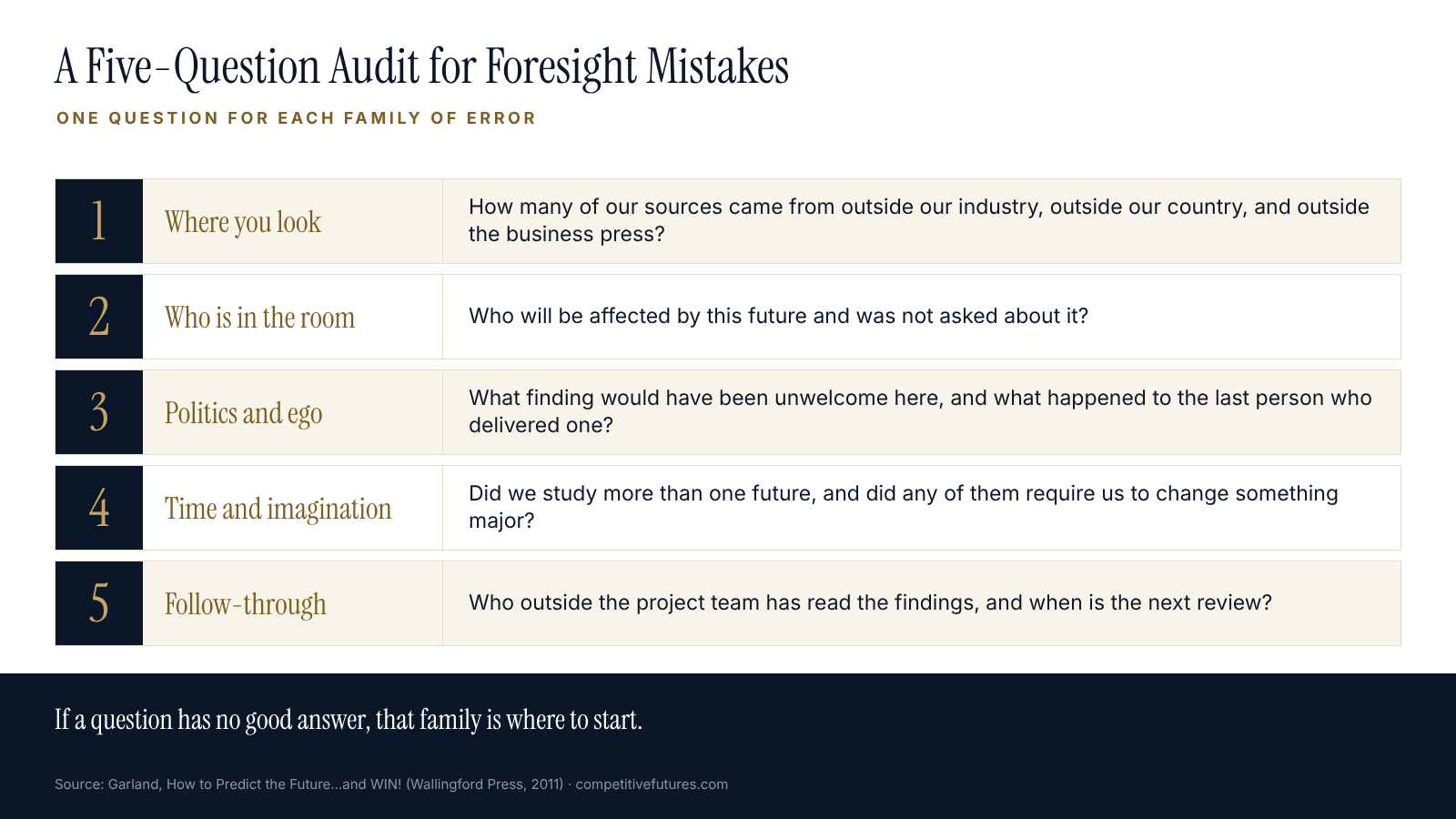
- Where you look. How many of our sources came from outside our industry, outside our country, and outside the business press?
- Who is in the room. Who will be affected by this future and was not asked about it?
- Politics and ego. What finding would have been unwelcome here, and what happened to the last person who delivered one?
- Time and imagination. Did we study more than one future, and did any of them require us to change something major?
- Follow-through. Who outside the project team has read the findings, and when is the next review?
If a question has no good answer, go back to that family’s table and read the fixes.
What the list teaches about building an intelligence function
Count the rows. Six of the 25 mistakes concern sources. The other 19 concern people, politics, imagination, and follow-through. That ratio matches what I have seen in three decades of practice, and it has a consequence for anyone building an intelligence or foresight unit.
In the book’s coda I passed along a point from Arik Johnson of Aurora WDC: we have left the era of data scarcity. Advantage used to go to whoever had the best collection network. It now goes to whoever interprets what everyone can see better than their rivals do. An intelligence function designed mainly around collection is designed for the old problem.
A function designed for the current one protects three things. It protects the analyst who brings bad news. It protects a regular place on the leadership calendar where findings are discussed. And it protects the right to say that the whole model may be changing. None of the three is expensive. Each one makes somebody senior uncomfortable, which is why they are rare.
The book ends on a line I still stand by: “behind every satire is optimism biding its time.”
Frequently asked questions
What are the most common foresight mistakes?
Planning on a single scenario, waiting for complete information before deciding, calling a study long-range while examining only the present, and treating foresight as a once-a-decade event. All four come from the list of 25 in How to Predict the Future…and WIN!
Why do strategic foresight programs fail?
Usually for human reasons, not technical ones. Of the 25 mistakes on this list, six concern where an organization gets its information. The rest concern who is heard, internal politics, a limited time horizon, and failure to share and revisit the findings.
Who is Dr. P. Hughes Egon?
A fictional consultant who narrates How to Predict the Future…and WIN! He offers 25 tips that are all bad advice. Eric Garland, the book’s author, answers each one with a corrective.
How do I audit a foresight project?
Ask one question for each of the five families of mistakes: where you looked, who was in the room, what politics and ego did to the findings, how far and how widely you imagined, and what happened after the report was delivered.
Is How to Predict the Future…and WIN! a serious book?
It is a satire with a serious purpose. The tips are jokes. The correctives after each tip are the author’s actual practice, and the book closes with a set of values for future-focused organizations.
Did the book’s own forecasts hold up?
We graded them in public. See the 2011 scorecard.
Work with Competitive Futures
Competitive Futures runs foresight audits, executive workshops, and keynotes that help leadership teams find which of these mistakes are built into their planning. To discuss your organization, contact the company.
Related reading
- I Wrote a Book About Predicting the Future in 2011. Here’s My Scorecard.
- Why Organizations Ignore Warning Signs
- Intelligence Is Always Wrong. Decide Anyway.
- Strategic Surprise: Why Companies Get Blindsided
- Cognitive Bias: A Field Guide
- Second-Order Effects
- What Is a Futurist?
References
- Garland, Eric. How to Predict the Future…and WIN! Wallingford Press, 2011.
- Garland, Eric. Future, Inc.: How Businesses Can Anticipate and Profit from What’s Next. New York: AMACOM, 2007.
Part of the Strategic Foresight guide from Competitive Futures.