The FCC Just Licensed a Step Toward a Kardashev II Civilization
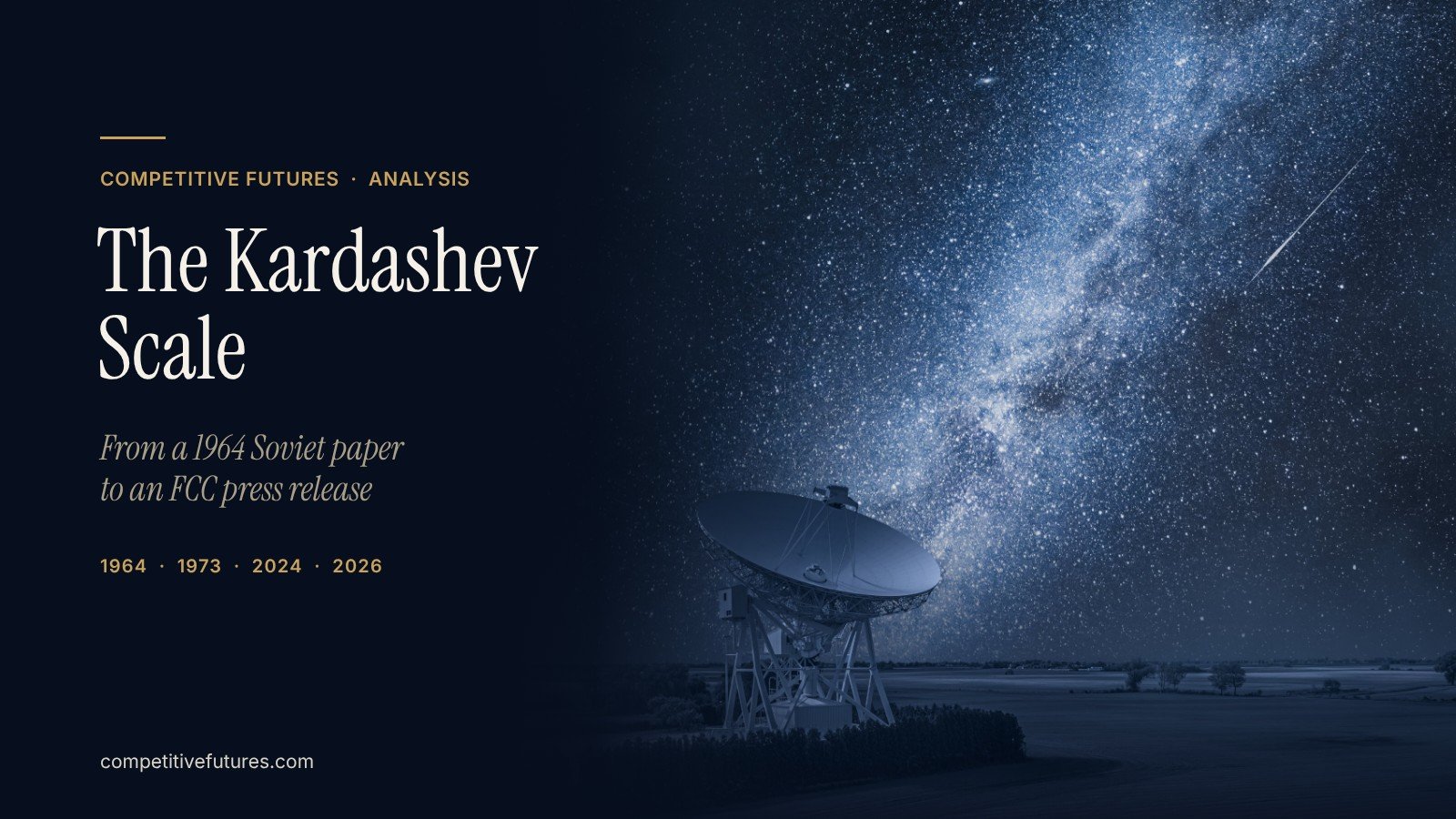
On 25 November 2026, the Federal Communications Commission authorized SpaceX to put up to 1,000,000 data centers in orbit. The constellation is called Starmind. In the announcement, Chairman Brendan Carr’s FCC said the project would bring humanity closer to a “Kardashev II civilization.” That is a term from the Kardashev scale, a 1960s framework for ranking civilizations by the energy they command, and it has never appeared in a U.S. licensing decision before.
How the Starmind License Happened
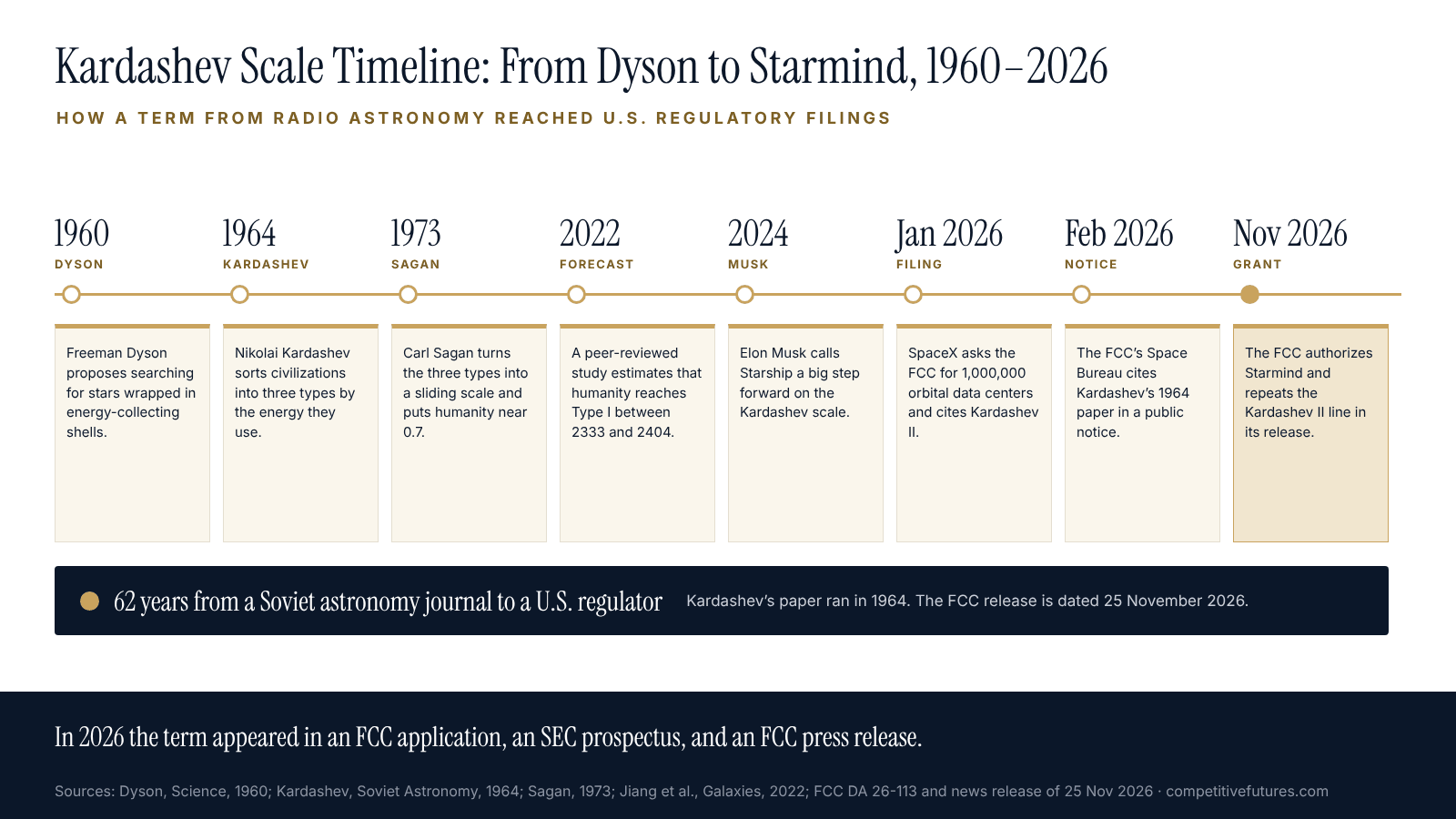
It moved fast. SpaceX filed the application on 30 January 2026, asking for a new system of up to 1,000,000 satellites that would act as solar-powered computing centers for artificial intelligence. The company’s filing called it a “first step towards becoming a Kardashev II-level civilization.” The FCC’s Space Bureau accepted the application 5 days later. Competitors filed petitions against it, and the FCC denied them. Ten months after the filing, the license was granted.
Why Nothing Like This Has Been Approved Before
- It is a first. The FCC calls it the first authorization in U.S. history for a constellation of data centers in space.
- The scale has no precedent. About 17,000 working satellites are in orbit today, from every country combined. This license covers roughly 60 times that.
- It runs on sunlight. Each satellite collects solar power in orbit and sends data, not electricity, back to Earth.
- It has deadlines. The license requires the first satellite by November 2033 and all 1,000,000 by 2040.
- More are coming. The FCC says it is reviewing other orbital data center proposals.
And then there is the language. A regulator’s press release normally talks about spectrum and orbital debris. The release from Carr’s FCC does that, and then says that the authorization, more fundamentally, moves the human race toward a civilization that can harness the full power of the Sun.
We covered it on Game Theory Today the day it happened:
A Milestone 66 Years in the Making
This is a huge milestone for an idea that American and Soviet futurists worked out at the height of the Cold War.
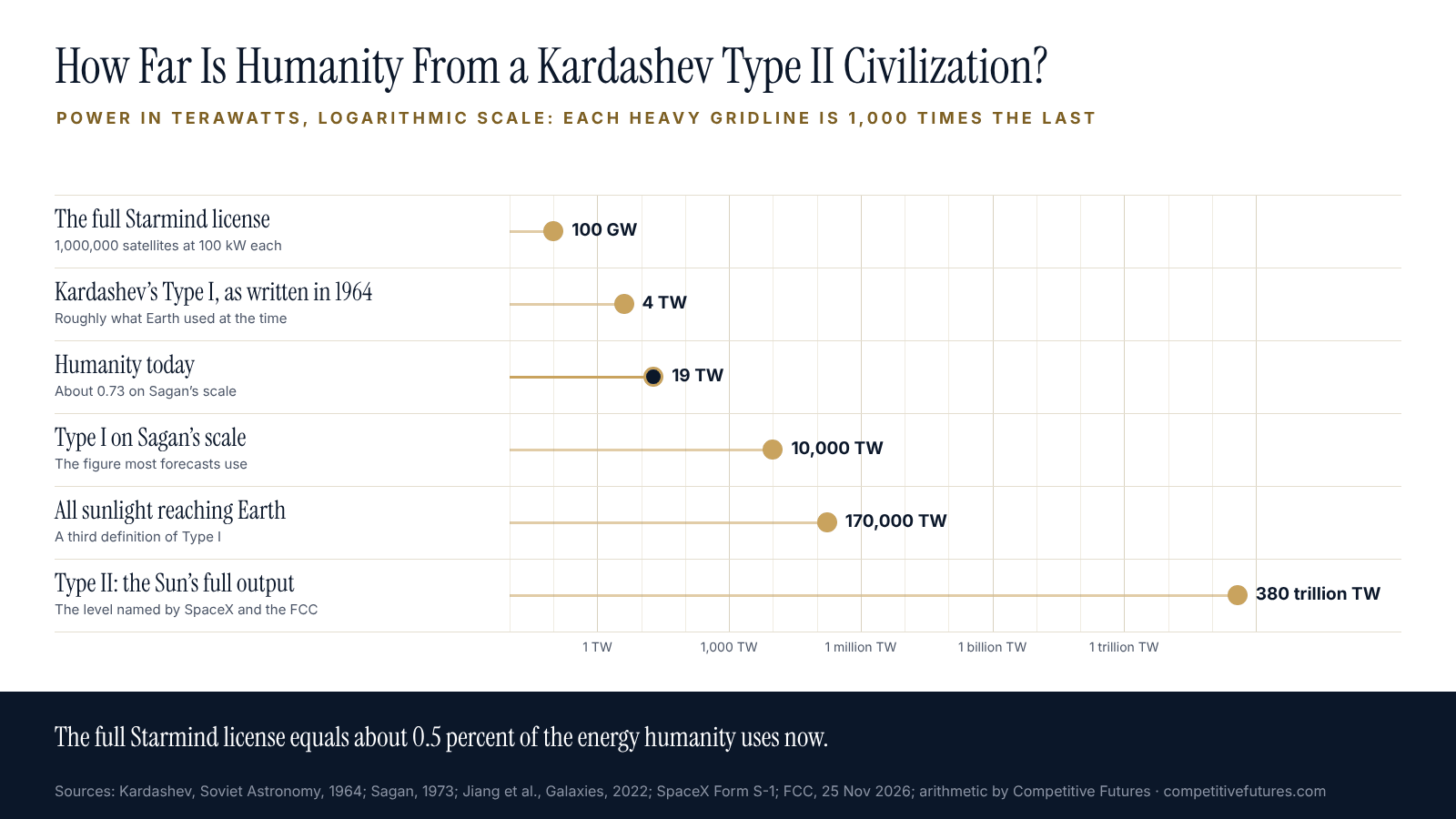
In 1960, the Princeton physicist Freeman Dyson proposed that an advanced civilization would eventually surround its star with collectors to capture all of its energy. In 1964, the Soviet radio astronomer Nikolai Kardashev built that into a classification. A Type I civilization commands energy on the scale of its planet. Type II commands the output of its star. Type III commands the output of its galaxy. In 1973, Carl Sagan turned the three types into a continuous scale and placed humanity at about 0.7.
For 6 decades the scale belonged to astronomers, science fiction writers, and futurists. Now it is in an FCC application, a stock prospectus, and a federal press release.
Type II Is Still an Enormous Leap
Let’s be clear about the distance. The full Starmind license, all 1,000,000 satellites, comes to about 100 gigawatts. That is roughly 0.5 percent of the energy humanity uses today. The Sun puts out about 20 trillion times what humanity uses. Getting from Starmind to the Sun’s full output would take 52 doublings.
The published forecasts say the same thing. One peer-reviewed estimate puts Type I around the year 2371. Another says millennia on present trends. A 2025 study places Type II somewhere between the years 3200 and 3500, under optimistic assumptions. Kardashev and Dyson themselves figured on about 3,000 years. Type III is a different order of thing altogether.
So nobody should read the FCC’s sentence as a schedule.
What Matters Is That the Government Signed Off on It
Here is what’s hugely significant. A United States government agency has approved a real project, with real deadlines, and described it in terms of where human civilization could be centuries from now. The applicant wrote the long-range vision into the filing. The regulator read it, kept it, and put it in the announcement.
Governments do not usually do that. Licensing decisions are justified by next year’s market and this decade’s competition. This one was also justified by a theory of civilization.
We’re Thinking About Ambitious Futures Again
For a long time, serious institutions stopped talking this way. Long-range thinking became risk registers and five-year plans. The future was something to be hedged.
Starmind marks a change. Companies are filing plans measured in millions of satellites and decades of buildout. Regulators are approving them in the language of Dyson, Kardashev, and Sagan. Whether or not the full constellation ever flies, the horizon that decision-makers are willing to plan for just got much longer.
That raises the stakes for everybody else. When the largest players plan on that scale, their competitors, their regulators, and their governments need a view of the long term that holds up, with numbers behind it.
Work With Competitive Futures
Competitive Futures is America’s leading strategic intelligence think tank on merging competitive intelligence, policy analysis, and long-range foresight. We tell clients what their competitors are doing now, what governments will permit next, and which futures are worth planning for.
If your organization is deciding how far ahead to look, contact us and we will be in touch.
Related
- What Is a Futurist?
- How to Read a Trend Curve
- Scenario Planning
- Keynote: Building a Foresight Culture
References
- FCC, “FCC Authorizes 1 Million Satellites for Data Centers in Space,” 25 November 2026.
- FCC Space Bureau, Public Notice DA 26-113, 4 February 2026.
- F. J. Dyson, “Search for Artificial Stellar Sources of Infrared Radiation,” Science 131 (1960): 1667–1668.
- N. S. Kardashev, “Transmission of Information by Extraterrestrial Civilizations,” Soviet Astronomy 8 (1964): 217–221.
- C. Sagan, The Cosmic Connection: An Extraterrestrial Perspective (1973).
- SpaceX, Form S-1.
- J. H. Jiang et al., Galaxies 10 (2022): 68.
- A. Zhang et al., Scientific Reports 13 (2023): 11305.
- J. H. Jiang and P. Das, “From Earthbound to Stars” (2025).