FinCEN’s Proposed Customer Due Diligence Rule: What Changes and Why It Matters
FinCEN’s proposed customer due diligence rule, released by the Treasury Department in November 2026, rewrites the beneficial ownership section of the CDD Rule at 31 CFR 1010.230. It is presented as a deregulatory measure, and part of it is: banks and other covered institutions would stop collecting the same ownership information every time an existing business customer opens a new account. The larger change runs the other way. The proposal tightens which identity documents count, bars the Individual Taxpayer Identification Number as a substitute for a Social Security number, and lets institutions ask about lawful immigration status and employment authorization where risk warrants it.
At a glance
- What it is: a proposed rule from the Financial Crimes Enforcement Network (FinCEN), “Customer Due Diligence Requirements for Covered Financial Institutions,” RIN 1506-AB78, docket FINCEN-2026-0298.
- Why now: it implements section 3(b) of Executive Order 14406, “Restoring Integrity to America’s Financial System,” signed 19 May 2026.
- Who it covers: about 14,554 institutions by FinCEN’s count: banks, broker-dealers, mutual funds, futures commission merchants, and introducing brokers in commodities.
- Burden relief: beneficial ownership information is collected when a legal entity customer first opens an account, then again only when the institution has reason to doubt it or its risk-based procedures call for an update.
- Tighter identification: a Social Security number for U.S. persons, with the ITIN expressly excluded; a passport or another photo government document for non-U.S. persons.
- New authority: institutions may collect information on lawful immigration status and employment authorization when relevant to fraud, identity misrepresentation, sanctions evasion, or other illicit finance.
- Unchanged: the 25 percent ownership threshold, the definitions of legal entity customer and beneficial owner, and the list of covered institutions.
- Timing: comments are due 60 days after publication in the Federal Register.
What the proposal changes
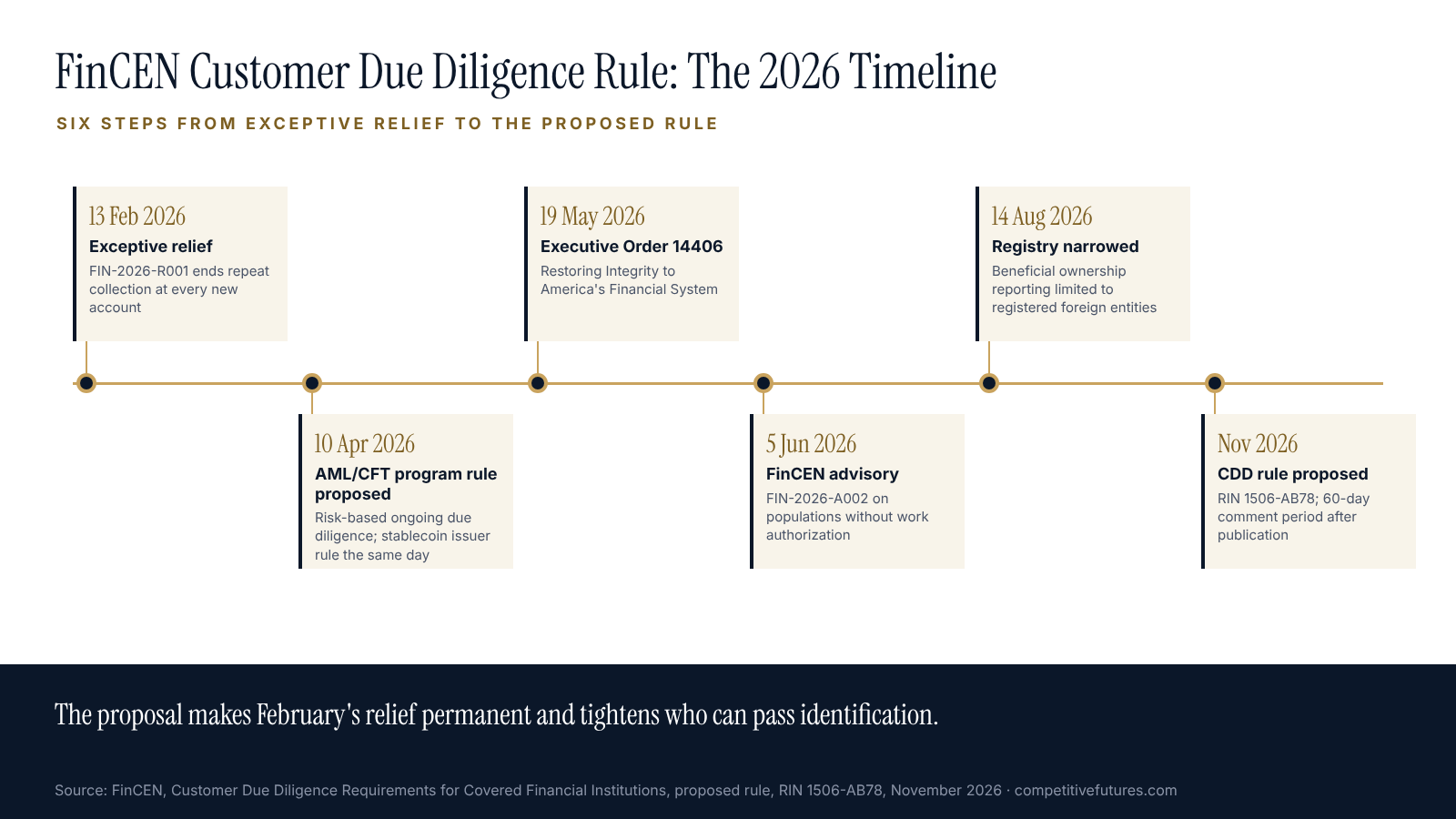
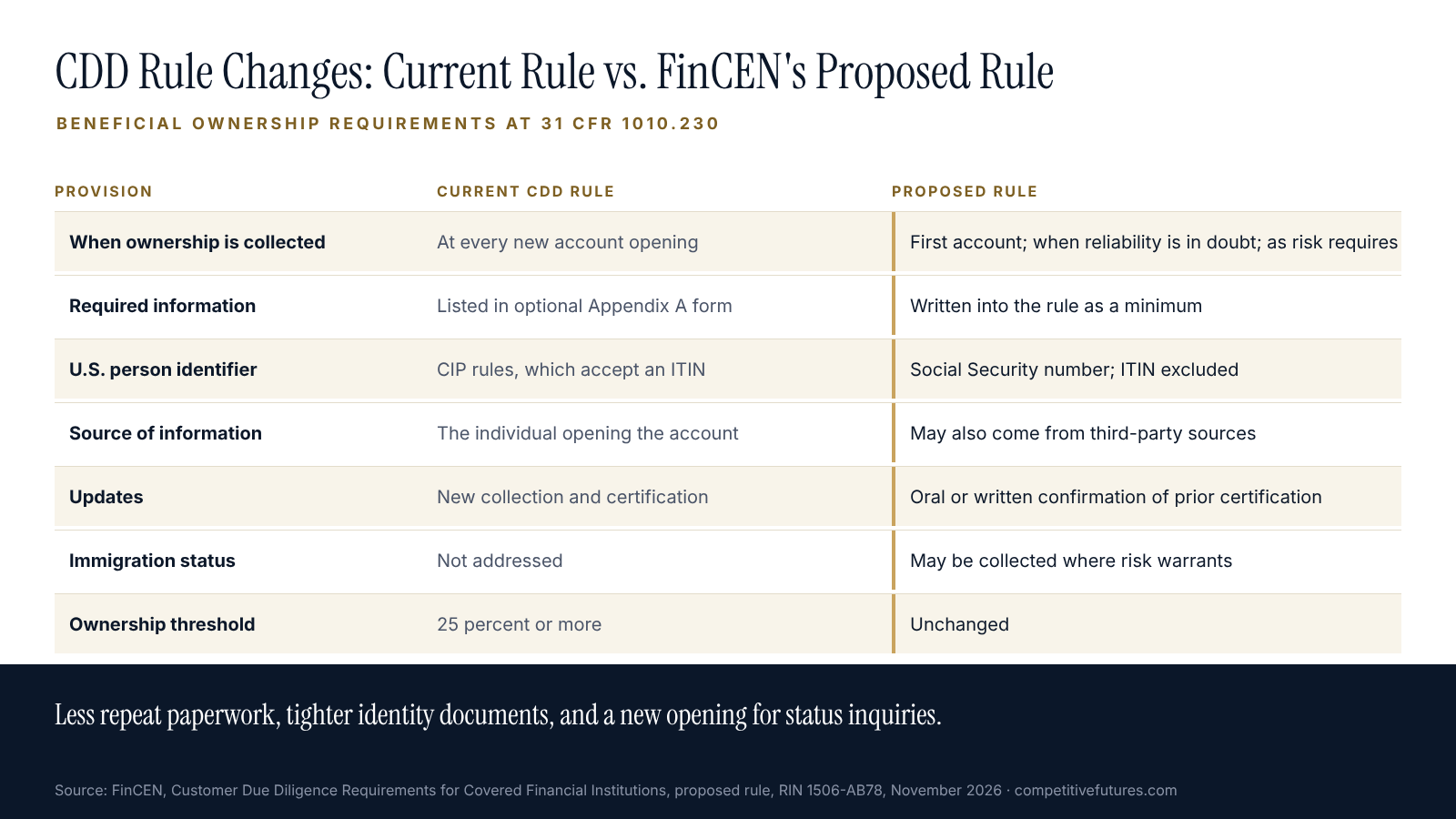
Collection timing. Under the 2016 CDD Rule, an institution identified and verified the beneficial owners of a legal entity customer each time that customer opened a new account. FinCEN granted exceptive relief from that requirement on 13 February 2026 (FIN-2026-R001). The proposal makes the relief permanent. Identification and verification would be required when the customer first opens an account, any time the institution learns facts that reasonably call the earlier information into question, and as needed under its risk-based ongoing due diligence.
The information list moves into the rule. Name, date of birth, address, and an identifying number have lived in an optional certification form, Appendix A. The proposal writes them into the regulation as a minimum. Where a beneficial owner has no residential or business street address, an APO or FPO box, or the address of next of kin or another contact, may be used.
Identifying numbers. For U.S. persons the number is a Social Security number, and the proposed text says in so many words that this does not include an ITIN. FinCEN’s reasoning is the IRS’s own description of the ITIN as a number issued for federal tax purposes only. Non-U.S. persons may present a passport number with country of issuance, an alien identification card number, or the number and country of another government document that shows nationality or residence and bears a photograph. The verification paragraph is rewritten so the Customer Identification Program rules, which do accept an ITIN as a taxpayer identification number, no longer leak into the CDD list.
Immigration status and work authorization. Where risk indicators or supervisory concerns warrant it, an institution may obtain more than the minimum, including information relevant to lawful immigration status and employment authorization in the United States. FinCEN ties this to the immigration provisions of Executive Order 14406 and to its 5 June 2026 advisory on populations without work authorization (FIN-2026-A002).
Third-party sources. The current rule requires the information to come from the individual opening the account. The proposal lets institutions obtain it from third-party sources, while keeping the certification requirement.
Certification. The person opening the account still certifies that the information is accurate to the best of their knowledge. For later updates, an institution may rely on that certification if a customer representative confirms, orally or in writing, that the information is still current. Institutions must keep a record of each certification or confirmation.
How the CDD Rule fits with the shrinking beneficial ownership registry
The proposal is not the CDD revision the Corporate Transparency Act requires; FinCEN says that will come separately. The context matters, though. On 14 August 2026 FinCEN issued a final rule limiting beneficial ownership reporting under the Corporate Transparency Act to foreign entities registered to do business in the United States. With domestic companies outside the federal registry, the beneficial ownership file a bank builds at account opening is now the main place ownership information on U.S. legal entities is collected and checked. This proposal makes that file harder to fill with weak identifiers, and easier to keep without repeated paperwork.
The proposal also leans on two other FinCEN rulemakings from 10 April 2026: the proposed AML/CFT program rule, which would require risk-based procedures for ongoing due diligence, and the proposed rule for permitted payment stablecoin issuers. FinCEN describes the three as complementary.
Our assessment
The burden relief is real but modest. FinCEN’s own analysis finds no significant economic effect and no new recordkeeping burden, and it did not quantify the savings. The substance of the proposal is in who can pass the identification step. Account opening becomes a checkpoint on documentation and, where risk warrants, on legal status. That is the same instrument the United States uses against sanctioned actors, which is cutting off access to the financial system, applied to the immigration priorities of the executive order.
The text is narrower than some coverage will suggest. It does not name cartels, China, Russia, or any specific sanctions program; it refers to sanctions evasion only in general terms. It does not require institutions to collect immigration status from every customer; it permits collection where risk warrants. And in line with Executive Order 14294 on overcriminalization, it states that criminal penalties under 31 U.S.C. 5322 require willfulness.
We expect the ITIN exclusion to draw the most comment, particularly from community banks, credit unions, and institutions serving immigrant-owned small businesses, along with questions about what a risk indicator for immigration inquiries looks like in practice. FinCEN rejected a fully risk-based alternative with no minimum information list, on the ground that illicit actors could exploit it, and it asks for comment on twelve topics, including whether ITINs could be allowed with added steps.
What covered institutions should do now
- Map every point where your onboarding accepts an ITIN for a beneficial owner, and estimate how many existing legal entity relationships rest on one.
- Review your ongoing due diligence triggers, since the reliability trigger and the risk-based update replace the per-account refresh.
- Decide, in writing, what risk indicators would justify asking about immigration status or work authorization, and how you will apply them consistently.
- Check whether third-party data vendors can supply beneficial ownership information that meets the minimum list, and how you will document certifications and oral confirmations.
- Read the twelve requests for comment and file where your data can change the outcome.
Frequently asked questions
What is the FinCEN customer due diligence rule?
The CDD Rule, at 31 CFR 1010.230, requires banks, broker-dealers, mutual funds, and futures firms to identify and verify the beneficial owners of legal entity customers. It took effect in 2018.
What does the November 2026 proposed rule change?
It ends repeated collection at every new account, writes the required information list into the rule, excludes the ITIN as a substitute for a Social Security number, allows third-party sources, and permits collection of immigration status and work authorization information where risk warrants.
Does the proposal change the 25 percent ownership threshold?
No. The ownership prong stays at 25 percent or more of the equity interests, and the definitions of legal entity customer and beneficial owner are unchanged.
Will banks have to ask every business owner about immigration status?
No. The proposed text permits institutions to obtain that information where risk indicators or supervisory concerns warrant it. It is an authority, not a universal requirement.
How does this relate to the Corporate Transparency Act?
It is a separate rulemaking. FinCEN says the CDD revision the Corporate Transparency Act requires will be handled separately, and its August 2026 final rule limited registry reporting to foreign entities registered to do business in the United States.
When can the public comment?
Comments are due 60 days after the proposal is published in the Federal Register, through docket FINCEN-2026-0298 on regulations.gov.
Work with Competitive Futures
Competitive Futures tracks enforcement instruments, including financial regulation, sanctions, and the courts, as the primary tools of statecraft. If your institution needs to understand how rules like this one change your risk picture, see our services or the Systemics Quarterly Brief.
Related reading
- Enforcement Risk: How U.S. Law Became an Instrument of Geopolitics
- U.S. Sanctions Risk: How OFAC Works and What It Means for Companies and Governments
- FARA Risk: How the Foreign Agents Registration Act Works
References
- Financial Crimes Enforcement Network, Customer Due Diligence Requirements for Covered Financial Institutions, proposed rule (RIN 1506-AB78), November 2026.
- Executive Order 14406, Restoring Integrity to America’s Financial System, 91 FR 30479 (19 May 2026).
- 31 CFR 1010.230, Beneficial ownership requirements for legal entity customers.