Why Iran Cannot Simply Surrender: Eric Garland in RealClearDefense
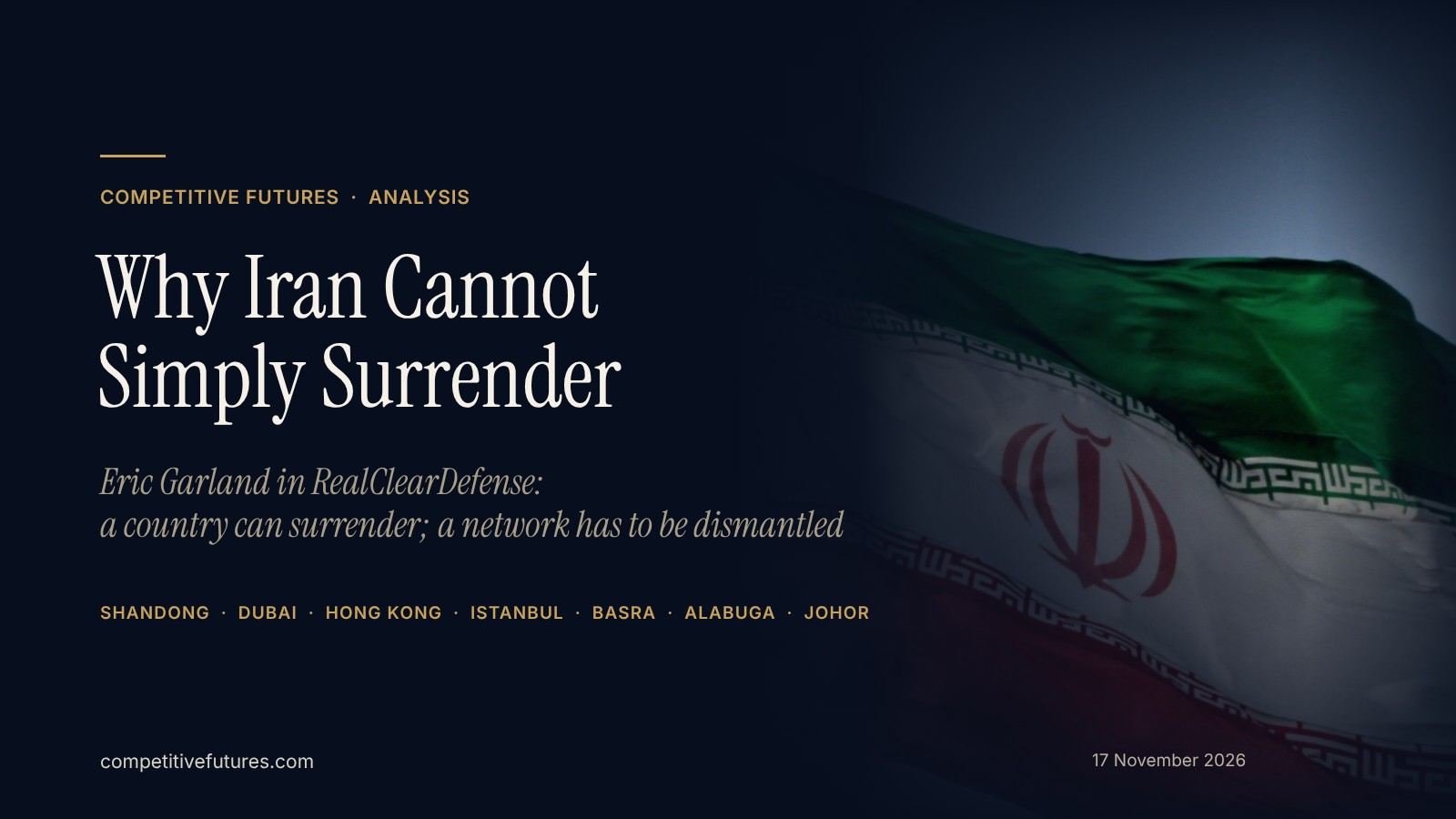
Our principal, Eric Garland, has an article in RealClearDefense today, “Why Iran Cannot Simply Surrender.” It asks why a regime that has lost its air force, its navy, much of its leadership, and its access to oil revenue and the dollar has not folded, and it answers that Iran is not only a country. It is the central node of a transnational network in oil, military technology, weapons components, and hired violence, and networks do not surrender the way countries do.
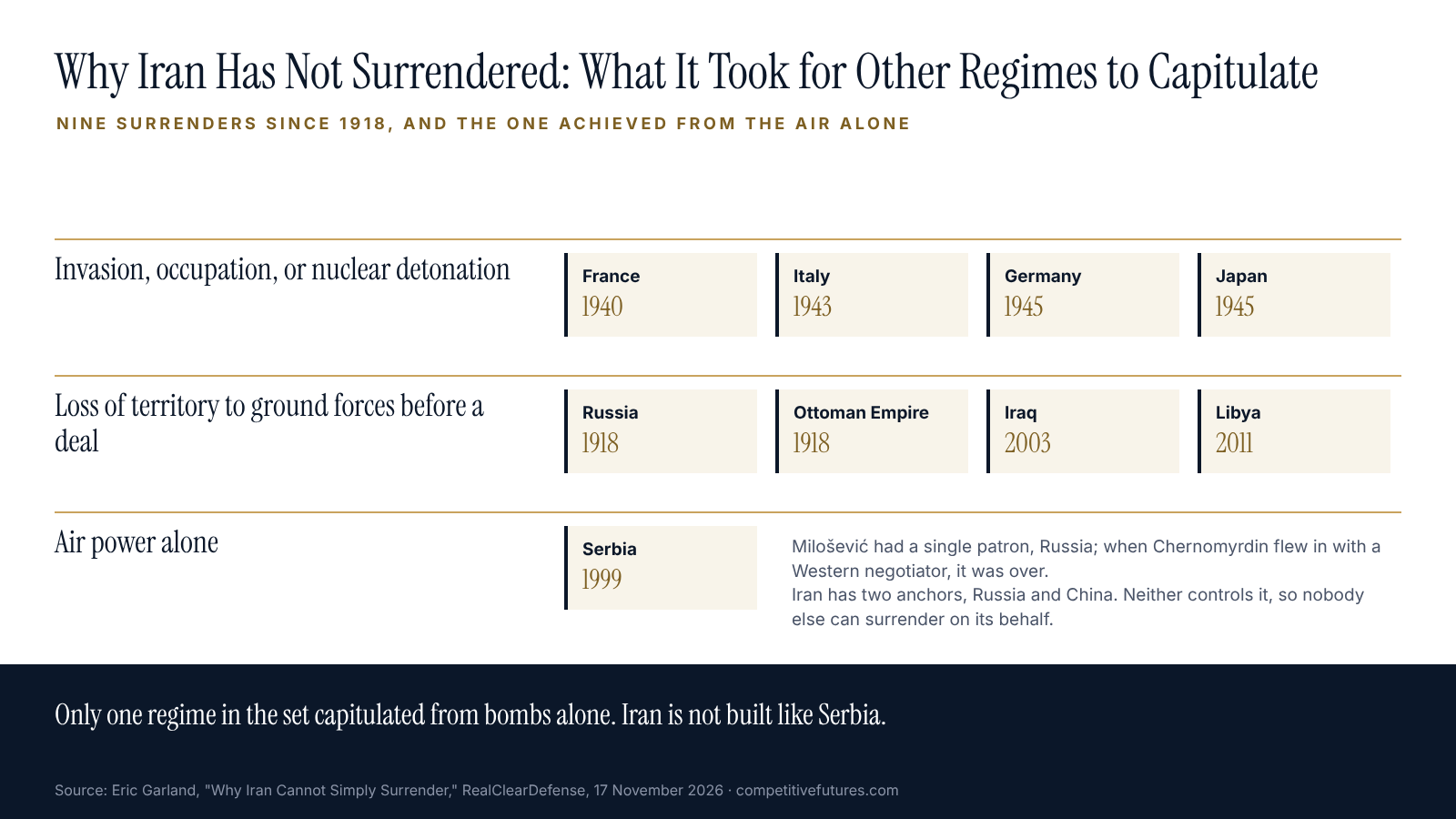
The article opens with the record. France in 1940, Italy in 1943, Germany in 1945, and Japan in 1945 surrendered only after invasion, occupation, or nuclear detonations. Russia and the Ottoman Empire in 1918, Iraq in 2003, and Libya in 2011 lost territory to ground forces before striking a deal. Only Serbia in 1999 capitulated from air power alone, and it did so because Slobodan Milošević had a single patron, Russia, and the moment Viktor Chernomyrdin flew in with a Western negotiator, it was over. Iran has two anchors, Russia and China. Both are structural for Iran, neither controls it, and nobody else can surrender on its behalf.
From the article
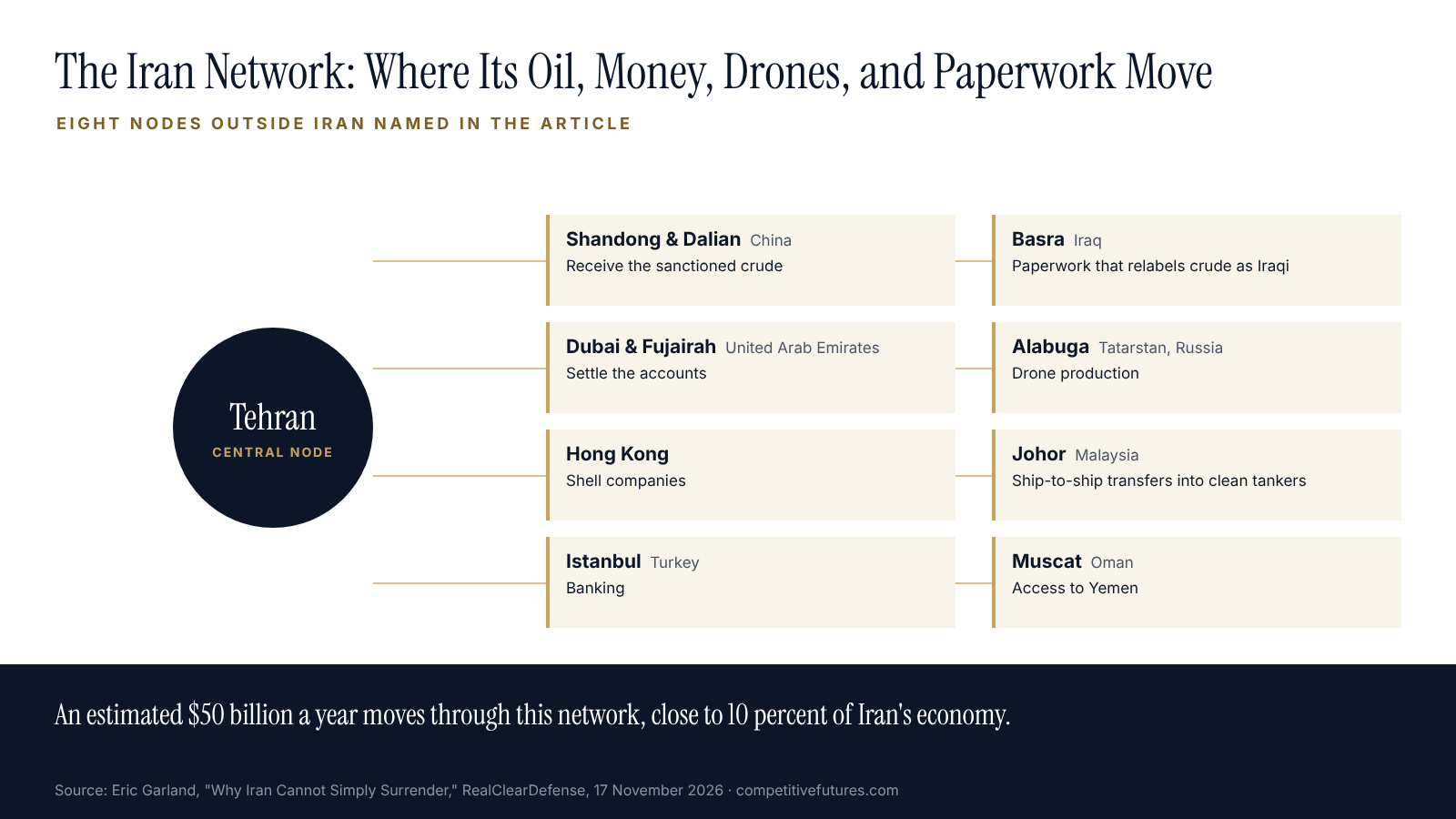
Iran’s threat cannot be perceived by simply looking at Tehran, Isfahan, and Kharg Island. The Iranian network goes from the Persian Gulf to Shandong and Dalian, China, which receive their sanctioned oil. The money goes to Dubai and Fujairah, United Arab Emirates, which settle their accounts. The shell companies are based out of Hong Kong. Istanbul banks them, too. Bogus paperwork is provided out of Basra, Iraq, so their oil can make it to more markets, marked as “Iraqi” crude. Alabuga, Tatarstan, Russia is where the drones are made, and the waters off Johor, Malaysia is where their crude is swapped out into non-sanctioned tankers. Muscat, Oman is where they get access to Yemen. And their violence is shipped to Stockholm, Brooklyn, Sydney, and Maryland — not to mention their proxies such as Hizballah.
Eric Garland, “Why Iran Cannot Simply Surrender,” RealClearDefense, 17 November 2026
The article’s working estimate from open sources puts the network’s revenue at around $50 billion a year, close to 10 percent of Iran’s entire economy, most of it crude oil sold to China. Its argument is that the money and the alignment moving through that network are what give Tehran the will to keep fighting after its conventional forces are gone, and that the United States should take the network apart with the same relentlessness it brought to Iran’s navy and air force.
The second half of the piece follows the U.S. Treasury’s Operation Economic Outcast through the Emirates and Turkey, where behavior has already changed, and sets the test for what comes next: whether Treasury designates a major Chinese bank or names the Hong Kong formation agents whose shell companies carry Iran’s oil trade.
Read the full article at RealClearDefense.
Related reading from Competitive Futures
- Seventy Countries, Six Cities: The Global Network Behind Iran
- We Don’t Have an Iran Problem. We Have a China Problem.
- A NATO Ally Is Bankrolling Iran’s Missile Program. The Treasury Just Proved It.
- Trump’s Blockade Isn’t About Iran. It’s About Everyone Who’s Been Doing Side Deals.
- U.S. Sanctions Risk: How OFAC Works and What It Means for Companies and Governments
Work with Competitive Futures
The analysis behind this article is the kind the company publishes each quarter in the Systemics Quarterly Brief, which treats courts, prosecutors, and sanctions bodies as primary instruments of statecraft, with military force in a supporting role. See our services for how we work with corporate and government clients.