Monaco 2029, Seventeen Years On: The Accession Address, the Livre Blanc, and the Record
Monaco 2029 was the name the National Council of Monaco gave, in February 2009, to a working group charged with considering what the Principality should become over the following twenty years. Competitive Futures had the honor of serving the National Council as its consultant on method. Seventeen years later, with the horizon of the study now nearer than its origin, we return to the documents: the Accession Address of His Most Serene Highness Prince Albert II, the Livre Blanc that the group delivered, and the public record of what the Principality has done since.
Version française : Monaco 2029, dix-sept ans après
At a glance
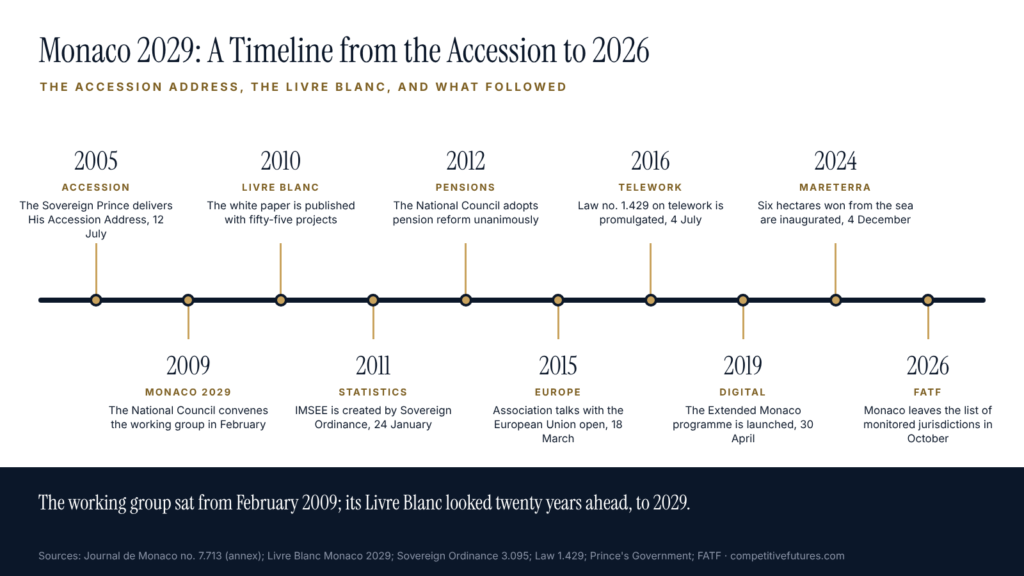
- 12 July 2005: His Most Serene Highness the Sovereign Prince delivers His Accession Address on the Place du Palais.
- February 2009: On the proposal of its President, Stéphane Valeri, the National Council convenes the groupe de réflexion Monaco 2029.
- January 2010: The group delivers its Livre Blanc: a vision, an assessment of strengths and weaknesses, six strategic axes, and fifty-five projects.
- 2011 to 2026: A national statistics institute, a telework statute, pension reform, a digital programme, six hectares of new territory, and a completed passage through international financial monitoring.
- 2029: The year the study was written for is three years away.
The Accession Address of 12 July 2005
When the period of official mourning for Prince Rainier III had closed, His Most Serene Highness addressed Monégasques and residents from the Place du Palais. The Address is the founding text of the reign, and the Livre Blanc cites it repeatedly as the source of its own vision.
Its first proposition concerned the inheritance. The Sovereign pledged fidelity to the work of the Builder Prince and, in the same breath, declined to treat that fidelity as repose: “la continuité n’est pas l’immobilisme.” What followed was a programme. Ethics was to govern the conduct of the authorities and was held to be indivisible. The financial centre was to exercise the utmost vigilance against undesirable activity, in concert with international bodies, and was to mature from deposit-taking toward asset management and venture capital. An economy confined to two square kilometres was to seek its growth in activities of high added value. The innovator and the entrepreneur were named as the agents of progress, and the young were to be trained to the highest standard and sent abroad for experience. The Principality was to ratify the Kyoto Protocol and to offer the world the example of a country respectful of nature. Health, sport, culture, and humanitarian action abroad each received their place.
The Address issued no schedule of instructions to the Government. It set a direction and asked every Monégasque and every resident to share in it.
The convening of Monaco 2029
By early 2009 the financial crisis had lent that direction a sharper urgency. The G20 had turned its attention to the jurisdictions it called tax havens, and the reputation of the Principality had suffered for it. The National Council, the elected assembly of the Monégasques, resolved to make its own intellectual contribution to the question of the country’s development.
The group it assembled joined specialists in economic foresight to Monégasques of varied callings: National Councillors, industrialists, financiers, a diplomat, and the Council’s own economic staff, and it placed them under the guidance of the late Jean Mandelbaum, who served as the group’s animateur. The choice was an inspired one. A graduate of HEC in the class of 1962, Mandelbaum was for decades a constant figure in French public life: the founder of the Cercle Rencontres et Échanges and the famed host of the Matins HEC, who conceived or presided over more than two thousand debates and became a celebrated interviewer of the powerful, a counsellor to heads of State and Government, the author of books on development, China, and Japan, and a convenor of debates from Paris to the World Economic Forum. He was above all a free thinker, at ease with ministers and impatient of received opinion, and the candor of the Livre Blanc owes a great deal to the liberty of mind he brought to the chair.
Competitive Futures was engaged by the National Council as a consultant to assist with methodology. Our part was to bring the discipline of foresight to the group’s deliberations: the framing of the horizon, the reading of long-term trends in the global economy, and the means of turning them into strategy. The work was conducted in French and in strict confidence, and our engagement ran through 2009 and into 2010. The programme itself continued for years after our part in it had closed.
President Valeri asked the group for strong ideas and innovative proposals, surprising or even disturbing if need be, provided they were realistic. The economists Christian de Boissieu and Pierre-André Chiappori contributed the introduction. The finished Livre Blanc was to be presented to the Sovereign Prince, published by the National Council, and offered to any resident who asked for it.
What the Livre Blanc saw
The document is candid to a degree unusual in official literature. Its preface observes that the tradition of Monaco is permanent innovation, and the pages that follow test the proposition without indulgence.
The diagnosis. The model that had carried the Principality since the 1950s was judged to be approaching its term. The group catalogued the country’s strengths: security, political stability, the absence of public debt, and a renown out of all proportion to its size. It then set down the weaknesses with equal care: resistance to change, a tendency to self-satisfaction, insufficient meritocracy, a legal framework in need of modernization, scant opportunity for young graduates, statistics that were neither reliable nor shared, and positions of monopoly and rent that dulled competitiveness. The last two items, the text admits, were fiercely debated within the group.
The forecasts. The Livre Blanc held that the general exchange of tax information would prove durable, that the offshore segment of finance would grow marginal, and that the future of the financial centre lay “onshore,” with residents and with the skills of asset management. It warned that attractiveness was slowly eroding, that the pension funds were a cause for concern, and that reliance on the Constitutional Reserve Fund to finance public investment could not continue indefinitely. It judged a dialogue with the European Union to be indispensable. It counted extension into the sea among the opportunities. Its scenario of drift, au fil de l’eau, described what would follow if nothing were done.
The recommendations. Six axes ordered the strategy: the scarcity of territory; the place of Monégasques and residents at the centre of the economy; attractiveness; the enlargement of the economic space through telework and cooperation with neighbouring communes; governance, transparency, and the country’s image; and the structure of the economy itself. Fifty-five projects were annexed, from a Monegasque Institute of Statistics and a telework statute to a nursery of talent, a development bank, a cross-border transport plan, and an indicator of value added per square metre.
What the Principality has done since
Competitive Futures had no authorship of the policies of the State, and claims none. Our part was method, in the service of the National Council, during the first year of a programme that outlasted our engagement. The Livre Blanc was a contribution to a national debate, and the decisions belonged to the Sovereign Prince, His Government, and the National Council. We set the record beside the text as former participants, with admiration for the work of the Monégasques who carried it on.
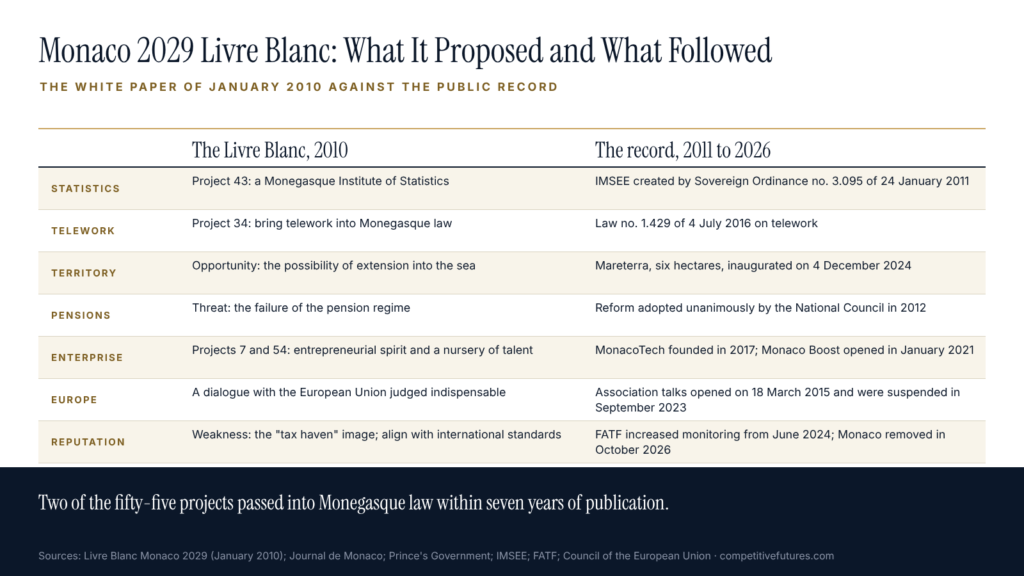
Statistics. Sovereign Ordinance no. 3.095 of 24 January 2011 created the Institut Monégasque de la Statistique et des Études Économiques, with a Scientific Council chaired by Professor Chiappori. The census, the national accounts, and the sectoral observatories that Monaco now publishes proceed from it.
Telework. Law no. 1.429 of 4 July 2016 gave telework its statute, supported by an amendment to the Franco-Monegasque social security convention, so that employees of Monegasque firms may work from home across the frontier.
Pensions. In 2012 the National Council adopted unanimously a reform intended to secure the employees’ pension regime to 2050. In April 2023 it voted the creation of a Monegasque complementary pension fund.
Enterprise. MonacoTech, an incubator and accelerator, was founded in 2017. Monaco Boost, a State-owned business incubator for Monégasque entrepreneurs, opened in January 2021 and has since supported some ninety-five companies.
The digital State. On 30 April 2019 His Most Serene Highness the Sovereign Prince launched Extended Monaco, the programme for the digital transition of the administration and the economy.
The environment. The Principality has bound itself to reduce greenhouse gas emissions by 55 percent by 2030 against 1990 and to reach carbon neutrality in 2050, and has written both objectives into its Environment Code.
Territory. On 4 December 2024 His Most Serene Highness inaugurated Mareterra, six hectares won from the sea at the Anse du Portier, an enlargement of about three percent.
Residents. The census of 2023 counted 38,367 residents, against 35,352 in 2008, and found Monégasques to be the largest single nationality in their own country for the first time.
Europe. Negotiations for an association agreement with the European Union opened on 18 March 2015. They were suspended in September 2023, when the parties found the Union’s requirements irreconcilable with the red lines the Sovereign Prince had drawn from the outset.
Financial standing. The Principality signed a succession of tax agreements to OECD standards. In June 2024 the Financial Action Task Force nevertheless placed Monaco under increased monitoring, and in October 2026, its action plan completed, removed it. The Address of 2005 had asked for the utmost vigilance, and the Livre Blanc had warned that a failure to anticipate international movements of this kind carries a cost.
What remains open. The chapter on monopolies and competition is still the most demanding in the document. Cross-border transport, which the group counted among the weaknesses, remains a daily preoccupation, and a metro is under study. In June 2026 the Government laid before the National Council a bill establishing a master plan for urban development, which answers in its way the group’s complaint that the country’s strategy lacked visibility.
What the exercise teaches
Three observations seem to us to survive the passage of time.
A parliament may commission foresight as properly as an executive, and the result gains from the independence. The Livre Blanc could say of the administration and of protected markets what no ministry would have printed about itself.
Foresight is worth more when it names its own disagreements. The group recorded that its members had argued over monopoly and rent and published the majority view as such. Readers have been able to trust the rest of the text accordingly.
A study should be read again when its horizon approaches. The proposals that passed into law were the specific ones, each with an institution or a statute attached. The broader exhortations are harder to trace. We draw from this a discipline for our own work: recommendations are written so that a reader, years later, can establish whether they were acted upon.
Frequently asked questions
What was Monaco 2029?
Monaco 2029 was a working group convened by the National Council of Monaco in February 2009 to study the Principality’s economic model over a twenty-year horizon. It delivered its Livre Blanc in January 2010.
Who commissioned the Monaco 2029 Livre Blanc?
The National Council of Monaco, the Principality’s elected assembly, on the proposal of its President, Stéphane Valeri. The white paper was to be presented to the Sovereign Prince and published by the Council.
What was Competitive Futures’ part in Monaco 2029?
Competitive Futures was a consultant to the National Council of Monaco, engaged in 2009 and 2010 to assist with foresight methodology. The firm’s principal, Eric Garland, worked with the group in French. The firm had no authorship of the Principality’s policies.
What did the Accession Address of 2005 ask for?
The Address of 12 July 2005 set out the priorities of the reign: ethics in public life, vigilance in finance, activities of high added value, the encouragement of innovators and entrepreneurs, the training of the young, and the protection of the environment.
Which Monaco 2029 proposals were carried out?
A national statistics institute was created in 2011, and telework was given a statute in 2016. Pension reform, business incubators, an extension into the sea, and talks with the European Union also followed. These were decisions of the Sovereign Prince, His Government, and the National Council; Competitive Futures had no part in them.
Why was the horizon 2029?
The group began work in 2009 and looked twenty years ahead, which is the span over which decisions about territory, pensions, education, and infrastructure show their effects.
Work with Competitive Futures
Competitive Futures has practised strategic foresight for governments and corporations since 2002. We conduct long-horizon studies, build foresight capability inside institutions, and brief leadership on what the findings require of them. To discuss a study, write to us through the contact page.
Related
- Monaco 2029: Strategic Foresight for a National Government (case study)
- Strategic Foresight: A Practitioner’s Guide to Seeing What’s Coming
- Our Work
References
- Journal de Monaco, annex to no. 7.713 of 22 July 2005, “Avènement de S.A.S. le Prince Albert II” (source)
- Conseil National de Monaco, Monaco 2029: Livre Blanc (January 2010), and Monaco 2029: Groupe de réflexion (February 2009). Copies held by Competitive Futures.
- Sovereign Ordinance no. 3.095 of 24 January 2011
- IMSEE, Monaco en chiffres 2011, foreword (source)
- Law no. 1.429 of 4 July 2016 on telework, Journal de Monaco no. 8.286 (source)
- Assemblée nationale (France), bill no. 2586 approving amendment no. 6 to the convention of 28 February 1952
- Journal de Monaco, annex to no. 8.118, National Council debates, extraordinary session of 2012, bill no. 900 on employees’ pensions (source)
- Prince’s Government, “Monaco Boost – A New Monegasque Business Incubator”
- Prince’s Government, “Extended Monaco: the Monegasque model in a digital world,” 2 May 2019
- Direction de l’Environnement, Plan Climat Air Énergie de la Principauté de Monaco (source)
- IMSEE, Recensement de la population 2023 (November 2024) (source)
- IMSEE, Monaco en Chiffres 2025, ch. 2, Population (source)
- Prince’s Government, “État des négociations entre Monaco et l’Union européenne,” 2 June 2016
- Council of the European Union, doc. ST 5290/2025 COR 1 (recital on the suspension of 2023)
- Prince’s Government, “Monaco added to the FATF’s grey list,” June 2024
- FATF plenary outcome, 30 October 2026.
- Prince’s Government, “Intensification of International Relations” (tax agreements to OECD standards)