Al Capone Was a Tax Evader
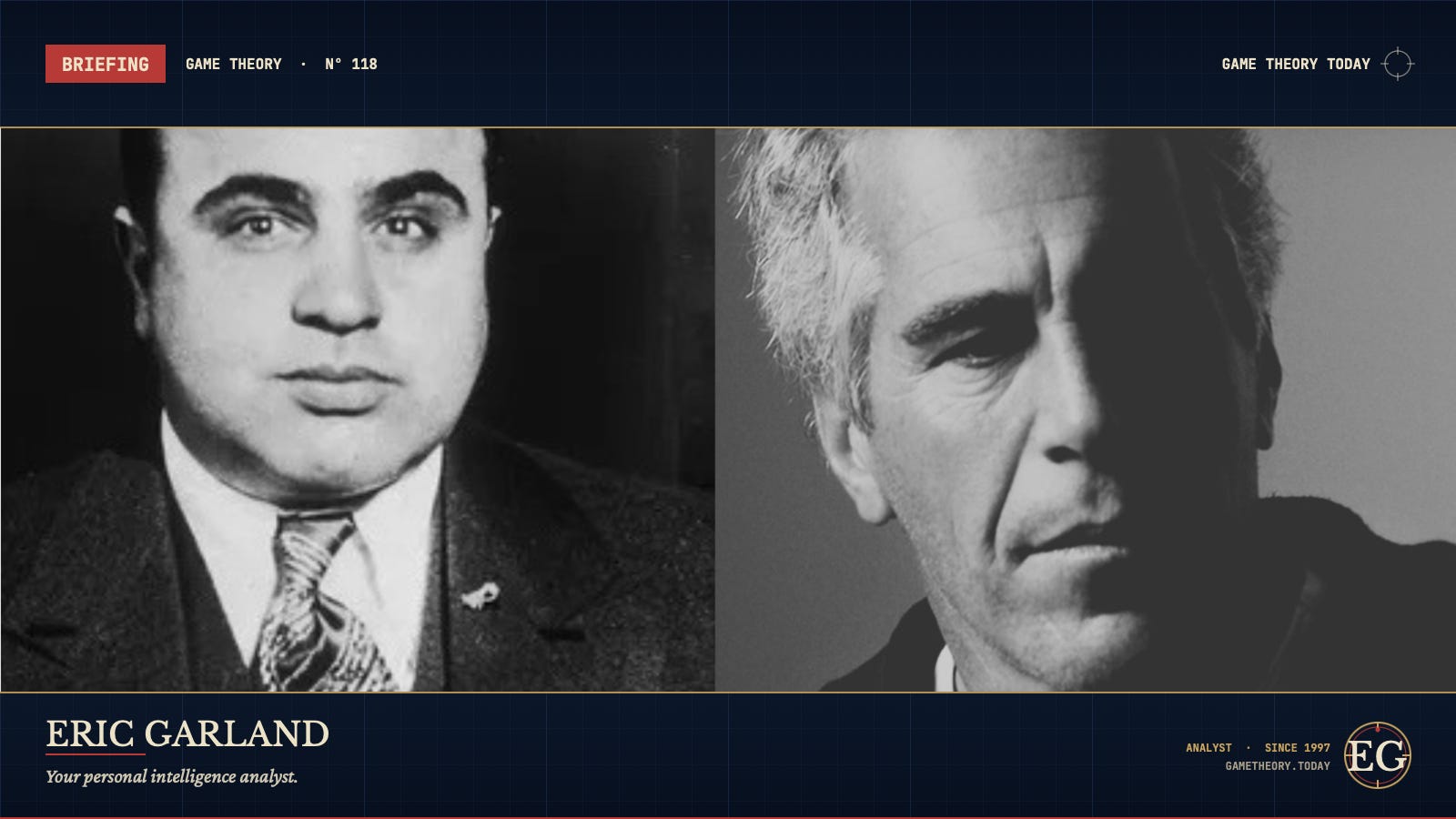
Al Capone terrorized Chicago. He ordered murders, trafficked contraband, rigged elections, and bought a city’s worth of cops and judges. He extorted the common man, made the streets run with blood, and inaugurated a system of corruption in the Midwest from which America is still suffering. The Federal Government knew the extent of his crimes. They charged him with failing to pay Federal income tax. Capone served seven years on the tax charge and died broken and syphilitic, a shadow of the man who once ran Chicago.
The tax charge was legit. Capone genuinely owed the money — the Supreme Court had already ruled that illegal income is taxable income, which is the small legal hinge on which the whole takedown swung. But nobody in 1931 believed the Republic had been menaced by a bookkeeping error. The tax conviction was a proxy for real justice. It was the provable, peripheral offense the state reached for because Capone’s actual empire of harm was beyond the reach of any indictment it could win in front of a jury.
This is a recurring feature of American law enforcement, not a quirk. When the substantive crime outruns the available statutes, prosecutors reach for the technicality that will stick. The charge that finally takes a man down is often a measure of what the state cannot reach, not what he did.
This goes even more for crimes of espionage, where the full extent of the Government’s knowledge is not something that would be helpful or safe in front of a jury.
And this is where we must continue examining the atrocious story of one Jeffrey Epstein.
A man so bad, child trafficking was the equivalent of tax evasion
Let me be precise, because this is the part that can be misread on the way to the comment section: Epstein’s crimes against women and girls were real, monstrous, and nothing about them was a technical crime in the same way as tax evasion. He should have been buried under a prison decades ago. Nothing in my following analysis softens that by a degree. His victims are not a rhetorical device.
But ask the Capone question: Was sex trafficking the whole of what made Jeffrey Epstein dangerous — or was it the provable offense that a system equipped to prosecute sex crimes could finally land on to take down a man whose actual function was something it had no statute for?
The millions of pages the Justice Department released this year, and the Miami Herald investigation that worked through them, point hard at the second answer. That reporting shows Jeffrey Epstein was a key interlocutor between Cuba, Venezuela, and the Emirates in a scheme that was breathtaking in its treachery against the United States’ sovereign interests. (The Herald had separately documented his 2003 meeting with Fidel Castro years earlier.)
They show a man who was not running a fortune. Nor was he simply running a network of fellow degenerates. The evidence shows that he was at the vanguard of a movement that attempted to rot the United States from the inside, to the benefit of our enemies.
A hostile spy in the service of everyone except us
Look at who Epstein cultivated in the new files and the pattern is unmistakable: he weighted his attention toward people who sat next to sovereign decisions.
- The chief executive of a Gulf state’s logistics empire.
- Brokers who could touch both the Chavista regime and its opposition.
- The chairman of an oil venture partnered with Venezuela’s state petroleum company.
- The owner of an aviation company later indicted over a $350 million cocaine-logistics scheme.
- A state-backed neuroscience conference that bought him a foothold in Havana.
This is a spy’s collection regime, not a business development portfolio, nor some bunch of pervs.
And here is the tell that separates a financier from a hostile intelligence asset: the deals kept not closing. The Chilean solar project went nowhere. The Venezuelan oil venture, both parties now insist, never materialized. One associate told the Herald there was no business relationship at all. For an actual investor, a portfolio of deals that never close is simply failure. For a collection platform, the deal was never the point — the proximity was the yield, and the unconsummated deal did its job the moment it put Epstein in the room. If you’ve ever (*ahem*) been an intelligence collector, this is obvious stuff, but especially once you see the pattern.
The clearest single document in the pile is the 2009 Venezuela episode. When Hugo Chávez expropriated the ports and the Emirati operator running Puerto Cabello lost control of its own terminals, its chief executive — a man who had known Epstein for decades — turned to Epstein for advice. Epstein’s counsel was not financial. He told him the real authors of the expropriation were the Cubans, and advised him to fly to Havana, win over the Castro regime, and let Havana lean on Caracas to give the ports back.
A private American citizen with no official standing is handing a foreign sovereign’s executive a geopolitical interpretation of a crisis and an operational plan to resolve it through a third country’s intelligence-saturated capital. That is not investment advice, right? Just so we’re clear, Epstein was a spy first and everything else second, right? Because I’m guessing your financial advisors don’t normally have operational advice on how to leverage Dirección de Inteligencia versus Venezuela’s SEBIN agency to achieve a strategic objective.
Ever have that conversation with your broker? I haven’t either.
Are we on the same page? Good.
Either way, Epstein was running an influence operation — shaping a foreign principal’s behavior with a curated read of the threat environment. Whether Epstein was doing it for himself, for a client, or for a nation-state service is the open question. That it is intelligence work is not.
The blackmail — the part the public has fixated on — was a competency that Epstein possessed, not the business. Sexual kompromat was how he maintained and upgraded access to powerful individuals. The upstream asset, the thing that made Epstein worth keeping around for thirty years, was the relational graph that this created:
- who needed whom
- who was exposed where
- who could quietly connect parties that could not be seen together.
Epstein’s real inventory was a live map of leverage across nation-state capitals. The island and the planes and the nondisclosure agreements were the collection infrastructure: controlled environments, captured communications, deniable travel.
We do not yet know the extent of this, but it seems that Epstein leveraged this impressive independent operation for everyone except one principal: The United States of America.
In other words, we don’t know exactly who Epstein served—but we do know that he wasn’t doing it for America’s benefit.
Historical crimes in search of a good statute
Here is the gap the whole story falls into. We have no statute for what Epstein actually was.
Treason is constitutionally hobbled — it requires levying war or giving aid to enemies, with a two-witness rule, and absent a declared war it is close to a dead letter. Espionage law needs the mishandling of classified national-defense information.
The Foreign Agents Registration Act is a registration formality with almost no teeth, designed to make influence disclosed, not to make it punished. The private actor who betrays the national interest for foreign benefit — who serves as an adversary’s eyes, broker, and side door — falls cleanly between every law we have. There is no federal crime called being an asset.
So when the state finally wants such a man gone, it reaches for the proxy. For Capone it was tax. For Epstein it was trafficking. The charge is real; the conviction is lawful; and the story the public is handed is the small true crime instead of the large unnameable one. That substitution is why Epstein is, six years dead, somehow the least dead man in America. A proxy conviction closes the case the system could see and leaves the real one open. Unfinished business does not rest. The fact that we can’t stop talking about this scumbag is the sign that his crimes were so big it’s taking a long time to digest them all.
Especially Epstein’s work as an Emirati asset.
The risk to our ports then is the risk to our AI now
If Epstein were only a historical curiosity, this would be an essay about the past. He isn’t. He is the legible early instance of a mechanism that is, right now, operating at a scale that dwarfs him — and the new files happen to point straight at the seam.
The Emirati operator that ran Venezuela’s ports under a Cuban shadow was DP World. That name should ring a bell. In 2006, DP World — the same state company — acquired the operations of several American ports, and a bipartisan revolt in Congress forced it to divest the U.S. terminals on national-security grounds. The Bush–Cheney administration had waved the deal through; Congress killed it anyway. So we have, on the record, already decided once that this Emirati entity running American port infrastructure was unacceptable.
Not everyone got the message.
Twenty years later, the same sovereign apparatus is being welcomed into something far more strategic than ports. Abu Dhabi’s MGX — a fund spun out of a joint venture between Mubadala and the AI company G42 — is now a marginal financier of the American artificial-intelligence frontier: a backer of OpenAI’s Stargate buildout, a partner in a hundred-billion-dollar infrastructure consortium with BlackRock and Microsoft, an investor in xAI and Databricks. And the UAE has secured access to thousands of Nvidia’s most advanced chips along the way.
That same G42 had to be surgically pried out of China’s orbit before American money could touch it. In 2024, with a congressional China committee demanding export controls, G42 made a quiet pact with the U.S. government to divest from its Chinese holdings as the price of a $1.5 billion Microsoft investment — holdings that had included stakes in ByteDance and JD.com, later reorganized under a separate investment vehicle in a way that left analysts wondering whether the China exposure had been severed or merely rebooked.
Now lay the timelines on top of each other, which is the move the original reporting never made. The same Emirati state that operated Venezuelan ports under Cuban-influenced Caracas, and whose flagship AI champion was entangled with Chinese intelligence-adjacent platforms, is now helping capitalize the commanding height of American technology — with chip access attached.
And the through-line back to Epstein is exact. The UAE’s entire strategic value proposition is his: the indispensable neutral broker who touches every side — Washington and Beijing, Caracas and the opposition, sanctioned oil and Gulf capital. “Neutrality” of that kind is not a reason to relax scrutiny of where the money comes from. It is the precise signature that should raise it. A party that can sit in every room is a party collecting in every room. America’s supposed-smartest people took Epstein’s neutral-financier cover at face value for thirty years. The unsettling question is whether we are doing the same thing with neutral-money cover at sovereign scale.
Like, are we learning anything from the Epstein story? Or are we still stuck pretending that his was predominantly about sex crimes? Are we not seeing the network of hostile intelligence that fit right underneath?
We should—because others are following in his grotesque footsteps.
Proxy charges are a loaded gun, so hold it correctly
There is a danger in the Capone frame, that we might forget that the only reason we didn’t prosecute the underlying crimes is that they were too enormous, and the bureaucratic clarity of the crimes charged was for the good of society. We got the bad man off the street quick, and that’s good.
Now, with Capone himself, there’s little risk. Everyone understands that he was Mafia, and vicious, and that the real issue was the Valentine’s Day Massacre and atrocities of that nature.
With Epstein, we are fully at risk. While some elected officials such as Ro Khanna and Thomas Massie bray about accusing people of being Epstein’s “clients,” they show a remarkable lack of curiosity about Epstein’s very obvious treasonous nature. As I said, I think he should have been buried beneath bedrock decades ago, but that’s no reason not to be curious about what he was doing trying to get the Emiratis to run Venezuela’s ports through the good graces of Cuban intelligence.
But there are emerging risks, too.

It has been reported that the United States is examining the relationship between “streamers” such as Hasan Piker and the regimes of Cuba and China — reportedly through administrative subpoenas from Treasury regarding transactions touching the sanctioned Cuban regime.
We would be remiss, though, if we reduced the nastiness of broadcasting that America deserved 9/11 and rooting for murderous communist regimes down to the credit card transactions for sandwiches at the wrong hotel in Cuba. Some of these operations are much broader and more sulfurous than all that.
The real problem is treachery, and we need more weapons to fight it
Herein lies our predicament. We have machinery to convict the tax cheat, the trafficker, the sanctions violator. We have none for the traitor — not the constitutional cartoon of treason, but the ordinary modern article: the private actor who sells the national position for foreign advantage and never touches a classified document or fires a shot. That conduct has no name in the criminal code, so we keep convicting people of the small real crime adjacent to it and calling the result justice. It wasn’t enough for Epstein, and it isn’t enough now.
We convicted the pedophile and missed the asset. We will keep doing versions of this — landing the tax charge, the trafficking charge, the sanctions charge — while the treachery they are standing next to goes unindicted and therefore unspoken, until we are willing to build the machinery to see it and the vocabulary to name it.
Keep thinking.
Eric Garland provides consulting services through Competitive Futures.
If you are an executive, consider subscribing to the Systemics Quarterly Brief.
Keep your audience thinking through one of Eric’s keynote speeches.
First published on Game Theory Today (Substack), May 31, 2026.