What Happens When You Tell Inconvenient Truths About Dictatorships Online
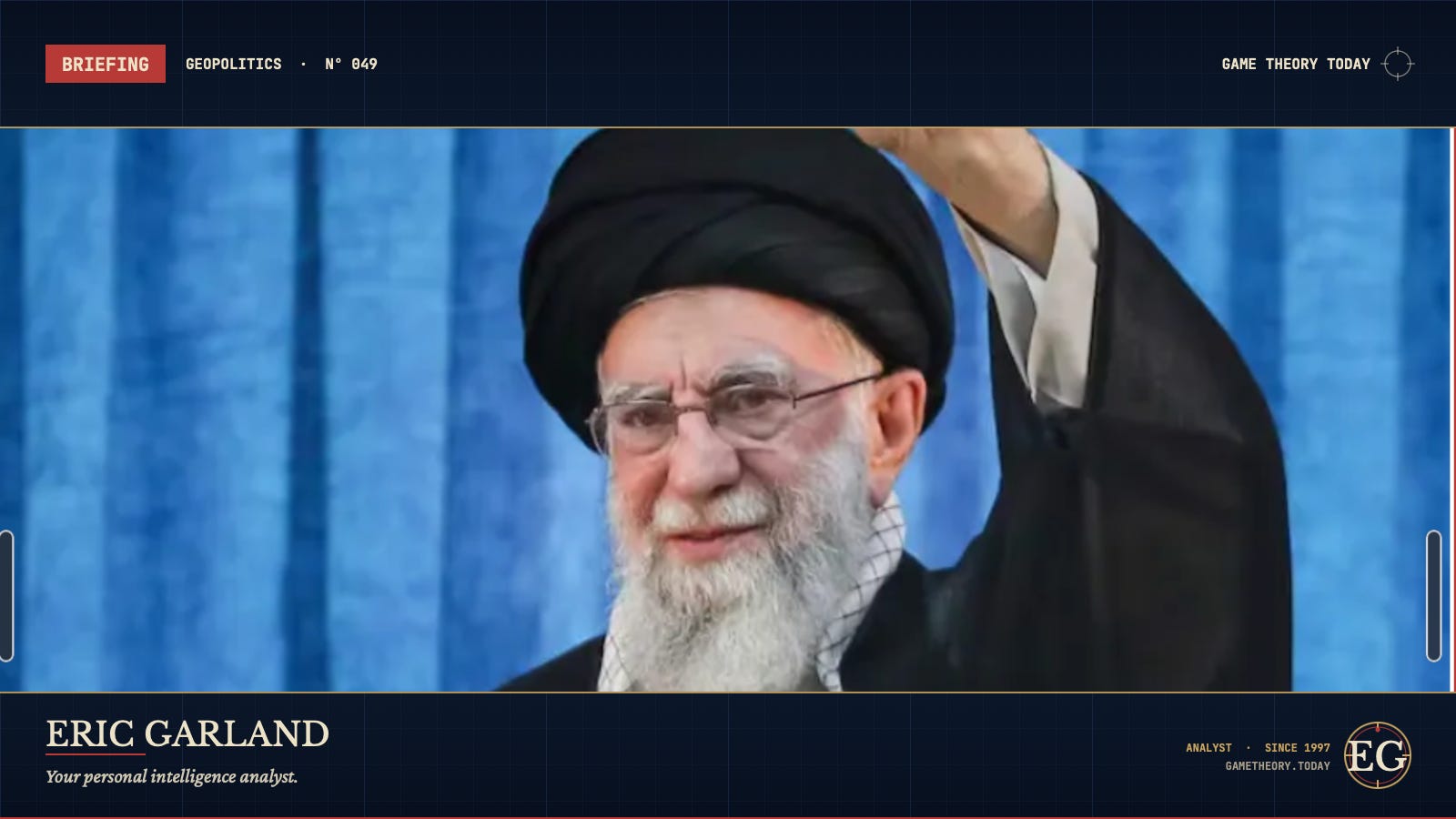
The following story is what happens when you tell inconvenient truths about dictatorships on social media ten years after I revealed the Russian influence in the 2016 election—you can still get hurt by Bad Guys at a distance. Because despite our knowledge of foreign interference, our defenses against it are still weak.
After a period of relative quiet, I am relaunching my media and consulting practices on multiple platforms, culminating in a new book on psychological operations against democracy which I hope to publish in 2027.
Twenty days ago, in support of this effort, I launched a short-form video channel on TikTok with zero followers. It has started from scratch with some terrific early success. But no sooner do I get a toehold, when I a reminded of how much foreign interference appears to still be rampant.
On the second day of my account, my third short video went viral.
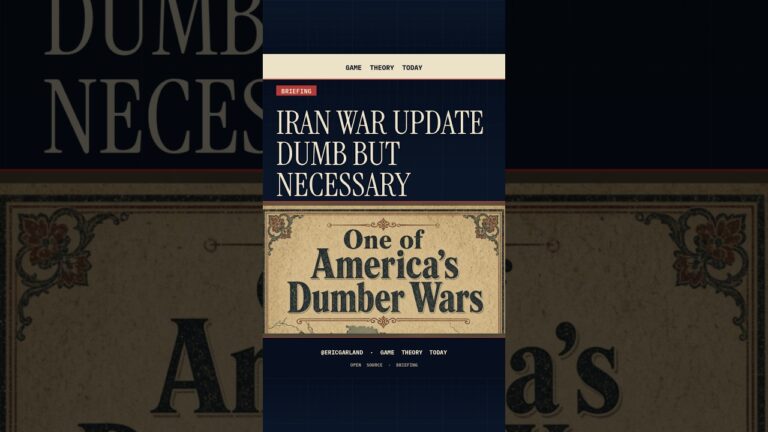
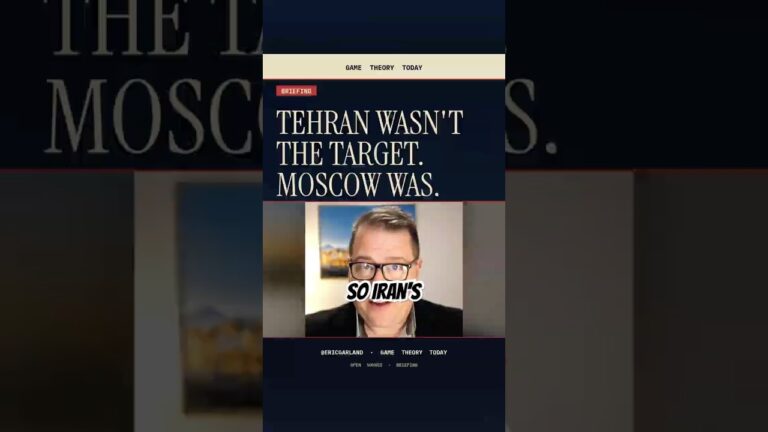
The two-minute video argues against the idea that Trump’s recent military adventures in Venezuela, Iran, and Cuba are senseless—that he has, perhaps surprisingly, been systematically dismantling Russia’s proxy architecture. This exploded into almost a quarter-million views and lots of positive dialogue. The good stuff about social media! Reminds me of 2017 on Twitter!
Hooray! Time to build a channel. So I keep going.
My subsequent videos have been carving an unexpected niche on TikTok for geopolitics. A subsequent video tracking a Russian oil tanker called the Anatoly Kolodkin toward Cuba established top search rankings on both TikTok and YouTube for the story as it developed. A third video connecting Trump’s foreign policy to Alexander Wendt’s Constructivism held a 27% completion rate on cold audiences. Lord Almighty you people are nerds! I love it. I am emboldened.
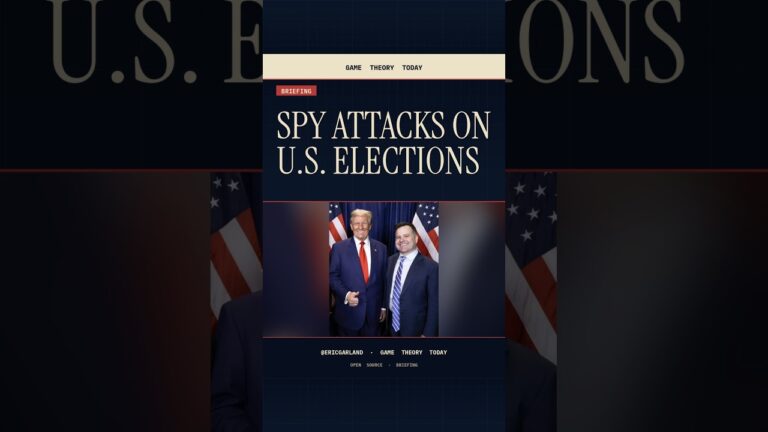
Then, on April 5—a Sunday!—I uploaded a second viral video, bigger than the first. It was the video version of my April 5, 2026 essay here on Substack about the family of Qassem Soleimani getting arrested.
By yesterday afternoon, it garnered 360,000 views and climbing, over 3500 shares, and brought me almost 3,000 new followers in a day.
But, as I’ve learned for many years, the Bad Guys don’t leave you alone for long while you’re racking up successes with the audience on material that explicitly attacks their methods and money. And especially not when they are under such stress.
I noticed a few accounts drop aggressive messages into the comments. They were accusing me of being an AI-generated account and claimed that ICE really arrested the wrong women. It seemed weirdly specific and coordinated.
Immediately after, I got a notice that my video had been suspended for being misinformation.
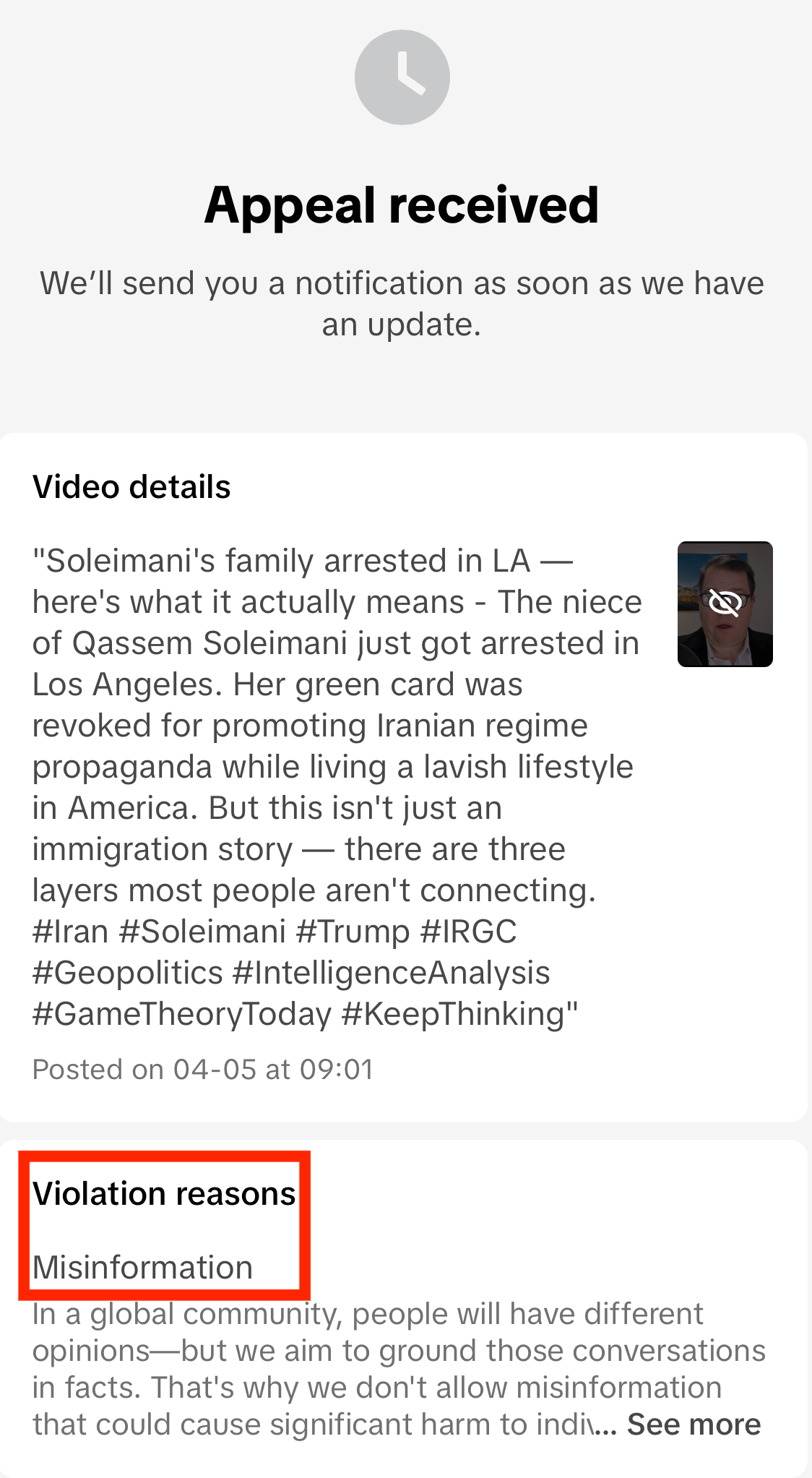
On TikTok, you can report accounts for being AI generated slop and/or for reporting factual inaccuracies.
I appealed. It appears that troll accounts reported me in such number that the algorithm suspended this video automatically.
Anatomy of an Attack—How It Starts Online
I want to break this down carefully, because the pattern matters beyond what happened to my video.
The “misinformation” label applied to my Soleimani video is not accurate. ICE arrested two women related to the late IRGC General Qassem Soleimani who had been living in the United States. Source: the U.S. Department of State. Multiple independent news organizations covered the arrests. No credible outlet has challenged the facts or issued a correction.
What I observed in the comments before the suspension were accounts pushing the claim that federal agencies had somehow arrested the wrong women — that the FBI, DHS, CIA, and State Department had confused two wealthy Iranian women for someone else, essentially by accident or by racism. There is no credible sourcing for that claim. I checked, as I always do. Several of these accounts were also promoting outlets with documented records of publishing content favorable to Russian and Iranian state narratives.
Whether this constitutes a coordinated foreign influence operation — transnational repression, which Freedom House and the State Department have both documented as a real and growing phenomenon — I cannot say with certainty based on what I observed. What I can say is that the reporting pattern is consistent with documented tactics, and the timing relative to the video’s rapid growth is worth noting analytically.
What I know from a decade of this work is that the “misinformation” or “conspiracy theory” label, once applied on a platform, tends to travel. It gets picked up by other accounts. Sometimes by journalists who cite the platform flag as their sourcing without independently verifying the underlying claim. That dynamic — platform flag becoming media narrative becoming search engine result — is documented and worth understanding.
I’ve experienced versions of this process personally over the past decade, in ways that went beyond online harassment. Those experiences inform why I take even a temporary video suspension seriously as a data point rather than a minor inconvenience.
The appeal is filed. The sourcing is documented. I expect the video to be restored. And I’ll keep posting regardless.
Keep thinking.
If you would like to improve your company’s analytic capabilities, consider a training session from Competitive Futures.
Looking for a keynote speaker on geopolitics or future trends? I’m represented by the lovely professionals at Executive Speakers Bureau. Check out my latest.
First published on Game Theory Today (Substack), April 7, 2026.