Business War Gaming: How to Test a Strategy Against Rivals Who Move Back
Business war gaming is a role-play exercise in which teams take the seats of your competitors, your customers, and your own company, then play out a strategy move by move to see how it holds up. A plan on paper assumes rivals will stand still. A war game puts people in the rivals’ chairs, gives them the rivals’ interests, and lets them answer back. It is the cheapest place to find out that a strategy has a hole in it.
At a glance
- What it is: a structured simulation in which several teams each play one party to a competitive situation, over a series of rounds, with a neutral control team ruling on the results.
- Where it came from: the Prussian Army’s Kriegsspiel, adopted in 1824, and the U.S. Naval War College, where war gaming began in 1886.
- What it is for: testing a plan before money is committed, and turning a pile of competitor information into a view of what rivals are likely to do.
- What it is not: a forecast. A war game shows what is plausible, not what is probable.
- What it runs on: intelligence. Teams can only play a rival as well as the company understands that rival.
What a business war game is
Jay Kurtz gave the standard description in the journal Strategy & Leadership in 2003: a role-playing simulation of a changing business situation, with a series of teams, each one assigned the identity of a party with a stake in the outcome. One team plays the home company. Others play individual competitors. Others may play the market, key customers, suppliers, partners, or regulators.
The feature that separates a war game from other planning tools is that the players’ decisions drive the result. The United Kingdom’s Ministry of Defence makes the same point in its Wargaming Handbook: a war game is a model of a contest in which the course of events is shaped by the decisions the players make, and those events in turn shape the players’ next decisions. Nobody writes the ending in advance.
Mark Chussil, who has run about a hundred of these games for large companies, noted in the Journal of Business Strategy in 2007 that there is no generally accepted definition of a business war game and that there are many ways to run one. Some are computer-supported and quantitative. Many need nothing more than conference rooms and flip charts. The common element is people playing the other side in earnest.
Where war gaming came from
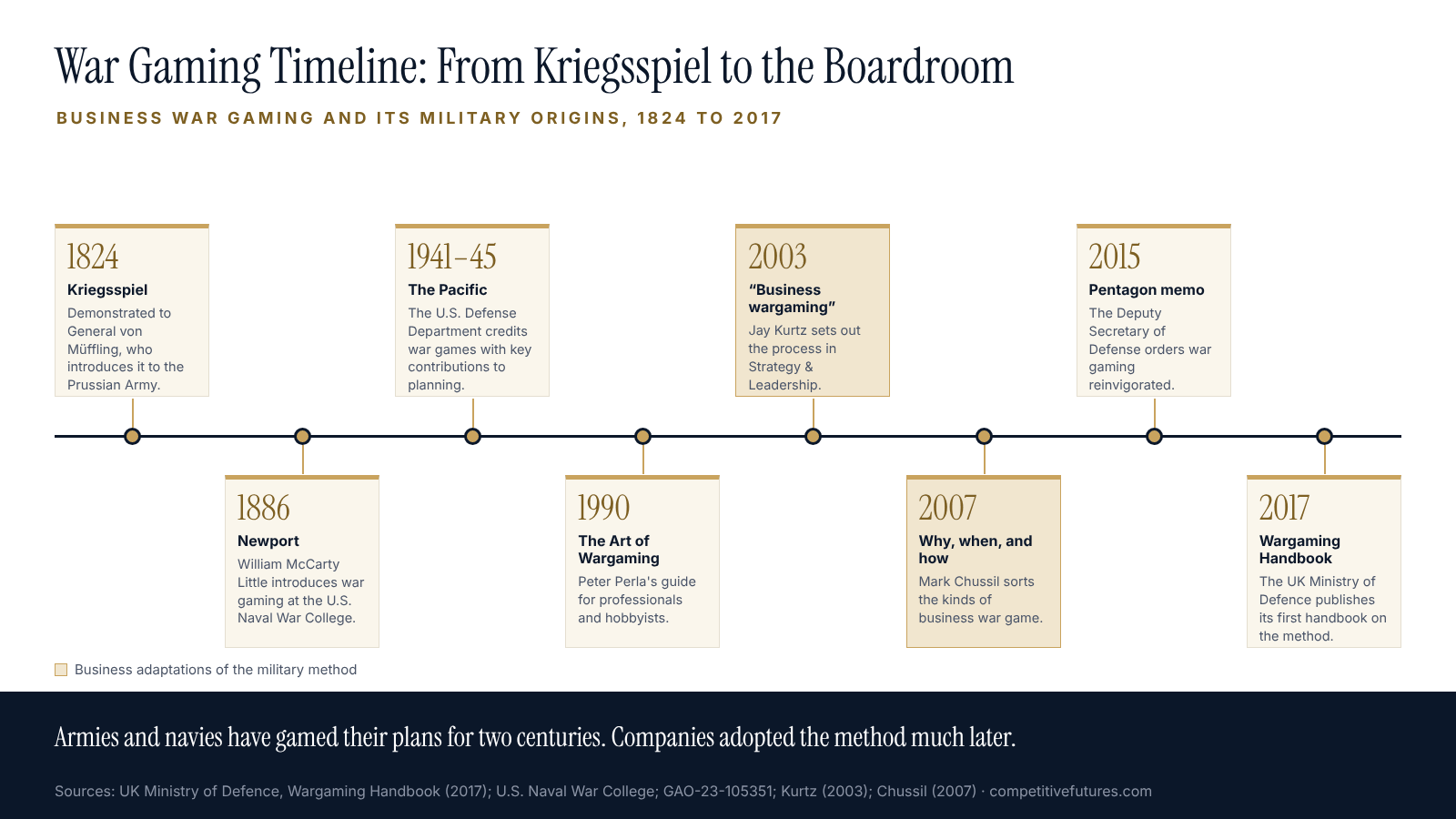
The professional war game is a Prussian invention. Two officers of the von Reisswitz family, father and son, developed a set of rules for representing tactical maneuvers on a map, called a Kriegsspiel, or war game. In 1824 it was demonstrated to General von Müffling, Chief of the Prussian General Staff, who introduced it to the army. The remark attributed to him is the best-known line in the field: “This is not a game! This is training for war!” The historian Pia Henning calls it the very first professional wargame.
The method reached the United States through the Naval War College in Newport, Rhode Island. William McCarty Little, a lieutenant who had left active service in 1884 after losing the sight of one eye, introduced war gaming there in 1886 and became the Navy’s first expert in the field. In 1903 Congress passed a special act promoting him to captain and assigning him permanently to the faculty. The college’s gaming building is named for him, and its wargaming department still runs more than 50 events a year.
The games mattered. The U.S. Department of Defense credits war games with key contributions to military planning for pivotal operations in the Pacific during World War II. In 1990 Peter Perla published The Art of Wargaming, a history and guide that official handbooks still cite. In February 2015 the Deputy Secretary of Defense wrote that the department’s war gaming ability had atrophied and issued a memorandum to reinvigorate it. In 2017 the UK Ministry of Defence published its first Wargaming Handbook.
Business came to the method late. Kurtz’s 2003 article set out the process for companies, and Chussil’s 2007 article sorted the kinds of game and when to use each.
When a war game is the right tool
Kurtz identified two points in a planning cycle where a game earns its cost:
- At the start, to turn data about markets, channels, and competitors into intelligence the plan can be built on.
- After a draft plan exists, to test whether it survives a realistic combination of events and competitor actions.
Chussil’s list of what companies want from a game is broader: creating strategy options, anticipating threats and opportunities, testing options before a decision, building skill in strategic thinking, and building commitment to a strategy.
In practice, a war game fits a decision that is expensive, hard to reverse, and dependent on what somebody else does next. A product launch into an incumbent’s market. A price move. A new entrant with a different business model. A merger that will draw a response from rivals and regulators at once. In the case Kurtz published, a game taught an information technology company that its best course was to grow by taking business from smaller rivals, without directly attacking the industry leader.
A war game is the wrong tool when no competitor’s reaction matters to the outcome, or when the question is about the long-range environment. That second question belongs to scenario planning.
A war game we ran
The client and the category stay confidential, so this account is general.
We designed a multi-team war game for a consumer products company that was the challenger in its market. One much larger rival dominated the category and defended its share ferociously. Whenever the challenger gained ground, the leader hit back, both at the challenger and at the distributors that had given it room.
We built the game around that dynamic and added one more player: a new competitor that nobody could yet name.
The game’s forecast was that someone would arrive and disrupt the low end of the market. Later, a new company did exactly that.
The lesson for game design is to leave a chair for the player nobody has met yet.
How a business war game works
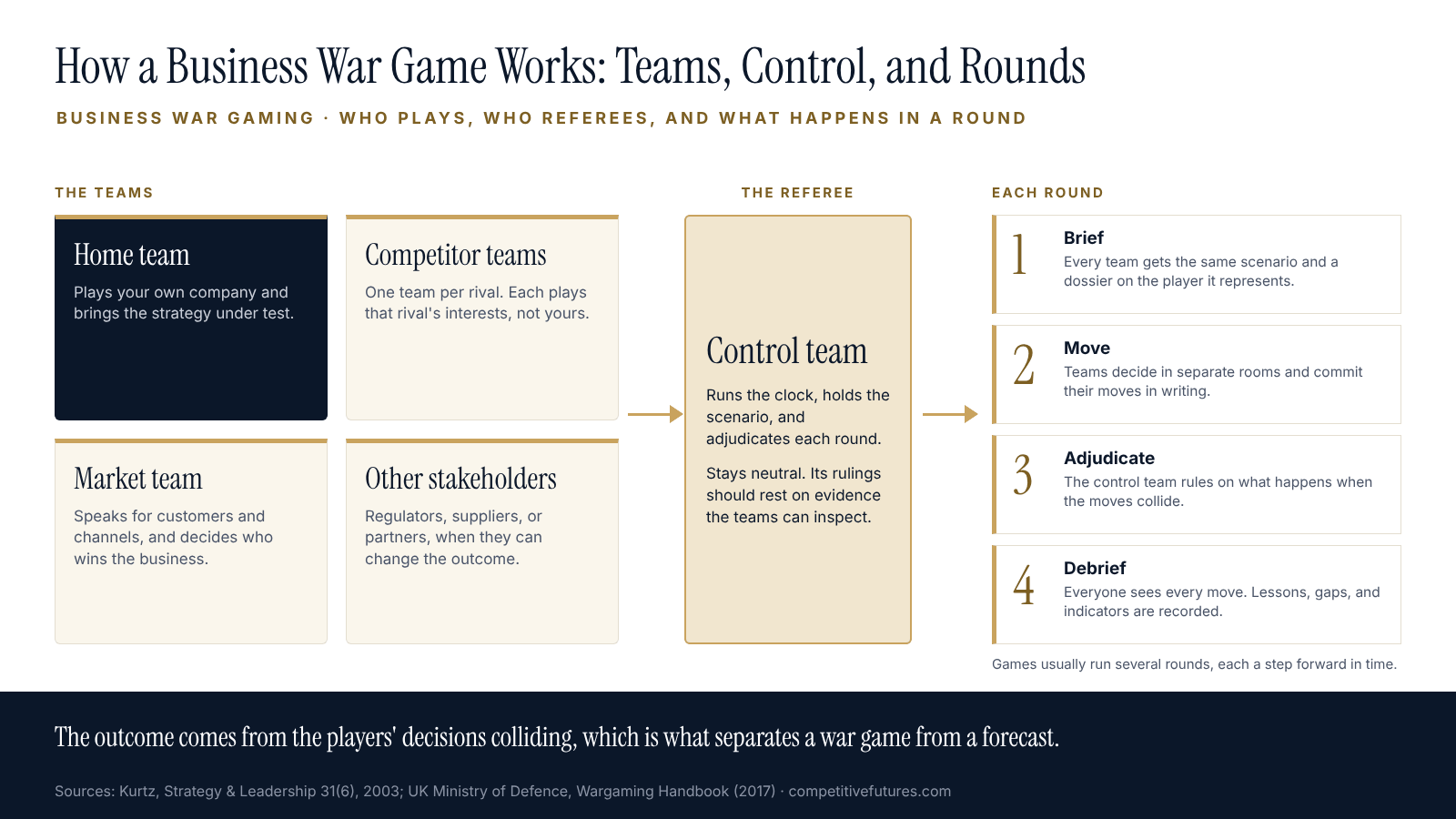
The teams. The home team plays your own company and brings the strategy under test. Competitor teams, one per rival, play that rival’s interests and not yours. A market team speaks for customers and channels and decides who wins the business. Other stakeholders, such as regulators, suppliers, or partners, get a team when they can change the outcome. Kurtz describes games with five to ten teams.
The referee. A control team runs the clock, holds the scenario, and adjudicates each round. It stays neutral, and its rulings should rest on evidence the teams can inspect.
The rounds. Games usually run several rounds, each a step forward in time. A round has four parts:
- Brief. Every team gets the same scenario and a dossier on the player it represents.
- Move. Teams decide in separate rooms and commit their moves in writing.
- Adjudicate. The control team rules on what happens when the moves collide.
- Debrief. Everyone sees every move. Lessons, gaps, and indicators are recorded.
The UK handbook lays out the work around the game as five stages: design, develop, execute, validate, and refine.
War game, scenario planning, or red team?
The three get mixed up, and they answer different questions.
| War game | Scenario planning | Red team | |
|---|---|---|---|
| Core question | What will rivals do when we move? | What kinds of future could we be operating in? | Where is our plan wrong? |
| Time horizon | Near term | Long range | The plan as written |
| Who plays | Teams as named competitors and stakeholders | A mixed group building alternative futures | An independent group challenging assumptions |
| Output | Tested moves, likely counter-moves, indicators | A set of futures and the signposts for each | A list of weaknesses and untested assumptions |
The UK handbook draws the last line carefully: the red cell in a war game plays the opposing force, while a red team challenges plans and assumptions. A company can use all three, and the output of a scenario project often supplies the setting for a war game.
What a war game cannot tell you
The UK handbook is blunt about limits, and they apply in a boardroom as much as in a headquarters.
- It is not predictive. A single run can teach a false lesson. Games show what is plausible, not what is probable.
- It is not reproducible. Different players will make different choices from the same starting point.
- It is qualitative. A game complements quantitative analysis. It does not replace it.
- It is only as good as its participants. Teams that do not know the party they are playing add little, and a sponsor who will not accept an unwelcome result wastes everyone’s time.
Common mistakes
- Playing the rival as a weaker copy of yourself. The competitor team has to argue from the rival’s costs, owners, incentives, and history. If it reasons the way your company reasons, the game tests nothing.
- Letting the home team win. A game designed so the sponsor’s plan succeeds is a rehearsal, and people in the room can tell.
- Thin briefing books. A team handed two pages on a competitor will fall back on stereotype.
- Leaving out the customer. Two companies can out-maneuver each other and both lose the buyer.
- No record. The value is in the debrief. If moves, reasoning, and surprises are not written down, the lessons are gone within a week.
What war gaming teaches about building an intelligence function
A war game is a public test of what a company knows about its competitors. When a competitor team cannot say how the rival makes money, who decides there, or what it did the last time it was attacked, the gap is visible to every executive in the room. That is useful. Each gap becomes a collection requirement for the intelligence team, with a sponsor already convinced it matters.
The game also produces indicators. For every counter-move the competitor team makes, the debrief can ask what the company would see in the real world a few months before that move happened. Those observations are the raw material for competitive early warning.
Finally, a game shows whether intelligence travels inside the organization. Companies often find that the sales force, the regulatory staff, and the product engineers each held a piece of the rival’s picture that nobody had put together. A standing competitive intelligence function exists to do that assembly all year, so the next game starts from a better dossier.
All of this depends on lawful, ethical collection. A dossier for a war game is built from public records, published statements, and properly conducted interviews. It never requires anything a company could not defend in court.
Frequently asked questions
What is business war gaming?
Business war gaming is a role-play simulation in which teams act as a company, its competitors, its customers, and other stakeholders, then play out a competitive situation over several rounds. It is used to test a strategy and to anticipate how rivals will respond.
Where did war gaming come from?
From the Prussian Army, which adopted the Kriegsspiel in 1824, and from the U.S. Naval War College, where William McCarty Little introduced war gaming in 1886. Companies adapted the military method for competitive strategy much later.
How long does a business war game take?
Sessions range from a single day to several days. Preparation takes longer, because each team needs a briefing book on the party it will play, and the quality of those books decides the quality of the game.
What is the difference between a war game and scenario planning?
A war game tests a specific strategy against the likely moves of named competitors over a short horizon. Scenario planning builds several long-range pictures of the environment a company may have to operate in. Scenario work often supplies the setting for a war game.
What is the difference between a war game and a red team?
In a war game, a team plays the opponent and makes moves against you. A red team is an independent group that challenges a plan’s assumptions and logic.
Can a war game predict what a competitor will do?
No. A game shows which competitor responses are plausible and how your plan fares against them. It is a way to prepare for a range of moves and to decide what to watch for.
Work with Competitive Futures
We design and run business war games, and we prepare the competitor intelligence that lets each team play its rival properly. If your organization faces a decision that depends on what a competitor does next, request a 20-minute conversation.
Related reading
- Competitive Intelligence: A Complete Guide for Leaders
- Competitive Early Warning: How Companies See Strategic Surprise Coming, and Why So Many Still Don’t
- Scenario Planning: How to Build Scenarios That Change Decisions
- Build a Competitive Intelligence Function
- Why Organizations Ignore Warning Signs
- Strategic Surprise: Why Companies Get Blindsided
References
- Chussil, Mark. “Learning Faster Than the Competition: War Games Give the Advantage.” Journal of Business Strategy 28, no. 1 (2007): 37–44. https://doi.org/10.1108/02756660710723198
- Henning, Pia. “‘Game On!’ A Research Project on the Prussian Kriegsspiel.” British Journal for Military History 7, no. 2 (2021): 174–183. https://doi.org/10.25602/GOLD.bjmh.v7i2.1561
- Kurtz, Jay. “‘Business Wargaming’: Simulations Guide Crucial Strategy Decisions.” Strategy & Leadership 31, no. 6 (2003): 12–21. https://doi.org/10.1108/10878570310505550
- Perla, Peter P. The Art of Wargaming: A Guide for Professionals and Hobbyists. Annapolis, MD: Naval Institute Press, 1990.
- UK Ministry of Defence, Development, Concepts and Doctrine Centre. Wargaming Handbook. August 2017. https://www.gov.uk/government/publications/defence-wargaming-handbook
- U.S. Government Accountability Office. Defense Analysis: Additional Actions Could Enhance DOD’s Wargaming Efforts. GAO-23-105351. April 2023. https://www.gao.gov/assets/d23105351.pdf
- U.S. Naval War College. “Wargaming.” https://usnwc.edu/Research-and-Wargaming/Wargaming
This piece is part of our guide to Competitive Intelligence.