The History of Ottoman Intelligence: From Mehmed the Conqueror to the Special Organization
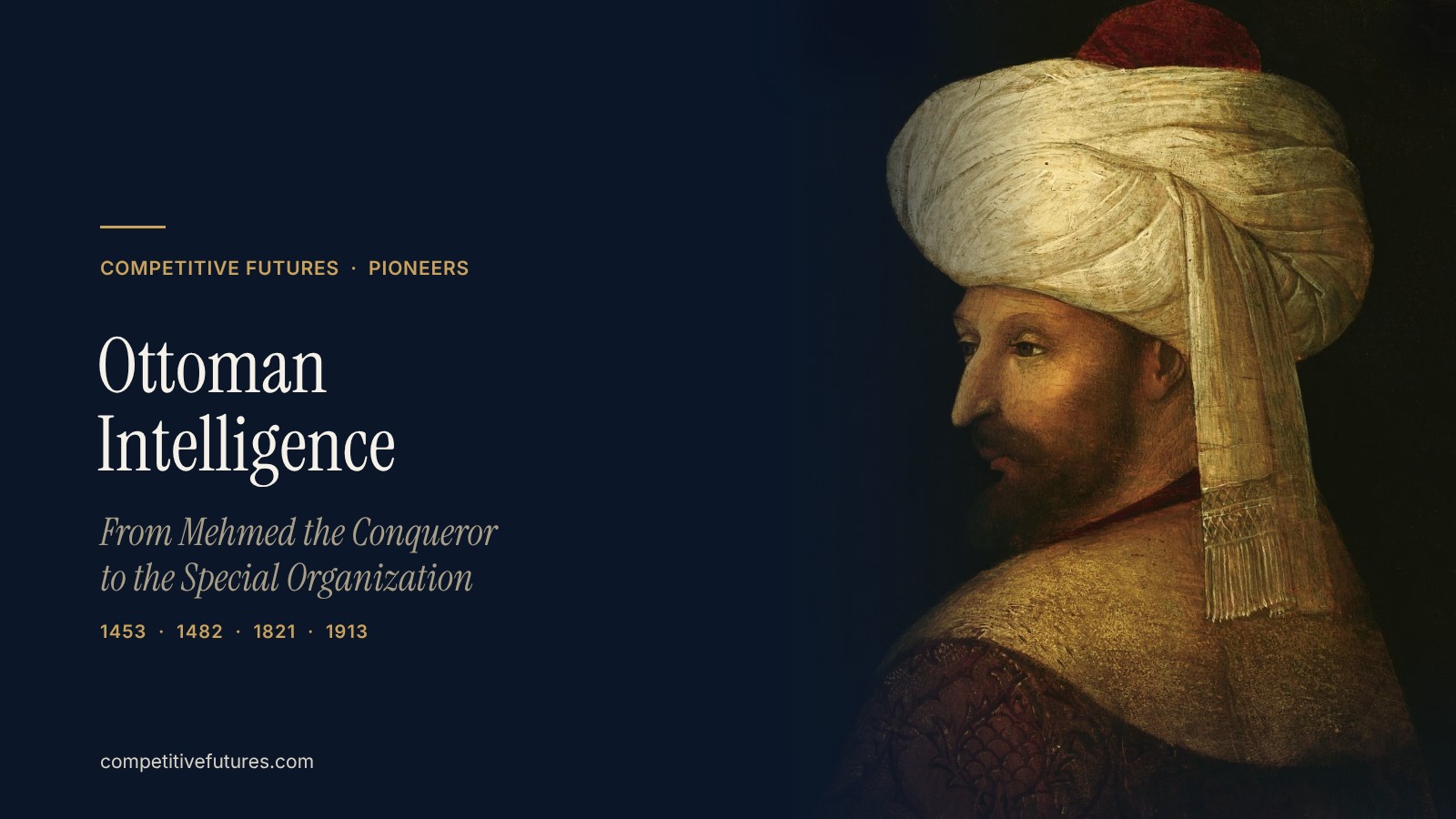
Türkçe: Osmanlı İstihbaratının Tarihi: Fatih Sultan Mehmed’den Teşkilât-ı Mahsusa’ya
Ottoman intelligence had no headquarters, no charter, and no name for most of the empire’s history. From the conquest of Constantinople in 1453 until the last years of the nineteenth century, the sultans learned what their enemies were doing through the private networks of their pashas, the reports of tributary states, and the interpreters who handled every conversation with Europe. It worked well enough to make the empire the dominant power in the eastern Mediterranean for two centuries.
The empire built formal services only at the end. Sultan Abdülhamid II ran a palace informer system from the 1880s that buried him in paper. The Young Turk government that replaced him created the Special Organization in 1913, a secret service that was also a guerrilla force, and it went down with the empire in 1918.
This page covers how Ottoman intelligence worked from Mehmed II to the end of the First World War, what it got right, where it failed, and what the record says about building an intelligence function. It stops before the Turkish War of Independence and the services of the Republic. For those, see our guide to Turkish intelligence.
At a glance
- Period covered: 1451, the second accession of Mehmed II, to October 1918, the Armistice of Mudros.
- Classical system (15th–17th centuries): No central service. Grand viziers, admirals, and frontier governors ran their own networks and reported to the Imperial Council.
- Main outside suppliers: The tributary Republic of Ragusa (Dubrovnik), the princes of Wallachia, Moldavia, and Transylvania, the Crimean khans, and allies such as France.
- The dragomans: Interpreters of the Imperial Council, mostly Phanariot Greeks from the 1660s to 1821, who handled the empire’s foreign correspondence.
- First formal diplomatic collection: Permanent embassies in London (1793), Vienna (1794), Berlin (1795), and Paris (1796) under Selim III.
- Hamidian system: Palace informers (hafiye) and their reports (jurnal), run from Yıldız Palace under Abdülhamid II; abolished by decree on 31 July 1908.
- Special Organization (Teşkilât-ı Mahsusa): Founded in late 1913, attached to the Ministry of War under Enver Pasha, renamed the Office for Eastern Affairs in 1915, dissolved in October 1918.
Mehmed II: intelligence as preparation for conquest
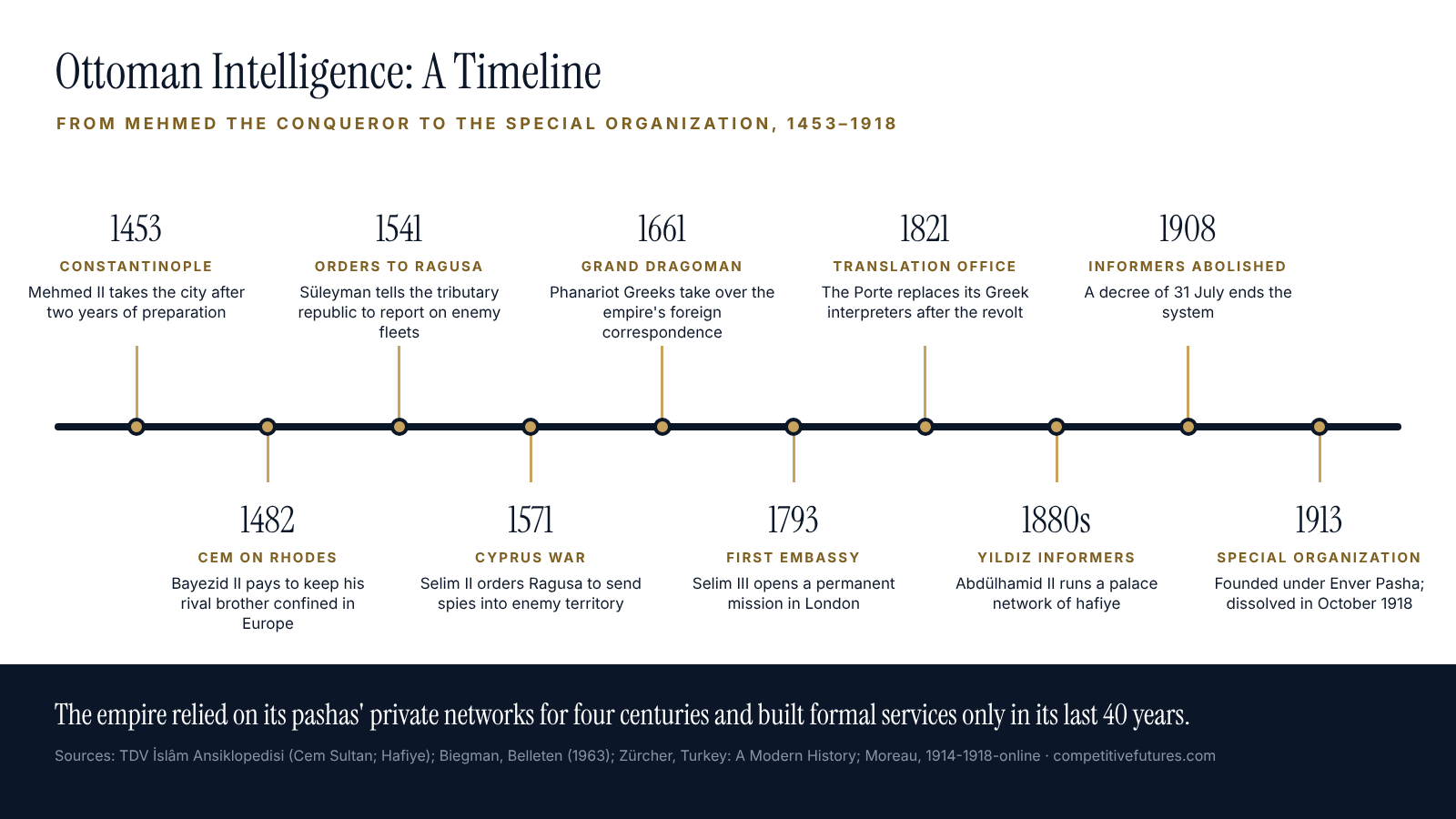
Mehmed II took Constantinople in 1453 after two years of preparation that depended on knowing the city’s condition better than its defenders’ allies did. He built the fortress of Rumeli Hisarı on the Bosphorus in 1452 to control traffic through the straits, which also gave him control of the news moving through them. The Genoese colony at Galata, across the Golden Horn, stayed formally neutral during the siege and traded information with both sides.
The methods of his reign stayed in use for 200 years. Frontier raiders brought back captives for questioning. Merchants and converts crossed between Ottoman and Christian territory and reported what they saw. Tributary states were expected to send news along with their tribute. Ragusa, which paid an annual tribute that reached 12,500 ducats, became the most useful of them: its merchants were in every Italian port, and its envoys traveled to Istanbul every year (Biegman, Belleten).
Mehmed was a target as much as a collector. Venice kept a resident envoy, the bailo, in Istanbul who functioned as a station chief, and the Venetian Council of Ten considered a long series of proposals to have the sultan poisoned. In 1480 an Ottoman force crossed the Adriatic and took Otranto, in southern Italy. Mehmed died the following spring, and the expedition was withdrawn.
The Cem affair: Bayezid II and the hostage prince
The first Ottoman intelligence operation that can be followed in the documents came out of a succession crisis. When Mehmed died in 1481 his sons Bayezid and Cem fought for the throne. Cem lost, and on 29 July 1482 he landed on Rhodes and put himself in the hands of the Knights Hospitaller (TDV İslâm Ansiklopedisi, “Cem Sultan”).
The Knights understood what they had. A rival claimant in Christian custody could be released at the head of a crusade whenever the sultan threatened Europe. Bayezid’s answer was to pay for his brother’s confinement: about 40,000 gold ducats a year, first to the Knights, who moved Cem to France, and then to the papacy after Pope Innocent VIII took custody of him in March 1489. In November 1490 an Ottoman envoy delivered 120,000 ducats to Rome, three years’ payment in advance.
For 13 years Bayezid’s foreign policy was organized around one question: where is Cem, and who holds him? He sent a stream of envoys and agents to find out. One of them, a sea captain named Barak Reis, was sent in 1486 to locate Cem in Savoy and France, and his written report survives in the Topkapı Palace archive (Turan, Belleten). Bayezid also bought Venice’s cooperation with trade concessions.
Cem died near Naples on 25 February 1495, shortly after the French king Charles VIII took him from the Pope. The story that the Pope had him poisoned has never been proven. His body was returned in 1499 and buried at Bursa.
The sixteenth century: the pashas’ networks
At its height under Süleyman the Magnificent (r. 1520–66) and his successors, the empire fought the Spanish and Austrian Habsburgs on land in Hungary and at sea across the Mediterranean, and the Safavids of Iran in the east. All three contests ran on information.
The Ottoman system had four layers, in the description of the historian Gábor Ágoston: collection at the center in Istanbul, collection by the governors of the frontier provinces, reporting from the vassal states, and agents sent into enemy and allied territory.
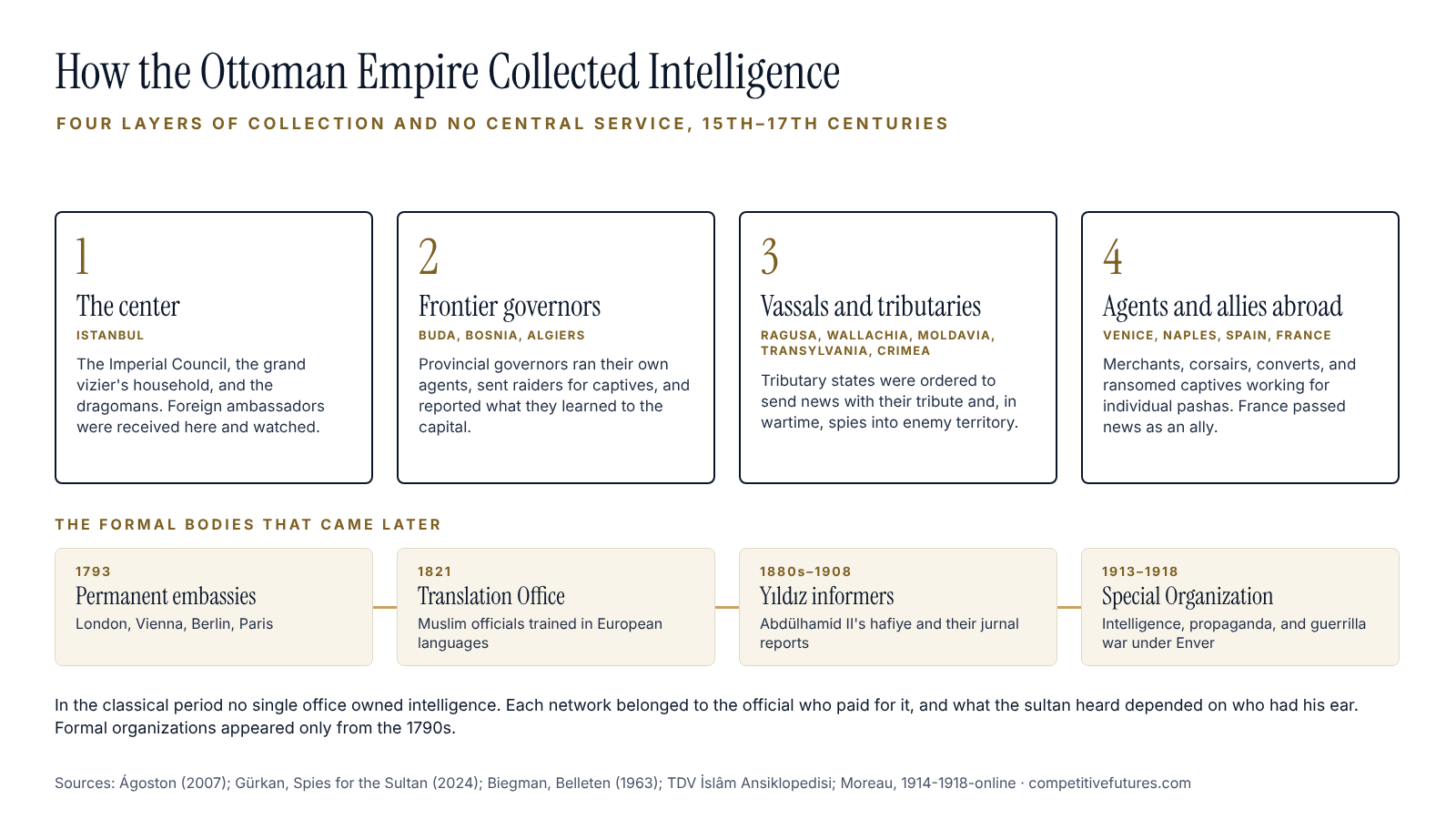
What it lacked was a central office. The Habsburgs tried to build a standing secret service with salaried station chiefs, ciphers, and a paymaster. The Ottomans delegated. Grand viziers, admirals, and court favorites built their own networks with their own money and used what they learned to win arguments in the Imperial Council (Gürkan, Georgetown dissertation). Grand Vizier Sokollu Mehmed Pasha had his sources. So did the grand admiral Uluç Ali, a Calabrian-born convert whose contacts ran through the corsair ports of North Africa and whom Spanish intelligence tried for years to bribe into defecting.
The people who did the work were go-betweens: merchants, ransomed captives, corsairs, converts, Jewish physicians and financiers with relatives in Christian ports, and Moriscos expelled from Spain. They moved easily across the religious frontier, and many of them worked for more than one side.
The vassals. Orders from Süleyman in the 1540s told Ragusa to keep sending accurate news of the sea and the enemy fleet. During the Cyprus war of 1570–71, Selim II ordered the republic to send capable spies into enemy territory. Ragusa reported the movements of Venetian galleys and, in 1571, the alliance of Venice, Spain, and the Pope that would fight at Lepanto.
Allies. France, allied with the Ottomans against the Habsburgs from the 1530s, passed political news to Istanbul through its ambassadors.
Counterintelligence. The Ottomans were better at denying information than at organizing its collection. They refused for centuries to post resident ambassadors abroad while accepting foreign ones in Istanbul, where they could be watched. They controlled the roads and ports, assigned escorts to foreign envoys, intercepted couriers, and periodically rounded up suspected Habsburg agents in the capital (Gürkan, Acta Orientalia). A firman of 1591 ordered escorts for Ragusan envoys crossing Bosnia because so many enemy spies traveled with them.
The arrangement had a cost. Because information belonged to whoever collected it, factions used it against each other. In the 1580s one group of officials fed the sultan misleading reports about Spanish intentions to push naval policy their way. Ciphers were another weakness: the Ottomans relied on oral messages carried by trusted men at a time when their rivals were adopting cryptography.
The dragomans
Ottoman officials rarely learned European languages, so the empire’s dealings with Europe ran through interpreters. From the 1660s the post of Grand Dragoman of the Imperial Council was held by Greeks from the Phanar district of Istanbul. They translated the correspondence, sat in the negotiations, read the European gazettes, and briefed the grand vizier. One of them, Alexander Mavrocordatos, helped negotiate the Treaty of Karlowitz in 1699. Phanariot families also governed Wallachia and Moldavia for the Porte in the eighteenth century and were expected to report on Russia and Austria from there.
The empire’s understanding of Europe was therefore in the hands of a small group of families who were not part of its ruling class. That was tolerable while the empire was winning. In the eighteenth century it began to lose wars to Russia, and its information was part of the reason. In 1770 a Russian fleet sailed from the Baltic around Europe and destroyed the Ottoman fleet at Çeşme; the Porte had not believed such a voyage was possible.
Selim III responded by opening the empire’s first permanent embassies: London in 1793, Vienna in 1794, Berlin in 1795, and Paris in 1796. Within a few years most of them were being run by Greek chargés d’affaires.
In 1821 the Greek revolt broke out. The Porte concluded that its interpreters had passed state secrets to the rebels, executed the Grand Dragoman, closed the missions abroad, and set up the Translation Office (Tercüme Odası) to train Muslim officials in European languages (Birkan, Journal of Anglo-Turkish Relations). The embassies reopened in 1834. The Translation Office became the school of the next two generations of Ottoman reformers and diplomats.
The nineteenth century: watching the capital
Earlier sultans had kept an ear on Istanbul through palace servants, dervishes, and their own walks through the city in disguise. Mahmud II (r. 1808–39), who destroyed the Janissaries in 1826, expanded the practice, and by the 1840s the government was paying informers to write down what people said in coffeehouses, barbershops, and mosques.
The Tanzimat reforms added the machinery of a modern state: a police ministry, a telegraph network from the 1850s, a census, and passports. All of it produced information the palace could use.
Abdülhamid II and the palace informers
Abdülhamid II came to the throne in 1876 after two sultans had been deposed in three months. He expected the same and governed accordingly. He moved the business of state from the ministries to Yıldız Palace and built an informer network to tell him what his own officials were doing (TDV İslâm Ansiklopedisi, “Hafiye”).
The informers were called hafiye and their reports jurnal. Most were volunteers hoping for reward. They included palace staff, ministers, governors, ambassadors, and members of the dynasty. Each had a cipher registered with the palace secretariat. They belonged on paper to the police ministry and answered in practice to the sultan’s chief secretary. The best known of the chief informers, Fehim Pasha, ran what amounted to a private gang in Istanbul until he was exiled in 1907.
The system had a defect built in. A true report was rewarded, and a false one cost nothing. At moments of political tension several thousand reports a day reached the palace. Officials informed on their rivals, and the rivals informed back. Abdülhamid said himself that informing was shameful and unavoidable, and that he could tell which reports were inflated. When he was deposed, thousands of them were found in boxes, unopened.
The network also worked abroad, against Armenian revolutionary committees and against the Young Turk exiles in Paris and Geneva. It watched them for 20 years and did not stop them. The revolution of July 1908 began among army officers in Macedonia. A decree abolishing the informer system was issued on 31 July 1908, a week after the constitution was restored.
After Abdülhamid’s removal in April 1909, the reports at Yıldız were taken to the Ministry of War, where a commission went through them. It found that much of the governing class had informed on one another. Most of the reports were burned.
The Special Organization, 1913–1918
The Committee of Union and Progress, which governed the empire from 1913, had come to power as a conspiracy, and its leaders kept the habits. Its officers had fought as irregulars against Italy in Libya in 1911 and in the Balkan Wars, and in late 1913 the war minister, Enver Pasha, gave them an organization: the Teşkilât-ı Mahsusa, or Special Organization, attached to the Ministry of War and first led by Süleyman Askeri. The Turkish intelligence service, which counts it as its earliest ancestor, dates its formal establishment to 5 August 1914 (MİT history).
It was a hybrid: part intelligence service, part propaganda bureau, part guerrilla force. Historians still argue over which of those it mainly was (Safi, Bilkent dissertation).
Abroad. When the empire entered the war in November 1914, the sultan’s government proclaimed a jihad, and the Special Organization was the instrument meant to make it real. Its officers tried to raise Muslim populations against Britain, France, and Russia: among the Senussi in Libya against British Egypt, in the Sinai ahead of the attack on the Suez Canal in February 1915, in the Caucasus, in Iran, and as far as Afghanistan. Germany paid for much of it. The revolts did not come. The Senussi campaign tied down British troops for a time; the rest achieved little.
At home. Before the war, in 1913 and 1914, the organization took part in driving Greek communities out of Thrace and the Aegean coast (Moreau, 1914-1918-online). In 1915, units under the organization’s name, many of them made up of released convicts and tribal irregulars, took part in the deportation and mass killing of the empire’s Armenians. Bahaeddin Şakir, a member of the party’s central committee who directed the organization in the eastern provinces, was sentenced to death in absentia by an Ottoman court-martial in 1919 for his part in it. Historians disagree about how much of this ran through the organization’s formal chain of command and how much through the party; they do not disagree that its units did the killing.
The organization was restructured in 1915 as the Office for Eastern Affairs (Umur-ı Şarkiye Dairesi) and dissolved in October 1918 as the empire signed the Armistice of Mudros. Conventional military intelligence stayed throughout with the Second Branch of the General Staff, which had its own successes, including the breaking of a British-run spy ring in Palestine in 1917.
One of the organization’s field officers, Eşref Kuşçubaşı, later claimed to have led it. The archives do not support the claim. He was a senior operative in Arabia and the Sinai, and much of what was written about the organization for decades came from his own account.
Within weeks of the armistice, former members formed an underground group in occupied Istanbul, the Karakol society, to hide weapons and move officers to Anatolia. What they did next belongs to the history of the Turkish Republic, which founded its own service, the National Security Service, in 1926. That story continues in our guide to Turkish intelligence.
What Ottoman intelligence teaches about building an intelligence function
- Networks that belong to individuals serve those individuals. The sixteenth-century system produced good information because powerful men paid for it. It also let them shade what the sultan heard. A company whose market intelligence lives in the heads and inboxes of a few senior executives has the same problem.
- Do not outsource your understanding of the other side. For 150 years the empire let a few interpreter families read Europe for it. When their loyalty came into question in 1821, there was nobody else who could do the job. Language, context, and source relationships have to exist inside the organization.
- Paying for volume gets you volume. Abdülhamid rewarded reports and never penalized false ones. He received thousands a day, could not read them, and was overthrown by officers his informers had been watching. Any system that rewards people for submitting information needs someone grading it. That is what Analysis of Competing Hypotheses and source validation are for.
- Denying information is cheaper than collecting it. The Ottomans’ best sustained performance was in counterintelligence: controlling who could travel, write, and talk. Most companies spend on collection and leave their own plans unprotected.
- Keep collection and covert action apart. The Special Organization was asked to gather intelligence, run propaganda, fight as guerrillas, and carry out the ruling party’s domestic policy. It did none of the first three well, and the fourth was a crime. The British solved the same problem early by splitting functions; see our history of MI5 and MI6.
Frequently asked questions
Did the Ottoman Empire have an intelligence service?
Not a formal one for most of its history. From the fifteenth to the nineteenth century, Ottoman intelligence was collected by the private networks of grand viziers, admirals, and frontier governors, by tributary states such as Ragusa, and by the interpreters of the Imperial Council. Formal organizations came late: Abdülhamid II’s palace informer system from the 1880s and the Special Organization founded in 1913.
What was the Teşkilât-ı Mahsusa?
The Teşkilât-ı Mahsusa, or Special Organization, was a secret service created in late 1913 by the Committee of Union and Progress and attached to the Ministry of War under Enver Pasha. It combined intelligence, propaganda, and guerrilla warfare, operated in Libya, the Sinai, the Caucasus, and Iran during the First World War, was renamed the Office for Eastern Affairs in 1915, and was dissolved in October 1918.
How did Sultan Abdülhamid II’s spy network work?
Informers called hafiye sent written reports, called jurnal, to Yıldız Palace. Most were volunteers seeking reward, and they included ministers, governors, and ambassadors. False reports went unpunished, so the volume grew to thousands a day and many were never read. The system was abolished by decree on 31 July 1908, and most of the reports were burned after the sultan was deposed in 1909.
Who spied for the Ottoman sultans in the sixteenth century?
Mostly go-betweens who could cross between the Muslim and Christian worlds: merchants, corsairs, ransomed captives, converts, and Jewish and Morisco exiles with contacts in European ports. They were recruited and paid by individual pashas. The Republic of Ragusa and other tributary states also supplied regular reports, and France shared news as an ally.
What was the Cem Sultan affair?
Cem was the brother and rival of Sultan Bayezid II. After losing the succession war he fled in 1482 to the Knights Hospitaller on Rhodes, who held him as a hostage in France and then handed him to the Pope. Bayezid paid about 40,000 ducats a year to keep him confined and sent agents to Europe to track him. Cem died near Naples in 1495.
What replaced Ottoman intelligence after 1918?
The Special Organization was dissolved at the armistice in October 1918. Former members formed the underground Karakol society in occupied Istanbul. During the War of Independence the Ankara government ran several intelligence groups of its own, and in 1926 the Turkish Republic founded the National Security Service, the predecessor of today’s National Intelligence Organization (MİT).
Work with Competitive Futures
The Ottoman Empire ran on borrowed networks for four centuries and tried to build a professional service in its last five years. We build and run intelligence functions for companies and governments before they are needed in a hurry. Request a 20-minute conversation.
Related analysis from Competitive Futures
- The Deep State Was Real: Derin Devlet and the History of Turkey’s State Within the State
- Turkish Intelligence: History, Structure, and the Headlines
- The History of MI5 and MI6: From the Secret Service Bureau to Thames House and Vauxhall Cross
- The DGSE and the DGSI: A History of French Intelligence From Napoleon to Today
- The Office of Strategic Services: Donovan, the CIA, and the 2026 Revival
- Russian Intelligence: History, Structure, and the Headlines
- James Jesus Angleton: Counterintelligence in a Wilderness of Mirrors
- Intelligence Services Around the World
References
- Ágoston, G. (2007). Information, ideology, and limits of imperial policy: Ottoman grand strategy in the context of Ottoman-Habsburg rivalry. In V. Aksan & D. Goffman (Eds.), The Early Modern Ottomans: Remapping the Empire. Cambridge University Press.
- Akçam, T. (2012). The Young Turks’ Crime Against Humanity. Princeton University Press.
- Babinger, F. (1978). Mehmed the Conqueror and His Time. Princeton University Press.
- Biegman, N. H. (1963). Ragusan spying for the Ottoman Empire: Some 16th-century documents from the State Archive at Dubrovnik. Belleten, 26(106), 237–255.
- Birkan, O. The Translation Office and Ottoman diplomacy. Journal of Anglo-Turkish Relations.
- Fortna, B. C. (2016). The Circassian: A Life of Eşref Bey, Late Ottoman Insurgent and Special Agent. Hurst.
- Gürkan, E. S. (2012). Espionage in the 16th Century Mediterranean: Secret Diplomacy, Mediterranean Go-Betweens and the Ottoman-Habsburg Rivalry (PhD dissertation). Georgetown University.
- Gürkan, E. S. (2012). The efficacy of Ottoman counter-intelligence in the 16th century. Acta Orientalia Academiae Scientiarum Hungaricae, 65(1), 1–38.
- Gürkan, E. S. (2015). Fooling the sultan: Information, decision-making and the “Mediterranean Faction” (1585–1587). Journal of Ottoman Studies, 45, 57–96.
- Gürkan, E. S. (2024). Spies for the Sultan: Ottoman Intelligence in the Great Rivalry with Spain. Georgetown University Press.
- Kırlı, C. (2004). Coffeehouses: Public opinion in the nineteenth-century Ottoman Empire. In A. Salvatore & D. Eickelman (Eds.), Public Islam and the Common Good. Brill.
- Malcolm, N. (2015). Agents of Empire: Knights, Corsairs, Jesuits and Spies in the Sixteenth-Century Mediterranean World. Allen Lane.
- Martirosyan, T. Şakir, Bahaeddin. 1914-1918-online: International Encyclopedia of the First World War.
- Ménage, V. L. (1965). The mission of an Ottoman secret agent in France in 1486. Journal of the Royal Asiatic Society, 97(2), 112–132.
- Millî İstihbarat Teşkilâtı. History of the MİT.
- Moreau, O. Teşkilat-ı Mahsusa (Ottoman Empire). 1914-1918-online: International Encyclopedia of the First World War.
- Safi, P. (2012). The Ottoman Special Organization – Teşkilat-ı Mahsusa: An Inquiry into Its Operational and Administrative Characteristics (PhD dissertation). Bilkent University.
- Safi, P. (2012). History in the trench: The Ottoman Special Organization – Teşkilat-ı Mahsusa literature. Middle Eastern Studies, 48(1), 89–106.
- TDV İslâm Ansiklopedisi. “Cem Sultan” and “Hafiye.”
- Turan, Ş. (1962). Barak Reis’in, Şehzade Cem mes’elesiyle ilgili olarak Savoie’ya gönderilmesi. Belleten, 26(103), 539–555.
- Yüksel, A. (2013). II. Mahmud Devrinde Osmanlı İstihbaratı. Kitap Yayınevi.
- Zürcher, E. J. (2017). Turkey: A Modern History (4th ed.). I.B. Tauris.
This piece is part of our guide to The Pioneers of Strategy, Intelligence, and Foresight.