The DGSE and the DGSI: A History of French Intelligence From Napoleon to Today
Version française : La DGSE et la DGSI : une histoire du renseignement français, de Napoléon à nos jours.
France has two principal intelligence services. The Direction générale de la sécurité extérieure (DGSE) spies abroad and answers to the Armed Forces Minister. The Direction générale de la sécurité intérieure (DGSI) handles counterespionage and counterterrorism at home and answers to the Interior Minister. The DGSE took its name in 1982 and the DGSI in 2014. This is the history of the DGSE and the DGSI, from Fouché’s police ministry to the reforms of the last two decades.
Both are much older than their names. The split between them, a police service watching the home front and a separate service born in the army watching foreign powers, was already in place under Napoleon Bonaparte. Every reorganization since has been an argument about where that line should run and who should hold each side of it.
This page follows the two lines from 1799 to 2026. For how the services are organized now and the cases currently in the news, see our profile of French intelligence.
At a glance
The domestic line (Interior Ministry)
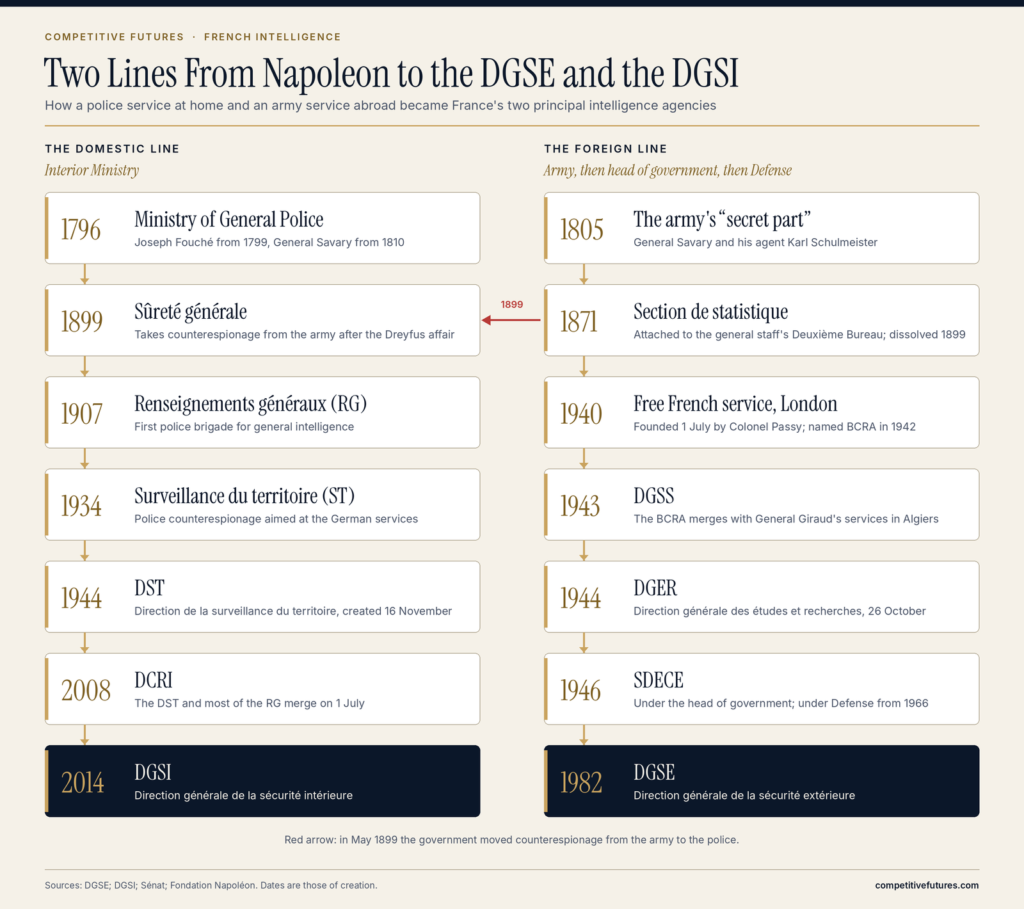
- 1796: Ministry of General Police created; Joseph Fouché takes it over in 1799
- May 1899: counterespionage moved from the army to the Sûreté générale
- 1907: first Renseignements généraux (RG) brigade
- 1934: Contrôle général de la surveillance du territoire (ST)
- 16 November 1944: Direction de la surveillance du territoire (DST)
- 1 July 2008: DST and RG merge into the Direction centrale du renseignement intérieur (DCRI)
- 12 May 2014: the DCRI becomes the DGSI
The foreign line (army, then head of government, then Defense)
- 1805–1814: the army’s “secret part” under General Savary
- 8 June 1871: Section de statistique attached to the general staff’s Deuxième Bureau
- 1 July 1940: Free French intelligence founded in London; named BCRA in 1942
- November 1943: Direction générale des services spéciaux (DGSS)
- 26 October 1944: Direction générale des études et recherches (DGER)
- 1946: Service de documentation extérieure et de contre-espionnage (SDECE)
- 2 April 1982: the SDECE becomes the DGSE
Napoleon’s two instruments
The police: Fouché’s ministry
The Ministry of General Police was created by the Directory in January 1796. It became an intelligence service when Joseph Fouché was appointed to run it on 20 July 1799, four months before Bonaparte’s coup. Bonaparte kept him. Fouché held the post until 1802, when the ministry was abolished during the peace with Britain, returned when it was restored in July 1804, and stayed until 1810 (Sénat).
What Fouché built in his second term is recognizable as a domestic security service. He divided the Empire into police districts, each under a councillor of state. A division under Pierre-Marie Desmarest handled state security and ran the secret police. Reports from prefects, police commissioners, the gendarmerie, and paid informants were condensed every day into a Bulletin for the Emperor, who insisted on complete and reliable information daily (Fondation Napoléon). The Paris Prefecture of Police, created in 1800, ran the capital, and a secret office at the post office opened the mail.
Napoleon never trusted one service. He kept the Paris prefecture, the gendarmerie, and his palace security independent of Fouché and read their reports against each other. In June 1810 he replaced Fouché with General Anne-Jean-Marie-René Savary, a soldier whose main qualification was loyalty.
The army: the “secret part”
Foreign and military intelligence belonged to the army. At Imperial headquarters it was Savary’s job before he became police minister. His best-known agent, the Alsatian smuggler Karl Ludwig Schulmeister, worked against the Austrians in the 1805 campaign that ended with the surrender at Ulm, then served as police commissioner of occupied Vienna and ran networks in the German lands (Fondation Napoléon). Much of the Schulmeister story has been embellished since. The arrangement is the durable part: agents handled by a staff officer close to the commander, paid in cash, and stood down when the campaign ended.
A counterespionage case from 1812
The Empire also produced a spy case that reads like a modern one. In February 1812, as Napoleon assembled the army that would invade Russia, the police noticed that Colonel Alexander Chernyshev, an aide-de-camp of the tsar posted in Paris, was sending detailed reports on the Grande Armée to St. Petersburg. Savary briefed the Emperor. Chernyshev left Paris the day after an audience with Napoleon, and a letter signed “M” was found in his rooms. It led to a clerk named Michel in the War Ministry, who had been selling military information to Russian diplomats since 1807. He was tried in April and executed on 1 May 1812 (Fondation Napoléon).
The case has every element of later ones: an accredited officer running sources under diplomatic cover, a low-paid insider with access to troop data, a five-year penetration found only when war was weeks away, and a police service, not the army, doing the catching.
The nineteenth century: the police keep watch, the army starts over
The Police Ministry did not outlive the Empire by long. It was folded into the Interior Ministry in 1818, and apart from a brief revival under Napoleon III, political policing was from then on an Interior function. Its field force was the corps of special commissioners, first posted to railway stations in 1855, who reported on travelers, foreigners, strikes, and opposition politics across the country.
The army’s capability lapsed between wars, and the defeat by Prussia in 1870 showed the cost. On 8 June 1871 the War Ministry created a permanent Section de statistique, attached to the general staff’s new Deuxième Bureau. The Deuxième Bureau analyzed foreign armies. The Section, a handful of officers, ran agents and hunted spies. France passed its first espionage law in 1886.
The Dreyfus affair moves counterespionage to the police
In 1894 the Section de statistique obtained a memorandum taken from the German embassy and attributed it to Captain Alfred Dreyfus, an artillery officer on the general staff. He was convicted of treason on a secret file. When the real author was identified, officers of the Section forged evidence to protect the verdict. Dreyfus was pardoned in 1899 and cleared in 1906.
The institutional consequence came in May 1899. The government took counterespionage away from the army and gave it to the Sûreté générale at the Interior Ministry, where the special commissioners would carry it out. The Section de statistique was dissolved that September.
A working rule followed that held for forty years: in peacetime, catching spies on French soil is police work, and the military is brought in only in wartime. It is the direct origin of the DGSI’s place in the Interior Ministry. The army recovered part of the mission in 1907 and kept a small collection service, the Service de renseignements (SR), with its counterespionage section, the SCR.
Two world wars
In 1907 the Sûreté’s director, Célestin Hennion, created a brigade for general intelligence, the first use of the name Renseignements généraux. Its job was to watch groups that might threaten the Republic’s institutions (DGSI).
The First World War made French military intelligence a serious organization, above all in codebreaking. In June 1918 the army cryptanalyst Georges Painvin broke the German ADFGVX field cipher in time to locate an offensive toward Paris.
Between the wars the SR bought the documents that started the attack on Enigma. From 1931 Captain Gustave Bertrand handled Hans-Thilo Schmidt, an employee of the German cipher office, and passed his material to the Polish cryptologists who reconstructed the machine. At the Interior Ministry, a law against espionage in January 1934 was followed that June by a new Contrôle général de la surveillance du territoire, a police counterespionage service aimed at the German services (DGSI).
The defeat of 1940 split the profession. Inside Vichy France, army counterespionage officers carried on under cover against the German services until the occupation of the southern zone in November 1942. In London, the line that leads to the DGSE started from nothing.
The BCRA: where DGSE history begins
On 1 July 1940, General de Gaulle asked a 29-year-old engineer officer, André Dewavrin, to build an intelligence service for Free France. Dewavrin took the alias “Passy.” The service changed names several times and became the Bureau central de renseignements et d’action (BCRA) in 1942. It ran intelligence networks in occupied France, armed and coordinated the Resistance, and worked alongside the British services and later the American Office of Strategic Services. Its counterespionage section was first led by Roger Wybot.
The DGSE names the BCRA as its ancestor and takes two principles from it that still hold (DGSE):
- One integrated service. Collection, analysis, and clandestine action sit in a single organization.
- Political, not military, control. The service answers to the political authority, not to the armed forces’ chain of command.
In November 1943 the BCRA merged with the rival services of General Giraud in Algiers to form the DGSS, which became the DGER on 26 October 1944. By then it had more than 10,000 people, 123 buildings, and 1,400 cars. Passy took over in 1945 and cut it down. The service that emerged in 1946 as the SDECE had 880 civilians, 600 military personnel, and 750 contractors, and reported to the head of government.
The SDECE, 1946–1982
The SDECE fought France’s wars of decolonization in Indochina and Algeria and its Cold War in Europe and Africa. It settled on boulevard Mortier in Paris, where the DGSE still is.
Its worst moment was domestic. On 29 October 1965 the Moroccan opposition leader Mehdi Ben Barka was abducted in central Paris and never seen again. The trial that followed implicated Moroccan officials, French police officers, and a SDECE informant. De Gaulle responded in 1966 by moving the SDECE from the prime minister’s office to the Defense Minister, where its successor remains.
Alexandre de Marenches ran the service from 1970 to 1981. When François Mitterrand took office in 1981 he appointed Pierre Marion, an aerospace executive, to reform it.
DGSI history: the DST and the RG, 1944–2008
At the Liberation, an ordinance of 16 November 1944 created the Direction de la surveillance du territoire inside the national police, with Wybot as its first director. He stayed until 1959. The DST’s targets followed France’s wars: Axis agents and collaborators, then Vietnamese and Algerian nationalist networks, then the Soviet bloc.
Its greatest success was the Farewell case. From 1981 a KGB officer in Moscow, Vladimir Vetrov, gave the DST thousands of documents on Soviet theft of Western science and technology. Mitterrand shared the take with Washington, and France expelled dozens of Soviet officials in 1983. A domestic police service had run one of the Cold War’s best agents inside the Soviet Union, without the foreign service.
A decree of 22 December 1982 fixed the DST’s three missions: counterespionage, counterterrorism, and protection of economic and scientific assets. Terrorism soon dominated. The DST broke the network behind the 1985–86 Paris bombings and took part in the capture of Carlos the Jackal in August 1994.
The RG, meanwhile, remained the government’s eyes on French society. A 1967 decree charged it with collecting the political, social, and economic intelligence the government needed, and it became a central directorate of the national police in 1968.
1982: the SDECE becomes the DGSE
Decree 82-306 of 2 April 1982 renamed the SDECE the Direction générale de la sécurité extérieure. Its mission is to seek and exploit intelligence bearing on the security of France and to detect and disrupt, outside the national territory, espionage directed against French interests.
Three years later the new name was world news. On 10 July 1985, DGSE officers sank the Greenpeace ship Rainbow Warrior in Auckland harbor, killing the photographer Fernando Pereira. Two officers were arrested by New Zealand police. The Defense Minister resigned and the DGSE’s director was dismissed. The full account is in our French intelligence profile.
The reform that followed, in 1989, opened a military-run service to civilian leadership and gave it a strategy directorate. That structure lasted until 2022, when the service reorganized around mission centers that put collection and analysis on the same problem in the same team.
2008–2014: the DCRI, then the DGSI
By the 2000s France had two police intelligence services with overlapping work on Islamist terrorism. On 1 July 2008 the DST and most of the RG were merged into the Direction centrale du renseignement intérieur (DCRI). The RG’s work on public order and social movements went to a separate territorial service.
The DCRI was still a directorate inside the national police. After the Toulouse and Montauban attacks of March 2012, carried out by a man the service already knew, the government decided that was not enough. Decree 2014-445 of 30 April 2014 created the Direction générale de la sécurité intérieure, reporting directly to the Interior Minister. It came into force on 12 May 2014.
A community, a coordinator, and a statute
For most of this history the services operated with no statute defining what they could do and no body coordinating them. That changed in a decade:
- 2007: Parliament created a joint intelligence committee, the Délégation parlementaire au renseignement.
- 2008: A defense white paper made intelligence a national priority. A National Intelligence Council chaired by the President and a national coordinator at the Élysée followed that July.
- 2015: The intelligence law of 24 July gave surveillance techniques a legal basis and created an independent commission, the CNCTR, to review them.
- 2017: The coordinator’s post was expanded to cover counterterrorism (CNRLT).
Since 2017 both services have grown fast. The DGSE’s 2026 budget is €1.14 billion (Sénat). Both are leaving their historic addresses: the DGSI for a single headquarters at Saint-Ouen in 2029, and the DGSE for the Fort Neuf de Vincennes in 2031 (Élysée). Nicolas Lerner, who has led the DGSE since January 2024, ran the DGSI for the five years before that.
What two centuries of French practice show
- The line between home and abroad never holds. Michel sold secrets in Paris to a foreign embassy. Farewell was a domestic service’s agent in Moscow. Terrorism crosses the border by definition. France’s answer has been to keep two services and add coordination above them. See our guide to intelligence services around the world for how other countries have drawn the same line.
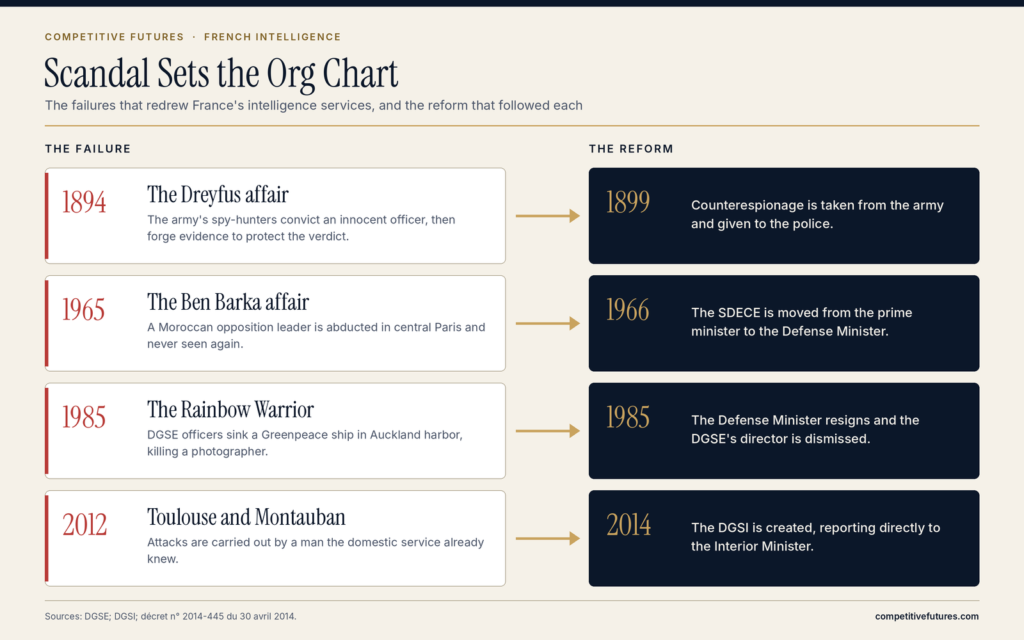
- Scandal sets the org chart. Dreyfus moved counterespionage to the police. Ben Barka moved the foreign service to Defense. Rainbow Warrior was followed by civilian leadership. Toulouse was followed by the DGSI. Each reform answered the last failure.
- Counterintelligence fails when the same people collect, judge, and defend the conclusion. The Section de statistique found a suspect, built the file, and then forged evidence to protect its own verdict. James Jesus Angleton’s career taught the same lesson again seventy years later.
- Capability decays between crises. France let its military intelligence lapse after 1815 and rebuilt it in 1871, cut the DGER by three-quarters in 1945, and has been expanding both services since 2015. Starting over costs the most when the need is greatest.
- Leaders who rely on one channel get managed by it. Napoleon read Fouché’s bulletin against the prefecture’s and the gendarmerie’s reports. Fouché served every regime from the Terror to the Restoration, so the precaution was sound.
Frequently asked questions
What is the difference between the DGSE and the DGSI?
The DGSE is France’s foreign intelligence service. It collects intelligence and conducts clandestine operations outside France and reports to the Armed Forces Minister. The DGSI is the domestic security service. It handles counterespionage, counterterrorism, and the protection of economic interests on French soil, and reports to the Interior Minister.
When was the DGSE created?
The DGSE took its name on 2 April 1982, when a decree renamed the SDECE, the foreign service founded in 1946. DGSE history begins earlier, with the BCRA, the Free French intelligence service that General de Gaulle had Colonel Passy build in London from 1 July 1940.
When was the DGSI created?
The DGSI was created by a decree of 30 April 2014 and began work on 12 May 2014. It replaced the DCRI, which had been formed on 1 July 2008 by merging the DST, the counterespionage service founded in 1944, with most of the Renseignements généraux, the police intelligence branch dating to 1907.
Did Napoleon create French intelligence?
Not the services themselves, but the model. Under Napoleon, Joseph Fouché’s Ministry of General Police ran domestic surveillance and counterespionage, while the army’s staff ran spies against foreign powers. That division between a police service at home and a separate foreign service born in the military is still the basis of the DGSI and the DGSE.
What was the Deuxième Bureau?
The Deuxième Bureau was the intelligence bureau of the French army’s general staff, created in the reorganization that followed the defeat of 1870. It analyzed foreign armies. Secret collection and counterespionage were handled by a small attached unit, the Section de statistique, which became notorious in the Dreyfus affair and was dissolved in 1899.
What was the SDECE?
The SDECE (Service de documentation extérieure et de contre-espionnage) was France’s foreign intelligence service from 1946 to 1982. It grew out of the Free French BCRA, reported first to the head of government and from 1966 to the Defense Minister, and was renamed the DGSE on 2 April 1982.
Who was Joseph Fouché?
Joseph Fouché was Napoleon’s Minister of General Police from 1799 to 1802 and from 1804 to 1810. He organized the Empire into police districts, ran a secret police division, and sent the Emperor a daily intelligence bulletin. His ministry is the earliest model for France’s domestic security service.
Work with Competitive Futures
Most of the reforms in this history were made after a failure. We help organizations build intelligence and counterintelligence functions before a crisis designs them instead. Request a 20-minute conversation.
Related analysis from Competitive Futures
- Intelligence Services Around the World: Structure, History, and the Headlines
- French Intelligence: History, Structure, and the Headlines
- The Office of Strategic Services: Donovan, the CIA, and the 2026 Revival
- James Jesus Angleton: Counterintelligence in a Wilderness of Mirrors
- British Intelligence: History, Structure, and the Headlines
- German Intelligence: History, Structure, and the Headlines
References
- Décret n° 82-306 du 2 avril 1982 portant création et fixant les attributions de la direction générale de la sécurité extérieure.
- Ordonnance du 16 novembre 1944 relative à l’organisation du ministère de l’Intérieur.
- Décret n° 2008-609 du 27 juin 2008 relatif aux missions et à l’organisation de la direction centrale du renseignement intérieur.
- Décret n° 2014-445 du 30 avril 2014 relatif aux missions et à l’organisation de la direction générale de la sécurité intérieure.
- Loi n° 2007-1443 du 9 octobre 2007 portant création d’une délégation parlementaire au renseignement.
- Loi n° 2015-912 du 24 juillet 2015 relative au renseignement.
- Décret n° 2017-1095 du 14 juin 2017 relatif au coordonnateur national du renseignement et de la lutte contre le terrorisme.
- Direction générale de la sécurité extérieure. Du BCRA à la DGSE. Ministère des Armées, Chemins de mémoire.
- Direction générale de la sécurité intérieure. DGSI’s history and Brève histoire de la Direction de la surveillance du territoire.
- Sénat. Joseph Fouché (archives).
- Gotteri, N. (2000). La police secrète sous le Premier Empire. Napoléon Ier, no. 1. Fondation Napoléon.
- Fondation Napoléon. Schulmeister, Karl Ludwig (1770–1853), l’espion de Napoléon; « L’affaire Michel » ou le recrutement d’employés pour le compte de la Russie.
- Sénat, Commission des affaires étrangères, de la défense et des forces armées. (2025). Avis sur le projet de loi de finances pour 2026, programme 144.
- Présidence de la République. (2025, March 11). Inauguration du futur siège unique de la DGSI.
- Vie publique. Renseignement français : quel cadre légal ?
- Warusfel, B. (1996). Histoire de l’organisation du contre-espionnage français entre 1871 et 1945. Cahiers du Centre d’études d’histoire de la défense, no. 1.
- Forcade, O. (2008). La République secrète: Histoire des services spéciaux français de 1918 à 1939. Nouveau Monde.
- Laurent, S. (2009). Politiques de l’ombre: État, renseignement et surveillance en France. Fayard.
- Albertelli, S. (2009). Les services secrets du général de Gaulle: Le BCRA, 1940–1944. Perrin.
- Van Puyvelde, D. (2026). The DGSE: A Concise History of France’s Foreign Intelligence Service. Georgetown University Press.
This piece is part of our guide to Intelligence Services Around the World.