The History of MI5 and MI6: From the Secret Service Bureau to Thames House and Vauxhall Cross
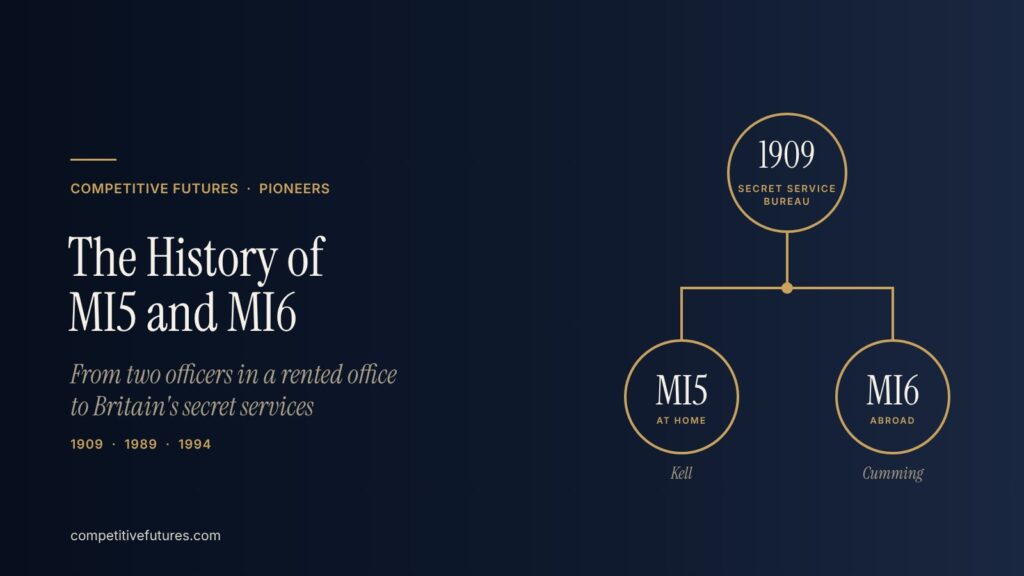
MI5 and MI6 began as one office with two officers. In October 1909 the British government set up a Secret Service Bureau, staffed by a 50-year-old naval commander named Mansfield Cumming and an army captain 14 years younger named Vernon Kell (MI5). Within a year they had divided the work. Kell took counter-espionage at home, which became the Security Service, or MI5. Cumming took espionage abroad, which became the Secret Intelligence Service, or MI6.
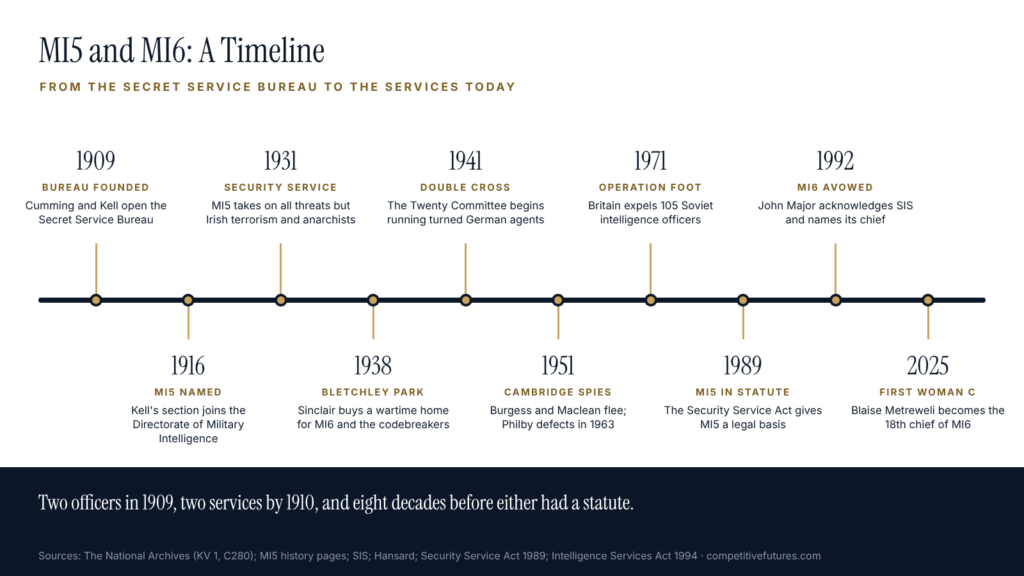
Both services spent most of the next 80 years officially not existing. MI5 had no statute until 1989. The British government did not admit that MI6 existed until 1992. In between, they ran the Double Cross System, helped win two world wars, suffered the worst penetration by a hostile service any Western country has publicly acknowledged, and recovered from it.
This page covers how the two services were founded, what they did in the world wars and the Cold War, how they came into the open, and what their history says about building an intelligence function. For how British intelligence is organized today and the cases now in the news, see our guide to British intelligence.
At a glance
- Founded: October 1909, as the Secret Service Bureau, on the recommendation of a sub-committee of the Committee of Imperial Defence.
- Founders: Vernon Kell (MI5, director 1909–1940) and Mansfield Cumming (MI6, chief 1909–1923).
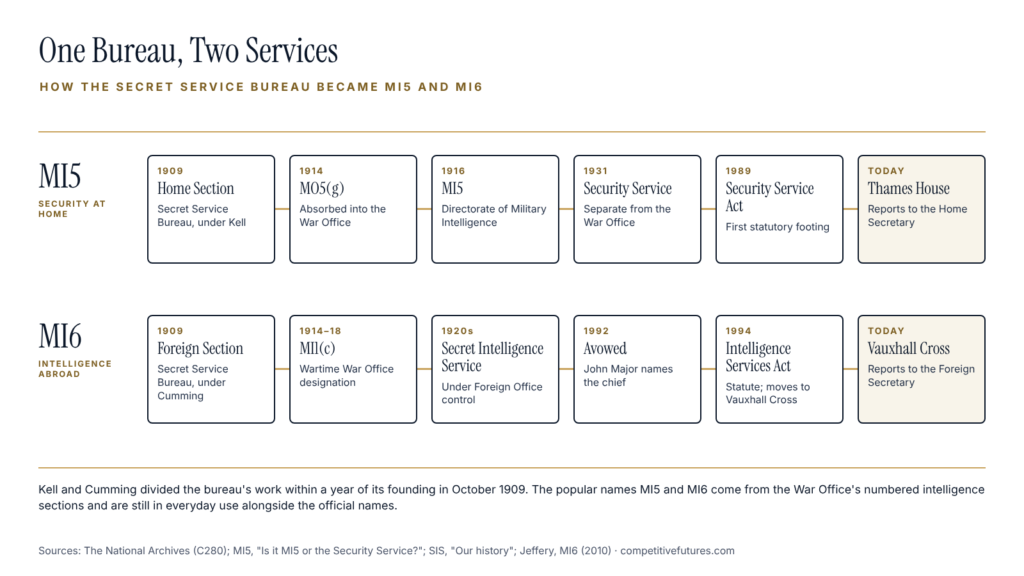
- MI5’s names: Home Section of the Secret Service Bureau, MO5(g), MI5 (from 1916), and the Security Service (from 15 October 1931).
- MI6’s names: Foreign Section of the Bureau, MI1(c) in the First World War, then the Secret Intelligence Service. “MI6” stuck as the popular name.
- Legal footing: MI5 under the Security Service Act 1989; MI6 and GCHQ under the Intelligence Services Act 1994.
- Headquarters today: MI5 at Thames House, Millbank; MI6 at Vauxhall Cross, across the Thames, since 1994.
- Heads today: Sir Ken McCallum, Director General of MI5 since April 2020; Blaise Metreweli, Chief of MI6 since 1 October 2025, the 18th “C” and the first woman in the post.
The founding: spy fever and a rented office
In the years before the First World War, the British public was convinced that Germany had filled the country with spies. Invasion novels sold well, newspapers ran sightings of German agents, and the Royal Navy worried about espionage at its ports. In March 1909, Prime Minister Asquith asked the Committee of Imperial Defence to look into the danger. Its sub-committee recommended a Secret Service Bureau to handle intelligence from abroad, work with agents, and act as a buffer between the War Office, the Admiralty, and the agents themselves (National Archives, Records of the Security Service).
The bureau’s start was modest. Cumming and Kell first met on 4 October 1909, in premises rented from a private detective (Andrew, Defence of the Realm). Cumming’s diary entry for 7 October recorded that he went to the office, stayed all day, saw no one, and had nothing to do (Jeffery, MI6).
The two men soon agreed that one office couldn’t do both jobs. Running agents in foreign countries and catching foreign agents at home need different people, different methods, and different relationships with the police and the courts. Cumming took the foreign side and Kell the domestic side. The split, made almost at once, is still the basic design of British intelligence. Kell’s small staff was led on the administrative side by a capable office manager, Edith Lomax, and in 1911, with Home Secretary Winston Churchill’s support, Parliament passed the Official Secrets Act (National Archives, MI5: Official Secrets).
Cumming and “C”
Cumming set the tone for the foreign service in ways that still show. He signed papers with a single letter, C, in green ink. Every chief since has been known as C, and the chief still writes in green (Jeffery, MI6).
He ran the service personally, on very little money, and he had to defend it repeatedly against attempts by the War Office and Admiralty to absorb or shrink it. Its survival through those fights is one of the main threads of the service’s authorized history.
The First World War
MI5. The war began with the bureau’s most important early success. Kell’s section had spent five years identifying German agents in Britain, and when war came it helped round up most of Imperial Germany’s network in a matter of days (MI5). Spies sent later were caught too, and several were executed, starting with Carl Hans Lody at the Tower of London in November 1914. During the war the section was absorbed into the War Office as MO5(g), and in January 1916 it moved into the new Directorate of Military Intelligence as MI5 (MI5, “Is it MI5 or the Security Service?”).
MI6. Cumming’s service, then known as MI1(c), spent the war building networks behind German lines. Its best was La Dame Blanche, a network of Belgian volunteers who watched railway lines in occupied Belgium and northern France and counted the German troop trains passing through. Keith Jeffery, the service’s authorized historian, called it the most successful single British human intelligence operation of the war. Cumming’s officers also worked in revolutionary Russia, which made the Bolsheviks the service’s main target for the next two decades.
Between the wars
Both services shrank after 1918, and both fought for their budgets.
MI5 took on a broader mandate. On 15 October 1931 it became the Security Service and took responsibility for assessing all threats to national security except those from Irish terrorists and anarchists, which stayed with the police (National Archives). In practice that meant Soviet espionage and communist subversion, which dominated its work in the 1930s along with the growing fascist movement.
MI6 passed to Admiral Hugh “Quex” Sinclair when Cumming died in 1923. Sinclair also took charge of the Government Code and Cypher School, the codebreaking agency founded in 1919, which put signals intelligence and human intelligence under one chief. In May 1938, with war expected and the government unwilling to pay, Sinclair bought Bletchley Park as a wartime home for both, by most accounts with his own money. He died in November 1939. His successor, Stewart Menzies, served until 1952.
The Second World War
MI6 had a bad start. On 9 November 1939, German security officers posing as anti-Nazi conspirators lured two British intelligence officers to Venlo on the Dutch border and kidnapped them. The incident exposed much of the service’s network in Western Europe. In 1940 its sabotage branch, Section D, was folded into the new Special Operations Executive, which took over subversion and sabotage for the rest of the war.
The war still made MI6’s reputation, mostly through Bletchley. Because the codebreakers reported to C, Menzies controlled the distribution of ULTRA, the intelligence from broken German and other Axis ciphers, to Churchill and the commanders. That gave the service a place at the center of the war effort that its agent networks alone would not have earned.
MI5 had a near collapse and then its greatest success. In the invasion scare of 1940 the service was overwhelmed by the work of vetting and interning enemy aliens. Churchill removed Kell in June 1940 after 31 years in charge, and his successor, Sir David Petrie, reorganized the service from 1941.
What followed was the Double Cross System. MI5 captured nearly every agent Germany sent to Britain and turned many of them into double agents, about 120 in all. A committee called the Twenty Committee, chaired by J. C. Masterman, decided what information those agents could send back. Germany believed it had a working spy network in Britain; MI5 ran it. In 1944 the double agents, above all GARBO, carried the deception that persuaded German commanders the main Allied landing would come at the Pas de Calais rather than Normandy.
The Cold War and the Cambridge spies
The Cold War brought both services their worst failures, and the failures came from inside.
The Soviet Union had recruited a group of young Cambridge men in the 1930s who went on to senior posts in British government: Kim Philby, Guy Burgess, Donald Maclean, Anthony Blunt, and John Cairncross. Philby rose inside MI6, ran its anti-Soviet section after the war, and served as its liaison in Washington. Blunt was an MI5 officer during the war. Burgess and Maclean fled to Moscow in May 1951. Philby was confronted in Beirut in January 1963 and defected within days. Blunt confessed to MI5 in April 1964 in exchange for immunity, and his role stayed secret until Prime Minister Margaret Thatcher named him in the Commons in 1979. MI5 released more than 100 files on the ring to The National Archives in January 2025.
The penetration didn’t stop with Cambridge. MI5 had cleared Klaus Fuchs, the atomic scientist convicted of spying for Moscow in 1950. George Blake, an MI6 officer working for the KGB, betrayed the joint British-American tunnel under East Berlin and hundreds of agents before his conviction in 1961; he escaped from prison in 1966. The damage went beyond the secrets lost. For decades afterward, suspicion inside the services about further moles led to internal investigations that consumed careers and strained the relationship with the Americans. James Jesus Angleton‘s mole hunt at the CIA was partly a product of the Philby case.
The services also had real wins:
- Oleg Penkovsky, a GRU colonel run jointly by MI6 and the CIA in 1961 and 1962, provided intelligence on Soviet missiles that proved valuable during the Cuban Missile Crisis. He was arrested in October 1962 and executed the following year.
- Operation FOOT. On 24 September 1971, after the defection of a KGB officer named Oleg Lyalin, the government expelled 105 Soviet intelligence officers from London. MI5’s authorized historian calls it the turning point in Cold War counter-espionage in Britain; it made Britain a hard target for Soviet intelligence for the first time (MI5, “The later Cold War”).
- Oleg Gordievsky, a KGB officer who worked for MI6 from 1974, rose to be the KGB’s acting head in London. He identified Michael Bettaney, an MI5 officer trying to sell secrets to the KGB, who was convicted in 1984, and his reporting on Soviet fears of a Western first strike in 1983 reached Thatcher and Reagan. When the KGB recalled and interrogated him in 1985, MI6 smuggled him out of the Soviet Union that July.
- Vasili Mitrokhin, a former KGB archivist, was brought out by MI6 in 1992 with his notes on decades of KGB foreign operations.
Coming into the open
For most of their history the services had no legal basis beyond the royal prerogative and a 1952 directive from the Home Secretary to the head of MI5. That changed in the late 1980s, under pressure from published memoirs such as Peter Wright’s Spycatcher and from a European human rights case brought by two former officials of the National Council for Civil Liberties whom MI5 had kept files on.
- 1989. The Security Service Act put MI5 on a statutory footing for the first time and defined its function as the protection of national security (Security Service Act 1989).
- 1992. Stella Rimington became Director General in March, the first woman to lead any of the world’s major intelligence agencies and the first MI5 head whose appointment was announced publicly (MI5, “Since the Cold War”). The same year MI5 took the lead from the Metropolitan Police Special Branch for intelligence on Irish republican terrorism in Great Britain.
- 6 May 1992. Prime Minister John Major told the House of Commons that the government would acknowledge the continuing existence of the Secret Intelligence Service, named its chief, Sir Colin McColl, and promised legislation (Commons statement, 6 May 1992).
- 1994. The Intelligence Services Act placed MI6 and GCHQ on a statutory basis and created a committee of parliamentarians to oversee all three agencies (Hansard, 1 November 1994). MI6 moved into Vauxhall Cross, opened by the Queen in July 1994 (SIS), and MI5 moved into Thames House.
The services also opened their own history. MI5 commissioned Christopher Andrew’s authorized history for its centenary in 2009. MI6 commissioned Keith Jeffery’s history of its first 40 years, published in 2010; the period after 1949 is still closed.
After 9/11
The end of the Cold War and the Irish peace process looked, for a few years, like they might shrink both services. September 2001 reversed that. MI5 grew rapidly and turned most of its effort to Islamist terrorism. It led the response to the 7 July 2005 bombings in London, which killed 52 people, and to a long series of plots disrupted before they reached attack stage. In October 2007 it took the lead for national security intelligence in Northern Ireland.
Iraq was MI6’s hardest test in the period. The Butler Review in July 2004 found that the service had relied too heavily on a small number of human sources on Iraq’s weapons programs and had not validated them properly; several streams of its reporting were withdrawn after the invasion. The Chilcot inquiry in 2016 repeated the criticism at greater length. Both reports are covered in our guide to British intelligence.
Both services kept moving into public view. Sir John Sawers gave the first public speech by a serving chief of MI6 in 2010, and the heads of both services now give regular public threat assessments. The legal framework was rebuilt by the Investigatory Powers Act 2016 and the National Security Act 2023, which replaced the old espionage offences in the Official Secrets Acts and created new offences of foreign interference.
The services today
The threat picture has turned back toward hostile states, which is where both services started. In her first public speech as C in December 2025, Blaise Metreweli described a world in which “the front line is everywhere,” with Russia’s sabotage, cyberattacks, and information operations putting Britain in a space between peace and war (Speech by the Chief of SIS, 15 December 2025). In his annual threat update on 13 October 2026, McCallum said MI5 now counters as many state threats as terrorist ones, named Russia the leading aggressor, warned that Iran was going after harder targets such as military sites, and announced a new center to assess threats from artificial intelligence (13 October 2026).
Stella Rimington, who took MI5 into the open, died in August 2025.
What MI5 and MI6 teach about building an intelligence function
The British services have had more than a century to learn what makes an intelligence function work, and they paid for most of the lessons.
- Separate collection from protection. Cumming and Kell split the bureau within months because finding out about others and protecting your own secrets are different jobs with different people and rules. Companies that ask one team to do both, competitive intelligence and insider risk, usually end up doing one badly.
- The insider is the real threat. The Cambridge spies did more damage than any foreign operation against Britain, and they were vetted, trusted, and promoted. Every organization that holds valuable information needs to assume that someone inside may be working for someone else.
- Validate the source, not just the report. The Iraq failures came from reporting that sounded right from sources that hadn’t been tested. The same discipline applies to market rumors, expert networks, and anything that arrives because it confirms what leadership already believes. Analysis of Competing Hypotheses exists to catch it.
- Legitimacy is a capability. Both services operated for decades without a legal basis and paid for it in scandals, lawsuits, and lost trust. Putting them on a statutory footing made them stronger. An intelligence function inside a company needs the same thing: a written mandate, clear legal limits, and leaders who know what it does.
- Survival depends on a patron and a record. Cumming fought off repeated attempts to absorb his service. What saved it was a chief who defended it and results the government could see. Compare the American OSS, which had one patron and was abolished within months of his death.
Frequently asked questions
What is the difference between MI5 and MI6?
MI5, the Security Service, protects the United Kingdom at home against espionage, terrorism, and other threats to national security. MI6, the Secret Intelligence Service, collects intelligence overseas, mainly from human sources. MI5 reports to the Home Secretary and MI6 to the Foreign Secretary. Both grew out of the same organization, the Secret Service Bureau, founded in October 1909.
When were MI5 and MI6 founded?
Both began operations in October 1909 as a single organization, the Secret Service Bureau, staffed by Commander Mansfield Cumming of the Royal Navy and Captain Vernon Kell of the Army. Within a year Kell had taken responsibility for counter-espionage at home and Cumming for intelligence abroad. Those two sections became MI5 and MI6.
Why is the head of MI6 called C?
The first chief, Mansfield Cumming, signed papers with the letter C in green ink. Every chief since has used the title C, and the chief still writes in green ink. The current C is Blaise Metreweli, who took office on 1 October 2025 as the 18th chief and the first woman to hold the post.
What do the names MI5 and MI6 mean?
MI stands for Military Intelligence. During the First World War both services sat inside the War Office’s intelligence directorate, which numbered its sections. Kell’s section became MI5 in 1916, and Cumming’s became known as MI6 later. MI5’s official name has been the Security Service since 1931, and MI6’s is the Secret Intelligence Service, but the old names are still in everyday use.
When did the British government admit MI6 existed?
On 6 May 1992, when Prime Minister John Major told the House of Commons that the government would acknowledge the continuing existence of the Secret Intelligence Service and named its chief, Sir Colin McColl. The Intelligence Services Act 1994 then placed MI6 and GCHQ on a statutory basis. MI5 had been placed on a statutory basis by the Security Service Act 1989.
Who were the Cambridge spies?
Kim Philby, Guy Burgess, Donald Maclean, Anthony Blunt, and John Cairncross, recruited by Soviet intelligence while at Cambridge in the 1930s. They reached senior posts in the Foreign Office, MI6, MI5, and wartime codebreaking. Burgess and Maclean fled to Moscow in 1951, Philby defected in 1963, and Blunt confessed to MI5 in 1964 and was publicly named in 1979.
Work with Competitive Futures
Cumming and Kell built two functions from nothing: one to learn what others intended and one to keep others from learning what Britain knew. Most organizations need both and have neither. We build and run intelligence functions for companies and governments. Request a 20-minute conversation.
Related analysis from Competitive Futures
- British Intelligence: History, Structure, and the Headlines
- The Office of Strategic Services: Donovan, the CIA, and the 2026 Revival
- James Jesus Angleton: Counterintelligence in a Wilderness of Mirrors
- J. Edgar Hoover: Building American Counterintelligence
- Russian Intelligence: History, Structure, and the Headlines
- Intelligence Services Around the World
References
- The National Archives. Records of the Security Service (catalogue C280), including KV 1, the Secret Service Bureau and First World War papers.
- The National Archives. MI5: Official Secrets exhibition (2025).
- MI5. “The establishment of the Secret Service Bureau”; “MI5’s early years”; “Is it MI5 or the Security Service?”; “The later Cold War”; “Since the Cold War”; “Dame Stella Rimington.”
- Secret Intelligence Service. “Our history.”
- Major, J. (1992, May 6). Statement to the House of Commons on the Loyal Address. John Major Archive.
- Hansard, HC Deb 1 November 1994, written answers, “Open government and accountability.”
- Security Service Act 1989 (c. 5).
- Intelligence Services Act 1994 (c. 13).
- National Security Act 2023 (c. 32).
- Review of Intelligence on Weapons of Mass Destruction [the Butler Report], HC 898, 14 July 2004.
- The Report of the Iraq Inquiry [the Chilcot Report], 6 July 2016, Section 4.3.
- Metreweli, B. (2025, December 15). Speech by the Chief of SIS.
- Andrew, C. (2009). The Defence of the Realm: The Authorized History of MI5. Allen Lane.
- Jeffery, K. (2010). MI6: The History of the Secret Intelligence Service, 1909–1949. Bloomsbury.
- Masterman, J. C. (1972). The Double-Cross System in the War of 1939 to 1945. Yale University Press.
- Judd, A. (1999). The Quest for C: Mansfield Cumming and the Founding of the Secret Service. HarperCollins.
- Hughes, G. (2006). “Giving the Russians a Bloody Nose”: Operation Foot and Soviet espionage in the United Kingdom, 1964–71. Cold War History, 6(2), 229–249.
This piece is part of our guide to The Pioneers of Strategy, Intelligence, and Foresight.