In 1997, Three Futurists Described 2025. You’ll Be Shocked at How Close They Were.
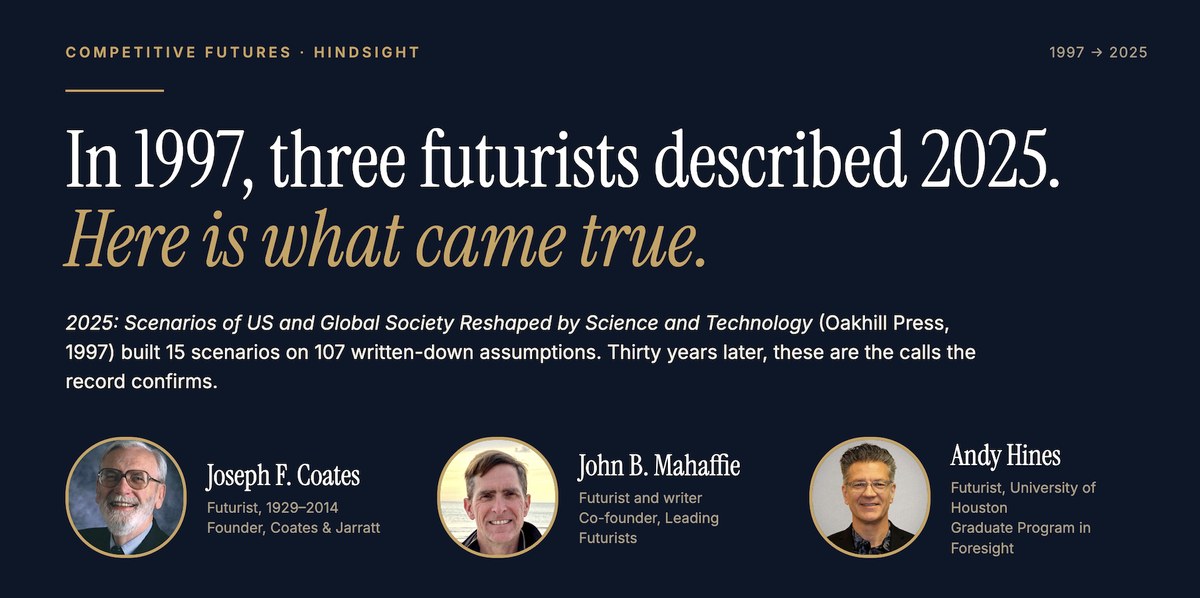
2025: Scenarios of US and Global Society Reshaped by Science and Technology came out in February 1997. Joseph F. Coates wrote it with two colleagues from his Washington think tank, Coates & Jarratt, Inc.: John B. Mahaffie and Andy Hines. Bill Clinton was in his second term. Most American homes were not online. Google did not exist yet.
The book set out to describe the world of 2025, nearly three decades out. Now 2025 has come and gone, so we can check the work.
The result is one of the best records in long-range forecasting. The authors got the big structural shifts right: the networked world, machine learning and translation, cybercrime, the genome, the global middle class, the move to remote work. Several of their calls arrived early. Where they missed, they missed in a consistent direction, and that pattern teaches as much as the hits do.
How the book worked
2025 was not a list of gadget predictions. It came out of a two-phase project at Coates & Jarratt. The first phase organized forecasts made from 1970 through 1992 across nearly every field of science and engineering. The second built fresh forecasts about how those technologies would interact.
The authors wrote down 107 explicit assumptions about 2025: 83 core assumptions and 24 “slightly less probable” developments. On those they built 15 scenarios, one per area of life: the home, information, genetics, energy, materials, the environment, global management, space, infrastructure, transportation, manufacturing, food, health, daily life, and work and leisure.
Each scenario chapter closes with two tables. One is a dated list of “Critical Developments 1990–2025.” The other lists “Unrealized Hopes and Fears,” things people expected or dreaded that, in the scenario, never happened.
Two features matter for judging the book fairly. First, the authors separated a forecast, a statement about the qualities and likelihood of a trend, from a prediction, a specific and usually numerical claim. Most of the 107 assumptions are forecasts. Second, the timelines are full of invented laws, agencies and prize-winners, on purpose; the book says so. You score the trend each one stands for, not the made-up name.
That is a forecaster’s discipline: state your assumptions in public, in advance, where anyone can grade them later. Joe insisted on it.
What they got right
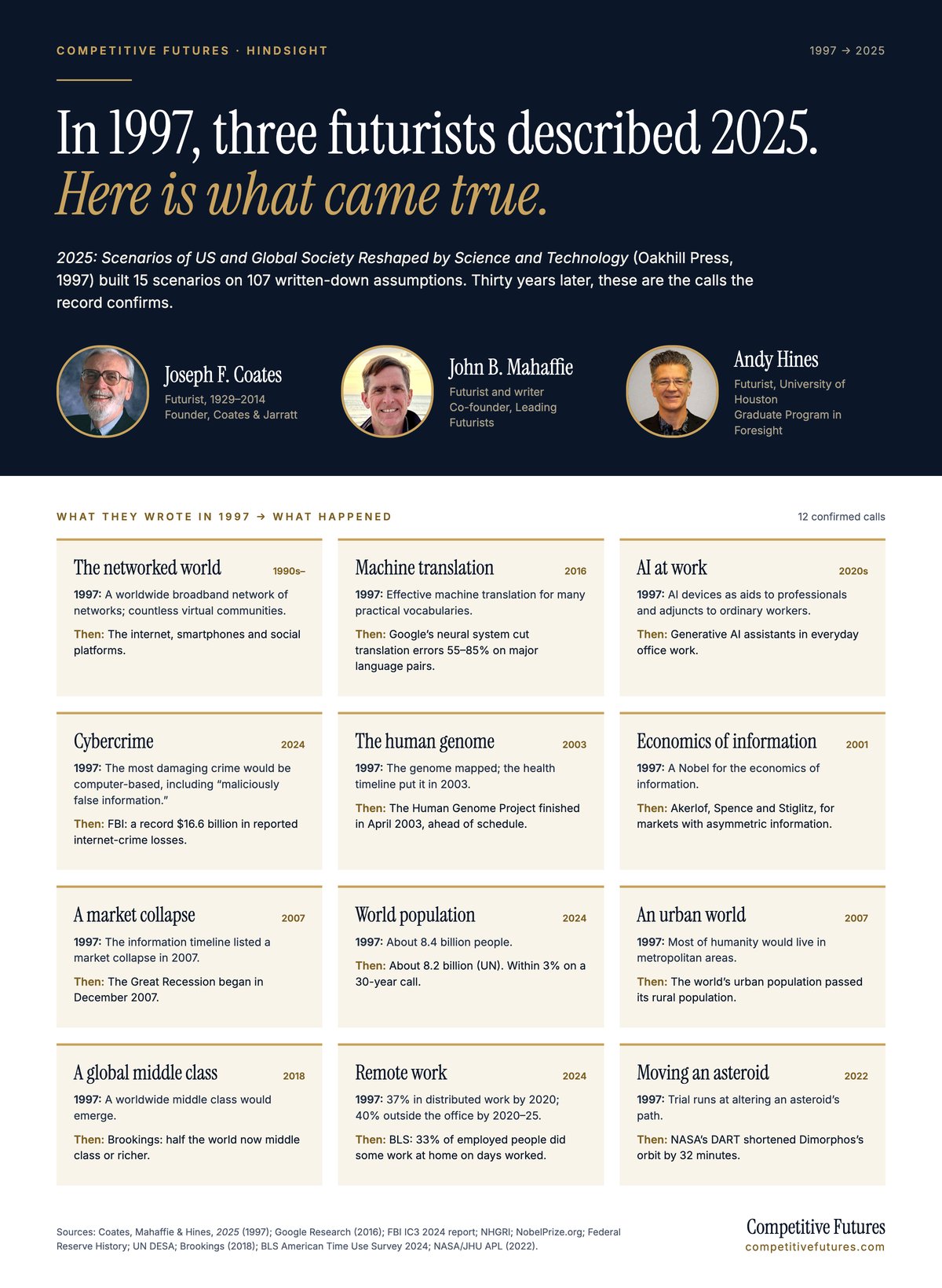
The networked world. Assumption 23 described a worldwide broadband “network of networks” giving the affluent world and the global middle class communication “to any place at any time from anywhere.” Assumption 65 called for “countless virtual communities based on electronic linkages,” and 64 said people in the advanced nations would be “computer literate and computer dependent.” In 1997 those read as bold. Today they read as a description of your phone.
Machine translation and machine learning. Assumption 30 forecast effective machine translation of text, and to a lesser extent voice, “for many practically-significant vocabularies.” In September 2016 Google moved its translation service to a neural network system that, in human-rated tests, cut translation errors by 55 to 85 percent on several major language pairs. Assumption 31 forecast machine learning that would “mimic or surpass human learning” in some tasks. Among the less probable developments, item 14 imagined AI devices that would “flower as aids to professionals” and “adjuncts to ordinary workers.” Anyone who has used an AI assistant at work in the past two years has lived that sentence.
Cybercrime and “maliciously false information.” Assumption 77 said the crimes with the widest damage in advanced nations would be “increasingly economic and computer-based,” and it named the examples: disruption of business, theft, money laundering, “introduction of maliciously false information,” and tampering with critical systems. In 2024 the FBI’s Internet Crime Complaint Center recorded $16.6 billion in reported losses, a 33 percent jump from 2023 and the highest it had ever logged. The book’s timeline also imagined a 2006 law requiring images to be certified for authenticity or “extent of doctoring.” The European Union’s AI Act now requires that deepfakes be disclosed as artificially generated or manipulated. The trend was right; the date was twenty years early.
The genome. The genetics and health chapters expected the human genome to be mapped by the early 2000s, and the health timeline put the milestone in 2003. The Human Genome Project announced completion in April 2003, more than two years ahead of its own schedule. The genetics timeline expected “widespread therapies for single-gene disorders” around 2020. In December 2023 the FDA approved the first gene therapies for sickle cell disease, one of them the first approved treatment to use CRISPR genome editing. “Widespread” is still ahead of us, but the direction and the decade were right.
A Nobel for the economics of information. Assumption 38 said a Nobel Prize would go to “the economist who develops an effective theory of the economics of information.” The book’s own timeline guessed 2016. It came sooner: the 2001 economics prize went to George Akerlof, Michael Spence and Joseph Stiglitz for their analyses of markets with asymmetric information.
A market collapse in 2007. The information chapter’s timeline lists a market collapse in 2007. The US economy entered recession in December 2007, after losses on mortgage-related assets began to strain global financial markets that year. Nobody should claim the book foresaw subprime mortgages. But a team that wrote down “2007” in 1996 earned a mention.
Population, cities and the middle class. Assumption 39 put world population in 2025 at about 8.4 billion. The UN’s 2024 estimate was 8.2 billion, within about 3 percent on a 30-year call. Assumption 45 said most of the world would be metropolitan; in 2007, for the first time, the world’s urban population passed its rural population. Assumption 46 forecast “a worldwide middle class.” In 2018 Brookings researchers estimated that just over half of humanity now lived in middle-class or rich households.
Remote work. This may be the book’s most striking number. The work-and-leisure timeline put 37 percent of workers in “distributed work part of the week” by 2020, and the less-probable list said 40 percent of the workforce would work outside the traditional office by 2020 to 2025. In 2024 the Bureau of Labor Statistics found that 33 percent of employed people did some or all of their work at home on days they worked, up from 24 percent in 2019. The authors thought comfort with technology would get us there. A pandemic did the job faster.
Moving an asteroid. Among the less probable items, number 12 imagined an asteroid watch whose achievements would include “several trial runs at altering an asteroid’s path.” In September 2022 NASA’s DART spacecraft hit the small asteroid Dimorphos on purpose and shortened its orbit by 32 minutes. It was the first full-scale test of asteroid deflection.
What they got wrong
The misses fall into a pattern, and the pattern is the lesson.
The authors expected institutions to keep pace with technology. They forecast supranational government becoming “prominent and effective” (assumption 49), a global currency (59), a US national universal health care system (71), electronically assisted national referenda (63), and worldwide unrest declining after a peak between 1995 and 2010 (47). None of those happened.
Some engineering calls missed too: factory-built housing as the norm (33), tens of thousands of miles of smart highway (36), widespread brain-mind manipulation technology (5), sharply less meat in rich-country diets (12), and the revival of the mastodon.
Two misses deserve a closer look, because they are fears the authors listed as unrealized. The health chapter listed fast-mutating pandemics killing tens or hundreds of millions as a fear that never came true. The WHO estimates that the COVID-19 pandemic was associated with about 14.9 million excess deaths in 2020 and 2021. The information chapter listed “massive invasions of privacy” by companies and governments as another fear that never came true. Few readers in 2026 would agree.
Some calls are still open. Assumption 72 expected the likely collapse of Social Security to produce a new old-age system. The 2025 Trustees Report projects the retirement trust fund will be depleted in 2033, with 77 percent of scheduled benefits payable after that. The verdict on that one is still being written.
The through-line
Read the hits and the misses together and one pattern stands out. Coates, Mahaffie and Hines were right about what technology would make possible. They were too hopeful about how institutions would govern it. They saw the network, the genome and the machines clearly. They underestimated how slowly governments adapt, and how readily the new tools would be turned to surveillance, fraud and conflict.
That pattern is useful. It tells a strategist where to trust a technology forecast and where to discount a governance forecast. It is also why the book holds up: the authors wrote their assumptions down where they could be checked, so 30 years later we can see exactly where their reasoning was strong and where it was weak.
Most published forecasts can’t be graded, because they were never specific enough to be wrong. This one can, and it passes.
The scorecard at a glance
| What 2025 said (1997) | What happened | Verdict |
|---|---|---|
| Worldwide broadband network, anywhere, any time (#23); countless virtual communities (#65) | The internet and social platforms | Hit |
| Effective machine translation (#30); machine learning matching humans in some tasks (#31); AI aids to professionals (less-probable #14) | Neural machine translation (2016); generative AI assistants | Hit |
| Economic, computer-based crime incl. “maliciously false information” as the most damaging crime (#77) | FBI IC3: record $16.6 billion in reported losses, 2024 | Hit |
| Law requiring images certified for authenticity (timeline, 2006) | EU AI Act deepfake disclosure rules | Right trend, ~20 years early |
| Human genome mapped (health timeline, 2003) | Human Genome Project completed April 2003 | Hit |
| Widespread single-gene therapies (genetics timeline, 2020) | First CRISPR therapy approved by FDA, Dec 2023 | Partial: right decade, not yet widespread |
| Nobel for the economics of information (#38; timeline 2016) | Akerlof, Spence and Stiglitz, 2001 | Hit, early |
| Market collapse (information timeline, 2007) | Great Recession began December 2007 | Hit on the year |
| World population about 8.4 billion (#39) | About 8.2 billion (UN, 2024) | Hit, within ~3% |
| Majority metropolitan world (#45) | Urban passed rural in 2007 | Hit |
| A worldwide middle class (#46) | Half the world middle class or richer by 2018 (Brookings) | Hit |
| 37% in distributed work by 2020 (work timeline); 40% outside the office by 2020–25 | 33% of employed did some work at home on days worked, 2024 (BLS) | Hit, close on the number |
| Trial runs at deflecting an asteroid (less-probable #12) | NASA DART, 2022 | Hit |
| Supranational government (#49), global currency (#59), US universal health care (#71), e-referenda (#63), unrest declining after 2010 (#47) | None happened | Miss |
| Factory housing as the norm (#33), smart highways (#36), brain-mind technology in wide use (#5), less meat (#12) | Not yet | Miss |
| Pandemic killing tens of millions listed as an “unrealized fear” | About 14.9 million excess deaths, 2020–21 (WHO) | Miss: the fear came true |
| Collapse of Social Security leads to a new system (#72) | Trustees project retirement fund depletion in 2033 | Open |
Where the authors are now
I joined Coates & Jarratt a couple of years after 2025 came out, so I can’t claim any credit for it. I later worked for Joe and for John, and the book’s habits of mind ran through everything the firm did.
Joseph F. Coates died in 2014. He was my mentor. I wrote about him in Elegy for My Mentor, Joe Coates, and the French futurist Michel Godet explained what made him great in this piece.
John B. Mahaffie spent more than three decades as a futurist, first at Coates & Jarratt and then at Leading Futurists LLC, which he ran with Jennifer Jarratt. He co-founded the Association of Professional Futurists and later chaired its board. His long-running blog on organizational foresight is at ForesightCulture.com, and his current writing is at johnmahaffie.com.
Andy Hines is Associate Professor and Program Coordinator of the University of Houston’s Graduate Program in Foresight, and he consults and speaks through his firm, Hinesight. Like Mahaffie, he co-founded and chaired the Association of Professional Futurists.
Three decades on, the book they wrote together still teaches. My thanks to John and Andy for that work, and my best wishes to both.
Keep reading
- Strategic Foresight: what it is and how organizations use it
- The Future Intelligence Process: the six-step method from Future, Inc.
- STEEP Trend Analysis: the trend-scanning discipline behind books like 2025
- Scenario Planning: How to Build Scenarios That Change Decisions
- I Wrote a Book About Predicting the Future in 2011. Here’s My Scorecard.: the same test applied to my own forecasts
- Forecasting Works: Functional Foods 1999–2009
- The Evolution of Forecasting
- And They Mock Futurists for Bad Forecasts
- Survivorship Bias: How Only Studying the Winners Can Mess Up Your Foresight: why you grade the misses too
- Cognitive Bias
Work with us
Competitive Futures applies the discipline Joe Coates taught: explicit assumptions, honest scoring, and scenarios built to change decisions. If your organization needs to see five, ten or thirty years ahead, talk to us about a strategic foresight engagement or a keynote.
Sources
- Coates, J. F., Mahaffie, J. B. & Hines, A. (1997). 2025: Scenarios of US and Global Society Reshaped by Science and Technology. Oakhill Press for Coates & Jarratt, Inc. ISBN 1-886939-09-8. Assumptions from Ch. 1; timelines and “Unrealized Hopes and Fears” from Ch. 3, 4, 14 and 16.
- Google Research, “A Neural Network for Machine Translation, at Production Scale,” 27 Sept 2016: blog.research.google
- FBI Internet Crime Complaint Center, 2024 Internet Crime Report: ic3.gov
- EU AI Act, Article 50 (European Commission AI Act Service Desk): ai-act-service-desk.ec.europa.eu
- NHGRI, “International Consortium Completes Human Genome Project” (2003): genome.gov
- US FDA, “FDA Approves First Gene Therapies to Treat Patients with Sickle Cell Disease,” 8 Dec 2023: fda.gov
- NobelPrize.org, Economic Sciences 2001: nobelprize.org
- Federal Reserve History, “The Great Recession and Its Aftermath”: federalreservehistory.org
- UN DESA, World Population Prospects 2024 press release: un.org
- UN DESA, World Urbanization Prospects: The 2014 Revision, “Trends in urbanization”: un-ilibrary.org
- Kharas, H. & Hamel, K., “A global tipping point: Half the world is now middle class or wealthier,” Brookings, 27 Sept 2018: brookings.edu
- US Bureau of Labor Statistics, American Time Use Survey — 2024 Results: bls.gov; and BLS, “35 percent of employed people did some or all of their work at home… in 2023” (2019 baseline of 24%): bls.gov
- Johns Hopkins APL / NASA, “NASA Confirms DART Mission Impact Changed Asteroid’s Motion in Space,” 11 Oct 2022: jhuapl.edu
- WHO, “14.9 million excess deaths associated with the COVID-19 pandemic in 2020 and 2021,” 5 May 2022: who.int
- Social Security and Medicare Boards of Trustees, 2025 Annual Reports summary: ssa.gov