How an Engagement Works
A strategic intelligence engagement with Competitive Futures begins with one conversation and ends with a written product and a briefing, on a fixed schedule and for a fixed fee. This page describes each stage, how long it takes, and what the company asks of a client.
At a glance
- First step: a scoping conversation about the decision you face.
- Terms: a written scope of work with a fixed deliverable schedule and a fixed fee.
- Duration: two to six weeks for a single deliverable. Larger programs run for several quarters.
- Deliverable: a written product and an executive briefing.
- Confidentiality: work under a non-disclosure agreement as a matter of course.
- Other arrangements: most work is fixed in scope and fee. Retainers and other structures are available when a client’s needs call for them.
Who Usually Calls
Our client is usually a senior vice president, a program director, or a deputy-level official who has been handed a hard question and must find the right help. Often the team around that person has little time to spare. In one engagement, each member of the client team could give the project no more than 15 percent of their time, and we built the work around that limit.
Stage One: The Scoping Conversation
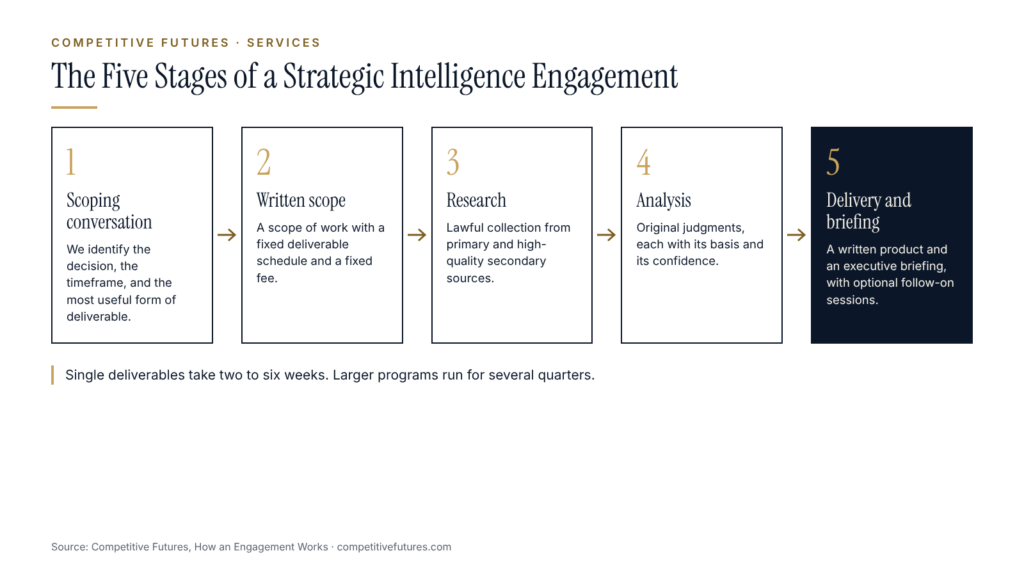
The first conversation is about your decision. We work with you to identify three things: the decision the analysis must support, the date by which you need it, and the form of deliverable that will be most useful to the people who will receive it. We ask the client to name one person who owns the question.
Stage Two: The Written Scope
We then send a written scope of work with a fixed deliverable schedule and a fixed fee. The written scope is usually short enough to read in one sitting. Every engagement has a defined scope, a defined deliverable, and a defined analytical product, which makes the work easy to procure and easy to audit.
Before work begins, the engagement is screened for law, conflicts of interest, and the interests of existing clients.
Stage Three: Research
Research is lawful collection from primary sources and high-quality secondary sources. All of it takes place in the unclassified space.
Stage Four: Analysis
Analysis turns the research into original judgments. Each judgment states its basis and our confidence in it. The work is done by Eric Garland and the Competitive Futures team.
Stage Five: Delivery and Briefing
You receive a written product and an executive briefing, in person or through a secure channel. Follow-on briefings are available when the audience widens to a board or a leadership team.
What You Receive
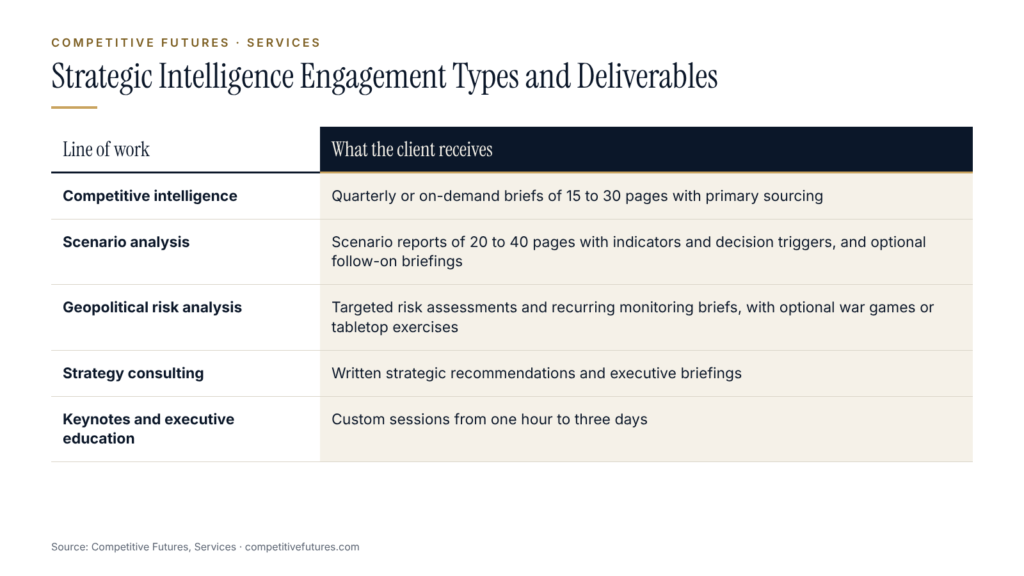
The company offers five lines of work. They can be scoped one at a time or combined.
- Competitive intelligence: quarterly or on-demand briefs of 15 to 30 pages with primary sourcing.
- Scenario analysis: scenario reports of 20 to 40 pages with indicators and decision triggers, and optional follow-on briefings.
- Geopolitical risk analysis: targeted risk assessments and recurring monitoring briefs, with optional war games or tabletop exercises for leadership teams.
- Strategy consulting: written strategic recommendations and executive briefings.
- Keynotes and executive education: custom sessions from one hour to three days.
How Long It Takes
A single deliverable takes two to six weeks. Larger analytical programs run for several quarters, with recurring briefs and a continuing advisory relationship.
Contracts and Procurement
We work under a non-disclosure agreement as a matter of course. The company is accustomed to the confidentiality and procurement requirements of large corporations and national governments, and it can work within most standard client contracting frameworks.
Most engagements are fixed in scope and fee, because that structure is the easiest to procure and to audit. It is not the only one we offer. When a client’s needs call for a retainer, hourly work, or a continuing advisory relationship, we arrange it.
Lessons for Building an Intelligence Function
- Start from the decision. A project scoped around a decision produces something a leader can use.
- Fix the scope in writing. A defined deliverable protects the client and the analyst.
- Fit the work to the team’s time. A study the team cannot absorb goes unread.
- Plan the briefing early. The audience for the result is often larger than the team that asked the question.
Frequently Asked Questions
How does a strategic intelligence engagement begin?
With a scoping conversation that identifies the decision the analysis must support, the timeframe, and the most useful form of deliverable.
How long does an engagement take?
A single deliverable takes two to six weeks. Larger programs run for several quarters.
How is the work priced?
Each engagement has a written scope with a fixed deliverable schedule and a fixed fee.
Does Competitive Futures work on retainer or by the hour?
Most engagements are fixed in scope and fee. Retainers and hourly arrangements are available when a client’s needs call for them.
Do you work under a non-disclosure agreement?
Yes, as a matter of course.
Can the company work with our procurement process?
Yes. The company can work within most standard client contracting frameworks.
Work With Competitive Futures
The first step is a conversation about the decision in front of you. The company will respond. Request a consultation
Related reading
- Strategic Intelligence Services
- Case Studies
- Mission and Doctrine
- Ethics and Standards
- Keynote Speaker
- How to Build a Competitive Intelligence Function
Back to Strategic Intelligence Services.