The Mission and Doctrine of Competitive Futures
The Competitive Futures mission is to give the people responsible for hard decisions the most accurate view of the world available in the unclassified space, and of where that world is going. The company was established in 2002 to join two disciplines that rarely spoke to each other: competitive intelligence and futures studies. We call the combined practice future intelligence.
At a glance
- Founded: 2002, to put current intelligence and long-range foresight in one practice.
- Doctrine: world affairs run on an overt level and a covert level, and a sound assessment reads both.
- Clients: senior vice presidents, program directors, and deputy-level officials who have been handed a difficult question.
- Standard: original analysis from primary and high-quality secondary sources, backed by 30 years of practice.
- Ethics: lawful collection only, no propaganda, no attacks on reputations, and no altered findings.
- Partners: corporations and governments in the United States and allied nations.
Why the Company Exists
The company’s founder, Eric Garland, began his career producing competitor dossiers at a competitive intelligence firm in Vermont. He then moved to Coates & Jarratt, the Washington futures research firm led by Joseph Coates, where the work looked ten and twenty years ahead.
He noticed that the two firms often served the same person. The executive who commissioned a long-range study was frequently the one who also needed to know what a competitor would do next quarter. Yet the two professions kept apart. They had separate conferences, separate vocabularies, and separate budgets, and each fell out of fashion at a different time.
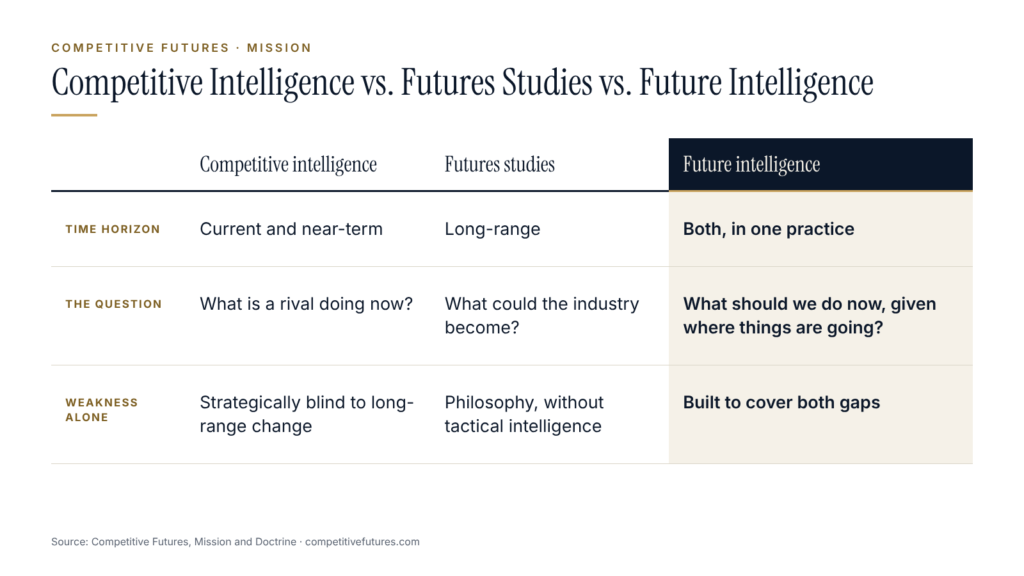
His conclusion shaped the company. A competitive intelligence function that ignores long-range change is strategically blind. A foresight team that does not understand tactical intelligence produces philosophy. Competitive intelligence asks what a rival is doing now. Futures studies asks what an industry could become. A decision maker needs the answer to a third question: what to do now, given where things are going.
Competitive Futures was founded in Washington, D.C., and now works from Stowe, Vermont. The method is set out in Future, Inc. (2007).
The Doctrine: The World Runs on Two Levels
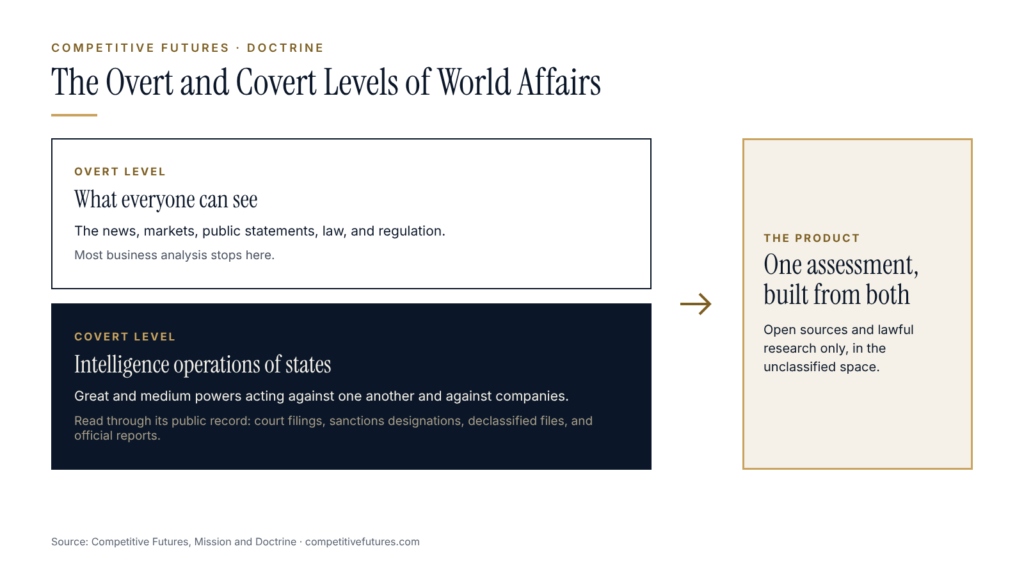
Most business analysis reads the overt level of world affairs: the news, markets, public statements, law, and regulation. That level is real, and it is incomplete.
There is also a covert level. Great and medium powers run intelligence operations against one another and against companies, and those operations shape markets, elections, supply chains, and careers. In practice, the vendors who study that level are mostly defense contractors around Washington, and their work rarely reaches a corporate strategy team.
Competitive Futures reads both levels and stays in the unclassified space. Covert activity leaves a public record in court filings, sanctions designations, declassified files, and official reports. We read that record alongside the news and build one assessment from both.
Systemics, the lens behind the Systemics Quarterly Brief, is one application of this doctrine. It treats courts, prosecutors, and sanctions bodies as primary instruments of state power, with military force in support.
Who We Work For
Our client is usually not the chief executive or the head of an agency. It is the senior vice president, program director, or assistant deputy director who has been trusted to find the right help in a difficult period. This person carries a great deal of responsibility and often less authority than the job deserves.
We work as that person’s partner. The aim is work good enough that the client is proud to put it in front of a superior, a board, and every other stakeholder.
What a Client Can Count On
Every product is original analysis. It rests on primary sources and high-quality secondary sources, and on 30 years of answering questions where an organization’s future depended on the answer.
Software can now produce 300 pages in two minutes. We do not consider that a threat to this work. Our clients do not lack pages. They need judgment about which finding will hold up in the boardroom, which one will get them shouted at, and what the people across the table will do next. That judgment comes from experience with human beings, including long experience of being the outside analyst in rooms where the news was unwelcome.
The Work in Practice
In 2007, a team at a global consumer products company was assigned to study the future of wet shaving technology. No one on the team had done foresight before. The budget was generous, but each member could give the project no more than 15 percent of their time. Other vendors offered to place them in studies that already existed, on consumers in general or on the internet.
We built the project around their question and their schedule, ran the analysis, and worked with the whole team. Our research also pointed to the housing crisis about a year before it arrived, and we advised the client to move toward low-cost strategies. The client gained share against the category leader.
What We Will Not Do
- We do not break the law, and we do not use illegal or deceptive collection.
- We follow the code of ethics of the competitive intelligence profession. Eric Garland was named a Fellow of the Council of Competitive Intelligence Fellows in 2018.
- We do not produce propaganda.
- We do not attack reputations.
- We do not alter findings to suit a client.
The last line gets tested. A senior figure at a large technology company once asked us to soften our risk assessment of an investment decision before it went to the board. We refused. The client was angry and took six months to pay. The assessment stood, and it saved that company about $150 million.
Whom We Work With
Many of the methods of competitive intelligence and foresight were developed in the United States, and we practice them at the level the profession recognizes with its Fellowship. The company has worked for national governments, including France and Monaco, and for major corporations in several countries. In 2022 the Russian Federation placed our founder under sanction.
We prefer to work with the United States and its allies. Every engagement is screened for law, conflicts of interest, and the interests of existing clients before it begins.
Where the Company Is Going
Over the next ten years we intend to serve at least 100 organizations that rely on us to train their people in intelligence analysis and to carry out custom research. We will also keep informing the public about the important issues of the day, in a way that is non-partisan, respectable, and respectful.
Lessons for Building an Intelligence Function
- Put current intelligence and foresight under one roof. Separate teams answer separate questions, and the decision maker is left to combine them.
- Read past the headlines. Court dockets, sanctions lists, and declassified records often show what the news has not yet explained.
- Protect the analyst’s independence. An assessment that can be softened on request has no value to the board that receives it.
- Build around the people who carry the question. A study fits the team’s time and standing, or it goes unread.
Frequently Asked Questions
What is the Competitive Futures mission?
To give the people responsible for hard decisions the most accurate view of the world available in the unclassified space, and of where it is going.
What is future intelligence?
It is the practice of combining competitive intelligence, which covers the current and near-term environment, with futures studies, which covers long-range change. The method is described in Future, Inc. (2007).
What does the company mean by overt and covert levels?
The overt level is what appears in the news, in markets, and in public law. The covert level is the intelligence activity of states. We study the second through its public record, such as court filings, sanctions designations, and declassified files.
Does Competitive Futures use classified information?
No. All of our work is done in the unclassified space, from open sources and lawful research.
Who hires Competitive Futures?
Usually a senior vice president, program director, or deputy-level official who has been made responsible for a difficult strategic question, in a corporation or a government.
Will the company change a finding if a client asks?
No. We do not alter findings to suit a client, and we have declined to do so under pressure.
Work With Competitive Futures
If you have been handed a question your organization cannot afford to get wrong, tell us about it. The company will respond. Request a consultation
Related reading
- How to Build a Competitive Intelligence Function
- Strategic Foresight: A Practitioner’s Guide
- Corporate Counterintelligence
- Enforcement Risk: How U.S. Law Became an Instrument of Geopolitics
- Intelligence Services Around the World
- Systemics Quarterly Brief
References
- Garland, Eric. Future, Inc.: How Businesses Can Anticipate and Profit from What’s Next. AMACOM, 2007.
- Council of Competitive Intelligence Fellows, roster of Fellows, class of 2018.
- Ministry of Foreign Affairs of the Russian Federation, 2022 list of sanctioned United States citizens.
Back to About Competitive Futures.