Strategic Mind Traps: The Cognitive Biases That Wreck Strategy and Intelligence
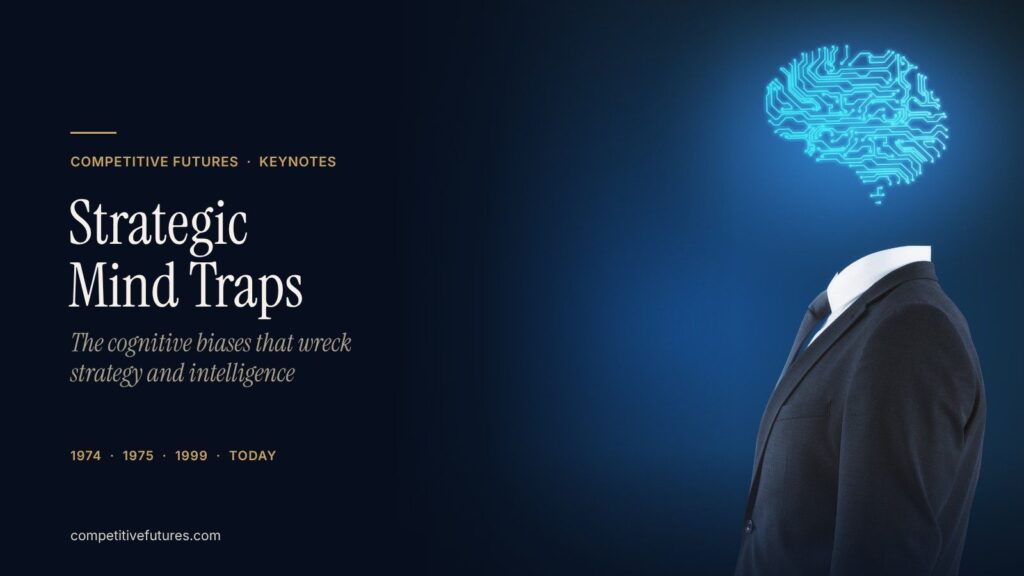
Strategic Mind Traps is a cognitive bias keynote for leaders and analysts who make high-stakes calls with incomplete information. Eric Garland walks through the ways trained, intelligent, well-meaning people get the world wrong, using Richards Heuer’s catalog of biases and more than 40 real failures from business, government, and intelligence. Every attendee leaves with a bias audit to use on their own decisions.
At a glance
- Full title: Strategic Mind Traps (offered by some bureaus as “How to Think About the Future (and How Not to Screw It Up!)”)
- Length: 45 to 60 minutes as a keynote; also a breakout or a day-long executive education session
- Audiences: strategy teams, intelligence and competitive intelligence units, risk committees, boards, and government analysts
- Delivery: in person or virtual, in English or French
- Take-home: a bias audit for reviewing real decisions
Smart people, bad calls
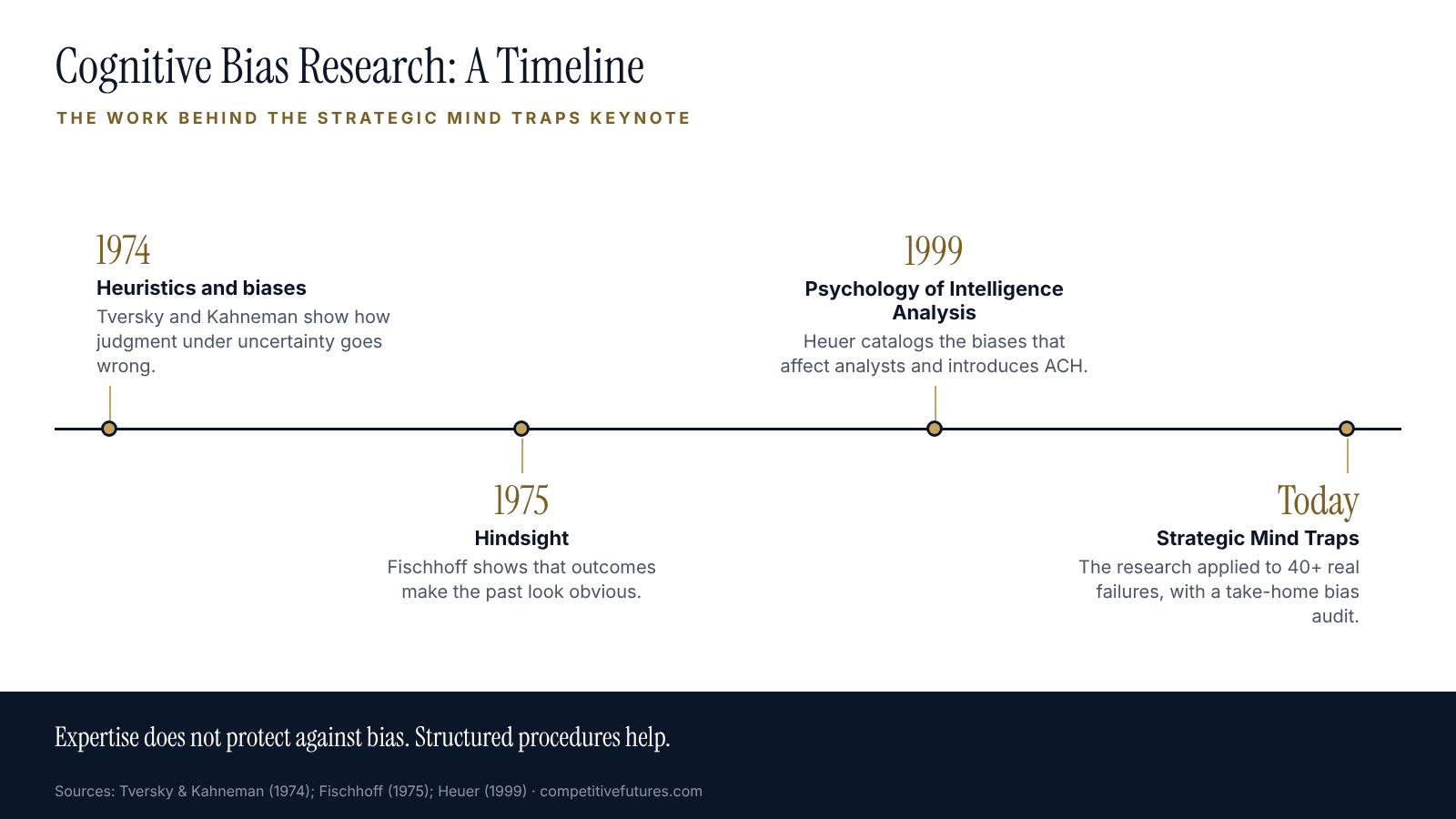
The biggest strategic failures rarely come from a shortage of information or intelligence. They come from the way the human mind handles uncertainty. Psychologists have documented these patterns for half a century, since Amos Tversky and Daniel Kahneman’s 1974 paper on heuristics and biases and Baruch Fischhoff’s 1975 study of hindsight. Intelligence agencies learned the hard way that training and expertise do not protect against them. Experts are often better at arguing for their mistakes.
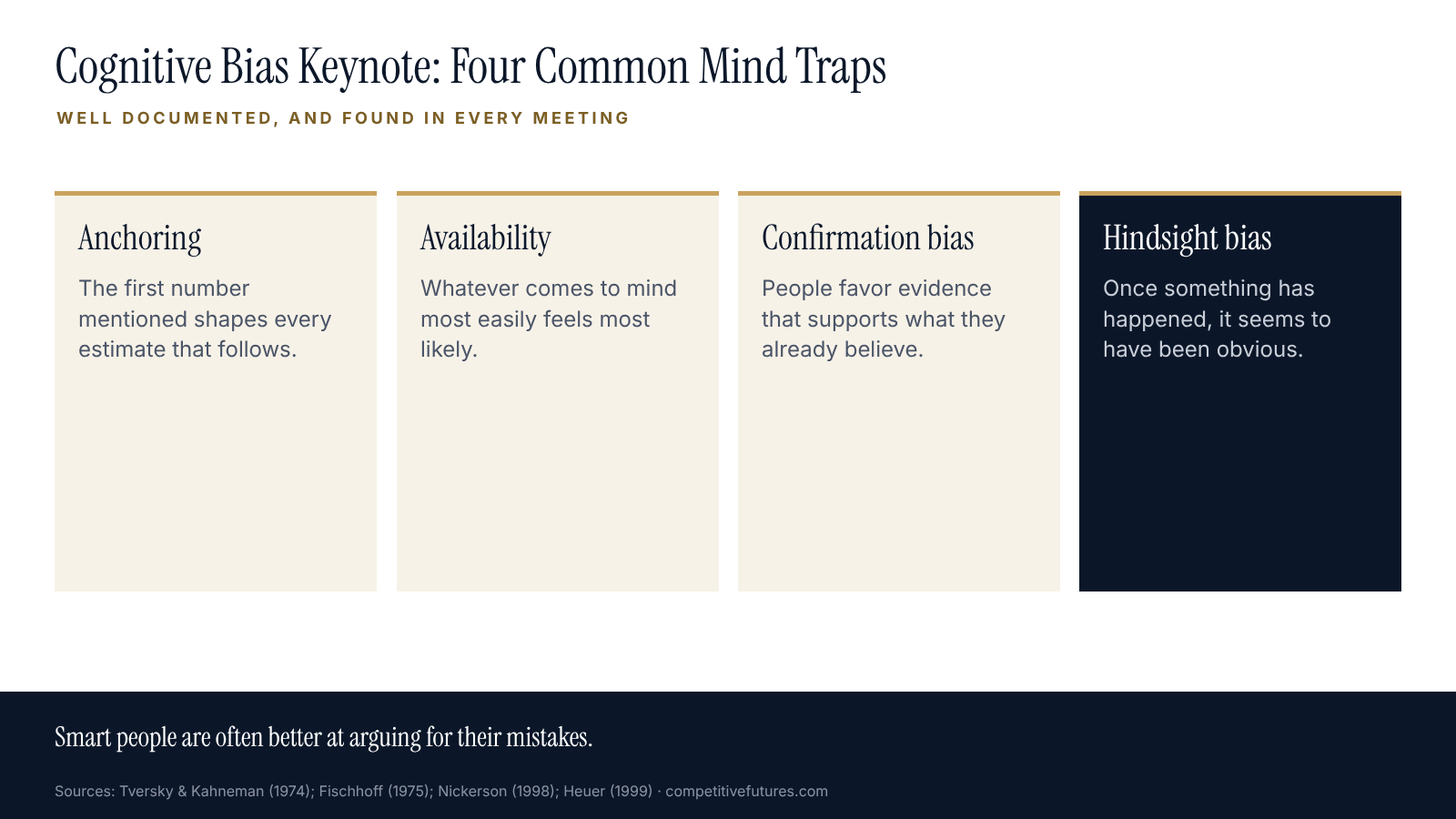
A few of the best-documented traps show how ordinary they are:
- Anchoring: the first number mentioned shapes every estimate that follows.
- Availability: whatever comes to mind most easily, usually the most recent or vivid event, feels most likely.
- Confirmation bias: people look for and favor evidence that supports what they already believe.
- Hindsight bias: once something has happened, it seems to have been obvious all along.
The keynote draws on that research, including the book many analysts treat as the foundation of the field, Richards Heuer’s Psychology of Intelligence Analysis. We cover Heuer’s career and the method he built in our pages on Richards Heuer and the Analysis of Competing Hypotheses.
What the keynote covers
- The history of forecasting, and a tour of famous forecasts that went badly wrong.
- The biases themselves, in plain language, with the failures they caused.
- How hierarchy makes it worse. What happens to these biases inside an organization where the most senior person speaks first.
- What actually helps. Why a resolution to be more open-minded fails, and why structured procedures work better.
- The audit. A practical tool for checking a team’s own past and pending decisions.
What audiences take away
- The ability to recognize the most common mind traps in their own meetings and documents.
- An understanding of why expertise and intelligence don’t protect against bias.
- Structured habits that reduce bias without slowing decisions to a crawl.
- A take-home bias audit for reviewing real decisions after the event.
From the stage to the organization
Every intelligence function eventually learns that its biggest risk is in its own analysts’ heads, not in the data. Good programs build checks into the process: competing hypotheses, deliberate challenges to the leading view, and reviews of past calls that score the misses as well as the hits. We help organizations put those checks in place. Our cognitive bias field guide is a good place to start.
Frequently asked questions
What is the Strategic Mind Traps keynote about?
It is a cognitive bias keynote that shows how intelligent, well-trained people make strategic mistakes, drawing on Richards Heuer’s work and more than 40 real failures, and it gives attendees a take-home bias audit.
Is this the same as “How to Think About the Future (and How Not to Screw It Up!)”?
Yes. Some speakers bureaus list the program under that title. It covers the history of forecasting, famous bad forecasts, cognitive bias, and how organizations can anticipate change better.
Who should attend?
Strategy teams, competitive intelligence and intelligence analysts, risk committees, boards, and government professionals who want sharper analytical skills.
Can it run longer than a keynote?
Yes. It is available as a keynote, a breakout session, or a day-long executive education session with exercises on the organization’s own decisions.
Who was Richards Heuer?
A veteran CIA analyst whose 1999 book Psychology of Intelligence Analysis catalogued the cognitive biases that affect analysts and introduced the Analysis of Competing Hypotheses.
Is it available virtually or in French?
Yes, in person or virtually, in English or French.
Work with Competitive Futures
To check dates, contact us with your event date, location, and audience. We will be in touch within one business day with availability, fees, and a proposed angle. Speakers bureaus are welcome to inquire on a client’s behalf.
Related from Competitive Futures
- Cognitive Bias: A Field Guide for Leaders
- Richards Heuer
- Analysis of Competing Hypotheses
- Why Smart Organizations Still Can’t See Obvious Disasters
- Building a Foresight Culture keynote
References
- Tversky, A., & Kahneman, D. (1974). Judgment under uncertainty: Heuristics and biases. Science, 185(4157), 1124–1131. https://doi.org/10.1126/science.185.4157.1124
- Fischhoff, B. (1975). Hindsight ≠ foresight: The effect of outcome knowledge on judgment under uncertainty. Journal of Experimental Psychology: Human Perception and Performance, 1(3), 288–299. https://doi.org/10.1037/0096-1523.1.3.288
- Heuer, R. J., Jr. (1999). Psychology of Intelligence Analysis. Center for the Study of Intelligence. https://www.cia.gov/resources/csi/books-monographs/psychology-of-intelligence-analysis-2/
- Nickerson, R. S. (1998). Confirmation bias: A ubiquitous phenomenon in many guises. Review of General Psychology, 2(2), 175–220. https://doi.org/10.1037/1089-2680.2.2.175