The Future of Risk Analysis: AI, Sensors, and the Next Generation of Analysts
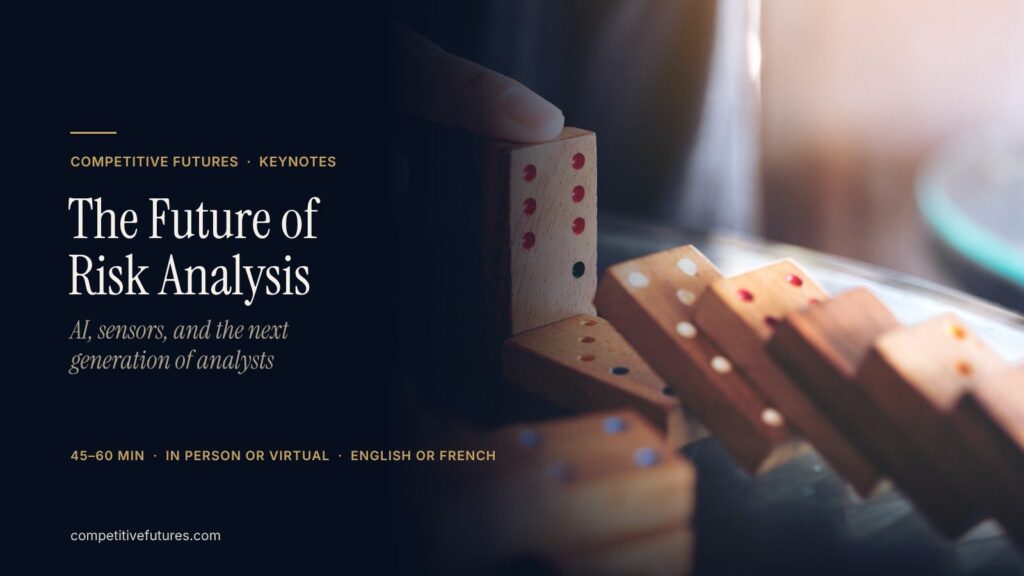
The future of risk analysis is a keynote about what happens to the work of judging risk when sensors and artificial intelligence produce more data than any team can read. Eric Garland explains which technologies will matter, which will disappoint, and what human analysts will still do that software cannot.
At a glance
- Full title: The Future of Risk Analysis
- Length: 45 to 60 minutes, including Q&A
- Audiences: risk, compliance, and security teams; financial services; insurers; supply-chain and operations leaders; and intelligence and analysis professionals
- Delivery: in person or virtual, in English or French
- Watch: a full recorded version is below
Everyone analyzes risk
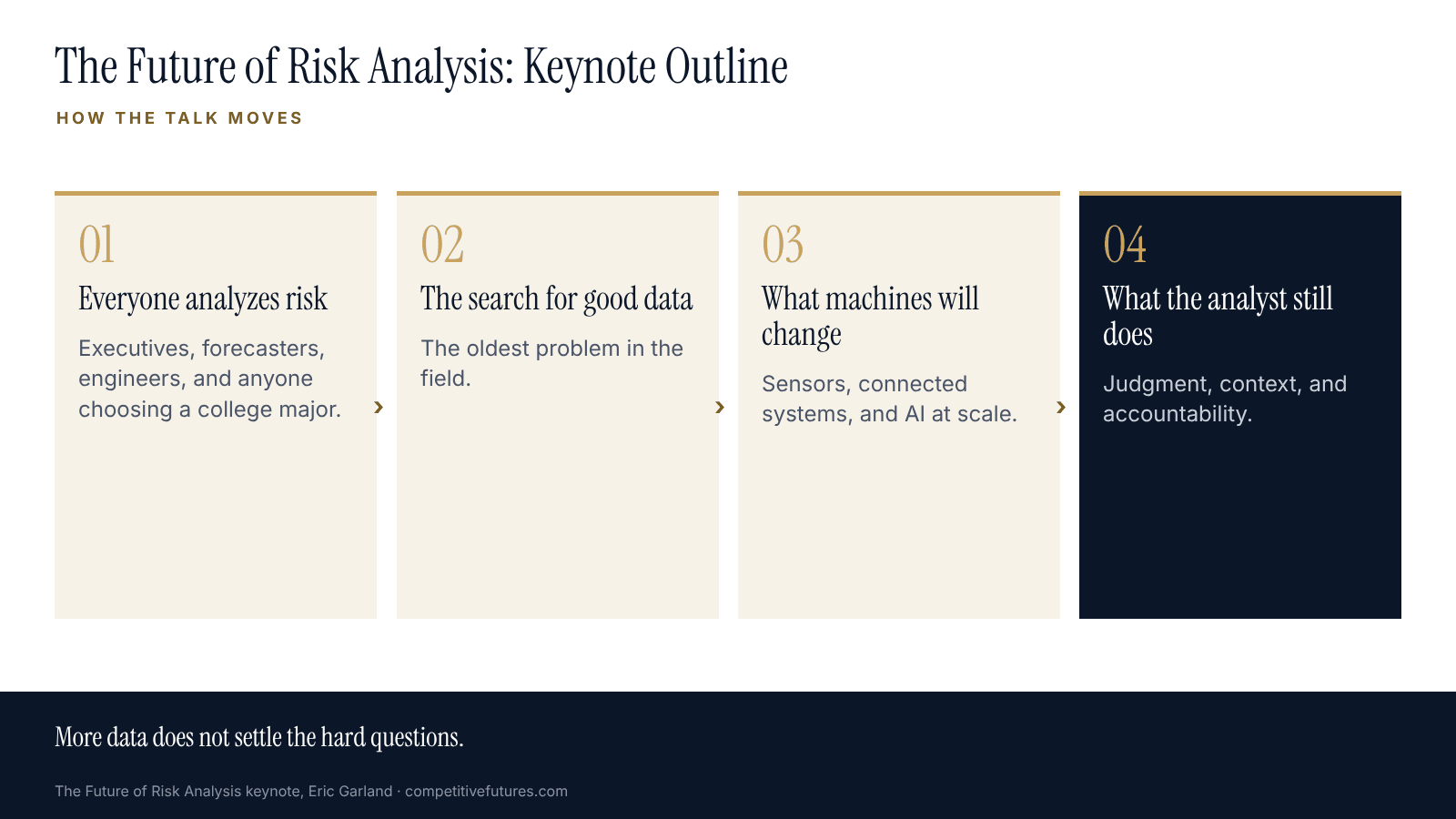
Risk analysis is not only the job of the risk department. Chief executives, financial forecasters, product managers, supply-chain engineers, and geopolitical analysts all make judgments about what could go wrong and how likely it is. So does anyone choosing a college major or bringing home a puppy. The keynote starts there, with the long history of people trying to see around corners, and with the oldest problem in the field: getting data good enough to decide on.
What the machines will change
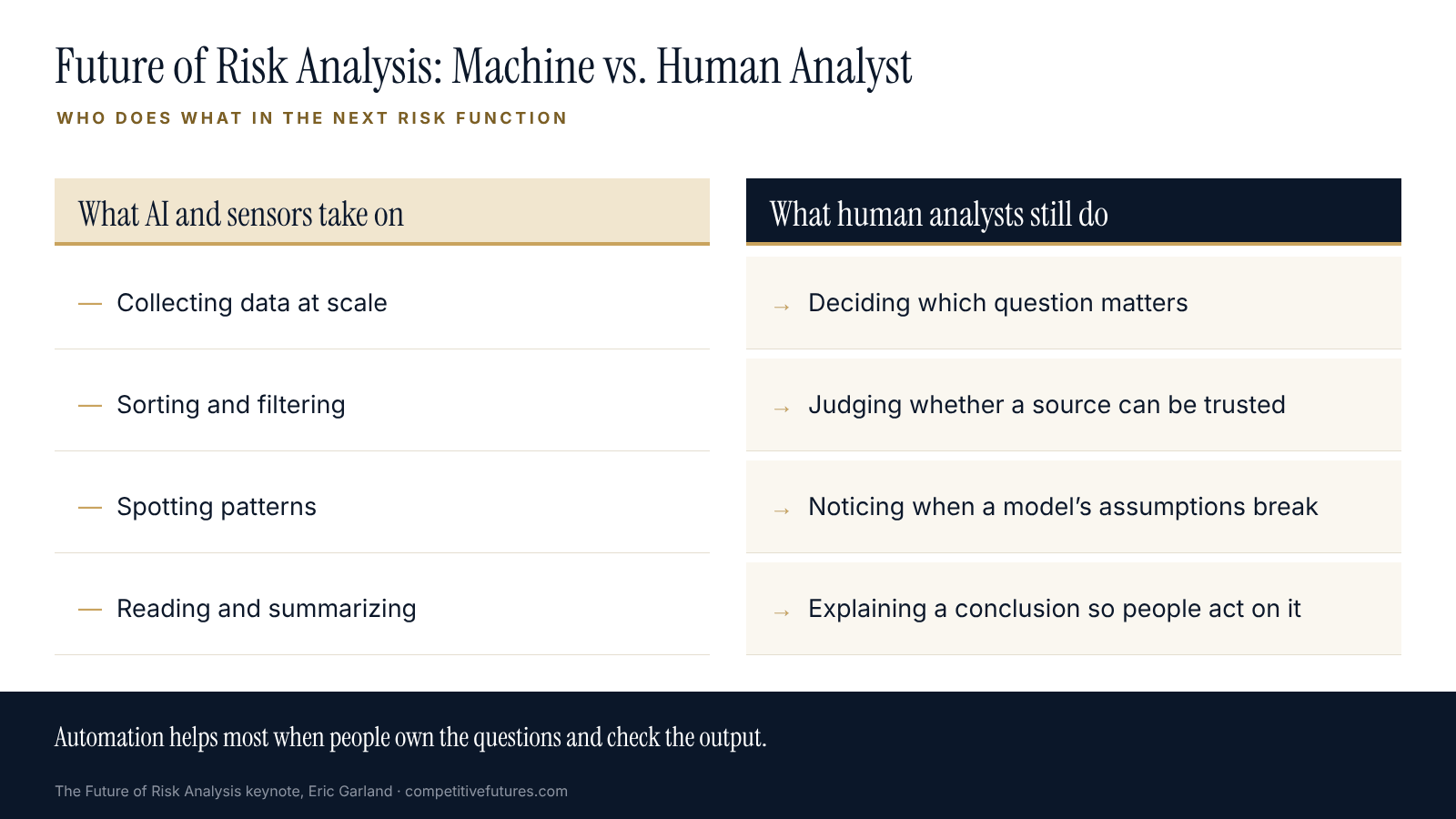
More sensors, more connected systems, and AI models that can read and summarize at scale are changing the raw material of risk analysis. Much of the collection, sorting, and pattern-spotting that once took teams of people is being automated. The keynote separates the technologies that will change how risk is measured from the ones that will mostly change how it is marketed.
What the human analyst still does
More data does not settle the hard questions. Someone still has to decide which question matters, judge whether a source can be trusted, notice when the model’s assumptions no longer fit the world, and explain a conclusion to a decision-maker in a way they will act on. Those tasks depend on judgment, context, and accountability, and they are where the next generation of analysts will earn their keep.
What audiences take away
- Which AI and sensor technologies will matter most to risk work in their sector.
- Where automation helps, and where it speeds up bad decisions.
- The skills the next generation of analysts will need.
- How to organize a risk function so that people and tools each do what they do best.
From the stage to the organization
Buying better tools is the easy part. The organizations that get real value from AI in risk analysis decide in advance who owns each question, how machine output gets checked, and how conclusions reach the people who decide. That design work is the same work as building an intelligence function. Our guides to intelligence analysis and the Analysis of Competing Hypotheses cover the analytic side.
Frequently asked questions
What is The Future of Risk Analysis keynote about?
It looks at how sensors and AI are changing risk analysis, which technologies matter, and what human analysts still contribute that software cannot.
Is there a recording of the keynote?
Yes. A full recorded version is embedded on this page and on our speaker page.
Who is this keynote for?
Risk, compliance, and security teams, financial services and insurance audiences, supply-chain leaders, and analysis professionals in government and business.
Will AI replace risk analysts?
The keynote argues that AI will take over much of the collection and sorting, while judgment about questions, sources, assumptions, and communication stays with people.
How long is the keynote?
45 to 60 minutes, including Q&A. It can be tailored to a specific industry’s risks.
Can it be delivered virtually?
Yes, in person or virtually, in English or French.
Work with Competitive Futures
To check dates, contact us with your event date, location, and audience. We will be in touch within one business day with availability, fees, and a proposed angle. Speakers bureaus are welcome to inquire on a client’s behalf.
Related from Competitive Futures
- Intelligence Analysis
- How to Evaluate a Forecast
- Intelligence Is Always Wrong. Decide Anyway.
- Strategic Mind Traps keynote
References
- Garland, E. The Future of Risk Analysis (keynote slides). https://www.slideshare.net/egarland/the-future-of-risk-analysis
- Garland, E. The Future of Risk Analysis (keynote video). https://www.youtube.com/watch?v=959PFRSYIbY
- Heuer, R. J., Jr. (1999). Psychology of Intelligence Analysis. Center for the Study of Intelligence. https://www.cia.gov/resources/csi/books-monographs/psychology-of-intelligence-analysis-2/